


History of the Jews in Algeria
 | This article has multiple issues. Please help improve it or discuss these issues on the talk page. (Learn how and when to remove these template messages)
|


יהדות אלג'יריה يهود الجزائر | |
|---|---|
 Algerian Jews by Théodore Chassériau (1851). | |
| Total population | |
| <200[1] (2020) | |
| Regions with significant populations | |
| Algiers | |
| Languages | |
| Arabic, French, Berber, Tetuani Ladino | |
| Religion | |
| Judaism | |
| Related ethnic groups | |
| Jews (Maghrebi Jews) |
| Part of a series on |
| Jews and Judaism |
|---|
The history of Jews in Algeria goes back to Antiquity, although it is not possible to trace with any certainty the time and circumstances of the arrival of the first Jews in what is now Algeria.[N 1] In any case, several waves of immigration helped to increase the population. There may have been Jews in Carthage and present-day Algeria before the Roman conquest, but the development of Jewish communities is linked to the Roman presence. Jewish revolts in Israel and Cyrenaica in the 1st and 2nd centuries certainly led to the arrival of Jewish immigrants from these regions. Jewish proselytizing among the Berbers is an established historical fact, but its importance remains debated.
The Muslim conquest of North Africa, which was completed in Algeria in the 8th century, brought North Africa into the realm of Islamic civilization and had a lasting impact on the identity of local Jewish communities, whose status was henceforth governed by the dhimma.
New immigrants later strengthened the Algerian Jewish community: Jews fled Spain during the Visigothic persecutions of the 5th and 6th centuries, and again during the persecutions linked to the Spanish Reconquista of the 14th and 16th centuries. Many Jews from the Iberian Peninsula settled in Algeria, mixing with the local Jewish population and influencing its traditions. In the 18th century, other Jews, the Granas of Livorno, were few in number, but played a role as commercial intermediaries between Europe and the Ottoman Empire. Later in the 19th century, many Jews from Tetouan arrived in Algeria, strengthening the ranks of the community.[2]
After the French colonization of Algeria in 1830, Algerians were guaranteed respect for their religious freedom and customs. The dhimma was abolished, and Jews became equal to Muslims under French law. Indeed, the Muslim law that governed the country put the former at a distinct disadvantage to the latter, especially in the legal sphere and their treatment as inhabitants of the country. This explains the pro-French opinion that developed among Algerian Jews from this period onwards.[citation needed] Having become French citizens following the Crémieux Decree of 1870, the Jews increasingly identified with metropolitan France, and despite their forced return to second-class indigenous status during World War 2,[3] they opted en masse to be repatriated to France on the eve of Algerian Independence, with a minority choosing Israel. This exile virtually put an end to more than 2,000 years of presence on Algerian soil. A few dozen very discreet Jews still live in Algeria.[4][5]
History[edit]
Early Jewish history in Algeria[edit]

There is evidence of Jewish settlements in Algeria since at least the Roman period (Mauretania Caesariensis).[6] Epitaphs have been found in archaeological excavations that attest to Jews in the first centuries CE. Berber lands were said to welcome Christians and Jews very early from the Roman Empire. The destruction of the Second Temple in Jerusalem by Titus in 70 CE, and thereafter by the Kitos War in 117, reinforced Jewish settlement in North Africa and the Mediterranean. Early descriptions of the Rustamid capital, Tahert, note that Jews were found there, as they would be in any other major Muslim city of North Africa. Centuries later, the letters found in the Cairo Geniza mention many Algerian Jewish families.
Muslim dominance era[edit]
In the 7th century, Jewish settlements in North Africa were reinforced by Jewish immigrants that came to North Africa after fleeing from the persecutions of the Visigothic king Sisebut[7] and his successors. They escaped to the Maghreb, which was at the time still part of the Byzantine Empire. It is debated whether Jews influenced the Berber population, making converts among them. In that century, Islamic armies conquered the whole Maghreb and most of the Iberian peninsula. The Jewish population was placed under Muslim domination in constant cultural exchanges with Al Andalus and the Near East.
Later many Sephardic Jews were forced to take refuge in Algeria from the persecutions in Spain of Catalonia, Valencia and Balearic Islands in 1391 and the Spanish Inquisition in 1492.[8] Together with the Moriscos, they thronged to the ports of North Africa, and mingled with native Jewish people. In the 16th century there were large Jewish communities in places such as Oran, Bejaïa and Algiers. Jews were also present in the cities of the interior such as Tlemcen and Constantine and as far spread as Touggourt and M'zab in the south, with the permission of the Muslim authorities. Some Jews in Oran preserved Ladino language—which was a uniquely conservative dialect of Spanish—until the 19th century.
Jewish merchants did well financially in late Ottoman Algiers. The French attack on Algeria was provoked by the Dey's demands that the French government pay its large outstanding wheat debts to two Jewish merchants. Between the 16th and 17th centuries, richer Jews from Livorno in Italy started settling in Algeria. Commercial trading and exchanges between Europe and the Ottoman Empire reinforced the Jewish community. Later again in the 19th century, many Sephardic Jews from Tetouan settled in Algeria, creating new communities, particularly in Oran.
French Algeria[edit]
In 1830, the Algerian Jewish population was between 15,000 and 17,000, mostly congregated in the coastal area. Some 6,500 Jews lived in Algiers, where they made up 20% of the population; 2,000 in Oran; 3,000 in Constantine; and 1000 in Tlemcen.[9] After their conquest, the French government rapidly restructured the Ottoman millet system. While Muslims resisted the French occupation, some Algerian Jews aided in the conquest, serving as interpreters or suppliers.[10]
At the time, the French government distinguished French citizens (who had national voting rights and were subject to French laws and conscription) from Jewish and Muslim "indigenous" peoples, who each were allowed to keep their own laws and courts. By 1841, the Jewish batei din "religious courts" were placed under French jurisdiction, linked to the Israelite Central Consistory of France. Regional Algerian courts or consistoires were put in place, operating under French oversight.[10]
In 1845, the French colonial government reorganized communal structure, appointing French Jews, who were Ashkenazi Jews, as chief rabbis for each region, with the duty "to inculcate unconditional obedience to the laws, loyalty to France, and the obligation to defend it".[11] Such oversight was an example of the French Jews' attempt to "civilize" Jewish Algerians, as they believed their European traditions were superior to Sephardic practices.
This marked a change in the Jewish relationship with the state. They were separated from the Muslim court system, where they had previously been classified as dhimmis, or a protected minority people. As a result, Algerian Jews resisted those French Jews attempting to settle in Algeria; in some cases, there was rioting, in others the local Jews refused to allow French Jewish burials in Algerian Jews' cemeteries.[10] In 1865, the Senatus-Consulte liberalized rules of citizenship, to allow Jewish and Muslim "indigenous" peoples in Algeria to become French citizens if they requested it. Few did so, however, because French citizenship required renouncing certain traditional mores. The Algerians considered that a kind of apostasy.[10]
The French government granted the Jews, who by then numbered some 33,000,[12] French citizenship in 1870 under the Crémieux Decree, while maintaining an inferior status for Muslims who, though technically French nationals, were required to apply for French citizenship and undergo a naturalization process.[13] For this reason, they are sometimes incorrectly categorized as pieds-noirs. The decision to extend citizenship to Algerian Jews was a result of pressures from prominent members of the liberal, intellectual French Jewish community, which considered the North African Jews to be "backward" and wanted to bring them into modernity.
Within a generation, despite initial resistance, most Algerian Jews came to speak French rather than Arabic or Judaeo-Spanish, and they embraced many aspects of French culture. In embracing "Frenchness," the Algerian Jews joined the colonizers, although they were still considered "other" to the French. Although some took on more typically European occupations, "the majority of Jews were poor artisans and shopkeepers catering to a Muslim clientele."[10] Moreover, conflicts between Sephardic Jewish religious law and French law produced contention within the community. They resisted changes related to domestic issues, such as marriage.[14]
After the 1882 conquest of the M'zab, the French government in Algeria legally categorized southern Algerian Jews, like the Muslims, as "indigènes", and thus subject to restricted and decreased rights under the indigénat compared to their northern Jewish counterparts, who were still French citizens under the Crémieux Decree of 1870. In 1881, there were only about 30,000 Mozabite Jews in Southern Algeria. They established, in Southern Algeria, “local civil status” laws, with rabbis overseeing legal issues. The French government recognized Jewish laws pertaining to domestic issues, such as marriage and inheritance. While these laws allowed for Jews to be structured under halakha, it prevented southern Jews from accessing “elite” opportunities, as their indigenous status established them as lesser citizens.[15]
French antisemitism set down strong roots among the expatriate French community in Algeria, where every municipal council was controlled by anti-Semites, and newspapers were rife with xenophobic attacks on the local Jewish communities.[16] Much of this was encouraged by the French colonial administration, in particular by the militant antisemitic Max Régis. In Algiers when Émile Zola was brought to trial for his defense in an 1898 open letter, J'Accuse…!, of Alfred Dreyfus, sympathy for whom was widespread in the Arabic press,[17] over 158 Jewish owned shops were looted and burned and two Jews were killed, while the army stood by and refused to intervene (see 1898 Algerian riots).[18] Hannah Arendt was to comment later that,'that pogroms against Jews in Algeria were carried out not, as it was claimed, by “‘backward Arabs’” but by “thoroughly sophisticated officers of the French colonial administration” and by the mayor of Algiers, Max Régis.'[19]
Under French rule, some Muslim anti-Jewish riots still occurred, as in 1897 in Oran.[20]

In 1931, Jews made up less than 2% of Algeria's total population. This population was more represented in the largest cities: Algiers, Constantine and Oran, which each had Jewish populations of over 7%. Many smaller cities such as Blida, Tlemcen and Setif also had small Jewish populations.[citation needed] By the mid-thirties, François de La Rocque's extremist Croix-de-Feu and, later, the French Social Party movements in Algeria proved active in trying to turn Muslims against Algerian Jews by publishing tracts in Arabic, and were responsible for inciting the 1934 Constantine Pogrom, in which 25 Jews were killed and some 200 stores were pillaged.[21][16][22]
| Part of a series on |
| Jewish exodus from the Muslim world |
|---|
 |
| Background |
| Antisemitism in the Arab world |
| Exodus by country |
| Remembrance |
| Related topics |
Holocaust in Algeria, under the Vichy regime[edit]
One of the first moves of the pro-German Vichy regime was to revoke the effects of the Crémieux Decree, on October 7, 1940, thereby abolishing French citizenship for Algerian Jews, affecting some 110,000 Algerians.[23][24] Under Vichy rule in Algeria, even Karaites and Jews who had converted to another religion were subject to anti-semitic laws, known collectively as Statut des Juifs.[23][25] The Vichy regime's laws ensured that Jews were forbidden from holding public office or other governmental positions, as well as from holding jobs in industries such as insurance and real estate.[23] In addition, the Vichy regime set strict limitations on Jewish people working as doctors or lawyers.[23]
The Vichy regime also limited the number of Jewish children in Algeria's public school system, and eventually terminated all Jewish enrollment in public schools.[23] In response, Jewish professors who had been forced from their jobs set up a Jewish university in 1941, only for its forced dissolution to occur at the end of that same year.[23] The Jewish communities of Algeria also set up a system of Jewish primary schools for children, and by 1942 some 20,000 Jewish children were enrolled in 70 elementary and 5 secondary schools all over Algeria.[23] The Vichy government eventually created legislation allowing the government to control school curriculum, and schedules, which helped dampen efforts to educate young Jews in Algeria.[23]
Under Admiral Darlan and General Giraud, two French officials who administered the French military in North Africa, the antisemitic legislation was applied more severely in Algeria than France itself, under the pretext that it enabled greater equality between Muslims and Jews and considered racial laws a condition sine qua non of the armistice. Under the Vichy regime in Algeria, an office called the "Special Department for the Control of the Jewish Problem" handled the execution of laws applying to Algeria's Jewish population.[23] This was unique in French North Africa, and as such the laws covering the status of Jews were governed much more harshly in Algeria than in Morocco or Tunisia.[23] A bureau for "Economic Aryanization" was also installed in order to eradicate the Jewish community's significance in the economy, mostly by taking control of Jewish businesses.[23]
On March 31, 1942, the Vichy government issued a decree demanding the creation of a local Jewish government called the Union Générale des Israélites d’Algérie (UGIA).[23] The UGIA was intended to be a body of Jews that would execute the Vichy regulations within Jewish communities, and was seen by much of the Jewish population as collaboration with the government.[23] In response, many young Jews joined the Algerian resistance movement, which itself had been founded by Jews in 1940. On November 8, 1942, the Algerian resistance to the Vichy government took part in the takeover of Algiers in preparation for the Allied liberation of North Africa, known as "Operation Torch."[23] Of the 377 resistance members who took Algiers, 315 were Jewish.[23] In November 1942, Allied forces landed and took control of Algiers and the rest of Algeria. However, Jews were not returned all of their former civil rights and liberties, nor their French citizenships until 1943. This can partially be explained by the fact that Giraud himself, along with the Governor-General Marcel Peyrouton, in promulgating the cancellation of Vichy statutes on March 14, 1943, after the allies landed in North Africa, retained exceptionally the decree abolishing citizenship rights for Algerian Jews, claiming that they did not wish to incite violence between the Jewish and Muslim communities in Algiers.[25] It was not until the arrival of Charles De Gaulle in October 1943 that Jewish Algerians finally regained their French citizenship with the reinstatement of the Crémieux Decree.
In addition to the discriminatory and antisemitic laws faced by Jews all over Algeria, some 2,000 Jews were placed in concentration camps at Bedeau and Djelfa.[23] The camp at Bedeau, near Sidi-bel-Abbes, became a place for the concentration of Jewish Algerian soldiers, who were forced to perform hard labor.[26] These prisoners formed the "Jewish Work Group," and worked on a Vichy plan for a trans-Saharan railroad; many died from hunger, exhaustion, disease, or beatings.[23][26]
After WWII[edit]
During the Algerian War, most Algerian Jews took sides with France, out of loyalty to the Republic which gave them French citizenship, against the indigenous Independence movement, though they rejected that part of the official policy which proposed independence for Algeria. Some Jews did join the FLN fighting for independence, but a larger group made common cause with the OAS, secret paramilitary group.[27]
The FLN published declarations guaranteeing a place in Algeria for Jews as an integral constituent of the Algerian people,[28] hoping to attract their support. Algerian Muslims had assisted Jews during their trials under the Vichy régime in WW2, when their citizenship rights under the Crémieux Degree had been revoked.[27][28]
Some Algerian Jews responded positively to the call from the FLN, joining with local militias or making financial contributions. For these Jews, they recognized a common attachment to Algeria and the antisemitism prevalent among the French.[29] For others, memories of the 1934 pogrom, and incidents of violent Muslim assault on Jews in Constantine and Batna, together with arson attacks on the Batna and Orleanville synagogues, played a role in their decisions to turn down the offer.
In 1961, with the French National Assembly Law 61-805,[30] the Mozabite Jews, who had been excluded from the Cremieux Decree, were also given French citizenship.[31]
Following a 1961 referendum, the 1962 Évian Accords secured Algerian independence. Some Algerian Jews had joined the Organisation armée secrète, which aimed to disrupt the process of independence with bombings and assassination attempts, targets including Charles de Gaulle and Jean-Paul Sartre.[32] Although final appeals were made in Algeria for the Jews to remain, around 130,000 Algerian Jews chose to leave the country, and went to France. Since 1948, around 25,000 Algerian Jews have moved to Israel.[33]
Independent Algeria[edit]
Between late 1961 and late summer 1962, 130,000 of Algeria's approximately 140,000 Jews left for France, while about 10,000 of them emigrated to Israel.[34][35] Moroccan Jews who were living in Algeria and Jews from the M'zab Valley in the Algerian Sahara, who did not have French citizenship, as well as a small number of Algerian Jews from Constantine, also emigrated to Israel at that time.[36]
By 1969, fewer than 1,000 Jews were still living in Algeria.[37] By 1975 the government had seized all but one of the country's synagogues and converted them to mosques or libraries.[38]
Since 2005, the Algerian government has attempted to reduce discrimination against the Jewish population, by establishing a Jewish association, and passing a law that recognized freedom of religion. They also allowed a relaunching of Jewish pilgrimage, to the most holy Jewish sites in North Africa. In 2014, the Minister of Religious Affairs Mohammed Eissa announced that the Algerian government would foster the reopening of Jewish synagogues. However, this never came to fruition, with Eissa stating that it was no longer the interest of Algerian Jews.[33] In 2017, there were an estimated 50 Jews remaining in Algeria, mostly in Algiers.[21] In 2020, there are an estimated 200 Jews in Algeria.[1]
Traditional dress[edit]

According to the Jewish Encyclopedia,[39]
A contemporary [1906] Jewess of Algiers wears on her head a "takrita" (handkerchief), is dressed in a "bedenor" (gown with a bodice trimmed with lace) and a striped vest with long sleeves coming to the waist. The "mosse" (girdle) is of silk. The native Algerian Jew wears a "ṭarbush" or oblong turban with silken tassel, a "ṣadriyyah" or vest with large sleeves, and "sarwal" or pantaloons fastened by a "ḥizam" (girdle), all being covered by a mantle, a burnus (also spelled burnoose), and a large silk handkerchief, the tassels of which hang down to his feet. At an earlier stage the Algerian Jewess wore a tall cone-shaped hat resembling those used in England in the fifteenth century.
Synagogues in Algeria[edit]
-
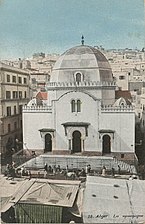 Grande Synagogue, Algiers
 -
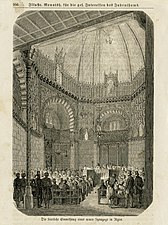
-
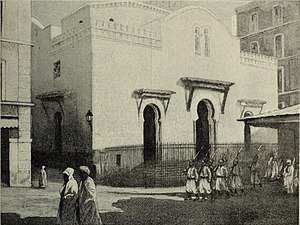 Grande Synagogue, Algiers
 -
 Houma Keramane, Béjaïa
 -
 Sanya Synagogue, Algiers
 -
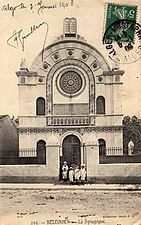 Belcourt Synagogue, Algiers
 -
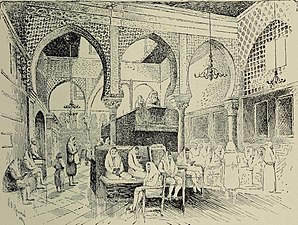 Synagogue, Algiers
 -

-
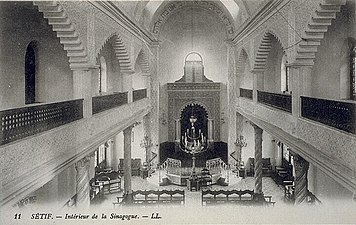 Sétif synagogue
 -
 Sétif synagogue interior
 -
 Tlemcen synagogue
 -
 Rabbi Ephraim Ankawa Synagogue in Tlemcen


Notable Algerian Jews[edit]
- Jean-Pierre Barda, singer, actor, make up artist
- José Aboulker, member of the anti-Nazi resistance
- Alon Abutbul, an actor[40]
- Franck Amsallem, jazz pianist and composer
- Françoise Atlan, French singer
- Yvan Attal, film director, actor (Algerian born parents)
- Jacques Attali, economist, writer
- Danny Ayalon, politician
- Jean-Pierre Bacri, actor
- Myriam Ben, activist and novelist [41]
- Baruj Benacerraf, immunologist, Nobel prize (1980) (Algerian Jewish mother)
- Paul Benacerraf, philosopher (Algerian Jewish mother)
- Maurice Benayoun, artist
- Jean Benguigui, actor[42]
- Éric Benhamou, businessman, CEO of 3Com, venture capitalist, philanthropist[43]
- Michel Benita, double bass player
- Daniel Bensaïd, philosopher and trotskyist (Jewish Algerian father)
- Richard Berry, actor
- Lili Boniche, musician
- Eliyahu Zini, Algerian-born rabbi and head of a Hesder Yeshiva in the Israeli town of Haifa and doctor of mathematics from the Technion.
- Patrick Bruel, singer, actor
- Alain Chabat, actor[44]
- André Chouraqui, writer
- Élie Chouraqui, French film director and scriptwriter
- Hélène Cixous, feminist writer
- Robert Cohen, boxer: World Bantamweight Champion
- Annie Cohen-Solal, academic and biographer of Jean-Paul Sartre
- Claude Cohen-Tannoudji, physicist, Nobel prize (1997)
- Jean-François Copé, (Algerian Jew mother), President of the Union for a Popular Movement (UMP) Group in the French National Assembly
- Abraham Daninos, author, wrote the first theatre play in Arabic (1847)
- Gérard Darmon, actor
- Jacques Derrida, post-structuralist philosopher
- Pascal Elbé, actor
- Jean-Pierre Elkabbach, journalist
- David Foenkinos, French born author and screenwriter.
- Eva Green, actress (mother was of Algerian Jewish descent)
- Alphonse Halimi, boxer: World Bantamweight Champion
- Roger Hanin, film actor & director
- Marlène Jobert, actress
- Judah Kalaẓ, cabalist and moralist
- Oded Kattash, Israeli basketball player, a superstar in Israel and Greece, currently head coach of Israel's national team and Panathinaikos
- Haim Korsia, Chief Rabbi of France (Algerian parents)
- Claude Lelouch, film director (Algerian Jew father)
- Bernard-Henri Lévy, philosopher
- Reinette L'Oranaise, singer
- Enrico Macias, singer
- Elissa Rhaïs, novelist
- Martial Solal, jazz pianist and composer
- Benjamin Stora, historian
- Avraham Tal, Israeli singer
- Patrick Timsit, humorist, actor
- Shmuel Trigano, sociologist and philosopher
- Éric Zemmour, journalist
- Claude Zidi, film director
Genetics[edit]
The largest study to date on the Jews of North Africa has been led by Gerard Lucotte et al. in 2003. Sephardi population studied is as follows: 58 Jews from Algeria, 190 from Morocco, 64 from Tunisia, 49 from the island of Djerba, 9 and 11 from Libya and Egypt, respectively, which makes 381 people.[45] This study showed that the Jews of North Africa showed frequencies of their paternal haplotypes almost equal to those of the Lebanese and Palestinian non-Jews when compared to European non-Jews.
The Moroccan/Algerian, Djerban/Tunisian and Libyan subgroups of North African Jewry were found to demonstrate varying levels of Middle Eastern (40-42%), European (37-39%) and North African ancestry (20-21%),[46] with Moroccan and Algerian Jews tending to be genetically closer to each other than to Djerban Jews and Libyan Jews.[47][48][49][50] According to the study:
"distinctive North African Jewish population clusters with proximity to other Jewish populations and variable degrees of Middle Eastern, European, and North African admixture. Two major subgroups were identified by principal component, neighbor joining tree, and identity-by-descent analysis—Moroccan/Algerian and Djerban/Libyan—that varied in their degree of European admixture. These populations showed a high degree of endogamy and were part of a larger Ashkenazi and Sephardic Jewish group. By principal component analysis, these North African groups were orthogonal to contemporary populations from North and South Morocco, Western Sahara, Tunisia, Libya, and Egypt. Thus, this study is compatible with the history of North African Jews—founding during Classical Antiquity with proselytism of local populations, followed by genetic isolation with the rise of Christianity and then Islam, and admixture following the emigration of Sephardic Jews during the Inquisition."[46]
Population numbers[edit]
| Year | Jewish Population[51] |
|---|---|
| 1830 | 26,000 |
| 1850 | 26,000 |
| 1866 | 38,500 |
| 1881 | 52,000 |
| 1914 | 96,000 |
| 1931 | 110,000 |
| 1948 | 140,000 |
| 1960 | 130,000 |
| 1963 | 4,000 |
| 2005 | 150 |
| 2020 | <100 |
See also[edit]
References[edit]
- ^ a b "Jews of Algeria". Jewish Virtual Library.
- ^ Jean-Jacques Deldyck (2000). Le processus d'acculturation des Juifs d'Algérie (in French). CIEMI. p. 41. ISBN 978-2-7384-9677-5..
- ^ "Les Juifs d'Algérie pendant la Seconde Guerre mondiale". northafricanjews-ww2.org.il/fr (in French). Retrieved 4 June 2018.
- ^ Maïna Fauliot (11 July 2014). "Algérie : Juifs, chrétiens… Comment le pays encadre les religions minoritaires". Jeune Afrique.
- ^ Benjamin Roger (2013-04-26). "Y a-t-il encore des Juifs au Maghreb ?". JeuneAfrique.com (in French). Retrieved 2019-02-04.
- ^ Karen B. Stern, Inscribing devotion and death: archaeological evidence for Jewish populations of North Africa, Bril, 2008, p.88
- ^ "Algeria". JewishEncyclopedia.com. Retrieved 2012-06-10.
- ^ "The Edict of Expulsion of the Jews - 1492 Spain". Sephardicstudies.org. Retrieved 2012-06-10.
- ^ Yardeni, Myriam (1980). Les juifs dans l'histoire de France : Premier colloque internationale de Haïfa (in French). BRILL. ISBN 978-9004060272.
- ^ a b c d e Friedman, Elizabeth. Colonialism & After. South Hadley, Massachusetts: Bergen, 1988. Print.
- ^ Stillman, Norman. "The Nineteenth Century and the Impact of the West / Social Transformations". The Jews of Arab Lands in Modern Times. The Jewish Publication Society. Archived from the original on August 28, 2006. Retrieved January 5, 2012.
- ^ Paula Hyman, The Jews of Modern France, University of California Press, 1998 p.83.
- ^ Patrick Weil, How to Be French: Nationality in the Making since 1789, Duke University Press 2008 pp. 128, 253.
- ^ [1], University of California Santa Cruz
- ^ Sarah Abrevaya Stein (6 May 2014). Saharan Jews and the Fate of French Algeria. University of Chicago Press. ISBN 978-0-226-12388-2. OCLC 1014071469.
- ^ a b Samuel Kalman (2008). The Extreme Right in Interwar France: The Faisceau and the Croix de Feu. Ashgate Publishing, Ltd. p. 210. ISBN 978-0-7546-6240-2. OCLC 1120553086.
- ^ Orit Bashkin, 'The Colonized Semites and the Infectious Disease: Theorizing and Narrativizing Anti-Semitism in the Levant, 1870–1914,' Critical Inquiry, Winter 2021, Vol. 47 Issue 2, pp.189-217, pp.199-202
- ^ Hyman p.105.
- ^ Orit Bashkin, 'The Colonized Semites and the Infectious Disease,' 2021 pp.202-203.
- ^ Algeria, 1830-2000: A Short History. Cornell University Press. 2004. pp. 10–. ISBN 978-0-8014-8916-7.
- ^ a b "Jews of Algeria". Jewish Virtual Library. 2000-09-05. Retrieved 2012-06-10.
- ^ Vance, Sharon (10 May 2011). The Martyrdom of a Moroccan Jewish Saint. BRILL. p. 182. ISBN 978-90-04-20700-4.
Muslim anti Jewish riots in Constantine in 1934 when 25 Jews were killed
- ^ a b c d e f g h i j k l m n o p q "The Jews of Algeria, Morocco and Tunisia". Yad Vashem. Retrieved 2018-12-02.
- ^ "The Jews of Algeria". dbs.bh.org.il. Retrieved 2018-12-02.
- ^ a b French civilization and its discontents: nationalism, colonialism, race. Stovall, Tyler Edward. Van den Abbeele, Georges. Lanham: Lexington Books. 2003. pp. 258, 259. ISBN 978-0739106464. OCLC 52109410.
{{cite book}}: CS1 maint: others (link) - ^ a b "Algeria" (PDF). Yad Vashem. Retrieved 2 December 2018.
- ^ a b Pierre Birnbaumn, 'French Jews and the "Regeneration" of Algerian Jewry,' in Ezra Mendelsohn (ed.)Studies in Contemporary Jewry: Volume XIX: Jews and the State: Dangerous Alliances and the Perils of Privilege, Studies in Contemporary Jewry, Vol. XIX Oxford University Press/Hebrew Institute of Jerusalem 2004 pp.88-103 p.97:'A larger group... took up arms towards the end of the war, with the opposing French terror group, the Organisation Armée Secréte (OAS), even though this group contained members of some of the most antisemitic and reactionary of French Algerian circles.'
- ^ a b Naomi Davidson, Only Muslim: Embodying Islam in Twentieth-Century France, Cornell University Press 2012 p.136:'It is because the FLN considers Algerian Jews as sons of our country that we hope the leaders of the Jewish community will have the wisdom to contribute to the construction of a free and truly fraternal Algeria. The FLN is convinced that leaders will understand that it is the duty and of course in the interest of the entire Jewish community not to remain "above the fray", to condemn without fail the dying French colonial regime, and to proclaim their choice of Algerian nationality.'
- ^ Fanon, Frantz (1967). A Dying Colonialism. New York: Grove Press. pp. 155–157.
- ^ Shepard, Todd. The invention of decolonization: the Algerian War and the remaking of France. Cornell University Press, 2008.
- ^ Sung-Eun Choi (19 November 2015). Decolonization and the French of Algeria: Bringing the Settler Colony Home. Palgrave Macmillan. pp. 84–. ISBN 978-1-137-57289-9.
- ^ Sung-Eun Choi (19 November 2015). Decolonization and the French of Algeria: Bringing the Settler Colony Home. Palgrave Macmillan. p. 84. ISBN 978-1-137-57289-9.
Jewish participation in the OAS has been widely acknowledged by historians, though just how many actually joined the organization and why, remain difficult to know exactly
- ^ a b "Community in Algeria." WJC, World Jewish Congress, Jan. 2018, www.worldjewishcongress.org/en/about/communities/DZ.
- ^ Ethan Katz (2015). The Burdens of Brotherhood Jews and Muslims from North Africa to France. Harvard University Press. p. 212. ISBN 978-0-674-08868-9.
- ^ "Marking the 60th Anniversary of the Mass Jewish Emigration from Algeria". JDC. Accessed 7 Dec. 2023.
- ^ Laskier, Michael M. (1994). North African Jewry in the Twentieth Century: The Jews of Morocco, Tunisia, and Algeria. NYU Press. ISBN 9780814750728.
- ^ "Algeria", Jewish Virtual Library
- ^ "Behind the Headlines the Jews of Algeria". Jewish Telegraphic Agency. 15 April 1975.
- ^ "Costume". JewishEncyclopedia.com. Retrieved 2012-06-10.
- ^ "Fear Was My Father". Haaretz. 22 November 2007. Retrieved 16 January 2016.
- ^ Jessica Hammerman. "Ben, Myriam." Encyclopedia of Jews in the Islamic World. Executive Editor Norman A. Stillman. Brill Online, 2015. Reference. <http://referenceworks.brillonline.com/entries/encyclopedia-of-jews-in-the-islamic-world/ben-myriam-SIM_000694>
- ^ "This domain was registered by Youdot.io".
- ^ Hallé, Charlotte (24 December 2004). "A Site for Sore Eyes The Israel21c Web site aims to show Americans that there's much more to Israel than the war-torn images they see on TV". Haaretz. Retrieved 13 May 2019.
- ^ "Un Nul bourré de talents". L'Express (in French). 24 January 2002. Retrieved 2021-09-06.
- ^ Lucotte, G; David, F (October 1992). "Y-chromosome-specific haplotypes of Jews detected by probes 49f and 49a". Hum. Biol. 64 (5): 757–61. PMID 1398615.
- ^ a b Campbell, Christopher L.; Palamara, Pier F.; Dubrovsky, Maya; Botigue, Laura R.; Fellous, Marc; Atzmon, Gil; Oddoux, Carole; Pearlman, Alexander; Hao, Li; Henn, Brenna M.; Burns, Edward; Bustamante, Carlos D.; Comas, David; Friedman, Eitan; Pe'er, Itsik; Ostrer, Harry (2012). "North African Jewish and non-Jewish populations form distinctive, orthogonal clusters" (PDF). Proceedings of the National Academy of Sciences. 109 (34): 13865–70. Bibcode:2012PNAS..10913865C. doi:10.1073/pnas.1204840109. PMC 3427049. PMID 22869716.
- ^ "Study completes genetic map of N. African Jews". The Jerusalem Post | JPost.com. Retrieved 2017-05-28.
- ^ A New Genetic Map Of Jewish Diasporas
- ^ Even, Dan (8 August 2012). "International genetic study traces Jewish roots to ancient Middle East". Haaretz. Retrieved 2 December 2021.
- ^ Brown, Eryn (2008-04-13). "Genetics study of North African Jews tells migratory tale - Los Angeles Times". Los Angeles Times. Retrieved 2013-04-12.
- ^ "The Jews of Algeria". The Museum of the Jewish People at Beit Hatfutsot.
- ^ La graphie « Juifs » (avec une capitale) désigne les membres d'une identité nationale ou ethnique. La graphie « juifs » (sans capitale) désigne les pratiquants de la religion juive. Voir à ce propos les articles Juifs et Usage des majuscules en français.
Sources[edit]
- Fieni, David (2020). Decadent Orientalisms: The Decay of Colonial Modernity. Fordham University Press. ISBN 9780823286409.
- Roberts, Sohpie P. (2017). Citizenship and Antisemitism in French Colonial Algeria, 1870-1962. Cambridge University Press. ISBN 9781107188150.
External links[edit]
- Resources > Jewish communities > Magreb The Jewish History Resource Center, Project of the Dinur Center for Research in Jewish History, The Hebrew University of Jerusalem
- Site multilingue sur la Hazanout des Juifs de Constantine
- Zlabia.com French site for Jews of Algerian origins
- Rabbis of Algeria
- Algeria Sephardim Deported from France or Executed in France during WWII (PDF)
- The Jewish Community of Oran Archived 2018-06-12 at the Wayback Machine Museum of the Jewish People at Beit Hatfutsot
- Documents from Old Jewish Algeria
- The Jewish Population of Algeria in 1931
| History | |
|---|---|
| People | |
| Historical sites | |
| Films | |

