


Alvis Car and Engineering Company
 | |
| Company type | Private company |
|---|---|
| Industry | Automotive industry |
| Founded | Coventry, England 1919 |
| Founder | Thomas George John |
| Defunct | 1967 |
| Successor | Rover Company |
| Headquarters | Coventry , England |
Number of locations | Production locations: Coventry, England: |
Area served | Worldwide |
Key people | Thomas George John Chairman and Managing Director, 1919–44 Geoffrey de Freville Chief Engineer, Aero Engine Division, 1922–72 |
| Products | Automobiles, military vehicles, aircraft engines |
| Website | www |
| Footnotes / references [1] | |
Alvis Car and Engineering Company Ltd was a British manufacturing company in Coventry from 1919 to 1967. In addition to automobiles designed for the civilian market, the company also produced racing cars, aircraft engines, armoured cars and other armoured fighting vehicles.[2]
Car manufacturing ended after the company became a subsidiary of Rover in 1965, but armoured vehicle manufacture continued. Alvis became part of British Leyland and then in 1982 was sold to United Scientific Holdings, which renamed itself Alvis plc.
In 2023, it successor company began manufacturing the brand’s classic models again.
History of the company[edit]


.JPG)
open two-seater T.T. replica


Early history[edit]
The original company, T.G. John and Company Ltd., was founded in 1919 by Thomas George John (1880–1946). Its first products were stationary engines, carburetors and motorscooters. Following complaints from the Avro aircraft company whose logo bore similarities to the original winged green triangle, the more familiar inverted red triangle incorporating the word "Alvis" evolved. On 14 December 1921 the company officially changed its name to The Alvis Car and Engineering Company Ltd. Geoffrey de Freville (1883–1965) designed the first Alvis engine and is also responsible for the company name.[1]
The origin of the name Alvis has been the subject of a great deal of speculation over the years. Some have suggested that de Freville proposed the name Alvis as a compound of the words "aluminium" and "vis" (meaning "strength" in Latin), or perhaps it may have been derived from the Norse mythological weaponsmith, Alvíss. De Freville vigorously rejected all of these theories. In 1921 he specifically stated that the name had no meaning whatsoever, and was chosen simply because it could be easily pronounced in any language. He reaffirmed this position in the early 1960s, stating that any other explanations for the source of the name were purely coincidental.[1]
Production was relocated to Holyhead Road in Coventry, where from 1922 to 1923 they also made the Buckingham car. In 1922 George Thomas Smith-Clarke (1884–1960) left his job as assistant works manager at Daimler and joined Alvis as chief engineer and works manager. Smith-Clarke was accompanied by William M. Dunn, who left his job as a draughtsman at Daimler to become chief draughtsman at Alvis. This partnership lasted for nearly 28 years and was responsible for producing some of the most successful products in the company's history. Smith-Clarke left in 1950, and Dunn assumed Smith-Clarke's position as chief engineer, remaining in that position until 1959.[1]
De Freville's first engine design was a four-cylinder engine with aluminium pistons and pressure lubrication, which was unusual for that time. The first car model using de Freville's engine was the Alvis 10/30. It was an instant success and established the reputation for quality workmanship and superior performance for which the company was to become famous. The original 10/30 side-valve engine was improved, becoming by 1923 the overhead valve Alvis 12/50, a highly successful sports car that was produced until 1932. Around 700 of the 12/50 models and 120 of the later Alvis 12/60 models survive today.[citation needed]
1927 saw the introduction of the six-cylinder Alvis 14.75. This engine became the basis for the long line of luxurious six-cylinder Alvis cars produced up to the outbreak of the Second World War. These cars were elegant and full of technical innovations. Independent front suspension and the world's first all-synchromesh gearbox came in 1933 followed by servo assisted brakes. The Alvis 12/75 model was introduced in 1928, a model bristling with innovation, such as front-wheel drive, in-board brakes, overhead camshaft and, as an option, a Roots type supercharger.[citation needed]
As with many upmarket engineering companies of the time, Alvis did not produce their own coachwork, relying instead on the many available coachbuilders in the Midlands area, such as Carbodies, Charlesworth Bodies, Cross & Ellis, Duncan Industries, E. Bertelli Ltd, Holbrook, Grose, Gurney Nutting, Hooper, Lancefield Coachworks, Martin Walter, Mayfair Carriage Co, Mulliners, Tickford, Vanden Plas, Weymann Fabric Bodies, and Arnold of Manchester. Several cars also survive with quite exotic one-off bodywork from other designers.[3]
In 1936 the company name was shortened to Alvis Ltd, and aircraft engine and armoured vehicle divisions were added to the company by the beginning of the Second World War. Smith-Clarke designed several models during the 1930s and 1940s, including the six-cylinder Speed 20, the Speed 25, and the Alvis 4.3 Litre model.[1]
Second World War[edit]
Car production was initially suspended in September 1939 following the outbreak of war in Europe. It later resumed and production of the 12/70, Crested Eagle, Speed 25, and 4.3 Litre continued well into 1940. The car factory was severely damaged on 14 November 1940 as a result of several bombing raids on Coventry by the German Luftwaffe, although the armaments factory suffered little damage. Much valuable cutting gear and other equipment was lost and car production was suspended for the duration of the war, only resuming during the latter part of 1946. Despite this, Alvis carried out war production on aircraft engines (as sub-contractor of Rolls-Royce Limited) and other aircraft equipment[1] in its shadow factories.[4][5]
Post war[edit]

Car production resumed with a four-cylinder model, the TA 14, based on the pre-war 12/70. A solid, reliable and attractive car, the TA 14 fitted well the mood of sober austerity in post-war Britain, but much of the magic attaching to the powerful and sporting pre-war models had gone and life was not easy for a specialist car manufacturer. Not only had Alvis lost their car factory but many of the pre-war coachbuilders had not survived either and those that had were quickly acquired by other manufacturers. The post-war history of Alvis was dominated by the quest for reliable and reasonably priced coachwork.[citation needed]
1950s[edit]


sports saloon
Smith-Clarke retired in 1950 and Dunn took over as chief engineer. Before retiring Smith-Clarke came up with the Alvis 3L3, TA21 prototype in 1947, TA14 body with a six-cylinder 3-litre engine, after retiring he used the prototype Alvis 3L3 as his personal car. In 1950 a new chassis based on the TA14 and six-cylinder 3–litre engine was announced and this highly successful engine became the basis of all Alvis models until production ceased in 1967.
Saloon bodies for the TA 21, as the new model was called, again came from Mulliners of Birmingham as they had for the TA 14, with Tickford producing the dropheads. With Mulliners committing themselves in October 1954 to supply only Standard Triumph, which purchased Mulliners in 1958,[6] and Tickford being acquired by David Brown, owner of Aston Martin Lagonda in late 1955, it was becoming clear that new arrangements would have to be made. Some of the most original and beautiful designs on the 3 Litre chassis were being produced by master coachbuilder Carrosserie Herman Graber of Switzerland. These often one-off–designed cars are highly sought after today.
Graber had begun to use TA 14 chassis soon after the war, building three Tropic coupés which were much admired. When the Three Litre chassis was introduced, his bodies displayed at the Geneva Motor Shows in 1951 and 1952 attracted sufficient interest for Graber to set up a standing order of 30 chassis per year. Swiss-built Graber coupés were displayed on the Alvis stand at both Paris and London Motor Shows in October 1955.
With a licence in place, from late 1955 all Alvis bodies became based on Graber designs however few chassis and few bodies were built over the next two years. Around 15 or 16 TC108/Gs were built by Willowbrook Limited of Loughborough and Willowbrook was subsequently taken over by Duple Coachbuilders. Over the same two years Graber built 22 TC 108Gs and complained that if he had received chassis he would have committed himself to buying 20 a year.
Only after late 1958 with the launch of the TD 21 did something resembling full-scale production resume as Rolls-Royce subsidiary Park Ward began to build the new bodies now modified in many small ways. These cars, the TD 21 and its later variants, the TE 21 and finally the TF 21 are well built, attractive and fast cars. However it was clear by the mid-1960s that with a price tag of nearly double that of the mass-produced Jaguar, the end could not be far off.[citation needed]
From 1952 to 1955 Alec Issigonis, the creator of the later Mini, worked for Alvis and designed a new model with a V8 engine which proved too expensive to produce.[citation needed]
1960s[edit]

fixed head coupé

drophead coupé or cabriolet
Rover took a controlling interest in Alvis in 1965. A Rover-designed mid-engined V8 coupé prototype named the P6BS was rumoured to be the new Alvis model but with the takeover by British Leyland this too was shelved. By the time the TF 21 was launched in 1966, available, like its predecessors in both saloon and drophead form and with either manual or automatic gearbox, the model was beginning to show its age despite a top speed of 127 mph – the fastest Alvis ever produced. With only 109 sold and with political troubles aplenty in the UK car manufacturing business at that time, production ceased in 1967.
In 1968, a management buyout of the car operations was finalised and all the Alvis car design plans, customer records, stock of parts and remaining employees were transferred to Red Triangle,[7][8] a company founded by ex-employees of Alvis to provide parts and service for their cars.[9]
1970s to 2004[edit]
As part of Rover, Alvis Limited was incorporated into British Leyland but was bought by United Scientific Holdings plc in 1981. Subsequently, the company's name was changed to Alvis plc. Alvis plc acquired British truck manufacturer Universal Power Drives in 1994, naming their new subsidiary Alvis Unipower Limited. The trucks were subsequently branded as Alvis-Unipower.
In 1998, Alvis plc acquired the armoured vehicle business of GKN plc, and the main UK manufacturing operation was moved from Coventry to Telford. The site of the Alvis works in Holyhead Road is now an out-of-town shopping complex, but its name, Alvis Retail Park, reflects the heritage of the site. In 2002 Alvis plc purchased Vickers Defence Systems to form the subsidiary Alvis Vickers Ltd, which was in turn purchased by BAE Systems in 2004. BAE Systems ended the use of the Alvis distinctive red triangle trademark.[citation needed]
In 2009, Red Triangle negotiated the legal transfer of the Alvis car trademarks. The following year, the company announced that the 4.3 Litre Short Chassis tourer would once again be available. All Alvis' records remain intact at the company's Kenilworth headquarters along with a large stock of period parts. One of the men to have worked on the last Alvis car produced in 1967 is still retained by Red Triangle in a training capacity.
Built to the original plans, the new car has been named the "Continuation Series", to reflect the 73-year interruption in its production between 1937 and 2010. It differs only in detail from the pre-war examples: for emissions, the engine is governed by an electronic fuel injection system with electronic ignition, brakes are hydraulic rather than cable, the steering column collapsible and the rear light arrangement reconfigured to conform to modern standards.[citation needed]
Revived company[edit]
In 2012 Alvis announced it would offer five variants of its cars.[10] These included both 4.3 litre and 3 litre chassis derivatives. In 2019, a sixth model was released to coincide with the agreement for Meiji Sangyo to be the distributor for Asia.[11]
In 2021, the firm was featured in the BBC Four documentary Classic British Cars: Made in Coventry[12] and released its Graber Super Coupe continuation car, with a convertible version due out in 2022.[13][14]
Alvis automobiles[edit]
List of most commercial models, 1920–67[edit]
| Model name | cyl. | disp. | b.h.p. | tax
H.P. |
Body | From | To | Number produced [note 1][15] |
Comments[16] |
|---|---|---|---|---|---|---|---|---|---|
| 10/30[17][18] | 4 | 1460 | 30 | 10.48 | 2-seater with double dickey, tourer | 1920 | 1923 | 603 | side valves |
| 11/40[17] | 4 | 1598 | 40 | 11.40 | 4-seater tourer and a full range of other types | 1921 | 1923 | 382 | side valves |
| 12/40[17] | 4 | 1598 | 40 | 11.47 | 1922 | 1925 | 1552 | side valves | |
| 12/50[17][19] | 4 | 1496
1598 1645 |
-
50 52 |
11.47
11.47 11.81 |
2 seat sports, drophead coupé, saloon | 1923
1924 1926 |
1929
1925 1932 |
3616 | Types: SA, SD, TF, TH
Type: SB, SC, Types: TE, TG, TJ |
| 12/80[17]: p.195 | 4 | 1598 | 11.47 | 2 seat sports | 1926 | 1926 | cost £1000, guaranteed maximum of 100 mph | ||
| 14.75[17][20][21] | 6 | 1870 | 75 | 14.75 | Alvista saloon | 1927 | 1929 | 492 | Types: SA, TA, TB |
12/75[17][22]
|
4 | 1481 | 50 | 11.40 | Front-wheel drive; 2-seat sports, 4-seat sports, Alvista sports saloon |
1928 | 1931 | 142 | Types: short chassis (FA and FD), long chassis (FB and FE)
75 b.h.p. supercharged |
Ulster T T[17][23]
|
8 | 1491 | 125 | 15.00 | Front-wheel drive; 2-seat sports, 4-seat sports | 1928 | 1929 | 12? | Guaranteed 95 mph in touring trim, 100 mph in racing trim |
| Silver Eagle[17] | 6 | 1991
2148 2362 2511 |
-
72 66 75 |
16.95 | 2 seat sports, coupé, drophead coupé, saloon | 1930
1929 1935 1931 |
1930
1936 1935 1932 |
1357 | Type: SD
Types: SA, SE, SF, SG, TA, TB, TC Type: SG Types: SA, TB, TC |
| 12/60[24][25] | 4 | 1645 | 54 | 11.81 | 2-seat sports, 4-seat sports, sports saloon | 1931 | 1932 | 282 | Types: TK, TL |
| Speed 20[17]: pp.200-210 | 6 | 2511
2762[26] |
87
95 |
19.82 | sports tourer, drophead coupé, sports saloon | 1932
1935 |
1934
1936 |
1165 | Types: SA, SB
Types: SC, SD |
| Firefly[17]: pp.211-216 | 4 | 1496 | 50 | 11.81 | 4 light saloon, 6 light saloon, drophead coupé, sports tourer | 1933 | 1934 | 904 | Types: SA, SB |
| Crested Eagle[17]: pp.217-221 [27][28] | 6 | 2148
2511 2762 3571 |
-
72 77 106 |
16.95
19.82 19.82 25.63 |
4 light saloon, 6 light saloon, limousine | 1933
1933 1935 1937 |
1934
1934 1940 1940 |
652 | Types: TE
Types: TD, TE Types: TF, TG, TJ, TK Types: TA, TB, TC, TD |
| Firebird[17]: pp.211-216 | 4 | 1842 | 55 | 13.22 | 4 light saloon, 6 light saloon, drophead coupé, sports tourer | 1935 | 1939 | 449 | Type: SA |
| 3½ Litre[17]: pp.222-234 | 6 | 3571 | 102 | 25.63 | chassis | 1935 | 1936 | 61 | |
| Speed 25[17]: pp.222-234 | 6 | 3571 | 110 | 25.63 | sports tourer, drophead coupé, sports saloon | 1936 | 1940 | 391 | |
| 4.3 Litre[17]: pp.222-234 | 6 | 4387 | 137 | 31.48 | sports saloon, sports tourer | 1937 | 1940 | 204 | |
| Silver Crest[17]: pp.235-239 | 6 | 2362
2762 |
68
95 |
16.95
19.82 |
Seventeen
4 light saloon, 6 light saloon, drophead coupé |
1937 | 1940 | 344 | Type: TF
Type: TH |
| 12/70[17]: pp.240-247 | 4 | 1842 | 63 | 13.22 | sports tourer, drophead coupé, sports saloon | 1938 | 1940 | 776 | Bodies by Mulliners (Birmingham) |
| TA 14[17]: pp.240-247 | 4 | 1892 | 65 | 13.58 | sports saloon, drophead coupé | 1946 | 1950 | 3311 | Bodies by Mulliners (Birmingham), coupés by Tickford |
| TB 14[17]: pp.240-247 | 4 | 1892 | 68 | 13.58 | 2 seater sports | 1948 | 1950 | 100 | Body by A P Metalcraft |
| TA 21[17]: pp.248-252 | 6 | 2993 | 83 | 26.25 | sports saloon, drophead coupé | 1950 | 1953 | 1316 (9) | Bodies by Mulliners (Birmingham), coupés by Tickford |
| TB 21[17]: pp.248-252 | 6 | 2993 | 90 | 26.25 | 2-seater sports | 1950 | 1953 | 31 | Body by A P Metalcraft |
| TC 21[17]: pp.248-252 | 6 | 2993 | 90
100 |
26.25 | sports saloon, drophead coupé | 1953 | 1955 | 757 (23) | Bodies by Mulliners (Birmingham), coupés by Tickford |
| TC 108G[17]: pp.248-252 | 6 | 2993 | 104 | 26.25 | sports saloon | 1955 | 1958 | 37 | Bodies by Graber (22) and Willowbrook (15) |
| TD 21[17]: pp.248-252 I & II | 6 | 2993 | 115 | 26.25 | 2 dr saloon, drophead coupé | 1958 | 1963 | 1073 (51) | Graber styled saloon and coupé bodies by Park Ward; later Mulliner Park Ward |
| TE 21[17]: pp.248-252 III | 6 | 2993 | 130 | 26.25 | 2dr saloon, drophead coupé | 1964 | 1966 | 352 (12) | as TD 21 |
| TF 21[17]: pp.248-252 IV | 6 | 2993 | 150 | 26.25 | 2dr saloon, drophead coupé | 1966 | 1967 | 106 (6) | Production ended September 1967 |
Racing cars[edit]
Three British car companies – Alvis, Bentley, and Sunbeam – entered vehicles in local racing events between 1920 and 1930. Alvis and Sunbeam were at that time the only British companies building cars to Grand Prix formula racing specifications. Of these, Alvis was the only company whose racing cars were characterized by front-wheel drive and fully independent suspension.[29]
Alvis was a pioneer of front-wheel drive vehicles. While J. Walter Christie had designed the first front-wheel drive racing car, which he drove in the 1906 Vanderbilt Cup,[30] the next notable front-wheel drive race car was the supercharged Alvis 12/50 racing car designed by G. T. Smith-Clarke and W. M. Dunn, which was entered in the 1925 Kop Hill Climb in Princes Risborough in Buckinghamshire on 28 March 1925. Two months later (on Saturday, 30 May 1925), Harry Arminius Miller's Miller 122 front-wheel drive car was entered in the 1925 Indianapolis 500.[29]
Gallery of racing cars[edit]
-
 1932 Alvis 12/50 Type TJ, rebuilt to resemble a car of the mid-1920s
 -
 1928 Alvis 12/75 Type FD 2 seat front-wheel drive sports car with a 1.5L supercharged engine and Tourist Trophy Race bodywork
 -
 1932 Alvis 12/60 Type TL 2 seat with "beetle-back" type coachwork
 -
 1934 Alvis Silver Eagle Type SF
 -
 1935 Alvis 4.3 Litre
 -
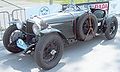 1936 Alvis Speed 20
 -
 1936 Alvis Speed 25
 -
 1939 Alvis 4.3 Litre
 -


Alvis aircraft engines[edit]

The initial Alvis aero-engines were licence-built Gnome-Rhone radials. The first aero-engine designed and built by Alvis was the 14-cylinder Alvis Pelides radial in 1936. Development of this and related engines (Pelides Major, Alcides, Alcides Major, Maeonides Major) was stopped with the start of the Second World War with only a handful built.
The Alvis Leonides, a smaller 9-cylinder radial, continued in development during the war and was used after the war in some aircraft and helicopters until production finished in 1966. In 1952, Alvis returned to 14-cylinder radials with a development of the Leonides as the Leonides Major.[31][32] The Major was used in the Westland Whirlwind helicopter.
Alvis military vehicles[edit]

The Hungarian automotive engineer Nicholas Straussler had designed an armoured car (AC1) in 1932, which was built by the Manfred Weiss company under licence in Budapest. When Hungary aligned itself with Germany soon afterwards, Straussler emigrated to England.[33] Straussler's small new company, Straussler Mechanisations Ltd, lacked the necessary resources and capacity to build the vehicle on a large scale, so Straussler approached Alvis, and Alvis-Straussler Ltd, a short-lived joint venture company, was formed in July 1936.[33][34]
The prototype vehicle produced, the Alvis Straussler AC2, was built upon the AC1 chassis. The first AC3 – the first operational purpose-built armoured car ever produced[citation needed] – was delivered in 1937 by Alvis-Straussler Ltd, built upon the AC2 prototype.[33] Twenty-seven vehicles were built: 12 for the Royal Air Force, 3 for the Portuguese Army, and 12 for the Royal Netherlands East Indies Army.[34] The AC2 was subsequently used as a basis for the 39M Csaba armoured scout car built for the Royal Hungarian Army during the Second World War.
- Alvis-Straussler AC3 armoured car (Alvis-Straussler Ltd., 1937)
- Alvis-Straussler light medium tank (Alvis-Straussler Ltd., 1937)
- Hefty gun tractor (Alvis Mechanisation Ltd., 1937)
- LAC armoured car (Alvis Mechanisation Ltd., 1938)
In 1938 Alvis Mechanisations was formed to take over the obligations of Alvis-Straussler Ltd. In 1938, Alvis produced a prototype armoured light reconnaissance vehicle for comparison trials with other manufacturers. The Alvis Dingo lost out to a design by BSA Cycles but 'Dingo' was adopted as the name for the BSA design; which was built by a BSA subsidiary as the Daimler Dingo.
Post-war, Alvis designed a series of six-wheel drive vehicles. The Saladin (FV601) armoured car and Saracen armoured personnel carrier were first. The Saracen was built as a number of related vehicles including FV604 Regimental Command Vehicle, and FV610 Armoured Command Post. The Salamander was an airfield crash tender. It was subsequently used as a basis for the Stalwart amphibious military truck.[35] The FV611 model was also built to serve as an armoured ambulance.[36]
The FV432 tracked armoured personnel carrier and related vehicles was developed in the early 1960s by GKN Sankey and came under Alvis in 1998.
The Combat Vehicle Reconnaissance (Tracked) family of tracked vehicles were designed in the 1960s. The family includes the FV101 Scorpion, FV102 Striker, FV103 Spartan, FV104 Samaritan, FV105 Sultan, FV106 Samson, FV107 Scimitar, FV4333 Stormer, and the Streaker.[35] The first vehicle of this series was the FV101 Scorpion, which was the first aluminium hull tank ever to be built. The hull and turret are actually fabricated from a welded aluminium-zinc-magnesium alloy. Seventeen Scorpion prototypes were delivered for field testing in February 1969.[35]
Alvis military vehicles[edit]
-
 Dingo Scout armoured light reconnaissance vehicle. Not adopted by the British Army which chose a design by BSA instead.
 -
 FV601 Saladin armoured car
 -
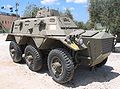 FV603 Saracen armoured personnel carrier
 -

-
 Stalwart cross-country amphibious load carrier
 -
 FV101 Scorpion armoured reconnaissance vehicle
 -
 FV102 Striker anti-tank guided missile vehicle
 -
 FV103 Spartan armoured personnel carrier
 -
 FV105 Sultan armoured command vehicle
 -
 FV106 Samson armoured recovery vehicle
 -
 FV107 Scimitar armoured reconnaissance vehicle
 -

-
 Armoured Vehicle Launched Bridge (AVLB), manufactured by Alvis Unipower Limited
 -

-
 FV722 Vixen armoured reconnaissance vehicle(Wheeled)


_ARV.jpg)


Alvis ownership[edit]
More than 20 per cent of all Alvis cars ever manufactured were still in existence in 1989.[1] The Alvis Owner Club, founded in 1951, is a club for all Alvis car and military vehicle enthusiasts. It has over 1,300 members. It hosts International Weekends annually, where owners from the UK and overseas display their cars.
The Alvis Register is a club with more than 600 members, dedicated to all things related to vintage Alvis motor cars (1920–32). Members can access technical and historical information and share their interest with other Alvis enthusiasts. Most owners retain an eligible car or cars.[37]
See also[edit]
Notes[edit]
- ^ Figures in brackets show those cars that were bodied by Graber out of the number produced. Source TC108/G flash demonstration www.alvis-tc108-graber.ch accessed 8 April 2023 Archived 18 January 2008 at the Wayback Machine
References[edit]
Citations
- ^ a b c d e f g Day 1989, pp. 10–112.
- ^ Wragg, David W. (1973). A Dictionary of Aviation (first ed.). Osprey. p. 34. ISBN 9780850451634.
- ^ Walker, N. (1997). A–Z of British Coachbuilders. Bay View Books. ISBN 978-1-870979-93-1.
- ^ Stratton, M.; Trinder, B.S. (2000). Twentieth Century Industrial Archaeology. E & FN Spon. p. 74. ISBN 9780419246800. Retrieved 8 April 2015.
- ^ Alvis Limited. The Times, Thursday, 3 January 1946; pg. 7; Issue 50340
- ^ Ian Nicholls, 7 July 2019, History : The Rover-Triumph story – Part One : 1959, www.aronline.co.uk Retrieved 4 February 2023
- ^ Mullen, Enda (18 November 2018). "Alvis: The amazing history of a legendary Coventry car maker". Coventry Telegraph. Retrieved 20 May 2021.
- ^ "Alvis Car Company - Our Heritage". Retrieved 21 May 2021.
In 1968 the passenger car interests were relocated to Kenilworth along with the complete stock of spares, nearly 22,000 Car Records and over 50,000 works drawings, technical data sheets and correspondence files and as Red Triangle they have continued to provide support for passenger car owners to the present day.
- ^ "Red Triangle - Alvis Parts and Restoration". Retrieved 20 May 2021.
Founded by the ex-employees, with the help and support of the Alvis Company, Red Triangle started business in June 1968 providing parts and service for the cars in everyday use at that time.
- ^ "Historic British brand Alvis returns with continuation cars". Motor Authority. 25 July 2019. Retrieved 29 May 2021.
- ^ Top Gear www.topgear.com accessed 8 April 2023
- ^ "BBC Four - Classic British Cars: Made in Coventry". www.bbc.co.uk. Retrieved 8 April 2023.
- ^ "For the First Time Since the '60s, the Alvis Name Returns with Graber Super Coupe Continuation Car". www.carscoops.com. 4 October 2021. Retrieved 8 April 2023.
- ^ "Alvis Resurrected After Long Slumber, Blends Heritage with Modern Technology". www.carscoops.com. 27 July 2019. Retrieved 8 April 2023.
- ^ Robson, G. (2006). A-Z of British Cars 1945–1980. Herridge & Sons. ISBN 978-0-9541063-9-3.
- ^ Day 1989, pp. 164–256.
- ^ a b c d e f g h i j k l m n o p q r s t u v w x y z aa ab Day 1989.
- ^ The Times, Tuesday, 3 January 1922; p. 6; Issue 42919
- ^ The Times, Tuesday, 15 March 1927; p. 10; Issue 44530
- ^ The Times, Monday, 19 September 1927; p. 9; Issue 44690
- ^ The Times, Saturday, 13 October 1928; p. 6; Issue 45023
- ^ The Times, Friday, 12 October 1928; p. 8; Issue 45022
- ^ The Times, Monday, 9 September 1929; p. 21; Issue 45303
- ^ The Times, Saturday, 18 October 1930; p. 17; Issue 45647
- ^ The Times, Tuesday, 10 March 1931; p. 20; Issue 45767
- ^ The Times, Thursday, 13 September 1934; p. 8; Issue 46858
- ^ The Times, Wednesday, 22 October 1930; p. 10; Issue 45650.
- ^ The Times, Tuesday, 25 August 1931; p. 10; Issue 45910
- ^ a b Day 1989, pp. 113–163.
- ^ Christie, J. Walter (2011). "Walter Christie: Front-Wheel Drive Pioneer". Featured drivers. VanderbiltCupRaces.com. Archived from the original on 17 July 2011. Retrieved 24 July 2011.
- ^ Lumsden 2003, pp. 57–61.
- ^ Day 1989, pp. 257–271.
- ^ a b c Munro 2002, pp. 7–19.
- ^ a b Jost, Jacques (2000). "Alvis-Straussler Armoured Cars in the Netherlands East Indies". Forgotten Campaign: The Dutch East Indies Campaign 1941–1942. Archived from the original on 26 July 2011. Retrieved 24 July 2011.
- ^ a b c Day 1989, pp. 272–295.
- ^ Munro 2002, pp. 54–76.
- ^ Day 1989, pp. 296–341.
Bibliography
- Day, Kenneth (1989). Iles, Robert (ed.). Alvis: The Story of the Red Triangle (2nd ed.). Haynes Publishing Group. ISBN 978-0-85429-667-5.
- L, Klemen (2000). "Forgotten Campaign: The Dutch East Indies Campaign 1941–1942".[failed verification]
- Lumsden, Alec (2003). British Piston Engines and their Aircraft. Airlife Publishing. ISBN 978-1-85310-294-3.
- Munro, Bill (2002). Alvis Saracen Family. The Crowood Press. ISBN 978-1-86126-537-1.
Further reading[edit]
- Clarke, R. M. (1989). Alvis gold portfolio 1919–1967. Brooklands Books. ISBN 978-1-870642-84-2.
- Culshaw, D. (2003). Alvis three litre in detail: TA21 to TF21 1950–67. Herridge and Sons. ISBN 978-0-9541063-2-4.
- Padfield, A. (2000). "Captain G T Smith-Clarke: automobile and medical engineer" (PDF). J Med Biogr. 8 (2): 89–96. doi:10.1177/096777200000800205. PMID 10994055. S2CID 37574528. Archived from the original (PDF) on 1 October 2011.
External links[edit]


- Car brands
- Alvis vehicles
- Coventry motor companies
- Defunct motor vehicle manufacturers of England
- Defunct aircraft engine manufacturers of the United Kingdom
- Former defence companies of the United Kingdom
- Luxury motor vehicle manufacturers
- Military vehicle manufacturers
- Emergency services equipment makers
- Vehicle manufacturing companies established in 1919
- Vehicle manufacturing companies disestablished in 1967
- 1919 establishments in England
- 1967 disestablishments in England
- British companies disestablished in 1967
- British companies established in 1919
- Alvis aircraft engines
- Sports car manufacturers