


Corallus hortulana
| Corallus hortulana | |
|---|---|

| |
| Juvenile in Ecuador | |
Scientific classification 
| |
| Domain: | Eukaryota |
| Kingdom: | Animalia |
| Phylum: | Chordata |
| Class: | Reptilia |
| Order: | Squamata |
| Suborder: | Serpentes |
| Family: | Boidae |
| Genus: | Corallus |
| Species: | C. hortulana
|
| Binomial name | |
| Corallus hortulana | |
| Synonyms | |
|
Synonyms List
| |
Corallus hortulana, previously known as Corallus hortulanus, and commonly known as the Amazon tree boa, common tree boa,[3] garden tree boa,[4] and macabrel, is a boa species found in South America. Previously, there were two recognized subspecies, Corallus hortulanus hortulanus, and Corallus hortulanus cooki, though the species has undergone taxonomic revision and has been broken up into several species.[5] It is primarily nocturnal and arboreal, though it has been observed feeding and reproducing on the ground.[6] Like all boas, it is non-venomous.
Description[edit]
Adults grow to an average of 5 and 6.5 feet (1.5–2 m)[7] This species exhibits an array of colors and patterns. The basic color can be anywhere from black, brown, or gray, to any shade of red, orange, yellow, or many colors in between. The head generally has five dark stripes that extend from the eyes. The eyes can be yellowish, grayish, or reddish, and they have a reflective membrane that results in eyeshine at night.[5] Some are patternless, while others may be speckled, banded, or saddled with rhomboid or chevron shapes. Some reds will have yellow patterns, some yellows red or orange patterns. "The tongue is black. Males and females are similar in size and markings. They range from 525 to 1880 mm in length, usually from 1200 to 1500 mm."[5] Like all other boas they have a pair of anal spurs that extend from the cloaca, which are small, claw-like remnants of vestigial hindlimbs.[5]
In the herpetoculture hobby, they are often distinguished by two color 'phases' that appear genetically inherited, the 'garden phase' and the 'colored phase'. The 'garden phase' refers to boas with drab coloration, mostly brown or olive, with varied patterning, while the 'colored phase' refers to animals with combinations of red, orange, and yellow coloring.
-
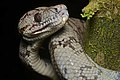 adult in Peru
 -
 juvenile in Peru


Geographic range[edit]
The range of Corallus hortulana stretches from southern Central America, across northern South America, southeast to the Tropic of Cancer in Brazil.[5] Amazon tree boas are found in a wide variety of habitats. They are common in arboreal regions with high humidity, especially Amazon rainforest. They can also be found in dry areas such as savannas or dry forests.[5]
Most studied Corallus hortulana specimens are found 2 m or more above the ground in trees or other vegetation. They have also been observed feeding and reproducing on the ground. Amazon tree boas are also relatively common along rivers. They occupy forest, rainforest and scrub forest terrestrial Biomes and are especially associated with Riparian habitats.[5]
They range from 0 to 900 m in elevation, though typically found below 300 m elevation.[8][5]
Diet[edit]
Like all other Boidae, Amazon Tree Boas feed by constricting whole, live prey. They have long teeth which help it to catch potentially flying prey while in trees. The diet is described as being "very euryphagic",[9] which means it consumes a wide variety of prey. In the wild the species has been observed to consume all manner of vertebrate prey, including birds, reptiles, amphibians, mammals and possibly even fish.[10][11] "More than 50% of the individuals fed on prey weighing up to 20% of their own body mass and about 20% preyed on animals weighing from 40-95% of their masses."[9] In terms of absolute mass, adults fed on larger prey items, while younger specimens ate proportionally larger food items.[9]
It has been suggested that there is an ontogenetic change in general prey preferences with younger individuals preferring reptiles and amphibians while adults eat almost exclusively birds and mammals.[11]
Reproduction[edit]
Amazon Tree Boas, like other Boas are ovoviparous,[12] which means they give birth to live young. The reproductive season of Corallus hortulana can vary between locations, and has variously been attributed to food availability and seasonal conditions.[6] During copulation, the male entangles about 30% of its body around the female and performs movements with his head, including rubbing the chin against the female’s neck and head. In captivity, two males copulated for ~37 minutes with a female, without engaging in combat. After a gestation period of 6–7 months, females give birth from 2–29 young that measure 28.2–64.4 cm in total length.[10]
Though the species has a wide distribution and is relatively abundant, comparatively little is known about its reproduction in the wild. There have been 4 documented cases of Amazon Tree Boas copulating in the wild. Surprisingly, though primarily arboreal and nocturnal, Amazon Tree Boas have been documented mating during the day and night as well as in the canopy and on the ground. Two daytime observations were in the trees, while two were on the ground.[6]
Captivity[edit]
While Amazon tree boas are encountered relatively frequently in the pet industry, they have a notoriously irritable temperament, do not hesitate to bite, and have specific care requirements. As such, they are not recommended for inexperienced keepers.
References[edit]
- ^ NatureServe (2013). "Garden Tree Boa Corallus hortulanus". IUCN Red List of Threatened Species. 2013. Retrieved 15 December 2014.
- ^ McDiarmid RW, Campbell JA, Touré T. 1999. Snake Species of the World: A Taxonomic and Geographic Reference, vol. 1. Herpetologists' League. 511 pp. ISBN 1-893777-00-6 (series). ISBN 1-893777-01-4 (volume).
- ^ "Corallus hortulanus". Integrated Taxonomic Information System. Retrieved 14 July 2008.
- ^ Mehrtens JM. 1987. Living Snakes of the World in Color. New York: Sterling Publishers. 480 pp. ISBN 0-8069-6460-X.
- ^ a b c d e f g h Winner, Kevin. "Corallus hortulanus (Garden Tree Boa)". Animal Diversity Web. Retrieved 29 March 2024.
- ^ a b c "Vol. 26 No. 2 (2019): Reptiles & Amphibians". Reptiles & Amphibians. 26 (2). 1 August 2019. doi:10.17161/randa.v26i2. ISSN 2332-4961.
- ^ Burnie D, Wilson DE. 2001. Animal. Dorling Kindersley. 624 pp. ISBN 0-7894-7764-5.
- ^ "Amazon Tree Boa". Reptile Range. Retrieved 10 August 2022.
- ^ a b c Pizzatto, Lígia; Marques, Otavio; Facure, Kátia (1 January 2009). "Food habits of Brazilian boid snakes: overview and new data, with special reference to Corallus hortulanus". Amphibia-Reptilia. 30 (4): 533–544. doi:10.1163/156853809789647121. ISSN 1568-5381.
- ^ a b "Amazon Tree-Boa (Corallus hortulana)". www.reptilesofecuador.com. Retrieved 29 March 2024.
- ^ a b "Amazon Tree-Boa (Corallus hortulana)". www.reptilesofecuador.com. Retrieved 29 March 2024.
- ^ "Corallus hortulana". The Reptile Database. Retrieved 29 March 2024.
Further reading[edit]
- Mattison C. 1999. Snake. DK Publishing. ISBN 0-7894-4660-X.
External links[edit]

- Corallus hortulanus at the Reptarium.cz Reptile Database. Accessed 14 July 2008.
| Authority control databases: National |
|---|
