


Aristoteles (crater)
 Lunar Orbiter 4 image of Aristoteles (large crater) and Mitchell (smaller one to the right) | |
| Coordinates | 50°12′N 17°24′E / 50.2°N 17.4°E |
|---|---|
| Diameter | 87 km |
| Depth | 3.3 km |
| Colongitude | 343° at sunrise |
| Eponym | Aristotle |
Aristoteles is a lunar impact crater that lies near the southern edge of the Mare Frigoris and to the east of the Montes Alpes mountain range. It was officially named in 1935 after the ancient Greek philosopher Aristotle by the International Astronomical Union, using the classical form of his name.[1]
To the immediate south of Aristoteles lies the slightly smaller crater Eudoxus, and these two form a distinctive pair for a telescope observer. An arc of mountains between these craters bends to the west before joining the walls. The smaller crater Mitchell is directly attached to the eastern rim of Aristoteles. To the west is the low, flooded feature Egede.
Observers have noted the crater wall of Aristoteles is slightly distorted into a rounded hexagon shape. The inner walls are wide and finely terraced. The outer ramparts display a generally radial structure of hillocks through the extensive blanket of ejecta. The crater floor is uneven and covered in hilly ripples. Aristoteles does possess small central peaks but they are somewhat offset to the south. The interior floor appears to have been filled with a layer of material partially burying these projections.
Aristoteles is a crater of Eratosthenian age.[2]
-
 Selenochromatic Image (Si) of Lacus Somniorum area
 -
 Location of Aristoteles as photographed at the McDonald Observatory
 -
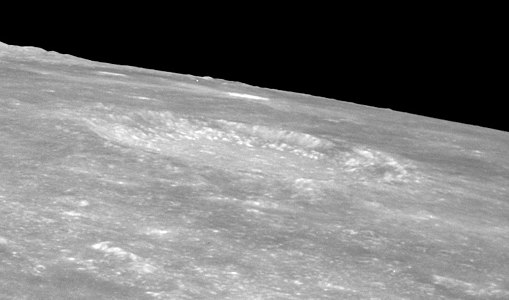 Oblique view from Apollo 16


Satellite craters[edit]
By convention these features are identified on lunar maps by placing the letter on the side of the crater midpoint that is closest to Aristoteles.
| Aristoteles | Latitude | Longitude | Diameter |
|---|---|---|---|
| D | 47.5° N | 14.7° E | 6 km |
| M | 53.5° N | 27.2° E | 7 km |
| N | 52.9° N | 26.8° E | 5 km |
References[edit]
- ^ "Aristoteles (crater)". Gazetteer of Planetary Nomenclature. USGS Astrogeology Research Program.
- ^ The geologic history of the Moon. USGS Professional Paper 1348. By Don E. Wilhelms, John F. McCauley, and Newell J. Trask. U.S. Government Printing Office, Washington: 1987. Table 12.2.
- Andersson, L. E.; Whitaker, E. A. (1982). NASA Catalogue of Lunar Nomenclature. NASA RP-1097.
- Bussey, B.; Spudis, P. (2004). The Clementine Atlas of the Moon. New York: Cambridge University Press. ISBN 978-0-521-81528-4.
- Cocks, Elijah E.; Cocks, Josiah C. (1995). Who's Who on the Moon: A Biographical Dictionary of Lunar Nomenclature. Tudor Publishers. ISBN 978-0-936389-27-1.
- McDowell, Jonathan (July 15, 2007). "Lunar Nomenclature". Jonathan's Space Report. Retrieved 2007-10-24.
- Menzel, D. H.; Minnaert, M.; Levin, B.; Dollfus, A.; Bell, B. (1971). "Report on Lunar Nomenclature by the Working Group of Commission 17 of the IAU". Space Science Reviews. 12 (2): 136–186. Bibcode:1971SSRv...12..136M. doi:10.1007/BF00171763. S2CID 122125855.
- Moore, Patrick (2001). On the Moon. Sterling Publishing Co. ISBN 978-0-304-35469-6.
- Price, Fred W. (1988). The Moon Observer's Handbook. Cambridge University Press. ISBN 978-0-521-33500-3.
- Rükl, Antonín (1990). Atlas of the Moon. Kalmbach Books. ISBN 978-0-913135-17-4.
- Webb, Rev. T. W. (1962). Celestial Objects for Common Telescopes (6th revised ed.). Dover. ISBN 978-0-486-20917-3.
- Whitaker, Ewen A. (1999). Mapping and Naming the Moon. Cambridge University Press. ISBN 978-0-521-62248-6.
- Wlasuk, Peter T. (2000). Observing the Moon. Springer. ISBN 978-1-85233-193-1.
External links[edit]

- Wood, Chuck (2007-02-27). "Twins - Not!". Lunar Photo of the Day. Archived from the original on 2015-07-04. Retrieved 2007-02-27.
- Wood, Chuck (2007-09-11). "Eating a Smaller Fry". Lunar Photo of the Day. Archived from the original on 2007-12-05. Retrieved 2007-09-11.
