Battle of Avarayr
39°20′20″N 45°3′26″E / 39.33889°N 45.05722°E
 | This article includes a list of references, related reading, or external links, but its sources remain unclear because it lacks inline citations. (October 2023) |
| Battle of Avarayr | |||||||
|---|---|---|---|---|---|---|---|
 A 15th-century Armenian miniature depicting the battle | |||||||
| |||||||
| Belligerents | |||||||
|
Sasanian Empire Pro-Sasanian Armenians | Christian Armenians | ||||||
| Commanders and leaders | |||||||
|
Vasak of Syunik Mushkan Niusalavurt |
Vardan Mamikonian † Ghevond Vanandetsi[6] | ||||||
| Strength | |||||||
|
200,000[4]–300,000[7] Sasanians 60,000 Armenian loyalists[7] Unknown number of elephants | 66,000 Armenians[7] | ||||||
| Casualties and losses | |||||||
| Heavy[5] | Heavy[5] | ||||||
The Battle of Avarayr (Armenian: Ավարայրի ճակատամարտ, romanized: Avarayri Chakatamart) was fought on 26 May 451 on the Avarayr Plain in Vaspurakan between a Christian Armenian army under Vardan Mamikonian and Sassanid Persia. It is considered one of the first battles in defense of the Christian faith.[8] Although the Persians were victorious on the battlefield, it was a pyrrhic victory as Avarayr paved the way to the Nvarsak Treaty of 484, which affirmed Armenia's right to practise Christianity freely.[4][5]
The battle is seen as one of the most significant events in Armenian history.[9] The commander of the Armenian forces, Vardan Mamikonian, is considered a national hero and has been canonized by the Armenian Apostolic Church.[10][11]
Background[edit]
 | This section needs additional citations for verification. (May 2017) |

| History of Armenia |
|---|
 |
| Timeline • Origins • Etymology |
The Kingdom of Armenia under the Arsacid dynasty of Armenia was the first nation to officially convert to Christianity, in 301 under Tiridates III. In 428, Armenian nobles petitioned Bahram V to depose Artaxias IV (Artashir IV).[12] As a result, the country became a Sassanid dependency with a Sassanid governor. The Armenian nobles initially welcomed Persian rule, provided they were allowed to practise Christianity; but Yazdegerd II, concerned that the Armenian Church was hierarchically dependent on the Latin- and Greek-speaking Christian Church (aligned with Rome and Constantinople rather than the Aramaic-speaking and Persian-backed Church of the East) tried to compel the Armenian Church to abandon Rome and Byzantium in favour of the Church of the East or simply convert to Zoroastrianism. He summoned the leading Armenian nobles to Ctesiphon, and pressured them into cutting their ties with the Orthodox Church as he had intended.[13] Yazdegerd II himself was a Zoroastrian rather than a Christian, and his concern was not religious but securing political loyalty.
Battle[edit]

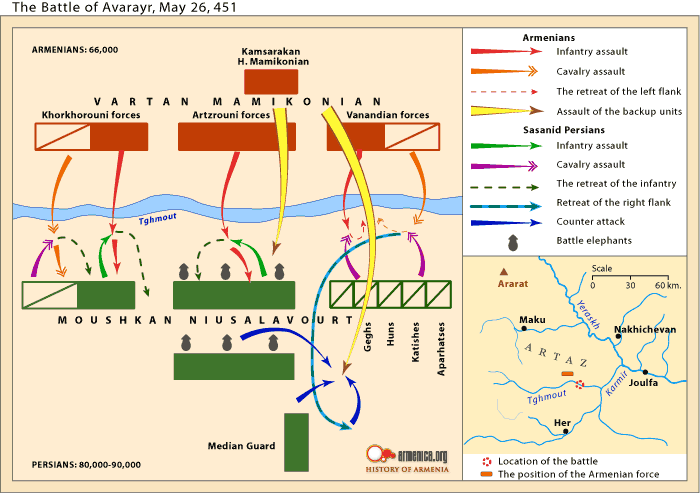
The 66,000-strong Armenian army took Holy Communion before the battle. The army was a popular uprising, rather than a professional force, but the Armenian nobility who led it and their respective retinues were accomplished soldiers, many of them veterans of the Sassanid dynasty's wars with Rome and the nomads of Central Asia. The Armenians were allowed to maintain a core of their national army led by a supreme commander (sparapet) who was traditionally of the Mamikonian noble family. The Armenian cavalry was, at the time, practically an elite force greatly appreciated as a tactical ally by both Persia and Byzantium. In this particular case, both officers and men were additionally motivated by a desire to save their religion and their way of life. The Persian army, said to be three times larger, included war elephants and the famous Savārān, or New Immortal, cavalry. Several Armenian noblemen with weaker Christian sympathies, led by Vasak Siuni, went over to the Persians before the battle, and fought on their side; in the battle, Vardan won initial successes, but was eventually slain along with eight of his top officers.[14][failed verification]
Outcome[edit]
.jpg)
Following the victory, Yazdegerd jailed some Armenian priests and nobles and appointed a new governor for Armenia.[citation needed]
The Armenian Church was also unable to send a delegation to the Council of Chalcedon, as it was heavily involved in the war. In the 6th century, the Armenian Church decided not to accept the Council of Chalcedon, instead adhering to Miaphysitism.[citation needed]
Armenian resistance continued in the decades following the battle, led by Vardan's successor and nephew, Vahan Mamikonian. In 484, Sahag Bedros I signed the Nvarsak Treaty, which guaranteed religious freedom to the Christian Armenians[15] and granted a general amnesty with permission to construct new churches. Thus, the Armenians see the Battle of Avarayr as a moral victory; the Feast of St. Vartan and His Companions is considered to be a holy day by Armenians, and is one of the most important national and religious days in Armenia.[citation needed]
See also[edit]
References[edit]
- ^ "Welcome to Encyclopaedia Iranica".
- ^ Nicholson, Oliver (2018-04-19). The Oxford Dictionary of Late Antiquity. ISBN 9780192562463.
- ^ Susan Paul Pattie, Faith in History: Armenians Rebuilding Community (Smithsonian Institution Press, 1997), 40.
- ^ a b c Hewsen, Robert H. (August 17, 2011). "AVARAYR". Encyclopædia Iranica.
So spirited was the Armenian defence, however, that the Persians suffered enormous losses as well. Their victory was pyrrhic and the king, faced with troubles elsewhere, was forced, at least for the time being, to allow the Armenians to worship as they chose.
- ^ a b c d Susan Paul Pattie (1997). Faith in History: Armenians Rebuilding Community. Smithsonian Institution Press. p. 40. ISBN 1560986298.
The Armenian defeat in the Battle of Avarayr in 451 proved a pyrrhic victory for the Persians. Though the Armenians lost their commander, Vartan Mamikonian, and most of their soldiers, Persian losses were proportionately heavy, and Armenia was allowed to remain Christian.
- ^ The Golden Age: Minor Writers, The Heritage of Armenian Literature, Vol.1, ed. Agop Jack Hacikyan (Wayne State University Press, 2000), 360.
- ^ a b c Babessian, Hovhannes (1965). "The Vartanantz Wars". The Armenian Review. 18: 16–19.
- ^ Agadjanian, Alexander (2014). "Six Elements of the Armenian Ethno-Religious Genealogy". Armenian Christianity Today: Identity Politics and Popular Practice. Routledge. ISBN 978-1472412713.
- ^ Hakobyan, Науk (2003). "Ավարայրի ճակատամարտը (պատմաքննական տեսություն) [The Avarayr Battle (historical-critical review)]". Patma-Banasirakan Handes (in Armenian) (1): 40–67.
- ^ Robert Armot, Alfred Aghajanian (2007). Armenian literature: comprising poetry, drama, folklore, and classic traditions. Los Angeles, CA: Indo-European Pub. p. 5. ISBN 9781604440003.
- ^ Suny, Ronald Grigor (1993). Looking toward Ararat Armenia in modern history. Bloomington: Indiana university press. p. 4. ISBN 9780253207739.
- ^ Introduction to Christian Caucasian History:II: States and Dynasties of the Formative Period, Cyril Toumanoff, Traditio, Vol. 17, 1961, Fordham University, 6.
- ^ Ronald Grigor Suny, The Making of the Georgian Nation (Indiana University Press, 1994), 23.
- ^ Mission, Conversion, and Christianization: The Armenian Example, Robert W. Thomson, Harvard Ukrainian Studies, Vol. 12/13 (1988/1989), 41-42.
- ^ www.ANSC.org - Armenian Network of Student Clubs Archived 2007-09-30 at the Wayback Machine
Further reading[edit]
- Elishe: History of Vardan and the Armenian War, transl. R.W. Thomson, Cambridge, Mass. 1982
- Visions Of Ararat: Writings On Armenia By Christopher J. Walker; Page 3
- Dr. Abd al-Husayn Zarrin’kub "Ruzgaran:tarikh-i Iran az aghz ta saqut saltnat Pahlvi" Sukhan, 1999. ISBN 964-6961-11-8
- Modern Armenia: People, Nation, State By Gerard J. Libaridian
- Vahan Kurkjian - Period of the Marzbans — Battle of Avarair
External links[edit]
- Battle map
- Summary of the battle from A History of Armenia by Vahan M. Kurkjian
- St Vartan's life on www.armenianchurch.net
- The Vartanank War The interregnum (428–861)

| Authority control databases: National |
|---|