


Bob's Big Boy
 Bob's Big Boy restaurant in Burbank in January 2014. | |
| Formerly | Bob’s Pantry (1936-1938) |
|---|---|
| Company type | Subsidiary |
| Industry | Casual dining restaurant |
| Founded | August 6, 1936 (as Bob's Pantry) Glendale, California, U.S.[1] |
| Founder | Bob Wian |
Area served | |
| Products |
|
| Parent | Big Boy Restaurants |
| Website | bobs |
Bob's Big Boy is a casual dining restaurant chain founded by Bob Wian in Southern California in 1936, originally named Bob's Pantry.[2][3] The chain's signature product is the Big Boy hamburger, which Wian created six months after opening his original location. Slicing a bun into three slices and adding two hamburger patties, Wian is credited with creating the original double-decker (or "double-deck") hamburger.[4]
When Wien began franchising his restaurant across the United States in 1940s, he only required franchisees to use "Big Boy", and omit his name "Bob's". The chain then changed hands several times after Wien sold it in 1967. It was eventually purchased by a group of Michigan investors in 2018, renaming the chain's parent company Big Boy Restaurant Group.[5][6] At its peak in 1989, there were over 240 locations throughout the country that included "Bob's" name.[7] With the closing of the Calimesa, California restaurant in 2020, only four locations remain using the full "Bob's Big Boy" branding, all in the Los Angeles, California area. Among those restaurants, two are now protected historic landmarks: the Burbank location on Riverside Drive and the Downey location, previously known as Johnie's Broiler. The other two Bob's Big Boy restaurants are in Norco and Northridge. The other locations across the United States, either directly under the Big Boy Restaurant Group or operated independently by trademark co-registrant Frisch's Big Boy, continue to omit "Bob's".[8][9]
History[edit]
Bob Wian before Big Boy[edit]
Bob Wian entered Glendale High School as the Great Depression started in 1929.[10]: inside back cover When his father's furniture business went bankrupt,[11] Wian washed dishes in the school cafeteria to pay for lunch.[12] Not being a committed student – he never took homework home[12]: D1 – classmates voted Wian most unlikely to succeed.[13] However, his father's business failure and classmates' doubts would lead Wian to success.[13]
After graduation in 1933, Wian found work as the overnight dishwasher at a Los Angeles White Log Coffee Shop,[10]: 33 [13] a West Coast chain similar to White Castle.[10]: 33, 36 Suddenly he was interested in how a restaurant worked and how it could be improved; he became determined to own a restaurant or even a chain.[13] And he was intent on proving his classmates wrong.[13]
Wian was promoted to fry cook and then a manager.[14][10]: 12 He learned the White Log system, its merchandising and pricing of foods, and use of a central commissary;[10]: 36 Wian would later apply these concepts to Big Boy.[15] He would also adopt White Log's pancake batter recipe.[10]: 13 At White Log he befriended fellow fry cook Bennie Washam, who would later sketch the original Big Boy mascot.[16]

Wanting wider experience, Wian quit and took a dishwashing job with his favorite Glendale restaurant, Lionel Sternberger's Rite Spot.[13][note 1] Again he was promoted to counterman and fry cook. The man who hired Wian and was his boss, Leonard Dunagan, would later be hired by Wian and became vice president of Bob's Big Boy.[13][10]: 34, 60 [note 2]
Wian discovered how Rite Spot made its chili, hamburgers, and red hamburger relish[12]: D1 [10]: 12–13 – the same relish Wian would use on the Big Boy hamburger. [12]: D4 And he learned the importance of consistency in foods served.[10]: 34–35
The Rite Spot also offered curb service, as Bob's Big Boy would several years later.[11] (His sister Dottie was a carhop at the Rite Spot before moving to Bob's Big Boy.[11]) However, Wian's first drive-in work was at a Pig Stand.[10] The restaurants used pig-shaped die-cut menus and some had a big pig in front; similarly, Bob's would use Big Boy shaped die-cut menus and later display large Big Boy statues out in front.
Wian also patronized other restaurants looking for additional menu items, attempting to recreate the favored items at home, and sometimes prodding food suppliers for how they were made.[12]: D4 Bob's hot fudge sundae, for example, was adopted from the sundae served at C. C. Brown's Ice Cream Parlor.[12]: D4
Wian claimed that there was nothing new at Bob's Big Boy[12]: D4 – excepting the double-deck Big Boy hamburger – and that he was building Big Boy in his mind while at these previous jobs.[13] Confident from his restaurant employment and encouraged by his father, he was already looking for a location when The Pantry was placed for sale.[13]
Bob's Pantry[edit]
In August 1936, Wian quit his job at the Rite Spot and sold his 1933 DeSoto Roadster for $300[15][13][18] to make the down payment on a 10-stool hamburger stand in Glendale called The Pantry.[note 3] He cleaned the place until it "shine[d] like a brand new penny"[13], borrowed $50 from his father for meat and supplies,[12]: D4 and reopened as Bob's Pantry. Six months later, Wian assembled his special double-decker hamburger. Created as a joke for a customer wanting something different, the novel hamburger began drawing business. The "snappy" name given to the popular sandwich provided a new name for his restaurant: Bob's Big Boy.[19]
Bob's Big Boy[edit]
Bob Wian: 1937–1967[edit]
Wian opened a second drive-in in Burbank in 1938,[14] launching drive-in curb service at both locations. During World War II, Wian experienced shortages of both meat and manpower, and one of the four Bob's then in operation closed.[14] Soon after the war – in 1946 – Wian formed Robert C. Wian Enterprises to assume his restaurant business.[20]
In the late 1940s, Wian licensed two operators in the East to sell his Big Boy hamburger, Frisch's Big Boy in Cincinnati and Eat'n Park Big Boy in Pittsburgh; this served Wian's goal to procure and maintain a national trademark.[21] In 1951, the third licensee Alex Schoenbaum of Shoney's Big Boy sold Wian on a formal franchising system, and with the popularity of the drive-in restaurant, a series of franchising and subfranchising Big Boy followed in the 1950s.[22] The franchisees were required to sell the Big Boy hamburger and use their own name with Big Boy, not Bob's.[8][9]
.jpg)
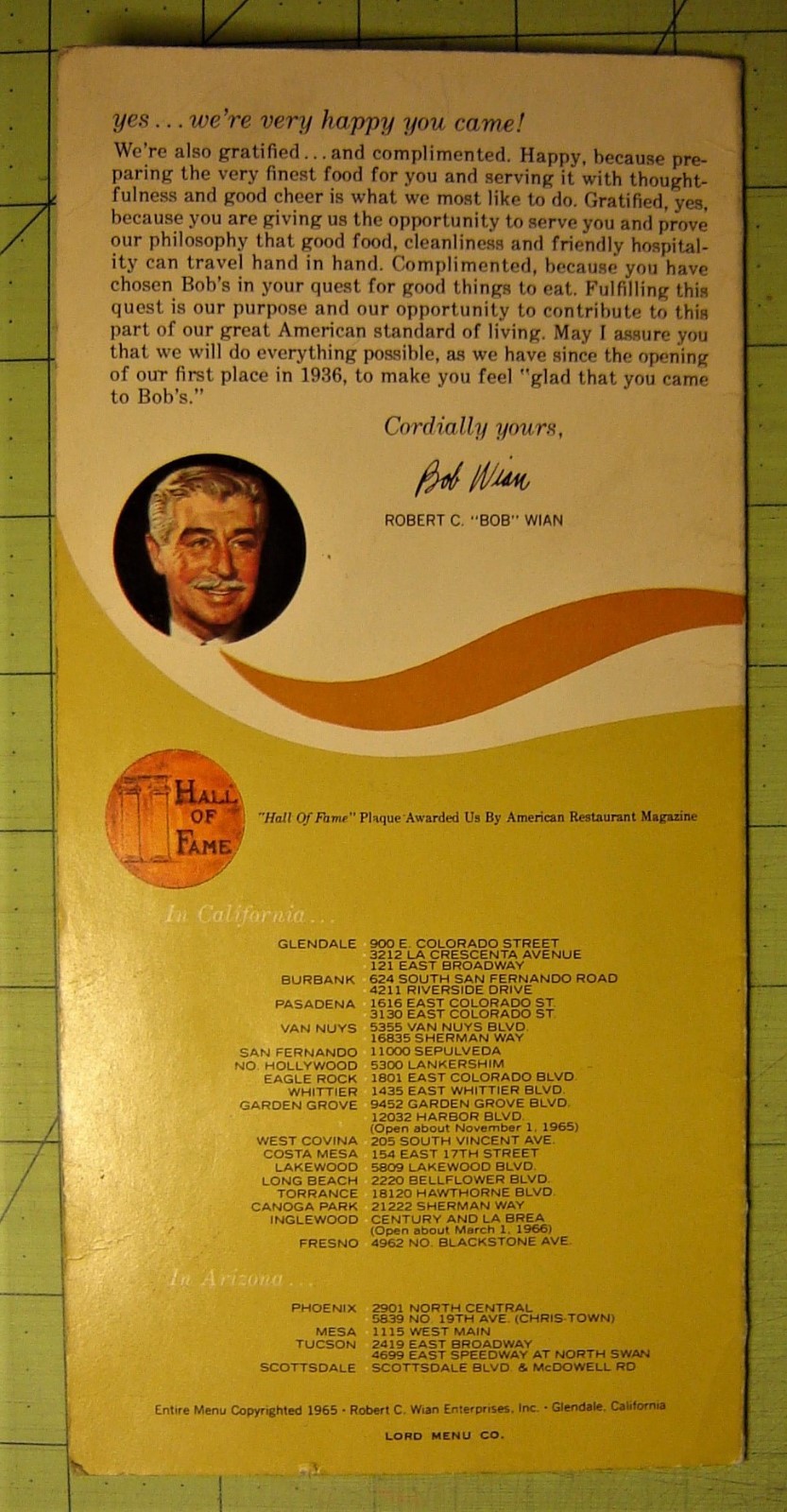
By 1951, eight Bob's Big Boys were in operation.[23] The Bob's imprint of the first (1956) edition of Adventures of the Big Boy comic book lists ten locations,[24] including one in Arizona, while a legal filing claims twelve locations.[20] The 18th Bob's opened in 1963,[25] and the chain's 1965 menu lists 23 California restaurants (including one opening in late 1965 and another in 1966) and six Arizona restaurants,[26] which represented about 5% of the national Big Boy chain.[27]
Wian provided his workers health insurance and a profit-sharing plan,[15] which included the option of employees to franchise a Bob's. In 1955 the first such unit opened in Phoenix,[28] another opened in Tucson in 1962[29] and three more locations by 1968.[30] (By 1974 there were nine Phoenix metropolitan area Bob's, including one under construction, when the units were acquired by JB's Big Boy for $2.7 million.[31])
Marriott: 1967–1987[edit]
In 1961, a merger was briefly explored with the John R. Thompson Co., a Chicago-based restaurant operator.[32][33] Five years later another merger was proposed, and in May 1967, Big Boy was sold to the Marriott Corporation. In addition to the trademark, the sale included Wian's 22 company-owned Bob's Big Boys. (Another 580 franchised Big Boy restaurants operated in 38 states nationwide.[34][22])
After the merger, Wian remained as president of Marriott's new "Big Boy Restaurants of America" division.[10]: 121 Used to dealing with franchisees and store managers on a personal level, he became overwhelmed with the increasing size of the chain, describing it as "this monster I built".[12]: D4 Also unhappy with Marriott's new focus on rapid growth and corporate profits, over his approach and practices,[35] Wian became discouraged and resigned as president in May 1968.[10]: 129 He accepted membership on Marriott's board but, his guidance never sought, Wian likewise quit that position in the summer of 1969.[10]: 123 [note 4] Although he attended the 1972 annual Big Boy Executive Conference,[37] Wian generally avoided Bob's Big Boys[12]: D4 and refused invitations to special events at the restaurants. He remained close friends with longtime associates at Big Boy.
Marriott began rapid expansion using the Bob's name that it now owned.[38] By 1971 there were 49 California Bob's,[10]: 125 and by 1979, 132.[39] It bought the Ken's Big Boy franchise in the Washington, DC-Baltimore metropolitan area in 1969[38] and JB's Big Boy's franchise in New Jersey in 1975,[40] rebranding them as Bob's. In the mid-1970s Bob's Big Boy expanded into Alaska[41] and Hawaii.[42] Marriott also bought the 39-unit Manners Big Boy chain in 1974 which may have been renamed Bob's Big Boy in 1979.[43][38][44] The 26 operating Cleveland-area restaurants were sold to and rebranded Elias Brothers Big Boy in 1985.[44][45]
Marriott as franchisee: 1987–1990s[edit]
In 1987, Marriott sold the Big Boy trademark to Elias Brothers, the Michigan Big Boy franchisee, but retained the Bob's Big Boy name and restaurants as a franchisee.[note 5] At the time, Marriott operated 208 Bob's Big Boys, including company-owned Bob's in Maryland, Virginia, New York, New Jersey, Pennsylvania, Florida, and the District of Columbia.[46] Many of these eastern Bob's were sited at rest stops on interstate toll roads, often conversions of recently purchased Howard Johnson's restaurants,[47] while others were in territory that belonged to previous franchisees.[48] Several Bob's Big Boy restaurants, such as five in the Harrisburg, Pennsylvania area[49] and two along the Ohio Turnpike[50] were not owned by Marriott.
Marriott kept its company-owned Bob's units under franchise after the sale to Elias Brothers, and the number of such Bob's increased to 238 by 1989 when Marriott decided to divest itself of its food service operations. In 1991, already having converted some San Diego stores to Allie's, named after J. Willard Marriott's wife Alice, it sold 104 California Bob's (to a company which outbid Elias Brothers) removing the units from the Bob's chain and the Big Boy system.[51] Toll road Bob's Big Boys remained in service longer due to Marriott's contractual obligations, but are no longer in operation. Privately-owned Eastern U.S. Bob's were also sold.[52]
Big Boy Restaurants International: 2000–2018[edit]
When Robert Liggett (i.e., Big Boy Restaurants International) bought Big Boy from the bankrupt Elias Brothers in 2000, ten western Bob's Big Boys were in operation, dropping to eight by 2006. The last Bob's in Hawaii closed after suffering a fire in 2009.[53]
Further shrinking their territory was the 2001 deal Liggett and Big Boy Restaurants International made with Frisch's. The Big Boy trademarks in Kentucky, Indiana, and most of Ohio and Tennessee transferred to Frisch's ownership; all other Frisch's territories transferred to Liggett.[54][55] As a franchisee, the Elias Brothers bankruptcy had threatened Frisch's future use of the Big Boy trademark, but it was forever resolved by this deal.[56] Under the agreement, Frisch's is no longer a franchisee, but Big Boy Restaurant Group and Frisch's are now independent co-registrants of the Big Boy name and trademark.[56]
Now limited to California, Bob's grew to 16 restaurants by 2011, but started to decline again. Although Big Boy Restaurants International expected to open 140 California units by 2018,[57] only a handful of Bob's Big Boy Restaurants remain, all in the Greater Los Angeles Area of Southern California.
Big Boy Restaurant Group: 2018-present[edit]
In 2018, Liggett sold the parent company which was renamed Big Boy Restaurant Group. The company franchises both Bob's Big Boy and non–branded Big Boy restaurants.
Specialty Products Division: Salad Dressings and Sauces[edit]
Bob Wian started a food manufacturing company, the "Specialty Products Division" to manufacture and sell Bob's Big Boy branded salad dressings, relish, and seasoning salt.[58] This division was purchased along with the restaurant chain by Marriott Corporation, who sold it to entrepreneur Kathy Taggares in June, 1987. She changed the name to K.T.'s Kitchens and continued manufacturing products for the restaurants and for retail stores. Taggares manufactured 10,000 gallons of salad dressing a day utilizing natural products and French cheeses. She noted that only 20% of her sales came from the 223 Big Boy restaurants open at the time. “I basically bought a $6-million company with $200,000 in cash,” Taggares told the Los Angeles Times in 1989. She sold her "life insurance policy, her condominium and all her jewelry to raise the money."[59] Taggares relocated the plant from Glendale, California to Carson, California, added frozen pizzas, and had over 300 employees as of 2019.[60] In February of 2019, Julie Pantiskas, former owner of the Nut Tree restaurant in Northern California, partnered with Salt Creek Capital to form a new company called The Flavor of California, which acquired the rights to Bob's Big Boy salad dressing and sauces. The company based in Pasadena, CA currently makes Bob's famous Bleu Cheese, Thousand Island, Ranch Country, Roquefort, and Lite Bleu Cheese dressings, as well as tartar sauce and seafood sauce. The product is sold in Target, Costco, Walmart, and supermarkets in 14 Western states. The one pint glass jars are printed with a mid 1950s Bob's logo and modified Big Boy mascot.[61]
Restaurants[edit]
Greater Los Angeles[edit]
| Unit No. |
Address | City | Condition | Ref. |
|---|---|---|---|---|
| 1 | 900 E Colorado St. | Glendale | Demolished | [62] |
| 2 | 624 S San Fernando Road | Burbank | Demolished | [63] |
| 3 | 3212 La Crescenta Ave. | Glendale | Transformed | [64] |
| 4 | 115 W Broadway (original) 121 E Broadway (moved) |
Glendale | Transformed | [65] |
| 5 | 1801 Colorado Blvd. | Eagle Rock | Transformed | [66] |
| 6 | 4211 W Riverside Dr. | Burbank | In operation | [67] |
| 7 | 5353 Van Nuys Blvd. | Van Nuys | Demolished | [68] |
| 8 | 1616 E Colorado St. | Pasadena | Demolished | [69] |
| 9 | 3130 E Colorado St. | Pasadena | Demolished | [70] |


The Bob's Big Boy Restaurant located at 4211 Riverside Drive[71] in Burbank, California, is the oldest remaining Bob's Big Boy in the United States.[72] Built in 1949 by local residents Scott MacDonald and Ward Albert, it was designed by Los Angeles architect Wayne McAllister, "incorporating the 1940s transitional design of Streamline Moderne style, while anticipating the freeform 1950s coffee shop architecture". The style's often referred to as 'Googie architecture', which originated in Southern California.
The building features a curving windowed facade, expansive roof overhangs with 1950s "free-form" style of cantilevered roofs, and tall display signs. The towering Bob's sign is an integral part of the building design and its most prominent feature."[72][73] The styling is said to have "made McAllister's reputation," and he is credited with creating the restaurant's circular drive-through design.[74]
The restaurant was designated a California Point of Historical Interest in 1993.[72] McAllister worked to preserve the structure as a historic landmark (McAllister was also the architect for the original Lawry's restaurant on La Cienega Boulevard in Beverly Hills, amongst other buildings).
The Riverside Drive venue was designed as a drive-in, in which car hops brought food to the cars, and now operates a drive-thru window. In 1993, the tower sign was renovated, the dining room updated and an outdoor dining area was added.[72] Carhop service was reintroduced on weekends and a weekly classic car show's hosted in the parking lot.[72]
Bob Hope and other film personalities including Mickey Rooney, Debbie Reynolds and Jonathan Winters were once regulars at the restaurant.[10]: 23 Hope frequented the Burbank drive-in as it afforded him privacy.[10]: 23
The Beatles dined at the Burbank location during their 1965 U.S. tour. For many years, a plaque has described the event; the plaque has been stolen many times by fans, and replaced each time. Many restaurant regulars call this booth "the Beatles Booth."[75]
This location was known as "Bob's #6".[76]
A Bob's Big Boy restaurant was also located in Calimesa, California, until it was closed in 2020 due to the COVID-19 pandemic.
Glendale[edit]
The original Bob's Big Boy (initially called Bob's Pantry) was the 10-stool hamburger stand in Glendale, California, which founder Bob Wian purchased in 1936 and expanded into a drive-in restaurant. It eventually outgrew itself, and was replaced by a larger Bob's restaurant similar in style to the Burbank location.[19] The larger restaurant opened in 1956 and could accommodate 90 customers inside seated in booths and at the counter, along with a separate area to serve additional take-out patrons, while the drive-in could service 55 cars at a time.[15] The building was designed by architects Wayne McAllister and William C. Wagner,[15] and was one of McAllister's last designs before resigning from architecture in 1956. This location was known as "Bob's #1"[76] and remained as a Bob's until it was closed and demolished in 1989.[76]
A second Glendale Bob's was located at the corner of West Broadway and Orange Street.[77] It closed and a later Bob's Coffee Shop was opened about two blocks away on the ground floor of a building located at the northwest corner of East Broadway and Maryland Avenue. This location was known as "Bob's #4".[76] Another Bob's Big Boy operated at 3212 La Crescenta Avenue in northern Glendale near the La Crescenta-Montrose community. There was also the Glenoaks Big Boy at 1407 Glenoaks that served the Brand Park neighborhood.
Phoenix[edit]
The first Phoenix, Arizona, Bob's Big Boy, established in 1954, was an exception to the California-based architecture. Located at Central Avenue and Thomas Road, the building employed horizontal overhanging roof lines and native stone at the entrance. Above was a large mural that resembled a Hopi sand painting of kachinas and a covered area to the east of the building for carhop service.[28]
Downey[edit]
Bob's Big Boy Broiler in Downey, California, was once known as Johnie's Broiler. Also of Googie styling, the demolished structure was rebuilt based on the initial floor plan, and features carhop service, a drive-thru, and an original neon sign. It re-opened in 2009 as a Bob's Big Boy.
Nevada[edit]
On November 8, 2020, a franchised Big Boy opened in the Terrible Casino in Indian Springs, Nevada. Initially referred to as a Bob's Big Boy, the restaurant opened as Big Boy without the Bob's branding.[78][79][80] Operator Terrible Herbst plans further expansion in Nevada.[81]
Later architectural designs[edit]
Beginning in the late 1950s, many Bob's Big Boy restaurants were designed by Armet & Davis, an architectural firm noted for its contributions to Googie architecture.[82] The firm was hired in 1958 to produce stock plans for Bob's and various Big Boy franchises nationwide.[83][84]
Serious crimes[edit]
The West Los Angeles location on La Cienega Blvd. was the scene of one of Los Angeles' worst crimes. On December 14, 1980, 11 people were forced into the walk-in freezer, robbed of approximately $1700 and shot, leaving four dead at the scene,[85] another dying five months later, and four others wounded, one of whom is in mental incoherency. Carletha Stewart, a former employee, and her companions, Franklin Freeman and Ricky Sanders, were arrested in 1981, and convicted in 1982, receiving sentences ranging from death, to 25 years to life.[86] The crime motivated Jeffrey Bloom's 1986 TV movie The Right of the People which raised issues about the Second Amendment right to bear arms, right-to-carry laws, and defensive gun use.[87]
Another murder occurred at the Bob's Big Boy in the Playa del Rey neighborhood of southwestern Los Angeles. On April 30, 1990, the restaurant manager was shot dead in an attempted robbery.[88]
Notes[edit]
- ^ Wian worked at Sternberger's Rite Spot Cafe at 606 East Colorado Boulevard in Glendale. Sternberger also operated a Rite Spot at 1500 West Colorado Boulevard in Pasadena.[17]
- ^ Wian likewise formed a close working relationship with Davis Wood, his manager at White Log Coffee Shop, and later hired Wood as purchasing agent for Bob's Big Boy.[13]
- ^ Some sources say Wian sold his car for $350, however, sources providing more detail, tend to say $300, this money used for the building itself. Several sources also refer to an additional $50 raised for initial food and supplies.
Most sources simply say Wian bought the Pantry with money from selling his car. Yet Wian's detailed narrative in Hansen[10] refers to paying an additional $25 monthly, and $300 is similar to down payments Wian made on adjacent properties purchased over time. - ^ One exception was naming Marriott's Roy Rogers Restaurants. After acquiring Bob's Big Boy, Marriott acquired the RoBee's Roast Beef chain but needed a new, preferably recognizable, name for national expansion. As a board member, Wian proposed Marriott approach Roy Rogers; they did, Rogers agreed, and his name was branded to RoBee's, converted Junior Hot Shoppes, and the new chain generally.[36] Wian joined Rogers and wife Dale Evans at ground breakings of several namesake units.
- ^ After Eat'n Park, Shoney's, the largest franchisee, and Elby's left Big Boy, and JB's having sued to leave, combined with Frisch's exemption from paying any fees, Marriott found owning the Big Boy system to be unprofitable. Nation's Restaurant News sources suggested Big Boy was simply given to Elias Brothers without cost.
References[edit]
- ^ Slavin, Barbara (August 9, 1978). "Drive-ins and carhops are things of the past". The Day. New London, CT. The New York Times Service. p. 5. Retrieved April 14, 2015.
- ^ "History of Big Boy". Big Boy Restaurants International LLC. Archived from the original on 2011-12-05. Retrieved 2011-11-27.
- ^ Chavez, Stephanie (October 17, 1989). "Big Boy Bowing Out: Original Glendale Diner Serves Its Last Burger After 51 Years". Los Angeles Times.
- ^ Chong, Jia-Rui (August 22, 2008). "Actually, it is your grandfather's Big Boy". Los Angeles Times. ISSN 0458-3035. Retrieved September 13, 2016.
- ^ Frank, Annalise (July 15, 2019). "Radio entrepreneur, former Big Boy owner Robert Liggett dies". Crain's Detroit Business. Archived from the original on July 23, 2019. Retrieved July 23, 2019.
- ^ Frank, Annalise (August 11, 2019). "Big Boy looks to bounce back under new ownership". Crain's Detroit Business. Archived from the original on August 11, 2019. Retrieved August 12, 2019.
- ^ Jakle, John A.; Sculle, Keith A. (2002). Fast Food: Roadside Restaurants in the Automobile Age. Baltimore: Johns Hopkins University Press. p. 78. ISBN 9780801869204.
- ^ a b Shaw, Richard (April 26, 2007). "Big Boy returns for a celebration". The Sun Advocate. Price, Utah. Birthdays. Retrieved September 20, 2017 – via NewsBank.
[O]ther than the restaurants he controlled directly, Wian didn't want his first name used in conjunction with those restaurants so emerged over 18 different restaurant names associated with the Big Boy across the United States.
- ^ a b Grantham, Loretta (October 20, 1996). "Bye-bye, Big Boy: Comic creator loss meal ticket". The Palm Beach Post (final ed.). p. 1D – via NewsBank.
Wian created franchises that included the name of each outlet's owner (e.g., Azar's Big Boy Restaurant).
- ^ a b c d e f g h i j k l m n o p q r Hansen, Christian (2002). The Big Boy Story: "King of Them All". Santa Barbara: Haagen Printing. ISBN 978-0967194363.
- ^ a b c Yamada, Katherine (November 29, 2003). "Remembering her big brother — Big Boy's creator". Glendale News-Press. Retrieved October 15, 2017.
- ^ a b c d e f g h i j Searl, Laura (June 9, 1986). "Big Boy's original Bob takes it easy in Newport". Orange County Register. Santa Ana, CA. Retrieved February 16, 2017 – via newspaperarchive.com.

- ^ a b c d e f g h i j k l Lawrence, Larry (December 16, 1958). "From Dishwasher to Owner of Chain of Restaurants Is the Story of Bob Wian". The Milwaukee Journal Green Sheet. The Journal Company. Retrieved January 12, 2018 – via GoogleNews.

- ^ a b c Finneman, John T. (January 26, 1967). "Big Boy Founder Turns $350 into $225 Million Business". Racine Journal-Times. p. 6A. Retrieved February 26, 2017 – via newspaperarchive.com.
- ^ a b c d e Advertisement (April 15, 1956). "New 'Bob's' Tuesday: California's Fanciest Hamburger Joint Newest 'Home of the Big Boy'". Los Angeles Times. p. G8 – via Newspapers.com.
One of the most elaborate drive-in restaurant in the entire western United States opens Tuesday at 900 East Colorado, Glendale, on the site of the original Bob's Pantry.
His original capital was $300... Note: Shows image of new McAllister designed drive in, describes Commissary, employee Pension Plan.
- ^ Sigall, Martha (2005). Living Life Inside the Lines: Tales from the Golden Age of Animation. Univ. Press of Mississippi. pp. 91–92. ISBN 9781578067497. Note: This book correctly identifies Washam as a fry cook and designer of the original Big Boy mascot. However, no other reference states that he worked for or was a partner with Bob Wian, but Hansen says Washam worked with Wian at a White Log Coffee Shop.[10]: 12 (The statues were created about 20 years later and modeled on a revised design by Manfred Bernhard.)
- ^ Piasecki, Joe (January 16, 2012). "Pasadena claims its slice of burger history". Los Angeles Times. ISSN 0458-3035. Retrieved December 21, 2017.
The undated menu ... locates The Rite Spot at 1500 W. Colorado Blvd., at Avenue 64, with a second location at 606 E. Colorado in Glendale, both operated by an L.C. Sternberger.
- ^ "Bob's Home of the 'Big Boy' Burger". Los Angeles Times. July 21, 1971. p. 18 Today. Retrieved November 28, 2017 – via Newspapers.com.
In 1936 Bob Wian's dream materialized in the form of an old diner on the main street of his home town, Glendale. The price was $300, and, in order to raise it, he had to sell his most prized possession—his car.
- ^ a b Rasmussen, Cecilia (November 2, 2003). "When Bob's Was the Big Hangout". Los Angeles Times. ISSN 0458-3035. Archived from the original on June 3, 2015. Retrieved September 13, 2016.
In 1938, Wian changed the name from Bob's Pantry to Bob's Big Boy and converted the stand into a drive-in restaurant....
It was a date-night and cruiser destination, a place to flirt, where boys eyeballed one another's engines, got into fistfights over girls and arranged drag races. Teenagers gorged on french fries dipped in blue cheese dressing and "suicide Cokes" splashed with cherry, vanilla, lemon and chocolate flavorings. - ^ a b "'Big Boy' Trademark Suit Opens, Glendale Firm Asks Verdict". The Independent Star News. Pasadena. July 26, 1959. p. 11 – via newspaperarchive.com.
- ^ "Obituary: William D. Peters / President of Eat'n Park restaurant". The Pittsburgh Post-Gazette. August 20, 2000. Archived from the original on December 13, 2013. Retrieved September 20, 2017.
[I]n order to get a nationwide patent [sic], [Bob Wian] needed to add another franchise so he could claim a national presence.
Note: it is a federal trademark which requires a national presence and which Wian sought. - ^ a b "Shoney's Chain Growing Across 10-State Region". Charleston Gazette-Mail. January 28, 1968. p. 87. Retrieved September 20, 2017 – via newspaperarchive.
- ^ "More beef to the bite". The Van Nuys News. November 8, 1951. p. 1–C. Retrieved September 20, 2017 – via newspaperarchive.
[W]e serve approximately 18,000 people each day in our eight San Fernando Valley locations.
Note: advertisement showing four restaurants in Glendale and one each in Burbank, Eagle Rock, Toluca Lake, and Van Nuys, California.
- ^ "Bob's". The Adventures of Big Boy. No. 1. Timely Illustrated Features. 1956. back page. Retrieved September 20, 2017.
- ^ "18th Bob's Big Boy Coffee Shop Opens". Press Telegram. Long Beach, CA. April 11, 1963. p. P 3 Z 1–2–3–4–5. Retrieved November 4, 2017 – via NewspaperArchive.com.
- ^ Robert C. Wian Enterprises, Inc. (1965), Bob's (Big Boy, Menu), Back cover, archived from the original (JPEG) on November 5, 2017
- ^ "A hearty, sincere thank you for the wonderful reception you have given Elby's Family Restaurant [advertisement]". The Weirton Daily Times. March 16, 1965. p. 8. Retrieved May 8, 2018 – via Newspapers.com.
You helped us set new records for the entire Big Boy organization (and there are 550 restaurants in the group).
- ^ a b "Big Boy Comes to Phoenix!! [advertisement]". Arizona Republic. July 6, 1955. p. 23 – via Newspapers.com.
The most elaborate drive-in restaurant in the entire Western United States opens today at North Central Ave. and Thomas Rd., Phoenix.
- ^ Schellie, Don (February 8, 1962). "Veep: Hold The Onion". Tucson Daily Citizen. p. 17. Retrieved September 23, 2017 – via newspaperarchive.com.
So 30 minutes before the official opening Tuesday of Bob's Big Boy Coffee Shop on East Broadway, I hustled over to the establishment... And there stood Bob Wian, Mr. Big Boy Bob himself, sipping coffee. He came over from California to be on hand for this Historic Event... The place was knee-deep in vice presidents. Wian said one was working in the commissary in back, another supervising dishwashing operations and still another working with the hostesses, teaching the new employes the Bob's Way of doing things.
Alternative links: clipping 1 clipping 2 via NewspaperArchive.com.
- ^ Brown, Mary (February 15, 1969). "Tucson To Tumwater: Tummy Teasers Are Twins". Tucson Daily Citizen. Retrieved February 16, 2017 – via newspaperarchive.com.
- ^ "Big Boy chain in state is sold for $2.7 million". Arizona Republic. July 3, 1974. p. 43 – via Newspapers.com.
JB's Big Boy Family Restaurants, Inc., Salt Lake City-based fast food chain, Tuesday announced the purchase of Bob's Restaurants of Arizona. Inc., owners of eight Bob's Big Boy Family Restaurants in Arizona. The price was $2.7 million to be paid over five years... Bob's Big Boy restaurants have four units in Phoenix and one each in Scottsdale, Mesa, Flagstaff and Chandler. A ninth is under construction and scheduled to open July 10 in Metrocenter. JB's Big Boy Restaurants has 51 units.
- ^ "Merger of restaurant chains eyed". Los Angeles Times. October 6, 1961. pp. 9–I. Retrieved December 10, 2017 – via Newspapers.com.
- ^ "Merger talks off". Los Angeles Times. November 14, 1961. pp. 9–IV. Retrieved December 10, 2017 – via Newspapers.com.
- ^ "Buys Restaurants". The Salt Lake Tribune. June 6, 1967. p. 26. Retrieved October 26, 2017 – via NewspaperArchive.com.
Marriott Hot Shoppes, Inc., has acquired Big Boy Properties, Inc., and Robert C. Wian Enterprises, Inc.... Big Boy operates 22 restaurants in the California area and franchises 580 in 38 states.
- ^ "Seventy-three beaming beauties". The Van Nuys News. March 31, 1952. p. 2B. Retrieved December 3, 2017 – via Newspapers.com.
[W]e will never sacrifice quality of food or service for added expansion.
- ^ Marriott, Bill (December 30, 2013). "Tasting Success With Roy Rogers - Marriott on the Move". Marriott Corp. Retrieved February 2, 2018.
- ^ "Made fortune in hamburgers: 'Big Boy' says, 'apply yourself'". The Tucson Daily Citizen. Associated Press. January 14, 1972. p. 17. Retrieved December 9, 2017 – via Newspapers.com.
- ^ a b c Byard, Katie (December 24, 1984). "48-year-old Big Boy has his buns in a wringer: Public to decide if he heads for corporate-symbol heaven". The Akron Beacon Journal. p. G1. Retrieved February 2, 2018 – via Newspapers.com.
[Marriott Corp.]-owned Big Boy outlets are in Northeast Ohio, the Baltimore-Washington, D.C., area and Southern California. These outlets go under the name Bob's Big Boy, while franchised operations have their own first names.
Note: An exception at that time was that "Bob's Big Boy" was used for Nevada and Arizona restaurants owned by JB's Big Boy.
- ^ "Big Boy Progress (image)". Janie's Big Boy Webpage. Archived from the original on July 19, 2008. Retrieved September 20, 2017.
- ^ "NJ's Big Boys Sold to Marriott". The Daily Journal. Vineland, New Jersey. January 31, 1975. p. 14. Retrieved January 16, 2018 – via Newspapers.com.
- ^ "Big Boy Hamburgers due in Alaska". The Fairbanks Daily News-Miner. July 7, 1973. p. 5. Retrieved December 2, 2017 – via Newspapers.com.
- ^ "Now in Hawaii: Bob's Big Boy [Advertisement]". The Honolulu Star-Bulletin. July 17, 1975. p. 18. Retrieved December 2, 2017 – via Newspapers.com.
- ^ Higgins, Bette Lou (August 9, 2009). "Restaurants". The Encyclopedia of Cleveland History. Case Western Reserve University. Retrieved September 9, 2016.
By 1964 there were 30 Manners Big Boy Restaurants in northeast Ohio ... In 1968 Manners merged with Consolidated Food Corp. of Chicago. In 1974 Marriott purchased 39 Manners Drive Ins from Consolidated Foods.... In 1995 the Big Boy Corp. was operating under the Elias Big Boy name.
- ^ a b Byard, Katie (February 16, 1985). "Michigan Firm To Purchase 26 Ohio Big Boys". Business. Akron Beacon Journal. p. B-7. Retrieved September 23, 2017 – via NewsBank.
Elias Brothers Restaurants Inc.... has agreed to purchase the 26 Bob's Big Boy outlets in Northeast Ohio from owner and Big Boy franchiser Marriott Corp.... Marriott purchased the Northeast Ohio Big Boy outlets, then under the name of Manners Big Boy Restaurants, from Chicago- based Consolidated Foods Corp. in the mid-1970s.
- ^ "Here's where you'll find our fresh magic choices... [advertisement]". The Akron Beacon Journal (Main ed.). October 25, 1985. p. D16. Retrieved February 2, 2018 – via Newspapers.com.
There are twenty six Elias Brothers restaurants in the metropolitan Cleveland area. Stop by soon and taste the Fresh Magic food of Elias Brothers Big Boy!
- ^ "Business Briefs". United Press International. Warren, Michigan. November 5, 1987. Retrieved September 20, 2017 – via NewsBank.
Marriott will continue to operate its 208 company-owned Big Boy restaurants in California, Maryland, Virginia, New York, Pennsylvania and the District of Columbia. Other major Big Boy franchise organizations will continue as Big Boy franchisees.
- ^ Fricker, Dan (September 10, 1986). "Goodbye Ho Jo, Hello Big Boy; Warren eatery part of chain changeover". The Morning Call (Easton / Northampton, Monroe and Warren Counties ed.). Allentown, Pennsylvania. p. B-10. Retrieved September 21, 2017 – via Newspapers.com.
- ^ "Ground broken Monday for new restaurant". Frederick News Post. January 30, 1985. p. 18. Retrieved September 24, 2017 – via newspaperarchive.com. Note: Maryland territory was once assigned to the past franchise: Ken's Big Boy.
- ^ "Area franchises unaffected by Marriott sale". The Patriot-News. Harrisburg, Pennsylvania. December 20, 1989. p. B-8. Retrieved September 20, 2017 – via NewsBank.
- ^ Patch, David (September 18, 2000). "Turnpike travelers still want food fast sit-down option gets cool reaction". The Blade. Toledo, Ohio. p. A-1. Retrieved September 23, 2017 – via NewsBank.
Only at the Middle Ridge and Vermilion Valley plazas, which have Bob's Big Boy restaurants, was sit-down food available on the [Ohio] [T]urnpike before last year.... HMS operates those Big Boys.... But ... has no plans to propose Big Boy restaurants for the new travel centers.
- ^ Stanton, Russ (January 23, 1991). "Bob's Big Boy eateries sold". The Orange County Register. Santa Ana, California. p. D-1. Retrieved September 20, 2017 – via NewspaperArchive.com. clipping 2, clipping 3, clipping 4.
- ^ Weigel, George (April 5, 1994). "Eat'n Park restaurants are coming // Chain plans to convert eight of area's Big Boys". The Patriot-News. Harrisburg, Pennsylvania. p. B-3. Retrieved September 21, 2017 – via NewsBank.
- ^ "Bob's Big Boy to reopen today under new name in Waipahu". Honolulu Star-Advertiser. January 24, 2014. Retrieved September 20, 2017.
- ^ "Transfer Agreement between The Liggett Restaurant Group and Frisch's Restaurants, Inc. Archived June 16, 2013, at the Wayback Machine", January 12, 2001.
- ^ "Agreement Regarding Use of Trademarks", November 7, 2007.
- ^ a b Biank-Fasig, Lisa (January 10, 2001). "Ohio turf gets larger for Frisch's". Cincinnati Enquirer. Retrieved September 5, 2016.
Craig Maier, chief executive of Frisch's, said the bankruptcy nearly cost the Cincinnati company its right to franchise Big Boys.
'In a bankruptcy proceeding, franchise contracts are considered to be no different than a contract to owe money,' Mr. Maier said. 'They could have said, "You are no longer franchisee of the Big Boy system."' - ^ Bagley, Chris (July 17, 2008). "Food: Big Boy bounces back". The North County Times. Escondido, California. Retrieved September 20, 2017 – via NewsBank.
[Big Boy chief executive Tony] Michaels said he expects franchisees to open eight to 10 restaurants in San Diego County and 140 statewide over the next decade.
- ^ "Roundabout with Art Ryan". Los Angeles Times. Los Angeles, California. December 2, 1964. p. D13.
- ^ "Redefining 'Dressing for Success'". Los Angeles Times. Los Angeles, California. April 21, 1989. Retrieved October 7, 2020.
- ^ "Pie Piper". Los Angeles Business Journal. Los Angeles, California. September 20, 2019. Retrieved October 7, 2020.
- ^ "Welcome to the Flavor of California". Pasadena, California. October 8, 2020. Retrieved October 8, 2020.
- ^ Bob's Big Boy. "1950's, Bob's Big Boy No. 1 (Mid-Century Drive-in), 900 E Colorado Glendale, CA 91205". Pinterest. Retrieved July 9, 2021.
- ^ Bob's Big Boy. "1970's, Bob's Big Boy No. 2, 624 S San Fernando Road, Burbank, CA 91502". Pinterest. Retrieved July 9, 2021.
- ^ Bob's Big Boy. "1960's, Bob's Big Boy No. 3, 3212 La Crescenta Ave, Glendale, CA 91208". Pinterest. Retrieved July 9, 2021.
- ^ Bob's Big Boy. "1940's, Bob's Big Boy No. 4, 121 E Broadway, Glendale, CA 91205". Pinterest. Retrieved July 9, 2021.
- ^ Bob's Big Boy. "1959, Bob's Big Boy No. 5, 1801 Colorado, Eagle Rock, CA 90041". Pinterest. Retrieved July 9, 2021.
- ^ Bob's Big Boy. "1950's, Bob's Big Boy No. 6, 4211 W Riverside Dr, Burbank, CA 91505". Pinterest. Retrieved July 9, 2021.
- ^ Bob's Big Boy. "1950's, Bob's Big Boy No. 7, 5353 Van Nuys Blvd, Van Nuys, CA 91401". Pinterest. Archived from the original on 2021-08-13. Retrieved August 13, 2021.
- ^ Bob's Big Boy. "1950's, Bob's Big Boy No. 8, 1616 E Colorado Blvd, Pasadena, CA 91106". Pinterest. Retrieved July 9, 2021.
- ^ Bob's Big Boy. "1950's, Bob's Big Boy No. 9, 3130 East Colorado, Pasadena, CA 91107". Pinterest. Retrieved July 9, 2021.
- ^ Google. "Bob's Big Boy" (Map). Google Maps. Google.
- ^ a b c d e Bob's Big Boy of Burbank menu, January 2007
- ^ Boose, Denise (February 5, 2012). "Big Boy". Historical Marker Database. Retrieved 27 September 2015.
- ^ Friedlander, Whitney (May 18, 2008). "Go on a SoCal hunt for Googie architecture". The Baltimore Sun.
- ^ Erskine, Chris (August 30, 2013). "Scoping classic cars at Bob's Big Boy in Burbank: Chris Erskine heads to Bob's Big Boy in Burbank on a Friday for the classic car show and meets folks like Chevy Jim". Los Angeles Times.
- ^ a b c d Yamada, Katherine (July 31, 2013). "Verdugo Views: A life with Bob's Big Boy". Los Angeles Times.
- ^ "Bobs Big Boy Restaurant 1938 match book cover stand-up 3 location". eBay. 1938. Archived from the original on May 1, 2018. Retrieved May 1, 2018.
Bob's Drive-in and Counter Service, 625 San Fernando Road, Burbank, 115 W Broadway, 900 E Colorado, Glendale
- ^ Rzucidlo, Jason (December 16, 2020). "PHOTOS: Big Boy restaurant opens for business in Indian Springs, NV". AmericaJR. Archived from the original on January 25, 2021. Retrieved June 18, 2021.
The restaurant opened for the first time on Nov. 8, 2020.... Originally, we thought the restaurant would carry the Bob's Big Boy name from the Southern California restaurants, but that appears not to be the case here.
- ^ Martin, Bradley (December 2, 2020). "Big Boy Returns to Nevada With Classic Burgers and Shakes". Eater Las Vegas. Archived from the original on June 14, 2021. Retrieved June 18, 2021.
- ^ "Wow, Big Boy, looking very photogenic at Terrible's Casino Indian Springs". Facebook: Big Boy Nevada. November 1, 2020. Archived from the original on 2021-06-18. Retrieved June 18, 2021.
- ^ Brewer, Ray (August 12, 2020). "Bob's Big Boy expanding to Southern Nevada". The Las Vegas Sun. Archived from the original on August 16, 2020. Retrieved August 16, 2020.
- ^ Nelson, Valerie (April 26, 2011). "Designer made 'Googie' famous". Obituaries. Los Angeles Times. p. AA5. Retrieved January 14, 2018 – via Newspapers.com.
- ^ "Large chain of drive-ins is scheduled". Los Angeles Times. October 12, 1958. part VI, p. 14. Retrieved January 14, 2018 – via Newspapers.com.
- ^ "Bob's Big Boy – Googie Art". Googie Art. Archived from the original on July 1, 2015. Retrieved January 14, 2018.
- ^ Hazlett, Bill (December 25, 1980). "3 suspects in restaurant slayings plead innocent". Los Angeles Times (Orange County ed.). Part II, p. 5. Retrieved January 6, 2018 – via Newspapers.com.
- ^ Stewart, Robert (December 19, 1984). "Slayer's life spared in Big Boy murders". The Los Angeles Timea (Valley ed.). Part II, p. 1. Retrieved January 6, 2018 – via Newspapers.com.
- ^ Buck, Jerry (January 13, 1986). "'Right of the People' probes gun ownership controversy". Television. Hattiesburg American. p. 8A. Retrieved January 10, 2018 – via Newspapers.com.
- ^ "3rd suspect surrenders in Bob's Big Boy slaying". Los Angeles Times (Valley ed.). May 19, 1990. p. B2. Retrieved January 6, 2018 – via Newspapers.com.


External links[edit]

Company sites