


Capillary number
In fluid dynamics, the capillary number (Ca) is a dimensionless quantity representing the relative effect of viscous drag forces versus surface tension forces acting across an interface between a liquid and a gas, or between two immiscible liquids. Alongside the Bond number, commonly denoted , this term is useful to describe the forces acting on a fluid front in porous or granular media, such as soil.[1] The capillary number is defined as:[2][3]


where is the dynamic viscosity of the liquid, is a characteristic velocity and is the surface tension or interfacial tension between the two fluid phases.


Being a dimensionless quantity, the capillary number's value does not depend on the system of units. In the petroleum industry, capillary number is denoted instead of .[4]


For low capillary numbers (a rule of thumb says less than 10−5), flow in porous media is dominated by capillary forces,[5] whereas for high capillary numbers the capillary forces are negligible compared to the viscous forces. Flow through the pores in an oil reservoir has capillary number values in the order of 10−6, whereas flow of oil through an oil well drill pipe has a capillary number in the order of unity.[4]
The capillary number plays a role in the dynamics of capillary flow; in particular, it governs the dynamic contact angle of a flowing droplet at an interface.[6]
Multiphase formulation[edit]
Multiphase flows forms when two or more partially or immiscible fluids are brought in contact.[7] The Capillary number in multiphase flow has the same definition as the single flow formulation, the ratio of viscous to surface forces but has the added(?) effect of the ratio of fluid viscosities:
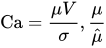
where and are the viscosity of the continuous and the dispersed phases respectively. [7]

Multiphase microflows are characterized by the ratio of viscous to surface forces, the capillary number (Ca), and by the ratio of fluid viscosities:[7]
and

See also[edit]
References[edit]
- ^ Dynamics of viscous entrapped saturated zones in partially wetted porous media. Transport in Porous Media (2018), 125(2), 193-210
- ^ Shi, Z.; et al. (2018). "Dynamic contact angle hysteresis in liquid bridges". Colloids and Surfaces A: Physicochemical and Engineering Aspects. 555: 365–371. arXiv:1712.04703. doi:10.1016/j.colsurfa.2018.07.004. S2CID 51916594.
- ^ "Archived copy" (PDF). Archived from the original (PDF) on 24 December 2013. Retrieved 2 July 2013.
{{cite web}}: CS1 maint: archived copy as title (link) - ^ a b "What is Capillary Number? - Definition from Petropedia". Petropedia. Archived from the original on 27 March 2019. Retrieved 5 October 2018.
- ^ Ding, M., Kantzas, A.: Capillary number correlations for gas-liquid systems, SEP 2004-062 (2004)
- ^ Lambert, Pierre (2013). Surface Tension in Microsystems: Engineering Below the Capillary Length. Springer Science & Business Media. pp. 8–11. ISBN 9783642375521.
- ^ a b c Günther, Axel; Jensen, Klavs F. (2006). "Multiphase microfluidics: from flow characteristics to chemical and materials synthesis". Lab Chip. 6 (12): 1487–1503. doi:10.1039/b609851g. ISSN 1473-0197. PMID 17203152.
 | This fluid dynamics–related article is a stub. You can help Wikipedia by expanding it. |