


Cornouaille
 | This article needs additional citations for verification. (April 2023) |


Cornouaille ([kɔʁ.nwaj]; Breton: Kernev, Kerne) is a historical region on the west coast of Brittany in West France. The name is cognate with Cornwall in neighbouring Great Britain. This can be explained by the settlement of Cornouaille by migrant princes from Cornwall who created an independent principality founded by Rivelen Mor Marthou,[1][2] and the founding of the Bishopric of Cornouaille by ancient saints from Cornwall. Celtic Britons and the settlers in Brittany spoke a common language, which later evolved into Breton, Welsh and Cornish.
Etymology[edit]
The toponym Cornouaille was established in the early Middle Ages in the southwest of the Breton peninsula.[3] Prior to this, following the withdrawal of Rome from Britain, other British migrants from what is now modern Devon had established the region of Domnonea (in Breton) or Domnonée (in French) in the north of the peninsula, taken from the Latin Dumnonia.
The region was first mentioned in surviving records by a Cornouaille-related name between 852 and 857, when Anaweten, bishop of Saint-Corentin at Quimper Cathedral, took over Cornugallensis under the order of Nominoe, Duke of Brittany and Tad ar Vro. The names Cornwall and Cornouaille, like the surname Cornwallis, are from Corn-wealas. The first element is from the name of a Brythonic tribe Latinized as Cornovii, meaning 'peninsula people', from the Celtic kernou, 'horn, headland'. It is a cognate of the Irish word ceann, 'head', and the English word horn, both being from PIE *ker- 'uppermost part of the body, head, horn, top, summit'.[4][5] The second element is the Anglo-Saxon suffix -wealas, from walh, a word used by the Germanic speakers for 'a non-Germanic foreigner', especially Celtic speakers but also sometimes used for Romance-language speakers. Walh is an element found in the words and names walnut, Walloon, Wales, Wallasey, Waleswood, Wallachia, Wallace, Walcheren, and Walsh.[6]
A Corn-/Kern- name was used in reference to the resettling of the new wave Celts from Great Britain in formerly Dumnonian-seized lands. This is related to the difference between Grande-Bretagne (Great Britain) and Bretagne (Brittany) in French, with Brittany having originally been thought of a British colony (and the second such in the same area). In Breton, Cornouaille is known as Kernev or Bro-Gernev, and in Latin as Cornugallia or Cornubia. In Cornish, Kernev is written Kernow, but the pronunciation is the same.
History[edit]
Strong contacts between Armorica (a larger region than the Duchy of Brittany or modern Brittany) and southern Britain had already been noted by Julius Caesar. Native British troops were hired to support the usurpation of Magnus Maximus, who is said to have settled them in Armorica. Settlements expanded when invading Anglo-Saxons expanded westward within Britain.[7] Strong links existed in the 6th century between the British and Armorican territories. Legends about King Arthur and the Matter of Britain make frequent reference to the maritime connections between the peoples of Wales, southern Ireland, Cornwall in southwestern Britain and the early kingdoms of Brittany, cf. the tale of Tristan and Iseult.
The existence of an ancient district in Anjou called "la Cornuaille" has led to the hypothesis that Cornouaille may have been a geographical or military label for all of southern Brittany as far as the northern shore of Domnonée in the 6th or 7th century.[speculation?]
At the origin of this feudal county, the reigning dynasty acceded to a dukedom of the region,[when?] which then passed to the Ancient Lord-Bishop of Quimper.
Diocese[edit]
The name Cornouaille signifies the diocese of Quimper which persisted until the French Revolution. The diocese covered more than half of the south of Finistère, and extended over part of Morbihan and the Côtes-d'Armor. There were two archdeacons, one for Cornouaille and one for Poher. There were also a cantor, a treasurer, a theologian and twelve canons. This episcopal division was the poorest in Brittany.
After the French Revolution, the new constitution created a diocese of Finistère, erasing that of the diocese of Kerne (Cournouaille); most of the old diocese was absorbed into the new.
Traditional districts[edit]
-
 Flag of Pays de l'Aven
 -
 Flag of Bidar
 -
 Flag of Pays Bigouden
 -
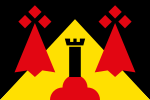 Flag of Pays de Calanhel
 -
 Flag of Cap Sizun
 -
 Flag of Chtou
 -
 Flag of Dardoup
 -
 Flag of Pays Fañch
 -
 Flag of Fisel
 -
 Flag of Pays Glazik
 -
 Flag of Kernevodez
 -
 Flag of Penn Sardin
 -
 Flag of Plougastel
 -
 Flag of Poher
 -
 Flag of Presqu'île de Crozon
 -
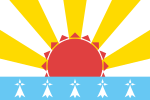 Flag of Pays Rouzig


List of rulers[edit]
- Gradlon (semi-legendary)
- Rivelen Mor Marthou (c. 430)
- Congar (c. 450)
- Daniel Drem Rud (c. 500)
- Melar (c. 500s)
- Budic II (c. 545)
- Macliau (544–577)
- Judicael (circa 857–874) – the county of Cornouaille is not yet precisely defined. Its leaders represent the interests of "western Brittany" and join the King of Brittany in fights against the Vikings.
- Riwallon (circa 874)
- Gourmaëlon (early 10th century)
- Alan II (early to mid-10th century)
- Alain Canhiart
- Hoel of Cornouaille, who ruled Brittany as Duke jure uxoris.
- Alan IV
Notes[edit]


- ^ "European Kingdoms Celts of Armorica". 2014. The History Files. Retrieved 13 June 2014.
- ^ Pognat, Jean Michel. "Brittany: Many Kingdoms or One?". 2002. Early British Kingdoms.Com. Retrieved 13 June 2014.
- ^ Isaac Taylor, Names and Their Histories: A Handbook of Historical Geography and Topographical Nomenclature, BiblioBazaar, LLC, 2008, p.70
- ^ "Cornwall". Online Etymology Dictionary. Retrieved 21 May 2013.
- ^ "Horn". Online Etymology Dictionary. Retrieved 21 May 2013.
- ^ "Welsh". Online Etymology Dictionary. Retrieved 21 May 2013.
- ^ Léon Fleuriot, Les origines de la Bretagne, Éd. Payot, 1980
| Authority control databases: National |
|---|
