In mathematics, an eigenvalue perturbation problem is that of finding the eigenvectors and eigenvalues of a system
A
x
=
λ
x
{\displaystyle Ax=\lambda x}
perturbed from one with known eigenvectors and eigenvalues
A
0
x
0
=
λ
0
x
0
{\displaystyle A_{0}x_{0}=\lambda _{0}x_{0}}
x
0
i
,
λ
0
i
,
i
=
1
,
…
n
{\displaystyle x_{0i},\lambda _{0i},i=1,\dots n}
Lord Rayleigh , in his investigation of harmonic vibrations of a string perturbed by small inhomogeneities.[1]
The derivations in this article are essentially self-contained and can be found in many texts on numerical linear algebra or numerical functional analysis.
This article is focused on the case of the perturbation of a simple eigenvalue (see in
multiplicity of eigenvalues ).
Why generalized eigenvalues? [ edit ] In the entry applications of eigenvalues and eigenvectors we find numerous scientific fields in which eigenvalues are used to obtain solutions. Generalized eigenvalue problems are less widespread but are a key in the study of vibrations .
They are useful when we use the Galerkin method or Rayleigh-Ritz method to find approximate
solutions of partial differential equations modeling vibrations of structures such as strings and plates; the paper of Courant (1943)
[2] Finite element method is a widespread particular case.
In classical mechanics, we may find generalized eigenvalues when we look for vibrations of multiple degrees of freedom systems close to equilibrium; the kinetic energy provides the mass matrix
M
{\displaystyle M}
K
{\displaystyle K}
[3]
With both methods, we obtain a system of differential equations or Matrix differential equation
M
x
¨
+
B
x
˙
+
K
x
=
0
{\displaystyle M{\ddot {x}}+B{\dot {x}}+Kx=0}
M
{\displaystyle M}
B
{\displaystyle B}
K
{\displaystyle K}
B
=
0
{\displaystyle B=0}
x
=
e
i
ω
t
u
{\displaystyle x=e^{i\omega t}u}
u
{\displaystyle u}
ω
2
{\displaystyle \omega ^{2}}
−
ω
2
M
u
+
K
u
=
0
{\displaystyle -\omega ^{2}Mu+Ku=0}
Setting of perturbation for a generalized eigenvalue problem [ edit ] Suppose we have solutions to the generalized eigenvalue problem ,
K
0
x
0
i
=
λ
0
i
M
0
x
0
i
.
(
0
)
{\displaystyle \mathbf {K} _{0}\mathbf {x} _{0i}=\lambda _{0i}\mathbf {M} _{0}\mathbf {x} _{0i}.\qquad (0)}
where
K
0
{\displaystyle \mathbf {K} _{0}}
M
0
{\displaystyle \mathbf {M} _{0}}
λ 0i x 0i i = 1, ..., N the eigenvalues are distinct .
Now suppose we want to change the matrices by a small amount. That is, we want to find the eigenvalues and eigenvectors of
K
x
i
=
λ
i
M
x
i
(
1
)
{\displaystyle \mathbf {K} \mathbf {x} _{i}=\lambda _{i}\mathbf {M} \mathbf {x} _{i}\qquad (1)}
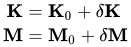
where
K
=
K
0
+
δ
K
M
=
M
0
+
δ
M
{\displaystyle {\begin{aligned}\mathbf {K} &=\mathbf {K} _{0}+\delta \mathbf {K} \\\mathbf {M} &=\mathbf {M} _{0}+\delta \mathbf {M} \end{aligned}}}
with the perturbations
δ
K
{\displaystyle \delta \mathbf {K} }
δ
M
{\displaystyle \delta \mathbf {M} }
K
{\displaystyle \mathbf {K} }
M
{\displaystyle \mathbf {M} }
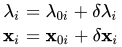
λ
i
=
λ
0
i
+
δ
λ
i
x
i
=
x
0
i
+
δ
x
i
{\displaystyle {\begin{aligned}\lambda _{i}&=\lambda _{0i}+\delta \lambda _{i}\\\mathbf {x} _{i}&=\mathbf {x} _{0i}+\delta \mathbf {x} _{i}\end{aligned}}}
We assume that the matrices are symmetric and positive definite , and assume we have scaled the eigenvectors such that
x
0
j
⊤
M
0
x
0
i
=
δ
i
j
,
{\displaystyle \mathbf {x} _{0j}^{\top }\mathbf {M} _{0}\mathbf {x} _{0i}=\delta _{ij},\quad }
x
i
T
M
x
j
=
δ
i
j
(
2
)
{\displaystyle \mathbf {x} _{i}^{T}\mathbf {M} \mathbf {x} _{j}=\delta _{ij}\qquad (2)}
where δij Kronecker delta .
Now we want to solve the equation
K
x
i
−
λ
i
M
x
i
=
0.
{\displaystyle \mathbf {K} \mathbf {x} _{i}-\lambda _{i}\mathbf {M} \mathbf {x} _{i}=0.}
In this article we restrict the study to first order perturbation.
First order expansion of the equation [ edit ] Substituting in (1), we get
(
K
0
+
δ
K
)
(
x
0
i
+
δ
x
i
)
=
(
λ
0
i
+
δ
λ
i
)
(
M
0
+
δ
M
)
(
x
0
i
+
δ
x
i
)
,
{\displaystyle (\mathbf {K} _{0}+\delta \mathbf {K} )(\mathbf {x} _{0i}+\delta \mathbf {x} _{i})=\left(\lambda _{0i}+\delta \lambda _{i}\right)\left(\mathbf {M} _{0}+\delta \mathbf {M} \right)\left(\mathbf {x} _{0i}+\delta \mathbf {x} _{i}\right),}
which expands to
K
0
x
0
i
+
δ
K
x
0
i
+
K
0
δ
x
i
+
δ
K
δ
x
i
=
λ
0
i
M
0
x
0
i
+
λ
0
i
M
0
δ
x
i
+
λ
0
i
δ
M
x
0
i
+
δ
λ
i
M
0
x
0
i
+
λ
0
i
δ
M
δ
x
i
+
δ
λ
i
δ
M
x
0
i
+
δ
λ
i
M
0
δ
x
i
+
δ
λ
i
δ
M
δ
x
i
.
{\displaystyle {\begin{aligned}\mathbf {K} _{0}\mathbf {x} _{0i}&+\delta \mathbf {K} \mathbf {x} _{0i}+\mathbf {K} _{0}\delta \mathbf {x} _{i}+\delta \mathbf {K} \delta \mathbf {x} _{i}=\\[6pt]&\lambda _{0i}\mathbf {M} _{0}\mathbf {x} _{0i}+\lambda _{0i}\mathbf {M} _{0}\delta \mathbf {x} _{i}+\lambda _{0i}\delta \mathbf {M} \mathbf {x} _{0i}+\delta \lambda _{i}\mathbf {M} _{0}\mathbf {x} _{0i}+\\&\quad \lambda _{0i}\delta \mathbf {M} \delta \mathbf {x} _{i}+\delta \lambda _{i}\delta \mathbf {M} \mathbf {x} _{0i}+\delta \lambda _{i}\mathbf {M} _{0}\delta \mathbf {x} _{i}+\delta \lambda _{i}\delta \mathbf {M} \delta \mathbf {x} _{i}.\end{aligned}}}
Canceling from (0) (
K
0
x
0
i
=
λ
0
i
M
0
x
0
i
{\displaystyle \mathbf {K} _{0}\mathbf {x} _{0i}=\lambda _{0i}\mathbf {M} _{0}\mathbf {x} _{0i}}
δ
K
x
0
i
+
K
0
δ
x
i
+
δ
K
δ
x
i
=
λ
0
i
M
0
δ
x
i
+
λ
0
i
δ
M
x
0
i
+
δ
λ
i
M
0
x
0
i
+
λ
0
i
δ
M
δ
x
i
+
δ
λ
i
δ
M
x
0
i
+
δ
λ
i
M
0
δ
x
i
+
δ
λ
i
δ
M
δ
x
i
.
{\displaystyle {\begin{aligned}\delta \mathbf {K} \mathbf {x} _{0i}+&\mathbf {K} _{0}\delta \mathbf {x} _{i}+\delta \mathbf {K} \delta \mathbf {x} _{i}=\lambda _{0i}\mathbf {M} _{0}\delta \mathbf {x} _{i}+\lambda _{0i}\delta \mathbf {M} \mathbf {x} _{0i}+\delta \lambda _{i}\mathbf {M} _{0}\mathbf {x} _{0i}+\\&\lambda _{0i}\delta \mathbf {M} \delta \mathbf {x} _{i}+\delta \lambda _{i}\delta \mathbf {M} \mathbf {x} _{0i}+\delta \lambda _{i}\mathbf {M} _{0}\delta \mathbf {x} _{i}+\delta \lambda _{i}\delta \mathbf {M} \delta \mathbf {x} _{i}.\end{aligned}}}
Removing the higher-order terms, this simplifies to
K
0
δ
x
i
+
δ
K
x
0
i
=
λ
0
i
M
0
δ
x
i
+
λ
0
i
δ
M
x
0
i
+
δ
λ
i
M
0
x
0
i
.
(
3
)
{\displaystyle \mathbf {K} _{0}\delta \mathbf {x} _{i}+\delta \mathbf {K} \mathbf {x} _{0i}=\lambda _{0i}\mathbf {M} _{0}\delta \mathbf {x} _{i}+\lambda _{0i}\delta \mathbf {M} \mathrm {x} _{0i}+\delta \lambda _{i}\mathbf {M} _{0}\mathbf {x} _{0i}.\qquad (3)}
In other words,
δ
λ
i
{\displaystyle \delta \lambda _{i}}
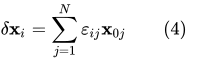
As the matrix is symmetric, the unperturbed eigenvectors are
M
{\displaystyle M}
δ
x
i
=
∑
j
=
1
N
ε
i
j
x
0
j
(
4
)
{\displaystyle \delta \mathbf {x} _{i}=\sum _{j=1}^{N}\varepsilon _{ij}\mathbf {x} _{0j}\qquad (4)\quad }
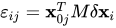
ε
i
j
=
x
0
j
T
M
δ
x
i
{\displaystyle \varepsilon _{ij}=\mathbf {x} _{0j}^{T}M\delta \mathbf {x} _{i}}
where the εij
In the same way, substituting in (2), and removing higher order terms, we get
δ
x
j
M
0
x
0
i
+
x
0
j
M
0
δ
x
i
+
x
0
j
δ
M
0
x
0
i
=
0
(
5
)
{\displaystyle \delta \mathbf {x} _{j}\mathbf {M} _{0}\mathbf {x} _{0i}+\mathbf {x} _{0j}\mathbf {M} _{0}\delta \mathbf {x} _{i}+\mathbf {x} _{0j}\delta \mathbf {M} _{0}\mathbf {x} _{0i}=0\quad {(5)}}
The derivation can go on with two forks.
First fork: get first eigenvalue perturbation [ edit ] Eigenvalue perturbation [ edit ] We start with (3)
K
0
δ
x
i
+
δ
K
x
0
i
=
λ
0
i
M
0
δ
x
i
+
λ
0
i
δ
M
x
0
i
+
δ
λ
i
M
0
x
0
i
;
{\displaystyle \quad \mathbf {K} _{0}\delta \mathbf {x} _{i}+\delta \mathbf {K} \mathbf {x} _{0i}=\lambda _{0i}\mathbf {M} _{0}\delta \mathbf {x} _{i}+\lambda _{0i}\delta \mathbf {M} \mathrm {x} _{0i}+\delta \lambda _{i}\mathbf {M} _{0}\mathbf {x} _{0i};}
we left multiply with
x
0
i
T
{\displaystyle \mathbf {x} _{0i}^{T}}
x
0
i
T
δ
K
x
0
i
=
λ
0
i
x
0
i
T
δ
M
x
0
i
+
δ
λ
i
{\displaystyle \mathbf {x} _{0i}^{T}\delta \mathbf {K} \mathbf {x} _{0i}=\lambda _{0i}\mathbf {x} _{0i}^{T}\delta \mathbf {M} \mathrm {x} _{0i}+\delta \lambda _{i}}
or
δ
λ
i
=
x
0
i
T
δ
K
x
0
i
−
λ
0
i
x
0
i
T
δ
M
x
0
i
{\displaystyle \delta \lambda _{i}=\mathbf {x} _{0i}^{T}\delta \mathbf {K} \mathbf {x} _{0i}-\lambda _{0i}\mathbf {x} _{0i}^{T}\delta \mathbf {M} \mathrm {x} _{0i}}
We notice that it is the first order perturbation of the generalized Rayleigh quotient with fixed
x
0
i
{\displaystyle x_{0i}}
R
(
K
,
M
;
x
0
i
)
=
x
0
i
T
K
x
0
i
/
x
0
i
T
M
x
0
i
,
with
x
0
i
T
M
x
0
i
=
1
{\displaystyle R(K,M;x_{0i})=x_{0i}^{T}Kx_{0i}/x_{0i}^{T}Mx_{0i},{\text{ with }}x_{0i}^{T}Mx_{0i}=1}
Moreover, for
M
=
I
{\displaystyle M=I}
δ
λ
i
=
x
0
i
T
δ
K
x
0
i
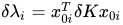
{\displaystyle \delta \lambda _{i}=x_{0i}^{T}\delta Kx_{0i}}
Bauer-Fike theorem which provides a bound for eigenvalue perturbation.
Eigenvector perturbation [ edit ] We left multiply (3) with
x
0
j
T
{\displaystyle x_{0j}^{T}}
j
≠
i
{\displaystyle j\neq i}
x
0
j
T
K
0
δ
x
i
+
x
0
j
T
δ
K
x
0
i
=
λ
0
i
x
0
j
T
M
0
δ
x
i
+
λ
0
i
x
0
j
T
δ
M
x
0
i
+
δ
λ
i
x
0
j
T
M
0
x
0
i
.
{\displaystyle \mathbf {x} _{0j}^{T}\mathbf {K} _{0}\delta \mathbf {x} _{i}+\mathbf {x} _{0j}^{T}\delta \mathbf {K} \mathbf {x} _{0i}=\lambda _{0i}\mathbf {x} _{0j}^{T}\mathbf {M} _{0}\delta \mathbf {x} _{i}+\lambda _{0i}\mathbf {x} _{0j}^{T}\delta \mathbf {M} \mathrm {x} _{0i}+\delta \lambda _{i}\mathbf {x} _{0j}^{T}\mathbf {M} _{0}\mathbf {x} _{0i}.}
We use
x
0
j
T
K
=
λ
0
j
x
0
j
T
M
and
x
0
j
T
M
0
x
0
i
=
0
,
{\displaystyle \mathbf {x} _{0j}^{T}K=\lambda _{0j}\mathbf {x} _{0j}^{T}M{\text{ and }}\mathbf {x} _{0j}^{T}\mathbf {M} _{0}\mathbf {x} _{0i}=0,}
j
≠
i
{\displaystyle j\neq i}
λ
0
j
x
0
j
T
M
0
δ
x
i
+
x
0
j
T
δ
K
x
0
i
=
λ
0
i
x
0
j
T
M
0
δ
x
i
+
λ
0
i
x
0
j
T
δ
M
x
0
i
.
{\displaystyle \lambda _{0j}\mathbf {x} _{0j}^{T}\mathbf {M} _{0}\delta \mathbf {x} _{i}+\mathbf {x} _{0j}^{T}\delta \mathbf {K} \mathbf {x} _{0i}=\lambda _{0i}\mathbf {x} _{0j}^{T}\mathbf {M} _{0}\delta \mathbf {x} _{i}+\lambda _{0i}\mathbf {x} _{0j}^{T}\delta \mathbf {M} \mathrm {x} _{0i}.}
or
(
λ
0
j
−
λ
0
i
)
x
0
j
T
M
0
δ
x
i
+
x
0
j
T
δ
K
x
0
i
=
λ
0
i
x
0
j
T
δ
M
x
0
i
.
{\displaystyle (\lambda _{0j}-\lambda _{0i})\mathbf {x} _{0j}^{T}\mathbf {M} _{0}\delta \mathbf {x} _{i}+\mathbf {x} _{0j}^{T}\delta \mathbf {K} \mathbf {x} _{0i}=\lambda _{0i}\mathbf {x} _{0j}^{T}\delta \mathbf {M} \mathrm {x} _{0i}.}
As the eigenvalues are assumed to be simple, for
j
≠
i
{\displaystyle j\neq i}
ϵ
i
j
=
x
0
j
T
M
0
δ
x
i
=
−
x
0
j
T
δ
K
x
0
i
+
λ
0
i
x
0
j
T
δ
M
x
0
i
(
λ
0
j
−
λ
0
i
)
,
i
=
1
,
…
N
;
j
=
1
,
…
N
;
j
≠
i
.
{\displaystyle \epsilon _{ij}=\mathbf {x} _{0j}^{T}\mathbf {M} _{0}\delta \mathbf {x} _{i}={\frac {-\mathbf {x} _{0j}^{T}\delta \mathbf {K} \mathbf {x} _{0i}+\lambda _{0i}\mathbf {x} _{0j}^{T}\delta \mathbf {M} \mathrm {x} _{0i}}{(\lambda _{0j}-\lambda _{0i})}},i=1,\dots N;j=1,\dots N;j\neq i.}
Moreover (5) (the first order variation of (2) ) yields
2
ϵ
i
i
=
2
x
0
i
T
M
0
δ
x
i
=
−
x
0
i
T
δ
M
x
0
i
.
{\displaystyle 2\epsilon _{ii}=2\mathbf {x} _{0i}^{T}\mathbf {M} _{0}\delta x_{i}=-\mathbf {x} _{0i}^{T}\delta M\mathbf {x} _{0i}.}
δ
x
i
{\displaystyle \delta x_{i}}
Second fork: Straightforward manipulations [ edit ] Substituting (4) into (3) and rearranging gives
K
0
∑
j
=
1
N
ε
i
j
x
0
j
+
δ
K
x
0
i
=
λ
0
i
M
0
∑
j
=
1
N
ε
i
j
x
0
j
+
λ
0
i
δ
M
x
0
i
+
δ
λ
i
M
0
x
0
i
(
5
)
∑
j
=
1
N
ε
i
j
K
0
x
0
j
+
δ
K
x
0
i
=
λ
0
i
M
0
∑
j
=
1
N
ε
i
j
x
0
j
+
λ
0
i
δ
M
x
0
i
+
δ
λ
i
M
0
x
0
i
(
applying
K
0
to the sum
)
∑
j
=
1
N
ε
i
j
λ
0
j
M
0
x
0
j
+
δ
K
x
0
i
=
λ
0
i
M
0
∑
j
=
1
N
ε
i
j
x
0
j
+
λ
0
i
δ
M
x
0
i
+
δ
λ
i
M
0
x
0
i
(
using Eq.
(
1
)
)
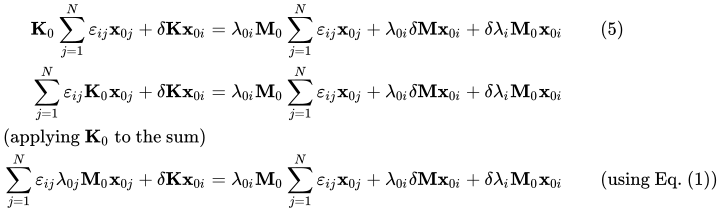
{\displaystyle {\begin{aligned}\mathbf {K} _{0}\sum _{j=1}^{N}\varepsilon _{ij}\mathbf {x} _{0j}+\delta \mathbf {K} \mathbf {x} _{0i}&=\lambda _{0i}\mathbf {M} _{0}\sum _{j=1}^{N}\varepsilon _{ij}\mathbf {x} _{0j}+\lambda _{0i}\delta \mathbf {M} \mathbf {x} _{0i}+\delta \lambda _{i}\mathbf {M} _{0}\mathbf {x} _{0i}&&(5)\\\sum _{j=1}^{N}\varepsilon _{ij}\mathbf {K} _{0}\mathbf {x} _{0j}+\delta \mathbf {K} \mathbf {x} _{0i}&=\lambda _{0i}\mathbf {M} _{0}\sum _{j=1}^{N}\varepsilon _{ij}\mathbf {x} _{0j}+\lambda _{0i}\delta \mathbf {M} \mathbf {x} _{0i}+\delta \lambda _{i}\mathbf {M} _{0}\mathbf {x} _{0i}&&\\({\text{applying }}\mathbf {K} _{0}{\text{ to the sum}})\\\sum _{j=1}^{N}\varepsilon _{ij}\lambda _{0j}\mathbf {M} _{0}\mathbf {x} _{0j}+\delta \mathbf {K} \mathbf {x} _{0i}&=\lambda _{0i}\mathbf {M} _{0}\sum _{j=1}^{N}\varepsilon _{ij}\mathbf {x} _{0j}+\lambda _{0i}\delta \mathbf {M} \mathbf {x} _{0i}+\delta \lambda _{i}\mathbf {M} _{0}\mathbf {x} _{0i}&&({\text{using Eq. }}(1))\end{aligned}}}
Because the eigenvectors are M 0 M 0
x
0
i
⊤
{\displaystyle \mathbf {x} _{0i}^{\top }}
x
0
i
⊤
ε
i
i
λ
0
i
M
0
x
0
i
+
x
0
i
⊤
δ
K
x
0
i
=
λ
0
i
x
0
i
⊤
M
0
ε
i
i
x
0
i
+
λ
0
i
x
0
i
⊤
δ
M
x
0
i
+
δ
λ
i
x
0
i
⊤
M
0
x
0
i
.
{\displaystyle \mathbf {x} _{0i}^{\top }\varepsilon _{ii}\lambda _{0i}\mathbf {M} _{0}\mathbf {x} _{0i}+\mathbf {x} _{0i}^{\top }\delta \mathbf {K} \mathbf {x} _{0i}=\lambda _{0i}\mathbf {x} _{0i}^{\top }\mathbf {M} _{0}\varepsilon _{ii}\mathbf {x} _{0i}+\lambda _{0i}\mathbf {x} _{0i}^{\top }\delta \mathbf {M} \mathbf {x} _{0i}+\delta \lambda _{i}\mathbf {x} _{0i}^{\top }\mathbf {M} _{0}\mathbf {x} _{0i}.}
By use of equation (1) again:
x
0
i
⊤
K
0
ε
i
i
x
0
i
+
x
0
i
⊤
δ
K
x
0
i
=
λ
0
i
x
0
i
⊤
M
0
ε
i
i
x
0
i
+
λ
0
i
x
0
i
⊤
δ
M
x
0
i
+
δ
λ
i
x
0
i
⊤
M
0
x
0
i
.
(
6
)
{\displaystyle \mathbf {x} _{0i}^{\top }\mathbf {K} _{0}\varepsilon _{ii}\mathbf {x} _{0i}+\mathbf {x} _{0i}^{\top }\delta \mathbf {K} \mathbf {x} _{0i}=\lambda _{0i}\mathbf {x} _{0i}^{\top }\mathbf {M} _{0}\varepsilon _{ii}\mathbf {x} _{0i}+\lambda _{0i}\mathbf {x} _{0i}^{\top }\delta \mathbf {M} \mathbf {x} _{0i}+\delta \lambda _{i}\mathbf {x} _{0i}^{\top }\mathbf {M} _{0}\mathbf {x} _{0i}.\qquad (6)}
The two terms containing εii
x
0
i
⊤
{\displaystyle \mathbf {x} _{0i}^{\top }}
x
0
i
⊤
K
0
x
0
i
=
λ
0
i
x
0
i
⊤
M
0
x
0
i
.
{\displaystyle \mathbf {x} _{0i}^{\top }\mathbf {K} _{0}\mathbf {x} _{0i}=\lambda _{0i}\mathbf {x} _{0i}^{\top }\mathbf {M} _{0}\mathbf {x} _{0i}.}
Canceling those terms in (6) leaves
x
0
i
⊤
δ
K
x
0
i
=
λ
0
i
x
0
i
⊤
δ
M
x
0
i
+
δ
λ
i
x
0
i
⊤
M
0
x
0
i
.
{\displaystyle \mathbf {x} _{0i}^{\top }\delta \mathbf {K} \mathbf {x} _{0i}=\lambda _{0i}\mathbf {x} _{0i}^{\top }\delta \mathbf {M} \mathbf {x} _{0i}+\delta \lambda _{i}\mathbf {x} _{0i}^{\top }\mathbf {M} _{0}\mathbf {x} _{0i}.}
Rearranging gives
δ
λ
i
=
x
0
i
⊤
(
δ
K
−
λ
0
i
δ
M
)
x
0
i
x
0
i
⊤
M
0
x
0
i
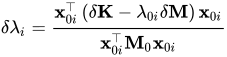
{\displaystyle \delta \lambda _{i}={\frac {\mathbf {x} _{0i}^{\top }\left(\delta \mathbf {K} -\lambda _{0i}\delta \mathbf {M} \right)\mathbf {x} _{0i}}{\mathbf {x} _{0i}^{\top }\mathbf {M} _{0}\mathbf {x} _{0i}}}}
But by (2), this denominator is equal to 1. Thus
δ
λ
i
=
x
0
i
⊤
(
δ
K
−
λ
0
i
δ
M
)
x
0
i
.
{\displaystyle \delta \lambda _{i}=\mathbf {x} _{0i}^{\top }\left(\delta \mathbf {K} -\lambda _{0i}\delta \mathbf {M} \right)\mathbf {x} _{0i}.}
Then, as
λ
i
≠
λ
k
{\displaystyle \lambda _{i}\neq \lambda _{k}}
i
≠
k
{\displaystyle i\neq k}
x
0
k
⊤
{\displaystyle \mathbf {x} _{0k}^{\top }}
ε
i
k
=
x
0
k
⊤
(
δ
K
−
λ
0
i
δ
M
)
x
0
i
λ
0
i
−
λ
0
k
,
i
≠
k
.
{\displaystyle \varepsilon _{ik}={\frac {\mathbf {x} _{0k}^{\top }\left(\delta \mathbf {K} -\lambda _{0i}\delta \mathbf {M} \right)\mathbf {x} _{0i}}{\lambda _{0i}-\lambda _{0k}}},\qquad i\neq k.}
Or by changing the name of the indices:
ε
i
j
=
x
0
j
⊤
(
δ
K
−
λ
0
i
δ
M
)
x
0
i
λ
0
i
−
λ
0
j
,
i
≠
j
.
{\displaystyle \varepsilon _{ij}={\frac {\mathbf {x} _{0j}^{\top }\left(\delta \mathbf {K} -\lambda _{0i}\delta \mathbf {M} \right)\mathbf {x} _{0i}}{\lambda _{0i}-\lambda _{0j}}},\qquad i\neq j.}
To find εii
x
i
⊤
M
x
i
=
1
{\displaystyle \mathbf {x} _{i}^{\top }\mathbf {M} \mathbf {x} _{i}=1}
implies:
ε
i
i
=
−
1
2
x
0
i
⊤
δ
M
x
0
i
.
{\displaystyle \varepsilon _{ii}=-{\tfrac {1}{2}}\mathbf {x} _{0i}^{\top }\delta \mathbf {M} \mathbf {x} _{0i}.}
Summary of the first order perturbation result [ edit ] In the case where all the matrices are Hermitian positive definite and all the eigenvalues are distinct
λ
i
=
λ
0
i
+
x
0
i
⊤
(
δ
K
−
λ
0
i
δ
M
)
x
0
i
x
i
=
x
0
i
(
1
−
1
2
x
0
i
⊤
δ
M
x
0
i
)
+
∑
j
=
1
j
≠
i
N
x
0
j
⊤
(
δ
K
−
λ
0
i
δ
M
)
x
0
i
λ
0
i
−
λ
0
j
x
0
j
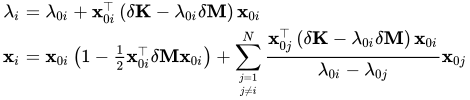
{\displaystyle {\begin{aligned}\lambda _{i}&=\lambda _{0i}+\mathbf {x} _{0i}^{\top }\left(\delta \mathbf {K} -\lambda _{0i}\delta \mathbf {M} \right)\mathbf {x} _{0i}\\\mathbf {x} _{i}&=\mathbf {x} _{0i}\left(1-{\tfrac {1}{2}}\mathbf {x} _{0i}^{\top }\delta \mathbf {M} \mathbf {x} _{0i}\right)+\sum _{j=1 \atop j\neq i}^{N}{\frac {\mathbf {x} _{0j}^{\top }\left(\delta \mathbf {K} -\lambda _{0i}\delta \mathbf {M} \right)\mathbf {x} _{0i}}{\lambda _{0i}-\lambda _{0j}}}\mathbf {x} _{0j}\end{aligned}}}
for infinitesimal
δ
K
{\displaystyle \delta \mathbf {K} }
δ
M
{\displaystyle \delta \mathbf {M} }
So far, we have not proved that these higher order terms may be neglected. This point may be derived using the implicit function theorem; in next section, we summarize the use of this theorem in order to obtain a first order expansion.
Theoretical derivation [ edit ] Perturbation of an implicit function. [ edit ] In the next paragraph, we shall use the Implicit function theorem (Statement of the theorem ); we notice that for a continuously differentiable function
f
:
R
n
+
m
→
R
m
,
f
:
(
x
,
y
)
↦
f
(
x
,
y
)
{\displaystyle f:\mathbb {R} ^{n+m}\to \mathbb {R} ^{m},\;f:(x,y)\mapsto f(x,y)}
J
f
,
b
(
x
0
,
y
0
)
{\displaystyle J_{f,b}(x_{0},y_{0})}
(
x
0
,
y
0
)
{\displaystyle (x_{0},y_{0})}
f
(
x
0
,
y
0
)
=
0
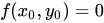
{\displaystyle f(x_{0},y_{0})=0}
f
(
x
,
y
)
=
0
{\displaystyle f(x,y)=0}
x
{\displaystyle x}
x
0
{\displaystyle x_{0}}
y
=
g
(
x
)
{\displaystyle y=g(x)}
g
{\displaystyle g}
g
{\displaystyle g}
J
f
,
y
(
x
,
g
(
x
)
)
J
g
,
x
(
x
)
+
J
f
,
x
(
x
,
g
(
x
)
)
=
0
(
6
)
{\displaystyle J_{f,y}(x,g(x))J_{g,x}(x)+J_{f,x}(x,g(x))=0\quad (6)}
As soon as the hypothesis of the theorem is satisfied, the Jacobian matrix of
g
{\displaystyle g}
f
(
x
0
+
δ
x
,
y
0
+
δ
y
)
=
0
{\displaystyle f(x_{0}+\delta x,y_{0}+\delta y)=0}
J
f
,
x
(
x
,
g
(
x
)
)
δ
x
+
J
f
,
y
(
x
,
g
(
x
)
)
δ
y
=
0
{\displaystyle J_{f,x}(x,g(x))\delta x+J_{f,y}(x,g(x))\delta y=0}
δ
y
=
J
g
,
x
(
x
)
δ
x
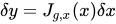
{\displaystyle \delta y=J_{g,x}(x)\delta x}
(
6
)
{\displaystyle (6)}
Eigenvalue perturbation: a theoretical basis. [ edit ] We use the previous paragraph (Perturbation of an implicit function) with somewhat different notations suited to eigenvalue perturbation; we introduce
f
~
:
R
2
n
2
×
R
n
+
1
→
R
n
+
1
{\displaystyle {\tilde {f}}:\mathbb {R} ^{2n^{2}}\times \mathbb {R} ^{n+1}\to \mathbb {R} ^{n+1}}
f
~
(
K
,
M
,
λ
,
x
)
=
(
f
(
K
,
M
,
λ
,
x
)
f
n
+
1
(
x
)
)
{\displaystyle {\tilde {f}}(K,M,\lambda ,x)={\binom {f(K,M,\lambda ,x)}{f_{n+1}(x)}}}
f
(
K
,
M
,
λ
,
x
)
=
K
x
−
λ
x
,
f
n
+
1
(
M
,
x
)
=
x
T
M
x
−
1
{\displaystyle f(K,M,\lambda ,x)=Kx-\lambda x,f_{n+1}(M,x)=x^{T}Mx-1}
Implicit function theorem , we study the invertibility of the Jacobian
J
f
~
;
λ
,
x
(
K
,
M
;
λ
0
i
,
x
0
i
)
{\displaystyle J_{{\tilde {f}};\lambda ,x}(K,M;\lambda _{0i},x_{0i})}
J
f
~
;
λ
,
x
(
K
,
M
;
λ
i
,
x
i
)
(
δ
λ
,
δ
x
)
=
(
−
M
x
i
0
)
δ
λ
+
(
K
−
λ
M
2
x
i
T
M
)
δ
x
i
{\displaystyle J_{{\tilde {f}};\lambda ,x}(K,M;\lambda _{i},x_{i})(\delta \lambda ,\delta x)={\binom {-Mx_{i}}{0}}\delta \lambda +{\binom {K-\lambda M}{2x_{i}^{T}M}}\delta x_{i}}
J
f
~
;
λ
0
i
,
x
0
i
(
K
,
M
;
λ
0
i
,
x
0
i
)
(
δ
λ
i
,
δ
x
i
)
=
{\displaystyle J_{{\tilde {f}};\lambda _{0i},x_{0i}}(K,M;\lambda _{0i},x_{0i})(\delta \lambda _{i},\delta x_{i})=}
(
y
y
n
+
1
)
{\displaystyle {\binom {y}{y_{n+1}}}}
δ
λ
i
=
−
x
0
i
T
y
,
and
(
λ
0
i
−
λ
0
j
)
x
0
j
T
M
δ
x
i
=
x
j
T
y
,
j
=
1
,
…
,
n
,
j
≠
i
;
{\displaystyle \delta \lambda _{i}=-x_{0i}^{T}y,\;{\text{ and }}(\lambda _{0i}-\lambda _{0j})x_{0j}^{T}M\delta x_{i}=x_{j}^{T}y,j=1,\dots ,n,j\neq i\;;}
or
x
0
j
T
M
δ
x
i
=
x
j
T
y
/
(
λ
0
i
−
λ
0
j
)
,
and
2
x
0
i
T
M
δ
x
i
=
y
n
+
1
{\displaystyle {\text{ or }}x_{0j}^{T}M\delta x_{i}=x_{j}^{T}y/(\lambda _{0i}-\lambda _{0j}),{\text{ and }}\;2x_{0i}^{T}M\delta x_{i}=y_{n+1}}
λ
i
{\displaystyle \lambda _{i}}
x
0
j
,
j
=
1
,
…
,
n
{\displaystyle x_{0j},j=1,\dots ,n}
The implicit function theorem provides a continuously differentiable function
(
K
,
M
)
↦
(
λ
i
(
K
,
M
)
,
x
i
(
K
,
M
)
)
{\displaystyle (K,M)\mapsto (\lambda _{i}(K,M),x_{i}(K,M))}
little o notation :
λ
i
=
λ
0
i
+
δ
λ
i
+
o
(
‖
δ
K
‖
+
‖
δ
M
‖
)
{\displaystyle \lambda _{i}=\lambda _{0i}+\delta \lambda _{i}+o(\|\delta K\|+\|\delta M\|)}
x
i
=
x
0
i
+
δ
x
i
+
o
(
‖
δ
K
‖
+
‖
δ
M
‖
)
{\displaystyle x_{i}=x_{0i}+\delta x_{i}+o(\|\delta K\|+\|\delta M\|)}
δ
λ
i
=
x
0
i
T
δ
K
x
0
i
−
λ
0
i
x
0
i
T
δ
M
x
0
i
;
{\displaystyle \delta \lambda _{i}=\mathbf {x} _{0i}^{T}\delta \mathbf {K} \mathbf {x} _{0i}-\lambda _{0i}\mathbf {x} _{0i}^{T}\delta \mathbf {M} \mathrm {x} _{0i};}
δ
x
i
=
x
0
j
T
M
0
δ
x
i
x
0
j
with
{\displaystyle \delta x_{i}=\mathbf {x} _{0j}^{T}\mathbf {M} _{0}\delta \mathbf {x} _{i}\mathbf {x} _{0j}{\text{ with}}}
x
0
j
T
M
0
δ
x
i
=
−
x
0
j
T
δ
K
x
0
i
+
λ
0
i
x
0
j
T
δ
M
x
0
i
(
λ
0
j
−
λ
0
i
)
,
i
=
1
,
…
n
;
j
=
1
,
…
n
;
j
≠
i
.
{\displaystyle \mathbf {x} _{0j}^{T}\mathbf {M} _{0}\delta \mathbf {x} _{i}={\frac {-\mathbf {x} _{0j}^{T}\delta \mathbf {K} \mathbf {x} _{0i}+\lambda _{0i}\mathbf {x} _{0j}^{T}\delta \mathbf {M} \mathrm {x} _{0i}}{(\lambda _{0j}-\lambda _{0i})}},i=1,\dots n;j=1,\dots n;j\neq i.}
Results of sensitivity analysis with respect to the entries of the matrices [ edit ] The results [ edit ] This means it is possible to efficiently do a sensitivity analysis on λi K k ℓK ℓk (2 − δ k ℓ term.)
∂
λ
i
∂
K
(
k
ℓ
)
=
∂
∂
K
(
k
ℓ
)
(
λ
0
i
+
x
0
i
⊤
(
δ
K
−
λ
0
i
δ
M
)
x
0
i
)
=
x
0
i
(
k
)
x
0
i
(
ℓ
)
(
2
−
δ
k
ℓ
)
∂
λ
i
∂
M
(
k
ℓ
)
=
∂
∂
M
(
k
ℓ
)
(
λ
0
i
+
x
0
i
⊤
(
δ
K
−
λ
0
i
δ
M
)
x
0
i
)
=
−
λ
i
x
0
i
(
k
)
x
0
i
(
ℓ
)
(
2
−
δ
k
ℓ
)
.
{\displaystyle {\begin{aligned}{\frac {\partial \lambda _{i}}{\partial \mathbf {K} _{(k\ell )}}}&={\frac {\partial }{\partial \mathbf {K} _{(k\ell )}}}\left(\lambda _{0i}+\mathbf {x} _{0i}^{\top }\left(\delta \mathbf {K} -\lambda _{0i}\delta \mathbf {M} \right)\mathbf {x} _{0i}\right)=x_{0i(k)}x_{0i(\ell )}\left(2-\delta _{k\ell }\right)\\{\frac {\partial \lambda _{i}}{\partial \mathbf {M} _{(k\ell )}}}&={\frac {\partial }{\partial \mathbf {M} _{(k\ell )}}}\left(\lambda _{0i}+\mathbf {x} _{0i}^{\top }\left(\delta \mathbf {K} -\lambda _{0i}\delta \mathbf {M} \right)\mathbf {x} _{0i}\right)=-\lambda _{i}x_{0i(k)}x_{0i(\ell )}\left(2-\delta _{k\ell }\right).\end{aligned}}}
Similarly
∂
x
i
∂
K
(
k
ℓ
)
=
∑
j
=
1
j
≠
i
N
x
0
j
(
k
)
x
0
i
(
ℓ
)
(
2
−
δ
k
ℓ
)
λ
0
i
−
λ
0
j
x
0
j
∂
x
i
∂
M
(
k
ℓ
)
=
−
x
0
i
x
0
i
(
k
)
x
0
i
(
ℓ
)
2
(
2
−
δ
k
ℓ
)
−
∑
j
=
1
j
≠
i
N
λ
0
i
x
0
j
(
k
)
x
0
i
(
ℓ
)
λ
0
i
−
λ
0
j
x
0
j
(
2
−
δ
k
ℓ
)
.
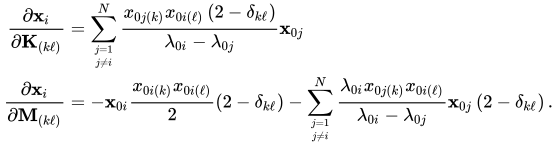
{\displaystyle {\begin{aligned}{\frac {\partial \mathbf {x} _{i}}{\partial \mathbf {K} _{(k\ell )}}}&=\sum _{j=1 \atop j\neq i}^{N}{\frac {x_{0j(k)}x_{0i(\ell )}\left(2-\delta _{k\ell }\right)}{\lambda _{0i}-\lambda _{0j}}}\mathbf {x} _{0j}\\{\frac {\partial \mathbf {x} _{i}}{\partial \mathbf {M} _{(k\ell )}}}&=-\mathbf {x} _{0i}{\frac {x_{0i(k)}x_{0i(\ell )}}{2}}(2-\delta _{k\ell })-\sum _{j=1 \atop j\neq i}^{N}{\frac {\lambda _{0i}x_{0j(k)}x_{0i(\ell )}}{\lambda _{0i}-\lambda _{0j}}}\mathbf {x} _{0j}\left(2-\delta _{k\ell }\right).\end{aligned}}}
Eigenvalue sensitivity, a small example [ edit ] A simple case is
K
=
[
2
b
b
0
]
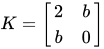
{\displaystyle K={\begin{bmatrix}2&b\\b&0\end{bmatrix}}}
[1] (see introduction in Wikipedia WIMS ) or using Sage SageMath . You get the smallest eigenvalue
λ
=
−
[
b
2
+
1
+
1
]
{\displaystyle \lambda =-\left[{\sqrt {b^{2}+1}}+1\right]}
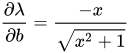
∂
λ
∂
b
=
−
x
x
2
+
1
{\displaystyle {\frac {\partial \lambda }{\partial b}}={\frac {-x}{\sqrt {x^{2}+1}}}}
x
~
0
=
[
x
,
−
(
x
2
+
1
+
1
)
)
]
T
{\displaystyle {\tilde {x}}_{0}=[x,-({\sqrt {x^{2}+1}}+1))]^{T}}
x
01
x
02
=
x
~
01
x
~
02
/
‖
x
~
0
‖
2
{\displaystyle x_{01}x_{02}={\tilde {x}}_{01}{\tilde {x}}_{02}/\|{\tilde {x}}_{0}\|^{2}}
‖
x
~
0
‖
2
=
2
x
2
+
1
(
x
2
+
1
+
1
)
{\displaystyle \|{\tilde {x}}_{0}\|^{2}=2{\sqrt {x^{2}+1}}({\sqrt {x^{2}+1}}+1)}
x
~
01
x
~
02
=
−
x
(
x
2
+
1
+
1
)
{\displaystyle {\tilde {x}}_{01}{\tilde {x}}_{02}=-x({\sqrt {x^{2}+1}}+1)}
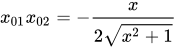
x
01
x
02
=
−
x
2
x
2
+
1
{\displaystyle x_{01}x_{02}=-{\frac {x}{2{\sqrt {x^{2}+1}}}}}
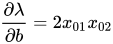
∂
λ
∂
b
=
2
x
01
x
02
{\displaystyle {\frac {\partial \lambda }{\partial b}}=2x_{01}x_{02}}
δ
λ
=
2
x
01
x
02
δ
b
{\displaystyle \delta \lambda =2x_{01}x_{02}\delta b}
Existence of eigenvectors [ edit ] Note that in the above example we assumed that both the unperturbed and the perturbed systems involved symmetric matrices , which guaranteed the existence of
N
{\displaystyle N}
N
{\displaystyle N}
K
{\displaystyle \mathbf {K} }
M
{\displaystyle \mathbf {M} }
simultaneously diagonalizable .
The case of repeated eigenvalues [ edit ] A technical report of Rellich [4] archive.org . We draw an example in which the eigenvectors have a nasty behavior.
Example 1 [ edit ] Consider the following matrix
B
(
ϵ
)
=
ϵ
[
cos
(
2
/
ϵ
)
,
sin
(
2
/
ϵ
)
sin
(
2
/
ϵ
)
,
s
cos
(
2
/
ϵ
)
]
{\displaystyle B(\epsilon )=\epsilon {\begin{bmatrix}\cos(2/\epsilon )&,\sin(2/\epsilon )\\\sin(2/\epsilon )&,s\cos(2/\epsilon )\end{bmatrix}}}
A
(
ϵ
)
=
I
−
e
−
1
/
ϵ
2
B
;
{\displaystyle A(\epsilon )=I-e^{-1/\epsilon ^{2}}B;}
A
(
0
)
=
I
.
{\displaystyle A(0)=I.}
ϵ
≠
0
{\displaystyle \epsilon \neq 0}
A
(
ϵ
)
{\displaystyle A(\epsilon )}
Φ
1
=
[
cos
(
1
/
ϵ
)
,
−
sin
(
1
/
ϵ
)
]
T
;
Φ
2
=
[
sin
(
1
/
ϵ
)
,
−
cos
(
1
/
ϵ
)
]
T
{\displaystyle \Phi ^{1}=[\cos(1/\epsilon ),-\sin(1/\epsilon )]^{T};\Phi ^{2}=[\sin(1/\epsilon ),-\cos(1/\epsilon )]^{T}}
λ
1
=
1
−
e
−
1
/
ϵ
2
)
,
λ
2
=
1
+
e
−
1
/
ϵ
2
)
{\displaystyle \lambda _{1}=1-e^{-1/\epsilon ^{2})},\lambda _{2}=1+e^{-1/\epsilon ^{2})}}
λ
1
≠
λ
2
{\displaystyle \lambda _{1}\neq \lambda _{2}}
ϵ
≠
0
{\displaystyle \epsilon \neq 0}
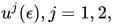
u
j
(
ϵ
)
,
j
=
1
,
2
,
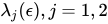
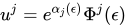
{\displaystyle u^{j}(\epsilon ),j=1,2,}
λ
j
(
ϵ
)
,
j
=
1
,
2
{\displaystyle \lambda _{j}(\epsilon ),j=1,2}
u
j
=
e
α
j
(
ϵ
)
Φ
j
(
ϵ
)
{\displaystyle u^{j}=e^{\alpha _{j}(\epsilon )}\Phi ^{j}(\epsilon )}
α
j
,
j
=
1
,
2
{\displaystyle \alpha _{j},j=1,2}
ϵ
≠
0.
{\displaystyle \epsilon \neq 0.}
α
1
(
ϵ
)
{\displaystyle \alpha _{1}(\epsilon )}
u
1
(
ϵ
)
{\displaystyle u^{1}(\epsilon )}
ϵ
→
0
,
{\displaystyle \epsilon \rightarrow 0,}
|
u
1
(
ϵ
)
|
=
|
cos
(
1
/
ϵ
)
|
{\displaystyle |u^{1}(\epsilon )|=|\cos(1/\epsilon )|}
ϵ
→
0.
{\displaystyle \epsilon \rightarrow 0.}
Note in this example that
A
j
k
(
ϵ
)
{\displaystyle A_{jk}(\epsilon )}
A
(
ϵ
)
{\displaystyle A(\epsilon )}
Example 2 [ edit ] This example is less nasty that the previous one. Suppose
[
K
0
]
{\displaystyle [K_{0}]}
u
0
=
[
1
,
1
]
T
/
2
{\displaystyle u_{0}=[1,1]^{T}/{\sqrt {2}}}
[
K
]
=
[
K
0
]
+
[
ϵ
0
0
0
]
{\displaystyle [K]=[K_{0}]+{\begin{bmatrix}\epsilon &0\\0&0\end{bmatrix}}}
Then the eigenvectors are
v
1
=
[
1
,
0
]
T
{\displaystyle v_{1}=[1,0]^{T}}
v
2
=
[
0
,
1
]
T
{\displaystyle v_{2}=[0,1]^{T}}
ϵ
{\displaystyle \epsilon }
‖
u
0
−
v
1
‖
{\displaystyle \|u_{0}-v_{1}\|}
See also [ edit ] References [ edit ] Further reading [ edit ] Ren-Cang Li (2014). "Matrix Perturbation Theory". In Hogben, Leslie (ed.). Handbook of linear algebra (Second ed.). ISBN 978-1466507289 Rellich, F., & Berkowitz, J. (1969). Perturbation theory of eigenvalue problems. CRC Press . {{cite book }}: CS1 maint: multiple names: authors list (link )Bhatia, R. (1987). Perturbation bounds for matrix eigenvalues. SIAM. Rellich, Franz (1954). Perturbation theory of eigenvalue problems . New-York: Courant Institute of Mathematical Sciences, New-York University. Journal papers [ edit ] Simon, B. (1982). Large orders and summability of eigenvalue perturbation theory: a mathematical overview. International Journal of Quantum Chemistry, 21(1), 3-25.
Crandall, M. G., & Rabinowitz, P. H. (1973). Bifurcation, perturbation of simple eigenvalues, and linearized stability. Archive for Rational Mechanics and Analysis, 52(2), 161-180.
Stewart, G. W. (1973). Error and perturbation bounds for subspaces associated with certain eigenvalue problems. SIAM review, 15(4), 727-764.
Löwdin, P. O. (1962). Studies in perturbation theory. IV. Solution of eigenvalue problem by projection operator formalism. Journal of Mathematical Physics, 3(5), 969-982. 


















![{\displaystyle {\begin{aligned}\mathbf {K} _{0}\mathbf {x} _{0i}&+\delta \mathbf {K} \mathbf {x} _{0i}+\mathbf {K} _{0}\delta \mathbf {x} _{i}+\delta \mathbf {K} \delta \mathbf {x} _{i}=\\[6pt]&\lambda _{0i}\mathbf {M} _{0}\mathbf {x} _{0i}+\lambda _{0i}\mathbf {M} _{0}\delta \mathbf {x} _{i}+\lambda _{0i}\delta \mathbf {M} \mathbf {x} _{0i}+\delta \lambda _{i}\mathbf {M} _{0}\mathbf {x} _{0i}+\\&\quad \lambda _{0i}\delta \mathbf {M} \delta \mathbf {x} _{i}+\delta \lambda _{i}\delta \mathbf {M} \mathbf {x} _{0i}+\delta \lambda _{i}\mathbf {M} _{0}\delta \mathbf {x} _{i}+\delta \lambda _{i}\delta \mathbf {M} \delta \mathbf {x} _{i}.\end{aligned}}}](https://wikimedia.org/api/rest_v1/media/math/render/svg/caa6adcd57e20edd87e8212fd962774424a7f862)




























































![{\displaystyle \lambda =-\left[{\sqrt {b^{2}+1}}+1\right]}](https://wikimedia.org/api/rest_v1/media/math/render/svg/2d87d234e45e58713416a2abfbe9b2a3fc658fe7)
![{\displaystyle {\tilde {x}}_{0}=[x,-({\sqrt {x^{2}+1}}+1))]^{T}}](https://wikimedia.org/api/rest_v1/media/math/render/svg/35374323e2fc7ee0780e62f6dd58d06b0ac4f8ce)









![{\displaystyle \Phi ^{1}=[\cos(1/\epsilon ),-\sin(1/\epsilon )]^{T};\Phi ^{2}=[\sin(1/\epsilon ),-\cos(1/\epsilon )]^{T}}](https://wikimedia.org/api/rest_v1/media/math/render/svg/6fd8155de1b24f7f4f0488a90efaee8d9076d0bb)







![{\displaystyle [K_{0}]}](https://wikimedia.org/api/rest_v1/media/math/render/svg/9b11a04d3364a2e573aee0f7056d4eca90bfebfa)
![{\displaystyle u_{0}=[1,1]^{T}/{\sqrt {2}}}](https://wikimedia.org/api/rest_v1/media/math/render/svg/47280582c04b5da1169460e1fe273077e596ce8e)
![{\displaystyle [K]=[K_{0}]+{\begin{bmatrix}\epsilon &0\\0&0\end{bmatrix}}}](https://wikimedia.org/api/rest_v1/media/math/render/svg/f9e2d2da8fc0c0030ac23b22dde6b3eb6874a5b0)
![{\displaystyle v_{1}=[1,0]^{T}}](https://wikimedia.org/api/rest_v1/media/math/render/svg/117025adafdeb766edc31f90a53bef579659ae93)
![{\displaystyle v_{2}=[0,1]^{T}}](https://wikimedia.org/api/rest_v1/media/math/render/svg/47843b88980e1785cdf77891c277f0fc1a30e5e6)

