


Hiroshima Peace Memorial
| UNESCO World Heritage Site | |
|---|---|
 Ruin of Hiroshima Prefectural Industrial Promotion Hall | |
| Location | Hiroshima, Japan |
| Criteria | Cultural: vi |
| Reference | 775 |
| Inscription | 1996 (20th Session) |
| Coordinates | 34°23′44″N 132°27′13″E / 34.39556°N 132.45361°E |
  Location of the Peace Memorial. Architect Jan Letz  Hiroshima Peace Memorial (Japan) | |
The Hiroshima Peace Memorial (広島平和記念碑, Hiroshima Heiwa Kinenhi), originally the Hiroshima Prefectural Industrial Promotion Hall, and now commonly called the Genbaku Dome, Atomic Bomb Dome or A-Bomb Dome (原爆ドーム, Genbaku Dōmu), is part of the Hiroshima Peace Memorial Park in Hiroshima, Japan and was designated a UNESCO World Heritage Site in 1996.[1]
The building was the only structure that remained standing in the area around the atomic bombing of Hiroshima at the end of World War II.[1] The ruin of the hall serves as a memorial to the over 140,000[2] people who were killed in the bombing. It is permanently kept in a state of preserved ruin as a reminder of the destructive effects of nuclear warfare.
Original building[edit]
The Product Exhibition Hall building was originally designed by Czech architect Jan Letzel. The design included a distinctive dome at the top of the building. It was completed in April 1915 and was named the Hiroshima Prefectural Commercial Exhibition (HMI).[2] It was formally opened to the public in August that year. In 1921, the name was changed to the Hiroshima Prefectural Products Exhibition Hall, and again, in 1933, to the Hiroshima Prefectural Industrial Promotion Hall (広島県産業奨励館 Hiroshima-ken Sangyo Shourei-kan). The building was located in the large business district next to the Aioi Bridge and was primarily used for art and educational exhibitions.[3]
Atomic bombing[edit]
During the Second World War, at 8:15 a.m. on 6 August 1945, the first atomic bomb to be used in war was dropped on Hiroshima. The bomb possessed a force equivalent to 15,000 tons of TNT, and effectively obliterated the city.[4] Hiroshima was chosen as a target because it was an important port on southern Honshu and was headquarters of the Japanese Second General Army with 40,000 military personnel in the city,[5] and was the only large city that was not known to have a POW camp.[6] Intended for the Aioi Bridge, the bomb missed its target by 240 m (790 ft) and exploded directly over the Shima Hospital, which was very near to the Genbaku Dome. The center of the blast occurred 150 m (490 ft) horizontally and 600 m (2,000 ft) vertically from the Dome. Everyone inside the building was killed instantly.[7][8]
Because the explosion was almost directly overhead, the building was able to retain its shape.[9] The building's vertical columns were able to resist the nearly vertical downward force of the blast, and parts of the concrete and brick outer walls remained intact. The building's durability can also be attributed to its earthquake-resistant design; it has held up to earthquakes before and since the bombing.
Preservation[edit]


Due to its stone and steel structure, the building was one of the few structures left standing near the bomb's hypocenter.[1] Soon commonly called the Genbaku ("A-Bomb") Dome, due to the exposed metal dome framework at its apex, the structure was scheduled to be demolished with the rest of the ruins, but the majority of the building was intact, delaying the demolition plans. The Dome became a subject of controversy, with some locals wanting it torn down, while others wanted to preserve it as a memorial of the bombing and a symbol of peace.[11] Ultimately, when the reconstruction of Hiroshima began, the skeletal remains of the building were preserved.[1]
From 1950 through 1964, the Hiroshima Peace Memorial Park was established around the Dome. The Hiroshima City Council adopted a resolution in 1966 on the permanent preservation of the Genbaku Dome, officially named the Hiroshima Peace Memorial (Genbaku Dome). The Dome continues to be the park's primary landmark.[1]
Weathering and deterioration of the Genbaku Dome continued in the post-war period. The Hiroshima City Council declared in 1966 that it intended to indefinitely preserve the structure, now termed "Genbaku Dome". The first popularly elected mayor of Hiroshima, Shinzo Hamai (1905–1968) sought funds for the preservation effort domestically and internationally. During one trip to Tokyo, Hamai resorted to collecting funds directly on the streets of the capital. Preservation work on the Genbaku Dome was completed in 1967.[2][12] The Genbaku Dome has undergone two minor preservation projects to stabilize the ruin, notably between October 1989 and March 1990.[2]
The Genbaku Dome stands almost exactly as it did after the bombing on 6 August 1945. Changes to the ruins, meant to ensure the stability of the structure, have been minimal.[1] A metal frame was installed inside to give the ruin more stability.
As a political venue[edit]

In international politics, Barack Obama became the first sitting U.S. President to visit the Memorial on May 27, 2016. As an act of reciprocity, Shinzo Abe visited the USS Arizona Memorial, Honolulu the same year.[13] The leaders of the 49th G7 summit visited the Memorial on May 19, 2023.[14]
Domestically, the memorial is a common venue for anti-war, anti-nuclear weapons and anti-nuclear power movement in Japan protests.[15] The municipal government of Hiroshima holds annual Hiroshima Peace Memorial Ceremony at the Memorial.
UNESCO World Heritage Site[edit]
In December 1996, the Genbaku Dome was registered on the UNESCO World Heritage List based on the Convention for the Protection of the World Cultural and Natural Heritage.[2] Its inclusion into the UNESCO list was based on its survival from a destructive force (atomic bomb), the first use of nuclear weapons on a human population, and its representation as a symbol of peace.[1]
Delegates to the World Heritage Committee from China and the United States had reservations regarding the confirmation of the memorial as a World Heritage Site. China cited the possibility that the monument could be used to downplay the fact that the victim countries of Japan's aggression suffered the greatest losses of life during the war, and the United States stated that having a memorial to a war site would omit the necessary historical context. The United States dissociated itself from the decision.[16]
Gallery[edit]

-
 Products Exhibition Hall in its original condition (c. 1921–1933)
 -
 Hall, taken from Motoyasu Bridge (c. 1921–1933)
 -
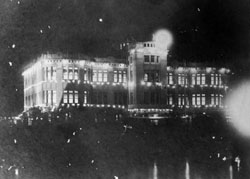 Nighttime photograph, 1921
 -
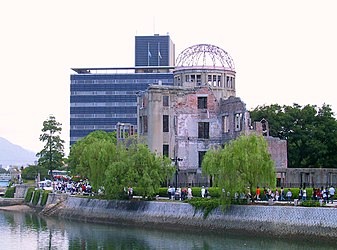 Citizens of the city pass by the Hiroshima Peace Memorial on their way to a memorial ceremony on 6 August 2004
 -
 The Dome, photo taken from the southwest side
 -
 Distant view of the Dome; shot is taken from the Aioi Bridge
 -
 Side view of the Hiroshima Peace Memorial
 -
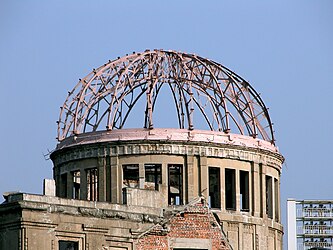 Close up of the dome
 -
 Dome with plaque
 -
 Peace Dome, then and now
 -
 Genbaku Dome in 2007
 -
 Genbaku Dome at night
 -
 Genbaku Dome at night
 -
-
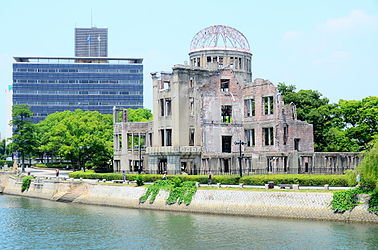 Hiroshima dome as seen from the memorial park
 -
 Genbaku Dome in October 2015 (HDR Image)
 -
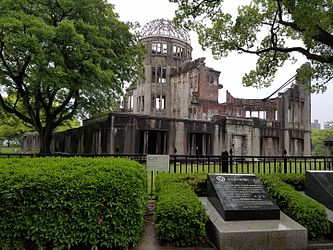 Overcast in the spring (May 2017)
 -
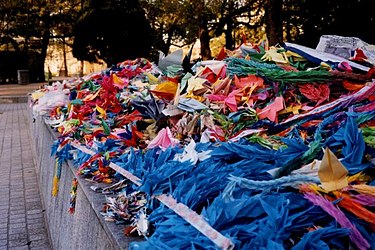
 Origami cranes at Hiroshima Peace Memorial
 -
 Genbaku Dome in moonlight (November 2018)
 -
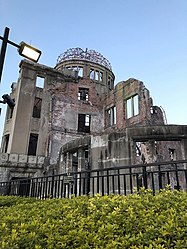 Atomic Bomb Dome pictured in 2020, 75 years after the bombing
 -
 Genbaku Dome seen from Orizuru Tower in 2019
 -
 High noon sun over the Genbaku Dome silhouette on 13 February 2017.


.jpg)


See also[edit]
- Hiroshima Witness
- Kaiser Wilhelm Memorial Church
- St. Nicholas Church, Hamburg
- Coventry Cathedral
- Tourism in Japan
- List of World Heritage Sites in Japan
- The Ribbon International
References[edit]
- ^ a b c d e f g UNESCO. "Hiroshima Peace Memorial (Genbaku Dome)".
- ^ a b c d e "原爆ドーム" [A-Bomb Dome]. Nihon Daihyakka Zensho (Nipponika) (in Japanese). Tokyo: Shogakukan. 2012. OCLC 153301537. Archived from the original on 25 August 2007. Retrieved 18 September 2012.
- ^ Logan, William (2008). Places of Pain and Shame: Dealing with 'Difficult Heritage'. Routledge.
- ^ Schofield, John; Cocroft, Wayne, eds. (2009). A Fearsome Heritage: Diverse Legacies of the Cold War. Left Coast Press. ISBN 9781598742596.
- ^ Van Rhyn, Mark E. "Hiroshima, Bombing of". PBS. Archived from the original on 14 December 2019. Retrieved 29 March 2013.
- ^ "Imprisoned at Ground Zero: American POWs in Hiroshima". HistoryNet. 11 July 2017. Retrieved 22 December 2022.
- ^ Hiroshima Prefectural Industrial Promotion Hall Memorial Plaque
- ^ Milam, Michael C. (July–August 2010). "Hiroshima and Nagasaki". Humanist. 70 (4). Buffalo, NY: American Humanist Association and the American Ethical Union: 32–35.
- ^ Ide, Kanako (Winter 2007). "A Symbol of Peace and Peace Education: The Genbaku Dome in Hiroshima". Journal of Aesthetic Education. 4. 41 (4): 12–23. doi:10.1353/jae.2007.0036. S2CID 192640225. Retrieved 10 February 2014.
- ^ "Let's look at the Special Exhibit: Hiroshima on October 5, 1945". Hiroshima Peace Memorial Museum. Retrieved 15 August 2010.
- ^ Hiroshima Peace Museum
- ^ "浜井信三" [Shinzo Hamai]. Nihon Jinmei Daijiten (in Japanese). Tokyo: Shogakukan. 2012. Archived from the original on 25 August 2007. Retrieved 23 October 2012.
- ^ "Japanese Leader's Pearl Harbor Visit, Called a First, Looks More Like a Fourth". New York Times. 26 December 2016.
- ^ "Symbolism rich as G7 leaders visit Hiroshima A-bomb museum". Japan Times. 19 May 2013. Archived from the original on 13 December 2023.
- ^ "8・6ヒロシマ大行動に立とう 安倍の7・1閣議決定と記念式典参加に怒りの大デモたたきつけよ 革共同中四国地方委員会". 前進. 2641: 4. 21 July 2014.
- ^ WH Committee: Report of the 20th Session, Merida 1996
External links[edit]

- Official website
- Entry on UNESCO (United Nations Educational, Scientific and Cultural Organization) website
- U.S. Attending 2010 Hiroshima Memorial – video report by Democracy Now!


| International | |
|---|---|
| National | |
| Geographic | |

- Buildings and structures completed in 1915
- War monuments and memorials
- Domes
- Monuments and memorials in Japan
- Monuments and memorials concerning the atomic bombings of Hiroshima and Nagasaki
- Peace monuments and memorials
- Tourist attractions in Hiroshima
- World Heritage Sites in Japan
- Buildings and structures in Hiroshima
- Buildings and structures in Japan destroyed during World War II
- Historic Sites of Japan
- World War II memorials in Japan
- Ruins in Japan
- Hiroshima Peace Memorial Park