


Giraffe
| Giraffe[1] | |
|---|---|
| A Maasai giraffe in Mikumi National Park, Tanzania | |
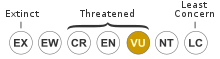
| Conservation status | |
| Scientific classification | |
| Kingdom: | Animalia |
| Phylum: | Chordata |
| Class: | Mammalia |
| Order: | Artiodactyla |
| Family: | Giraffidae |
| Genus: | Giraffa |
| Species: | G. camelopardalis |
| Binomial name | |
| Giraffa camelopardalis (Linnaeus, 1758) |
|
| Subspecies | |
|
9, see text |
|
| Range map of the giraffe divided by subspecies. | |
The giraffe (Giraffa camelopardalis) is an African even-toed ungulate mammal, the tallest living terrestrial animal and the largest ruminant. Its specific name refers to its camel-like face and patches of color on a light background, which bear a vague resemblance to a leopard's spots. The giraffe is also noted for its extremely long neck and legs and prominent horns. It stands 5–6 m (16–20 ft) tall and has an average weight of 1,200 kg (2,600 lb) for males and 830 kg (1,800 lb) for females. It is classified under the family Giraffidae, along with its closest extant relative, the okapi. There are nine subspecies, which differ in size, coloration, pattern, and range.
The giraffe's scattered range extends from Chad in the north to South Africa in the south and from Niger in the west to Somalia in the east. Giraffes usually inhabit savannas, grasslands, and open woodlands. They prefer areas with plenty of acacia trees, which are important food sources, and can browse at heights that most other herbivores cannot reach. While adults are nearly invulnerable to predation, lions, leopards, spotted hyenas and wild dogs prey on calves. Giraffes commonly gather in aggregations that usually disband every few hours. Males establish social hierarchies through "neckings", which are combat bouts where the neck is used as a weapon. Dominant males gain mating access to females, who bear the sole responsibility for raising the young.
The giraffe has intrigued various cultures, both ancient and modern, for its peculiar appearance, and has often been featured in paintings, novels and cartoons. It is classified by the IUCN as Least Concern, but has been extirpated from many parts of its former range, and some subspecies are classified as Endangered. Nevertheless, giraffes are found in numerous game reserves.
Contents |
Etymology and naming
The name giraffe has its earliest known origins in the Arabic word الزرافة al-zirāfah, perhaps from an African name. There were several Middle Eastern spellings such as jarraf, ziraph, and gerfauntz.[3] The Italian form giraffa arose in the 1590s from Arabic.[3] It appears in English from the 16th century through the French girafe.[3] The species name camelopardalis is a Latin word,[4] a romanization of the Greek καμηλοπάρδαλις,[5] from κάμηλος (kamēlos), "camel",[6] + πάρδαλις (pardalis), "leopard".[7] Kameelperd is also the name for the species in Afrikaans.
Among native Africans, the giraffe is known by many names, including:[8]:313 Ekorii (Ateso), Kanyiet (Elgon), Nduida (Gikuyu), Tiga (Kalenjin and Luo), Ndwiya (Kamba), Nudululu (Kihehe), Ntegha (Kinyaturu), Ondere (Lugbara), Etiika (Luhya), Kuri (Ma'di), Oloodo-kirragata or Olchangito-oodo (Maasai), Lenywa (Meru), Hori (Pare), Lment (Samburu), Geri (Somali) and Twiga (Swahili and many other languages).
Taxonomy and evolution
The giraffe is one of only two living species of the family Giraffidae, the other being the okapi. The family was once much more extensive, with over 10 fossil genera described. The ancestors of modern giraffids probably evolved 8 million years ago (mya) in south-central Europe during the Miocene epoch. The giraffids, together with the family Antilocapridae (whose only extant species is the pronghorn), evolved from the extinct family Palaeomerycidae.[9] The earliest known giraffid was the deer-like Climacoceras. While the progressive elongation of the neck and limbs can be traced to the early giraffids, it became more pronounced in later genera such as Samotherium and Bohlinia.[9] Bohlinia entered China and northern India in response to climate change. Genus Giraffa evolved from it, with a number of long-necked species. Around 7 mya, Giraffa entered Africa through Ethiopia.[9] Further climate changes caused the extinction of the Asian giraffes, while the African ones survived and radiated into several new species. It is believed that the main driver for the evolution of the giraffes were the changes in biome from extensive forests to savannas, which began 8 mya.[9] G. camelopardalis arose around 1 mya in East Africa during the Pleistocene.[9] Some biologists suggest that the modern giraffe descended from G. jumae[10] while others find G. gracilis a more likely candidate.[9]
The giraffe was one of the many species first described by Carl Linnaeus in 1758. He gave it the binomial name Cervus camelopardalis in the 10th edition of his Systema Naturae.[11] Morten Thrane Brünnich classified the genus Giraffa in 1772.[12] In the early 19th century, Jean-Baptiste Lamarck believed that the giraffe's long neck was an "acquired characteristic", developed as generations of ancestral giraffes strived to reach the leaves of tall trees.[13] This theory was eventually rejected, and scientists now believe that the giraffe's neck arose through Darwinian natural selection—that ancestral giraffes with long necks thereby had a competitive advantage that better enabled them to reproduce and pass on their genes.[13]
Subspecies
Different authorities have recognized different numbers of subspecies, distinguished by size, coloration, coat pattern and range.[1][2][12][15] Up to nine subspecies are recognized (with population estimates as of 2010[update]):
- G. c. camelopardalis,[16] the nominate subspecies, is known as the Nubian giraffe. Its coat pattern has large, four-sided spots of chestnut brown on an off-white background, with no spots on the inner sides of the legs or below the hocks. It is found in eastern South Sudan and south-western Ethiopia. It is estimated that fewer than 250 remain in the wild, but little is known about this subspecies, and consequently this estimate is uncertain.[17] It is rare in captivity, although a group is kept at Al Ain Zoo in the United Arab Emirates.[18] In 2003, this group numbered 14.[19]
- G. c. reticulata,[16] known as the Reticulated[16] or Somali giraffe, has a coat pattern of well-defined patches with sharp edges, separated by thin lines.[20] It is native to north-eastern Kenya, southern Ethiopia and Somalia. It is estimated that no more than 5,000 remain in the wild,[17] and based on ISIS records, more than 450 are kept in zoos.[21]
- G. c. angolensis, the Angolan or Namibian giraffe has large spots with some notches around the edges, extending down the entire lower leg. It is found in northern Namibia, south-western Zambia, Botswana and western Zimbabwe. One genetic study on Smoky giraffes suggests that the northern Namib Desert and Etosha National Park populations form a distinct subspecies.[22] It is estimated that no more than 20,000 remain in the wild;[17] based on ISIS records approximately 20 are kept in zoos.[21]
- G. c. antiquorum,[16] the Kordofan giraffe, has smaller, more irregular spots on the inner legs than other giraffes. Its distribution includes southern Chad, the Central African Republic, northern Cameroon and north-eastern DR Congo. Populations in Cameroon were formerly included in G. c. peralta, but this was incorrect.[23] No more than 3,000 are believed to remain in the wild.[17] Considerable confusion has existed over the status of this subspecies and G. c. peralta in zoos. In 2007 it was shown that all alleged G. c. peralta in European zoos were, in fact, G. c. antiquorum.[23] With this correction, based on ISIS records, approximately 65 are kept in zoos.[21]
- G. c. tippelskirchi,[16] known as the Maasai giraffe[16] or Kilimanjaro giraffe, has an irregular pattern of jagged-edged patches.[20] It can be found in central and southern Kenya and in Tanzania. It is estimated that no more than 40,000 remain in the wild,[17] and based on ISIS records, approximately 100 are kept in zoos.[21]
- G. c. rothschildi,[16] is known variously as the Rothschild giraffe,[16] Baringo giraffe or Ugandan giraffe. Its coat bears blotched or rectangular spots with poorly defined lines. Its legs are mostly white with no pattern. Its range includes Uganda and west-central Kenya, especially near Lake Baringo. It may also be found in South Sudan.[24] The Rothschild giraffe had been considered a hybrid population,[15] but genetic evidence confirms that it is a valid subspecies.[14] Fewer than 700 are believed to remain in the wild,[17] and based on ISIS records, more than 450 are kept in zoos.[21]
- G. c. giraffa, the South African giraffe, has rounded or blotched spots, some with star-like extensions, running down to the hooves. It is found in northern South Africa, southern Botswana, southern Zimbabwe and south-western Mozambique. It is estimated that no more than 12,000 remain in the wild,[17] and based on ISIS records, approximately 45 are kept in zoos.[21]
- G. c. thornicrofti,[16] called the Thornicroft giraffe[16] or Rhodesian giraffe, has leaf-shaped spots extending to the lower leg. It is restricted to the Luangwa Valley in eastern Zambia. No more than 1,500 remain in the wild,[17] and based on ISIS records, none are kept in zoos.[21]
- G. c. peralta,[16] commonly known as the West African giraffe[16] or Niger giraffe, has a light complexion, with rectangular spots. It is endemic to southern Niger. As fewer than 220 individuals remain in the wild, it is the rarest giraffe subspecies.[17] Giraffes in Cameroon were formerly believed to belong to this subspecies, but are actually G. c. antiquorum.[23] This error resulted in some confusion over its status in zoos, but in 2007 it was established that all "G. c. peralta" kept in European zoos actually are G. c. antiquorum.[23]
Although giraffes from these populations interbreed freely in captivity, suggesting that they are subspecific populations, a 2007 study published in BMC Biology has suggested that there may be at least six species of giraffe that are reproductively isolated and do not interbreed, even though no natural obstacles, such as mountain ranges or impassable rivers, block their mutual access. The study deduced from genetic drift in nuclear and mitochondrial DNA that the two giraffe populations living closest to each other—the reticulated giraffe and the Maasai giraffe—separated genetically 0.13–1.62 mya.[14] The implications of these findings for the conservation of giraffes were summarised by David Brown, lead author of the study, who told BBC News: "Lumping all giraffes into one species obscures the reality that some kinds of giraffe are on the brink. Some of these populations number only a few hundred individuals and need immediate protection."[25]
Appearance and anatomy
A fully grown giraffe is typically 5–6 m (16–20 ft) tall, with males taller than females.[12] The average weight is 1,200 kg (2,600 lb) for an adult male and 830 kg (1,800 lb) for an adult female.[26] The coat is made up of brownish blotches or patches separated by light hair. Each individual giraffe has a unique coat pattern.[20] The coat pattern serves as camouflage, allowing it to blend in with the light and shade combinations of savanna woodlands.[16] In particular, the patches may also serve as thermal windows, being sites for complex blood vessel systems and large sweat glands.[27] Giraffes have thick skin which allows them to run through thorn bush without much injury.[28]:34 Their fur may serve as a chemical defence, as it is full of parasite repellents that give the animal a characteristic scent. There are at least eleven main aromatic chemicals in the fur, although indole and 3-methylindole are responsible for most of the smell. Because the males have a stronger odour than the females, it is suspected that it also has a sexual function.[29] Along the animal's neck is a brown mane made of short, stiff hairs.[12] The tail has a tuft of long, dark hair at the end[20] and is used to swat flies away.[12]
The giraffe has fairly large eyes, which are located at both sides of the head and bulge outward, providing the animal good all-round vision from its great height.[28]:25 Giraffes are capable of seeing in color[28]:25 and their senses of hearing and olfaction are also advanced.[13] The nostrils have muscular openings, which allow the animal to open and close them. This may serve to protect against sandstorms and the ants that inhabit the trees it feeds on.[28]:27 The giraffe's tongue is about 50 cm (20 in) long and prehensile.[28]:27 It is purplish-black in color, perhaps to protect against sunburn, and is useful to gripping branches and stripping leaves as well as for grooming and cleaning the animal's nose.[28]:27 The upper lip of the giraffe is also prehensile and can grasp foliage. The lips, tongue and inside of the mouth are covered in papillae to protect against thorns.[12]
Skull and horns
Both sexes have prominent horns, or ossicones, formed from ossified cartilage, covered in skin and fused to the skull at the parietal bones.[20] Their appearance is a reliable method of identifying the sex of a giraffe: the horns of females display tufts of hair on top, whereas those of males are larger and tend to be bald on top.[20] There is also a median horn, which is more developed in males, at the front of the skull.[12] Males sometimes develop calcium deposits that form bumps on their skulls as they age, sometimes giving the appearance of additional horns.[13] The horns are well vascularized and may also have a thermoregulatory function.[27] A giraffe's skull is filled with sinuses.[12] However, as males age, their skulls become heavier and more club-like, helping them become more dominant in combat.[20] The upper jaw has a grooved palate, which lacks front teeth.[28]:26 While the teeth of many mammals are covered in smooth enamel, the giraffe's molars have a ridged, wrinkled surface.[28]:27
Legs, locomotion and posture
The front legs of a giraffe are about 10 percent longer than its hind legs. The radius and ulna of the front legs are articulated by the carpus which, while structurally equivalent to the human wrist, functions as a knee.[30] The rear of each hoof is low and the fetlock nearly touches the ground, allowing the foot to support the animal's weight.[12] Giraffes lack dewclaws. Compared to other ruminants, the giraffe's pelvis is relatively short while the ilium has broader upper ends.[12]
A giraffe has only two gaits: walking and galloping. Walking is done by moving the legs on one side of the body at the same time, then doing the same on the other side.[20] When galloping, the giraffe's front and hind legs work in pairs. The animal brings its hind legs ahead of and outside its front legs and the front legs move forward.[13] While galloping, the tail will curl up.[20] The head and neck also move back and forth to maintain balance and counter the momentum.[8]:327–29 The giraffe can reach a sprint speed of up to 60 km/h (37 mph).[31]
A giraffe rests by lying down with its legs folded underneath its body.[8]:329 To lie down, the animal kneels on its front legs and then lowers the rest of its body. To get back up, it first gets on its knees, splays its hind legs and raises its hindquarters. It then straightens its front legs. With each step, the animal swings its head up with a jerk.[28]:31 The giraffe has one of the shortest sleep requirements of any mammal, averaging around 4.6 hours of fragmented sleep per day, mostly at night.[32] It sleeps lying down, curled up and with its head resting on the rump or hind leg.[28]:33 If it wants to bend down to drink, the giraffe either spreads its front legs or bends its knees.[20]
Giraffes are assumed to be unable to swim. It has been estimated that the giraffe's limbs have a high resistance to rotation changes, which would make it difficult for the animal to make rapid swimming motions.[33] A swimming giraffe would not be able to move its neck and limbs as easily as it does on land, as the front legs would pull the thorax downwards.[33] A computer simulation conducted by Scientific American suggested that, while giraffes could float, "they would be clumsy and unstable in water".[34] The simulation suggests that the high density of the giraffe's limb bones would make it slow and cause it to experience high drag.[34] Furthermore, the weight of the forelimbs and shoulder would pull the front of the giraffe down, straining its neck.[34]
Neck
The giraffe has an extremely elongated neck, which can be over 2 m (6 ft 7 in) in length,[35] accounting for nearly half of the animal's vertical height. The long neck results from a disproportionate lengthening of the cervical vertebrae, not from the addition of more vertebrae. The cervical vertebrae comprise 45–50 percent of the giraffe's vertebral column, compared with the 30 percent typical of similar large ungulates, including the giraffe’s closest living relative, the okapi. This elongation, which occurs in large part after birth,[36] makes the vertebrae 150 percent longer than those of similar-sized animals. The giraffe's head and neck are held up by large muscles and a nuchal ligament, which are supported by long dorsal spines on the anterior thoracic vertebrae, forming a shoulder hump.[12]
The giraffe has a modified atlas-axis joint (C1 and C2), which functions like a ball and socket joint.[28]:29 This allows the animal to tilt its head vertically and reach branches that are an extra 1 m (3 ft 3 in) above its head with its long tongue. The point of articulation between the cervical and thoracic vertebrae of giraffes is shifted to lie between the first and second thoracic vertebrae (T1 and T2), rather than between the seventh cervical vertebra (C7) and T1, as in most other ruminants.[35][36] This allows C7 to contribute directly to increased neck length and has given rise to the suggestion that T1 is actually C8, and giraffes have added an extra cervical vertebra.[37] However, this proposition is not generally accepted, as T1 has other morphological features, such as an articulating rib, deemed diagnostic of thoracic vertebrae, and because exceptions to the mammalian limit of seven cervical vertebrae are generally characterized by increased neurological anomalies and maladies, symptoms that have not been observed in giraffes.[35]
There are two main hypotheses regarding the evolutionary origin and maintenance of elongation in giraffe necks.[38] The "competing browsers hypothesis" was originally suggested by Charles Darwin and only challenged recently. It suggests that competitive pressure from smaller browsers, such as kudu, steenbok and impala, encouraged the elongation of the neck, as it enabled giraffes to reach food that competitors could not. This advantage is real, as giraffes can and do feed up to 5 m (16 ft) high, while even quite large competitors, such as kudu, can only feed up to about 2 m (6 ft 7 in) high.[39] There is also research suggesting that browsing competition below 2 m is intense, and giraffes feed more efficiently (gaining more leaf biomass per bite) higher in the canopy.[40][41] However, scientists disagree about just how much time giraffes spend feeding at levels beyond the reach of other browsers.[10][38][39][42]
The other main theory, the sexual selection hypothesis, proposes that the long necks evolved as a secondary sexual characteristic, giving males an advantage in "necking" contests (see below) to establish dominance and obtain access to sexually receptive females.[10] In support of this theory, males have longer and heavier necks than females of the same age,[10][38] and necking is the only form of combat seen in male giraffes. Males in this species do not employ biting, kicking, butting or head wrestling, as do other mammals, including the okapi.[10] However, one criticism of this theory is that it fails to adequately explain why female giraffes also have long necks.[43]
Internal systems
In mammals, the left recurrent laryngeal nerve is longer than the right; in the giraffe it is over 30 cm (12 in) longer. This nerve is longer in the giraffe than in any other living animal;[44] the left nerve is over 2 m (6 ft 7 in) long.[45] Each nerve cell in this path begins in the brainstem and passes down the neck along the vagus nerve, then branches off into the recurrent laryngeal nerve which passes back up the neck to the larynx. Thus, these nerve cells have a length of nearly 5 m in the largest giraffes.[44] The structure of a giraffe's brain is similar in to that of domestic cattle.[28]:31 The shape of the skeleton gives the giraffe a small lung volume relative to its mass.[46] Its long neck gives it a high amount of dead space, in spite of its narrow windpipe. These factors give it a low respiratory rate. Nevertheless, the animal can still supply enough oxygen to its tissues.[46] An increased tidal volume also tends to compensate for the high volume of dead space.
The circulatory system of the giraffe has several adaptations for its great height. Its heart, which can weigh more than 25 lb (11 kg) and measures about 2 ft (61 cm) long, must generate approximately double the blood pressure required for a human to maintain blood flow to the brain.[13] In the upper neck, a complex pressure-regulation system called the rete mirabile prevents excess blood flow to the brain when the giraffe lowers its head to drink.[16] The jugular veins also contain several (most commonly seven) valves to prevent blood flowing back into the head from the inferior vena cava and right atrium while the head is lowered.[47] Conversely, the blood vessels in the lower legs are under great pressure (because of the weight of fluid pressing down on them). To solve this problem, the giraffe's lower legs have a thick, tight layer of skin, which prevents too much blood from pouring into them.[16] Compared with the digestive system of domestic cattle, the giraffe's has a smaller ratio of small to large intestine.[48]
Behavior and ecology
Habitat and feeding
Giraffes usually inhabit savannas, grasslands and open woodlands. They prefer Acacia, Commiphora, Combretum and open Terminalia woodlands and are not as common in denser Brachystegia woodland.[8]:322 The Angolan giraffe is known to inhabit desert environments.[49] Giraffes browse on the twigs of trees, preferring trees of genera Acacia, Commiphora and Terminalia.[15][50] They also feed on shrubs, grass and fruit.[8]:323–24 A giraffe eats 65 lb (29 kg) of leaves and twigs daily, but can survive on just 15 lb (6.8 kg).[50]
During the wet season, food is abundant and giraffes disperse widely, but during the dry season they need to congregate around evergreen trees and bushes.[15] As a ruminant, it first chews its food, then swallows it for processing and then visibly passes the half-digested cud up the neck and back into the mouth to chew again. This process is usually repeated several times for each mouthful. The giraffe requires less food than many other herbivores, because the foliage it eats has more concentrated nutrients and it has a more efficient digestive system.[15] When feeding, it is common for a giraffe to produce excess saliva.[28]:27 While the giraffe can survive without water,[50] it will drink at intervals of three days or less when it has access. Giraffes can also get water from dew-covered green leaves.[20]
Giraffes have a great effect on the trees that they feed on, delaying the growth of young trees for an extra year and forming "waistlines" around trees that are too tall.[8]:325 Browsing by giraffes gives trees a globular or hourglass shape and limit bushes to less than 1 m high.[8]:325 Feeding peaks during the first and last hours of daytime.[20] In between those hours, a giraffe may pass the time standing and ruminating. Rumination is the dominant activity during the night, when it is mostly done lying down.[20]
Social structure and breeding habits
While giraffes are usually found in groups, the composition of these groups is more fluid than in other social ungulates.[51] They have few strong social bonds, and aggregations usually disband every few hours, although calving groups can last weeks or months.[52] For research purposes, a "group" has been defined as "a collection of individuals that are less than a kilometre apart and moving in the same general direction."[53] Giraffe groups usually consist of just a few members, although 40 or more occur on occasion.[54] Adult males tend to be solitary.[52] Female giraffes associate in groups of roughly a dozen, occasionally including a few younger males. Calves and subadults are rarely alone.[53] Subadult males, in particular, are gregarious and may engage in playfights.[52] Giraffe groups with young tend to feed in more open areas, presumably to make it easier to detect predators, although it may reduce their feeding efficiency.[42] Giraffes are not territorial[12], but they have home ranges.[20] Male giraffes occasionally wander far from areas that they normally frequent.[8]:329
Reproduction is broadly polygamous: a few older males impregnate all the fertile females. Male giraffes assess female fertility by tasting the female's urine in order to detect estrus, in a multi-step process known as the Flehmen response.[52][53] Once an estrous female is detected, the male will attempt to court her.[53] Males prefer younger females, possibly because the latter are more fertile, while females prefer older, more dominant males.[52][53] During courtship, dominant males will displace subordinate ones from the presence of the females by staring and walking towards them. The female prolongs the courtship process for as long as possible, so only the most dominant male remains to mate with. During copulation, the male stands on its hind legs with its head sticking straight up and its front legs resting loosely on the female's sides.[20] Homosexual interactions have also been observed in giraffes. In one study, up to 94 percent of observed mounting incidents took place between males. The proportion of same-sex activities varied from 30–75 percent. Only one percent of same-sex mounting incidents occurred between females.[55]
Although generally quiet and non-vocal, giraffes have been heard to communicate with various sounds. During courtship, males emit loud coughs.[20] Females call their young by bellowing. Calves bleat, moo or make mewing sounds. Giraffes also snort, hiss, moan, make flute-like sounds,[20] and communicate over long distances using infrasound.[56]
Birthing and parental care
Giraffe gestation lasts 400–460 days, after which a single calf is normally born, although twins occur on rare occasions.[57] The mother gives birth standing up, and both amniotic sac and umbilical cord usually break when the newborn falls to the ground. The mother then licks and cleans the newborn and encourages it to walk.[28]:40 A newborn giraffe is about 1.8 m (6 ft) tall. Within a few hours of birth, the calf can run around and is almost indistinguishable from a one-week-old; however, for the first two weeks, it spends most of its time lying down, guarded by the mother.[52][58] Their coat pattern provides camouflage when they are hiding. The horns, which have lain flat since it was in the womb, become erect within a few days.[20]
Mothers with calves will gather in nursery herds consisting of two or more infants and/or juveniles and their mothers moving or browsing together.[58] Mothers in such a group may sometimes leave their calves with one female while they travel to other areas. This is known as a "calving pool".[58] Calves appear to form strong social bonds, facilitating social cohesion in nursery groups.[8]:330 Adult males play almost no role in raising the young. The young are vulnerable to predators.[8]:337 A mother giraffe will stand over her young and kick at any predator that approaches.[20] Giraffes only defend their own young; they form calving herds for selfish reasons.[58] A mother has a strong maternal bond with her calf, lasting until her next calving.[58] Calves suckle for 13 months and continue to associate with their mothers for another 2–5 months.[52]
Necking
Male giraffes use their necks as weapons in combat, a behavior known as "necking".[59] Necking is used to establish dominance and can occur at low or high intensity. In low intensity necking, the combatants gently rub their heads and necks and shoulders together and lean against each other. The male that can hold itself more erect wins the bout.[20]
In high intensity necking, the combatants will spread their front legs and swing their necks at each other, attempting to land blows with their horns.[20] The contestants may move their necks at the last moment, to to avoid being hit, and then get ready to counter. The power of a blow depends on the weight of the skull and the intensity of the swing.[20] A necking duel can last for up for over half an hour, although an outmatched combatant may be quickly defeated.[8]:331 The winner will mount his opponent in a show of dominance.[8]:331–32 Males that are successful in necking have greater reproductive success.[10]
Mortality and health
Healthy adult giraffes are almost invulnerable to predation due to their size;[20] a giraffe can defend itself with powerful kicks, which can kill a predator when well-placed. Calves, on the other hand, are preyed on by lions, leopards, spotted hyenas and wild dogs.[13] A quarter to a half of giraffe calves reach adulthood. Maximum lifespan is around 25 years in the wild.[16] Lions are capable of killing adult giraffes if they can make them fall over.[20] In Kruger National Park, giraffes are commonly preyed on by lions.[60] Nile crocodiles can also be a threat to giraffes when they bend down to drink.[28]:31
Some parasites feed on giraffes. They are often hosts for ticks, especially in the area around the genitals, which has thinner skin than other areas.[12] Tick species that commonly feed on giraffes are those of genera Hyalomma, Amblyomma and Rhipicephalus.[12] Giraffes have mutualistic relationships with red-billed and yellow-billed oxpeckers, which clean them of ticks and alert them to danger.[12] Giraffes host numerous species of internal parasite[12] and are susceptible to various diseases. They were victims of the (now eradicated) viral illness rinderpest.[12]
Relationship with humans
Cultural significance
Humans have interacted with giraffes for millennia. The Bushmen of southern Africa have medicine dances named after some animals; the giraffe dance is performed to cure head ailments.[61] Giraffes were subjects of art throughout the African continent, including those of the Kiffian, Egyptians and Meroë Nubians.[28]:45–47 The Kiffian were responsible for a life-size rock engraving of two giraffes, which has been called the "world's largest rock art petroglyph".[28]:45[62] The Egyptians gave the giraffe its own hieroglyph; its name being 'sr' in Old Egyptian and changing to 'mmy' in later periods.[28]:49 They also kept giraffes as pets had them and exported them to ports around the Mediterranean.[28]:48–49
The giraffe was also known to the Greeks and Romans, who believed that it was an unnatural hybrid of a camel and a leopard, and referred to as camelopardalis.[28]:50 The giraffe was among the many animals collected and displayed by the Romans. The first giraffe in Rome was imported by Julius Caesar in 46 BC and exhibited to the public.[28]:52 With the fall of the Roman Empire, housing of giraffes in Europe declined.[28]:54 During the Middle Ages, giraffes were only known to Europeans though legends from Arab travelers.[13] Arab prophets and poets revered the giraffe for its peculiar appearence.[13]
In 1414, a giraffe was taken from Malindi (in what is now Kenya) to Bengal. It was then taken to China by explorer Zheng He and placed in a Ming Dynasty zoo. The animal was a source of fascination and was considered it to be the mythical Qilin.[28]:56 The Medici giraffe was a giraffe presented to Lorenzo de' Medici in 1486. It caused a great stir on its arrival in Florence,[63] being reputedly the first living giraffe to be seen in Italy since antiquity. Another famous giraffe, called Zarafa, was brought from Egypt to Paris in the early 19th century. A sensation, Zarafa was the subject of numerous memorabilia or "giraffanalia".[28]:81
Giraffes continue to have a presence in modern culture. Salvador Dalí depicted them in some of his surrealist paintings, most often in various states of conflagration. Dali considered the giraffe to be a symbol of masculinity, and a flaming giraffe was meant to be a "masculine cosmic apocalyptic monster".[28]:123 Giraffes have also appeared in animated films, as minor characters in The Lion King and Dumbo, and in more prominent roles in The Wild and in the Madagascar films. Sophie the Giraffe has been a popular teether since 1961.[28]:127 Another famous fictional giraffe is the Toys "R" Us mascot Geoffrey the Giraffe.[28]:127
The giraffe has also been used for some scientific experiments and discoveries. Its skin has been studied by NASA scientists developing suits for astronauts.[64] The properties of the skin have been useful for these studies, since people this profession face the risk of passing out if blood rushes to their legs. Computer scientists have modeled the coat patterns of several subspecies using reaction–diffusion mechanisms.[65] The constellation of Camelopardalis depicts a giraffe.[28]:119–20
Exploitation and conservation status
Giraffes were probably common targets for hunters thoughout Africa.[8]:337 They were hunted for their tails, hides and meat.[12] The tail hairs were used for flyswatters, braclets, necklaces and thread;[8]:337 [12] the skin for shields, sandals and drums[12] and the the tendons as strings for instruments and as thread.[8]:337 The smoke of burning giraffe skins was used by the medicine men of Buganda to treat nose bleeding.[8]:337 European explorers also hunted them.[12]<[28]:129 Habitat destruction has hurt the giraffe, too: in the Sahel, trees are cut down for firewood and to make way for livestock.[16] Normally, giraffes can coexist with livestock, since they feed on the trees above the latter's heads.[16]
Overall, the giraffe is assessed as Least Concern from a conservation perspective by the International Union for Conservation of Nature (IUCN), as it is still widespread and lives in numerous reserves.[2] However, giraffes have been extirpated from Burkina Faso, Eritrea, Guinea, Malawi, Mauritania and Senegal.[2] They may also have disappeared from Angola, Mali, and Nigeria, but have been introduced to Rwanda and Swaziland.[2] Two subspecies, the West African giraffe and the Rothschild giraffe, have been classified as endangered,[2][24] as wild populations of each of them number in the hundreds.[17] In 1997, Jonathan Kingdon suggested that the Nubian giraffe was the most threatened of all giraffes;[15] as of 2010[update], it may number fewer than 250, but little recent information is available and consequently that estimate is the subject of considerable uncertainty.[17] While giraffe populations have declined in western Africa, they are stable and expanding in southern Africa thanks to private game reserves.[16] The giraffe is a protected species in most of its range. In 1999, the total wild giraffe population was estimated at over 140,000.[17] However, estimates in 2010 indicate that fewer than 80,000 remain.[17]
References
- ^ a b Grubb, P. (2005). "Giraffa camelopardalis". In Wilson, D. E.; Reeder, D-A. M. Mammal Species of the World: A Taxonomic and Geographic Reference (3rd ed.). Johns Hopkins University Press. p. 672. ISBN 9780801882210. OCLC 62265494. http://www.bucknell.edu/msw3/browse.asp?id=14200476.
- ^ a b c d e f Fennessy, J.; Brown, D. (2008). Giraffa camelopardalis. In: IUCN 2008. IUCN Red List of Threatened Species. Downloaded on 2009-03-13.
- ^ a b c "Giraffe". Online Etymology Dictionary. http://etymonline.com/?term=giraffe. Retrieved 2011-11-01.
- ^ "camelopardalis". A Latin Dictionary, Perseus Digital Library. http://www.perseus.tufts.edu/hopper/text?doc=Perseus%3Atext%3A1999.04.0059%3Aentry%3Dcamelopardalis. Retrieved 2011-11-23.
- ^ "καμηλοπάρδαλις:". A Greek-English Lexicon, Perseus Digital Library. http://www.perseus.tufts.edu/hopper/text?doc=Perseus%3Atext%3A1999.04.0057%3Aentry%3Dkamhlopa%2Frdalis. Retrieved 2011-11-23.
- ^ "κάμηλος". A Greek-English Lexicon, Perseus Digital Library. http://www.perseus.tufts.edu/hopper/text?doc=Perseus%3Atext%3A1999.04.0057%3Aentry%3Dka%2Fmhlos. Retrieved 2011-11-23.
- ^ "πάρδαλις". A Greek-English Lexicon, Perseus Digital Library. http://www.perseus.tufts.edu/hopper/text?doc=Perseus%3Atext%3A1999.04.0057%3Aentry%3Dpa%2Frdalis. Retrieved 2011-11-23.
- ^ a b c d e f g h i j k l m n o p Kingdon, J. (1988). East African Mammals: An Atlas of Evolution in Africa, Volume 3, Part B: Large Mammals. University Of Chicago Press. pp. 313–37. ISBN 0226437221.
- ^ a b c d e f Mitchell, G.; Skinner, J. D. (2003). "On the origin, evolution and phylogeny of giraffes Giraffa camelopardalis". Transactions of the Royal Society of South Africa 58 (1): 51–73. doi:10.1080/00359190309519935. http://www.bringyou.to/GiraffeEvolution.pdf.
- ^ a b c d e f Simmons, R. E.; Scheepers, L. (1996). "Winning by a Neck: Sexual Selection in the Evolution of Giraffe". The American Naturalist 148 (5): 771–86. doi:10.1086/285955. http://bill.srnr.arizona.edu/classes/182/Giraffe/WinningByANeck.pdf.
- ^ Linnaeus, Carolus (1758) (in Latin). Systema naturae per regna tria naturae :secundum classes, ordines, genera, species, cum characteribus, differentiis, synonymis, locis.. 1 (10th ed.). Holmiae (Laurentii Salvii). p. 66. http://www.biodiversitylibrary.org/page/726936#page/79/mode/1up.
- ^ a b c d e f g h i j k l m n o p q r s t u Dagg, A. I. (1971). "Giraffa camelopardalis". Mammalian Species 5: 1–8. http://www.science.smith.edu/msi/pdf/i0076-3519-005-01-0001.pdf.
- ^ a b c d e f g h i Prothero, D. R.; Schoch, R. M. (2003). Horns, Tusks, and Flippers: The Evolution of Hoofed Mammals. Johns Hopkins University Press. pp. 67–72. ISBN 0801871352.
- ^ a b c Brown, D. M.; Brenneman R. A.; Koepfli, K-P.; Pollinger, J. P.; Milá, B.; Georgiadis, N. J.; Louis Jr., E. E.; Grether, G. F.; Jacobs, D. K.; Wayne R. K. (2007). "Extensive population genetic structure in the giraffe". BMC Biology 5 (1): 57. doi:10.1186/1741-7007-5-57. PMC 2254591. PMID 18154651. http://www.pubmedcentral.nih.gov/articlerender.fcgi?tool=pmcentrez&artid=2254591.
- ^ a b c d e f Kingdon, J. (1997). The Kingdon Field Guide to African Mammals. Academic Press. pp. 339–44. ISBN 0124083552.
- ^ a b c d e f g h i j k l m n o p q r s Pellow, R. A. (2001). "Giraffe and Okapi". In MacDonald, D. The Encyclopedia of Mammals (2nd ed.). Oxford University Press. pp. 520–27. ISBN 0871968711.
- ^ a b c d e f g h i j k l m "Giraffe – The Facts: Current giraffe status?". Giraffe Conservation Foundation. http://www.giraffeconservation.org/giraffe_facts.php?pgid=40. Retrieved 2010-12-21.
- ^ "Exhibits". Al Ain Zoo. 2003-02-25. http://www.awpr.ae/en/Visit/Pages/AfricanMixedExhibit.aspx. Retrieved 2011-11-21.
- ^ "Nubian giraffe born in Al Ain zoo". UAE Interact. http://www.uaeinteract.com/docs/Nubian_giraffe_born_in_Al_Ain_zoo/6971.htm. Retrieved 2010-12-21.
- ^ a b c d e f g h i j k l m n o p q r s t u v w x Estes, R. (1992). The Behavior Guide to African Mammals: including hoofed mammals, carnivores, primates. University of California Press. pp. 202–07. ISBN 0520080858.
- ^ a b c d e f g "Giraffa". ISIS. 2010. https://app.isis.org/abstracts/Abs77545.asp. Retrieved 2010-11-04.
- ^ Brenneman, R. A.; Louis, E. E. Jr; Fennessy, J. (2009). "Genetic structure of two populations of the Namibian giraffe, Giraffa camelopardalis angolensis". African Journal of Ecology 47 (4): 720–28. doi:10.1111/j.1365-2028.2009.01078.x.
- ^ a b c d Hassanin, A.; Ropiquet, A.; Gourmand, B-L.; Chardonnet, B.; Rigoulet, J. (2007). "Mitochondrial DNA variability in Giraffa camelopardalis: consequences for taxonomy, phylogeography and conservation of giraffes in West and central Africa". Comptes Rendus Biologies 330 (3): 173–83. PMID 17434121.
- ^ a b Fennessy, J.; Brown, D. (2008). Giraffa camelopardalis ssp. rothschildi. In: IUCN 2008. IUCN Red List of Threatened Species. Downloaded on 2009-3-13.
- ^ Lever, A-M. (2007-12-21). "Not one but 'six giraffe species'". BBC News. http://news.bbc.co.uk/1/hi/sci/tech/7156146.stm. Retrieved 2009-03-04.
- ^ Skinner, J. D.; Smithers, R. H. M. (1990). The mammals of the southern African subregion. University of Pretoria. pp. 616–20. ISBN 0521844185.
- ^ a b Mitchell, G.; Skinner, J.D. (2004). "Giraffe thermoregulation: a review". Transactions of the Royal Society of South Africa: Proceedings of A Colloquium on Adaptations in Desert Fauna and Flora 59 (2): 49–57. ISSN 0035919X.
- ^ a b c d e f g h i j k l m n o p q r s t u v w x y z aa ab ac Williams, E. (2011). Giraffe. Reaktion Books. ISBN 1861897642.
- ^ Wood, W. F.; Weldon, P. J. (2002). "The scent of the reticulated giraffe (Giraffa camelopardalis reticulata)". Biochemical Systematics and Ecology 30 (10): 913–17. doi:10.1016/S0305-1978(02)00037-6.
- ^ MacClintock, D.; Mochi, U. (1973). A natural history of giraffes. Scribner. p. 30. ISBN 0684132397.
- ^ Garland, T; Janis, C. M. (1993). "Does metatarsal/femur ratio predict maximal running speed in cursorial mammals?". Journal of Zoology 229 (1): 133–51. doi:10.1111/j.1469-7998.1993.tb02626.x. http://www.biology.ucr.edu/people/faculty/Garland/GarlandJanis1993.pdf.
- ^ Tobler, I.; Schwierin, B. (1996). "Behavioural sleep in the giraffe (Giraffa camelopardalis) in a zoological garden". Journal of Sleep Research 5 (1): 21–32. doi:10.1046/j.1365-2869.1996.00010.x.
- ^ a b Henderson, D. M.; Naish, D. (2010). "Predicting the buoyancy, equilibrium and potential swimming ability of giraffes by computational analysis". Journal of Theoretical Biology 265 (2): 151–59. doi:10.1016/j.jtbi.2010.04.007. PMID 20385144.
- ^ a b c Naish, D. (January 2011). "Will it Float?". Scientific American 304 (1): 22. ISSN 00368733. http://www.scientificamerican.com/article.cfm?id=will-it-float.
- ^ a b c Badlangana, L. N.; Adams, J. W.; Manger P. R. (2009). "The giraffe (Giraffa camelopardalis) cervical vertebral column: A heuristic example in understanding evolutionary processes?". Zoological Journal of the Linnean Society 155 (3): 736–57. doi:10.1111/j.1096-3642.2008.00458.x.
- ^ a b Van Sittert, S. J.; Skinner, J. D.; Mitchell, G. (2010). "From fetus to adult – An allometric analysis of the giraffe vertebral column". Journal of Experimental Zoology Part B Molecular and Developmental Evolution 314B (6): 469–79. doi:10.1002/jez.b.21353.
- ^ Solounias, N. (1999). "The remarkable anatomy of the giraffe's neck". Journal of Zoology 247 (2): 257–68. doi:10.1111/j.1469-7998.1999.tb00989.x. http://www.ikhebeenvraag.be/mediastorage/FSDocument/73/download.pdf.
- ^ a b c Simmons, R. E.; Altwegg, R. (2010). "Necks-for-sex or competing browsers? A critique of ideas on the evolution of giraffe". Journal of Zoology 282 (1): 6–12. doi:10.1111/j.1469-7998.2010.00711.x.
- ^ a b du Toit, J. T. (1990). "Feeding-height stratification among African browsing ruminants". African Journal of Ecology 28 (1): 55–62. doi:10.1111/j.1365-2028.1990.tb01136.x. http://courses.biology.utah.edu/goller/7406/Goller7406/duToitPdfs/Feedingheightstrat_1990.pdf.
- ^ Cameron, E. Z.; du Toit, J. T. (2007). "Winning by a Neck: Tall Giraffes Avoid Competing with Shorter Browsers". American Naturalist 169 (1): 130–35. doi:10.1086/509940. PMID 17206591. http://www.cnr.usu.edu/files/uploads/faculty/winning_by_a_neck-du_Toit.pdf.
- ^ Woolnough, A. P.; du Toit, J. T. (2001). "Vertical zonation of browse quality in tree canopies exposed to a size-structured guild of African browsing ungulates". Oecologia 129 (1): 585–90. doi:10.1007/s004420100771.
- ^ a b Young, T. P.; Isbell, L. A. (1991). "Sex differences in giraffe feeding ecology: energetic and social constraints". Ethology 87 (1–2): 79–89. doi:10.1111/j.1439-0310.1991.tb01190.x. http://tpyoung.ucdavis.edu/publications/1991GiraffesEthology.pdf.
- ^ Mitchell, G.; van Sittert, S. J.; Skinner, J. D. (2009). "Sexual selection is not the origin of long necks in giraffes". Journal of Zoology 278 (4): 281–86. doi:10.1111/j.1469-7998.2009.00573.x.
- ^ a b Wedel, M. J. (2011). "A monument of inefficiency: the presumed course of the recurrent laryngeal nerve in sauropod dinosaurs". Acta Palaeontologica Polonica. doi:10.4202/app.2011.0019. http://www.app.pan.pl/archive/published/app56/app20110019_acc.pdf.
- ^ Harrison, D. F. N. (1995). The Anatomy and Physiology of the Mammalian Larynx. Cambridge University Press. p. 165. ISBN 0521453216.
- ^ a b Skinner, J. D.; Mitchell, G. (2011). "Lung volumes in giraffes, Giraffa camelopardalis". Comparative Biochemistry and Physiology – Part A: Molecular & Integrative Physiology 158 (1): 72–78. doi:10.1016/j.cbpa.2010.09.003. http://137.215.9.22/bitstream/handle/2263/16472/Mitchell_Lung(2011).PDF?sequence=1.
- ^ Mitchell, G.; van Sittert, S. J.; Skinner, J. D. (2009). "The structure and function of giraffe jugular vein valves". South African Journal of Wildlife Research 39 (2): 175–80. doi:10.3957/056.039.0210. http://137.215.9.22/bitstream/handle/2263/13994/Mitchell_Structure(2009).pdf?sequence=1.
- ^ Pérez, W.; Lima, M.; Clauss, M. (2009). "Gross anatomy of the intestine in the giraffe (Giraffa camelopardalis)". Anatomia, Histologia, Embryologia 38 (6): 432–35. doi:10.1111/j.1439-0264.2009.00965.x. PMID 19681830.
- ^ Fennessy, J. (2004). Ecology of desert-dwelling giraffe Giraffa camelopardalis angolensis in northwestern Namibia (Ph.D. thesis). University of Sydney. http://ses.library.usyd.edu.au/handle/2123/910.
- ^ a b c "Giraffe". African Wildlife Foundation. http://www.awf.org/content/wildlife/detail/giraffe. Retrieved 2009-03-07.
- ^ van der Jeugd, H. P; Prins, H. H. T. (2000). "Movements and group structure of giraffe (Giraffa camelopardalis) in Lake Manyara National Park, Tanzania". Journal of Zoology 251 (1): 15–21. doi:10.1111/j.1469-7998.2000.tb00588.x.
- ^ a b c d e f g Leuthold, B. M. (1979). "Social organization and behaviour of giraffe in Tsavo East National Park". African Journal of Ecology 17 (1): 19–34. doi:10.1111/j.1365-2028.1979.tb00453.x.
- ^ a b c d e Pratt D. M.; Anderson V. H. (1985). "Giraffe social behavior". Journal of Natural History 19 (4): 771–81. doi:10.1080/00222938500770471.
- ^ Ciofolo, I.; Le Pendu, Y. (2002). "The feeding behavior of giraffe in Niger". Mammalia 66 (2): 183–94. doi:10.1515/mamm.2002.66.2.183.
- ^ Bagemihl, B. (1999). Biological Exuberance: Animal Homosexuality and Natural Diversity. St. Martin's Press. pp. 391–93. ISBN 0312192398.
- ^ "Silent Sentinels?". PBS online – Nature. http://www.pbs.org/wnet/nature/episodes/tall-blondes/silent-sentinels/2256/. Retrieved 2011-12-21.
- ^ "Mammal Guide – Giraffe". Animal Planet. http://animal.discovery.com/guides/mammals/habitat/tropgrassland/giraffe.html. Retrieved 2009-03-07.
- ^ a b c d e Langman, V. A. (1977). "Cow-calf relationships in giraffe (Giraffe camelopardalis giraffa)". Zeitschrift fur Tierpsychologie 43 (3): 264–86. doi:10.1111/j.1439-0310.1977.tb00074.x
- ^ Coe, M. J. (1967). "'Necking' behavior in the giraffe". Journal of Zoology 151 (2): 313–21. doi:10.1111/j.1469-7998.1967.tb02117.x.
- ^ Owen-Smith, N.; Mills, M. G. (2008). "Predator-prey size relationships in an African large-mammal food web". Journal of Animal Ecology 77 (1): 173–83. PMID 18177336. http://137.215.9.22/bitstream/handle/2263/9023/Owen-Smith_Predator-prey(2008).pdf?sequence=1.
- ^ Ross, K. (2003). Okavango: jewel of the Kalahari. Struik. p. 168. ISBN 1868727297.
- ^ "The Dabous Giraffe rock art petrograph". The Bradshaw Foundation. http://www.bradshawfoundation.com/giraffe/. Retrieved 2011-11-06.
- ^ Ringmar, E. (2006). "Audience for a Giraffe: European Expansionism and the Quest for the Exotic". Journal of World History 17 (4): 353–97. JSTOR 20079397.
- ^ Gonzales, L. M. "Why Giraffes Don't Faint". NASA Quest. http://quest.nasa.gov/neuron/teachers/stellar/giraffes.html. Retrieved 2012-01-09.
- ^ Walter, M.; Fournier, A.; Menevaux, D. (2001). "Integrating shape and pattern in mammalian models in SIGGRAPH '01". Proceedings of the 28th annual conference on Computer graphics and interactive techniques: 317–26. doi:10.1145/383259.383294. http://www.csun.edu/~renzo/GraphicsResources/Articles/walter.pdf.
External links
| Find more about Giraffe on Wikipedia's sister projects: | |
| Definitions and translations from Wiktionary |
|
| Images and media from Commons |
|
| Species directories Giraffa camelopardalis from Wikispecies | |
- ARKive – images and movies of the giraffe (Giraffa camelopardalis).
- Animal Diversity Web – Giraffa camelopardalis
- Giraffa camelopardalis, Encyclopedia of Life
- IUCN Red List least concern species
- Giraffes
- Mammals of Africa
- Megafauna of Africa
- Mammals of the Democratic Republic of the Congo
- Mammals of Namibia
- Fauna of West Africa
- Mammals of Ethiopia
- Mammals of Sudan
- Mammals of Zambia
- Mammals of Angola
- Fauna of East Africa
- Mammals of Kenya
- Mammals of Tanzania
- Herbivorous animals
- Monotypic mammal genera
- Arabic loanwords
- Animals described in 1758