


Indian passport
| Indian passport | |
|---|---|
 The front cover of an Indian passport (2021). | |
| Type | Passport |
| Issued by | Ministry of External Affairs |
| First issued | 1920 (first version) 2021 (latest version Biometric Machine Readable Passport) |
| Purpose | Identification |
| Eligibility | Indian citizenship |
| Expiration | 10 years (Adult) 5 or 10 years (age 15 to 18) 5 years (Minor) |
| Cost | Adult (36 pages): ₹1,500[1] Adult (60 pages): ₹2,000[1] Minor (36 pages): ₹1,000[1] Note: If the application for renewal of passport is made under the Tatkaal (expedited processing), the additional Tatkaal fee of ₹2,000 is to be paid in addition to the regular application fee.[1] |
An Indian passport is a passport issued by the Ministry of External Affairs of the Republic of India to Indian citizens for the purpose of international travel. It enables the bearer to travel internationally and serves as proof of Indian citizenship as per the Passports Act (1967). The Passport Seva (Passport Service) unit of the Consular, Passport & Visa (CPV) Division of the Ministry of External Affairs functions as the issuing authority and is responsible for issuing Indian passports on application to all eligible Indian citizens. Indian passports are issued at 93 passport offices located across India and at 197 Indian diplomatic missions abroad.[2]
As of 12 December 2022, 7.2 percent (approximately 96 million) of Indian citizens possessed a valid passport, with Kerala having the highest number of passport holders of all Indian states. Previously, passports were not popular among the masses due to a time-consuming and complicated process and limited access to the passport facilitation centres located only in major cities. With the expansion of centres and technological improvements, accompanied by increased outsourcing of professionals and an expanding middle-class, the percentage is expected to go up.[3][4]
History[edit]

British Indian Empire[edit]
British Indian passports were issued to British subjects of the British Indian Empire, as well as to British subjects from other parts of the British Empire, and subjects of the British protected states in India (i.e. British protected persons of the 'princely states').[5] These passports were introduced in British India after the First World War.[6] The Indian Passport Act of 1920 required the use of passports, established controls on the foreign travel of Indians, and foreigners travelling to and within India.[7] The passport was based on the format agreed upon by the 1920 League of Nations International Conference on Passports.[8] However, the British Indian passport had very limited usage, being valid for travel only within the British Empire, Italy, Switzerland, Austria, Czechoslovakia, Germany, France, Spain, Norway, Sweden and Holland.[9]
Dominion of India[edit]
The use of the passport was discontinued after the establishment of the Dominion of India and Dominion of Pakistan in 1947, and its bearers were entitled to opt for Indian, Pakistani or British nationality.

Passport laws were made strict in both the countries in 1952. Initially, Indian passports were granted only to "respectable" people. A literacy test was required, and passports were denied to Communist Party of India members.[10] Only in 1967 did the Supreme Court rule that every citizen had the right to a passport.[11]
Types of passport[edit]


- Ordinary Passport (Navy Blue) is issued to ordinary citizens for private travel, such as for vacation, study and business trips (36 or 60 pages). It is a "Type P" passport, where P stands for Personal.
- Official Passport (White cover) is issued to individuals representing the Government of India on official business, including members of the Indian Armed Forces stationed abroad. It is a "Type S" passport, S stands for Service. Since 2021, all Official Passports issued have been ePassports, with a data chip embedded into the document.
- Diplomatic Passport (Maroon cover) is issued to Indian diplomats, Members of Parliament, members of the Union Council of Ministers, certain high-ranking government officials and diplomatic couriers, as well as their dependants. Upon request, it may also be issued to high-ranking state-level officials travelling on official business. It is a "Type D" passport, with D standing for Diplomatic. Since 2008, all Diplomatic Passports have been ePassports, with a data chip embedded into the document. Many visa requirements normally applied to Indian citizens are waived for Diplomatic Passport holders.
In addition, select passport offices in India, as well as overseas missions, were authorised to issue regular India-Bangladesh Passport to Indian nationals resident in West Bengal and the North-Eastern States; India-Sri Lanka Passport to Indian nationals resident in Tamil Nadu and Puducherry; and the India-Pakistan Passport to Indian nationals whose ancestral homes lay on the other side of the Radcliffe Line. These three passports respectively permitted travel to Bangladesh, Sri Lanka and Pakistan only and were not valid for travel to other foreign countries. Both India and Bangladesh stopped issuing the India-Bangladesh Passport in 2013 due to changes in ICAO regulations.[12][13]
Tatkaal and SVP[edit]
Tatkaal Passports (for urgent needs),[14] and Short Validity Passport (SVP)[15] are also available and these are likely considered Ordinary Passports once issued.
e-Passports[edit]
The need for e-Passports (or Biometric passport) in India was realised in the late 2010s. Till early 2022, the government issued 20,000 official and diplomatic e-passports, but not to ordinary citizens of India. The government had issued the first e-passport to former President of India, Pratibha Patil in 2008.[16]
The Union government officially announced to roll out e-passports on the lines of international standards for Indian citizens in the 2022-23 fiscal year. The Union Finance Minister Nirmala Sitharaman announced the same during the Union Budget 2022 address to the Lok Sabha. ICAO compliant passports with embedded electronic chip and digital inlays have been aimed for speedy immigration checks and high security. For the roll out of e-Passports, the Ministry of External Affairs entered into a contract with the Tata Consultancy Services. This has been officially termed as Passport Seva Programme V2.0.[17]
Physical appearance[edit]
Early passports dating back to the British Empire were handwritten; in addition, more than a hundred thousand handwritten passports were issued between 1997 and 2000 with 20-year validity dates. These passports have been ruled invalid by the Indian government and holders must replace them with machine-readable versions with validity for 10 years due to ICAO regulations.[18]
Versions prior to 2021 had deep bluish cover with golden coloured printing. The Emblem of India emblazoned in the centre of the front cover. The words भारत गणराज्य in Devanagari and REPUBLIC OF INDIA were inscribed below the Emblem whereas पासपोर्ट in Devanagari and PASSPORT in English were inscribed above the emblem.
The latest version of 2021 has the official name of the country and "Passport" engravings' positions changed mutually. The passport has the passport number perforated. The pages have been re-designed.
The standard passport contains 36 pages, but frequent travellers can opt for a passport containing 60 pages.[19]

Identity Information Page[edit]


- The Bio data page contains the following information:
- Type: P- Stands for "Personal", if it's a Diplomatic or Service passport then it listed as "D" or "S"
- Code: (listed as IND for "India")
- Nationality: भारतीय / INDIAN
- Passport number
- Surname
- Given name(s)
- Date of birth
- Sex
- Place of birth
- Place of issue
- Date of issue
- Date of expiry
- Photo of passport holder
- Ghost picture of the passport holder (only passports issued since 2013)
- Signature of the passport holder
- The information page ends with the Machine Readable Passport Zone (MRZ).
- The Demographics page at the end of the passport book contains the following information:
- Name of father or legal guardian
- Name of mother
- Name of spouse
- Address
- Old passport no. with date and place of issue
- File number
Passport note[edit]
All passports contain a note in Hindi and English, nominally from the President of India, addressing the authorities of all countries and territories:
इसके द्वारा, भारत गणराज्य के राष्ट्रपति के नाम पर, उन सब से जिनका इस बात से सरोकार हो, यह प्रार्थना एवं अपेक्षा की जाती है कि वे वाहक को बिना रोक-टोक, स्वतंत्रतापूर्वक आने-जाने दें, और उसे हर प्रकार की ऐसी सहायता और सुरक्षा प्रदान करें जिसकी उसे आवश्यकता हो ।
- भारत गणराज्य के राष्ट्रपति के आदेश से
These are to request and require in the Name of the President of the Republic of India all those whom it may concern to allow the bearer to pass freely without let or hindrance, and to afford him or her, every assistance and protection of which he or she may stand in need.
- By order of the President of the Republic of India
The note bearing page is typically stamped and signed by the issuing authority in the name of the President of the Republic of India.
Languages[edit]
The text of Indian Passport is printed in Hindi and English, two of the twenty-two scheduled official languages (as per Eighth Schedule to the Constitution of India) at the Union level.
Emigration check[edit]

Holders of Emigration Check Required (ECR) type passports need a clearance called an Emigration Check from the Government of India's Protector of Emigrants when going to selected countries on a work visa. This is to prevent the exploitation of Indian workers (especially the unskilled and less-educated) when going abroad, particularly to Middle Eastern countries. ECR type passport holders travelling on a tourist visa do not need a clearance; this is known as an Emigration Check Suspension.
Emigration Check Not Required (ECNR) status passports are granted to:
- Indian nationals born abroad;
- Indian nationals holding at least a matriculation certificate;
- All holders of diplomatic or official passports.
- All gazetted government servants;
- All income-tax payers (including agricultural income-tax payers) in their individual capacity;
- All graduate and professional degree holders (such as architects, doctors, engineers, chartered accountants, scientists, lawyers, etc.);
- Spouses and dependent children of category of certain holders of ECNR passports;
- Seamen in possession of a continuous discharge certificate;
- Sea Cadets and Deck Cadets who have:
- Passed their final examination on a three-year BSc Nautical Sciences Course at TS Chanakya, Mumbai; and
- Undergone three months' pre-sea training at any of the government-approved training institutes such as TS Chanakya, TS Jawahar, TS Rehman, Maritime Training Institute (SCI), or National Institute of Personnel Management, Chennai, after production of identity cards issued by the Shipping Master at Mumbai, Kolkata, or Chennai;
- Persons holding a Permanent Immigration Visa, such as visas issued by the UK, USA, or Australia;
- Persons possessing a two years' diploma from any institute recognized by the National Council for Vocational Training (NCVT) or the State Council of Vocational Training (SCVT), or persons holding a three years' diploma or equivalent degree from an institution such as a polytechnic recognized by the union or a state government;
- Nurses possessing qualifications recognised under the Indian Nursing Council Act, 1947;
- All persons above the age of 50 years;
- All persons who have been staying abroad for more than three years (whether in one continuous period or in aggregate), as well as their spouses;
- All children up to the age of 18 years.
In accordance with a ruling by the Ministry of External Affairs, passports issued from 2007 onwards do not have the ECNR stamp affixed; instead, a blank page 2 of the passport is deemed to have been ECNR endorsed. As a result, only ECR stamps are now affixed to Indian passports. For passports issued before January 2007, no notation in the passport means ECR. For passports issued in or after January 2007, no notation in the passport means ECNR. If Emigration Check is Required, there will be an endorsement in the passport regarding ECR.
Features[edit]
Since 25 November 2015, Indian passports that are handwritten or with an original date of expiry extending to 20 years have not been valid under ICAO travel regulations.[20] With more recent Indian passports the personal particulars of the passport holder, that were hitherto printed on the inner cover page, are printed on the second page of the document. Another added security feature in the newer non-handwritten passports is a ghost picture of the holder found on the right side of the second page. Apart from stymieing criminals from printing fake passports, recent changes also help prevent smudging of the document because of inkjet printers.[21][22]
Fees[edit]
The price for a standard passport in India:[23]
- ₹1500 – Fresh issuance or reissue of passport (36 pages, standard size) with 10-year validity.
- ₹2000 – Fresh issuance or reissue of passport (60 pages, 'jumbo' size) with 10-year validity.
- ₹3500 – First time applicant or renewal with expedited ('tatkaal') service (36 pages) with 10-year validity.
- ₹4000 – First time applicant or renewal with expedited ('tatkaal') service (60 pages) with 10-year validity.
- ₹1000 – Fresh passport issuance for minors (below 18 years of Age) with 5-year validity or till the minor attains the age of 18, whichever is earlier.
- ₹3000 – Duplicate passport (36 pages) in lieu of lost, damaged or stolen passport.
- ₹3500 – Duplicate passport (60 pages) in lieu of lost, damaged or stolen passport.
Indian passports can also be issued outside India, for which fees vary by country.
Issuance[edit]
Passport Seva Kendra[edit]
In September 2007, the Indian Union Council of Ministers approved a new passport issuance system under the Passport Seva Project. As per the project, front-end activities of passport issuance, dispatch of passports, online linking with police, and Central Printing Unit for centralised printing of passports will be put in place. The new system is trying to be 'timely, transparent, more accessible and reliable manner' for passport issuance. The applicant has to apply for fresh/reissue of passport through the Passport Seva system at one of the 77 Passport offices known as "Passport Seva Kendra"s operating throughout the country.
Biometric passport[edit]
India initiated the first phase of biometric e-passport for Diplomatic passport holders in India and abroad. The new passports have been designed locally by the Central Passport Organisation, the India Security Press and IIT Kanpur. It contains a security chip with all personal data and digital images. In the first phase new passports will have a 64KB chip carrying a photograph of the passport holder and in subsequent phases it will have a fingerprint. The new passport has already been tested with passport readers in the United States and has 4-second response time, while the US Passport has 10-second response time. It need not be carried in a metal jacket for security reasons. It will first need to be skimmed through a reader, after which it would generate an access code which then unlocks the chip for reader access.[24]
In India, the e-passport is under its first phase of deployment and is restricted to Diplomatic passport holders. On 25 June 2008 the Indian Passport Authority issued the e-passport to the then President of India Pratibha Patil.[25] As of 2016, the Government has plans to issue e-passports to all of its citizens. Also the Government has authorized Indian Security Press to float a global three-stage tender for procurement of ICAO-compliant electronic contactless inlays along with its operating system, which is required for the manufacture of Biometric Passports.[26] The necessary procurement have been initiated by India Security Press, Nasik by calling for Global tender for the supply of electronic contactless inlays.[27] The actual transition to the new age passport is expected to commence on the successful completion of the tendering and procurement process.[28] The Biometric E-Passport work is currently in progress/pipeline and is yet to be available for Ordinary Passport holders.[29]
During the 2022 Union budget of India speech, Finance minister Nirmala Sitharaman announced that e-Passports with embedded chip and futuristic technology will be rolled out in 2022–23. It contains microchips that would have important security data stored in them, which enhances the convenience of citizens in their overseas travel. The Ministry of External Affairs has stated that the digital passport will allow greater security for personal data as well as smoother immigration process.[30][31]
Passport power and visa requirements[edit]
Visa requirements for Indian citizens are administrative entry restrictions by the authorities of other states placed on citizens of India.
Passport Power Ranking and visa-free travel[edit]

As of January 2024[update], Henley Passport Index ranks Indian passport at 85th place, moving down one place from last year's rank, with visa-free or visa on arrival access to 62 nations and territories to Indian citizens.[32]
The Passport Index currently ranks Indian passport at 67th place out of 93 countries on global ranking with 73rd mobility ranking (based on visa-free or visa on arrival access to nations or territories).
Minister of State for External Affairs V. Muraleedharan in his reply to an unstarred question in Rajya Sabha in November 2019 stated that the rank of the Indian passport on the Henley Passport Index is expected to improve.[33][34] [35]
Indian citizens can live and work freely in Nepal under the generous terms of the 1950 Indo-Nepal Treaty of Peace and Friendship.
Foreign travel statistics[edit]
According to the statistics these are the numbers of Indian visitors to various countries in 2017 (unless otherwise noted)


- ^ a b c d e f g h i j k l m n o p q r s t u Data for 2016
- ^ a b c d e f g h i j k l m n o p q r s t u v w x y z aa ab ac ad ae af ag ah ai aj ak al am an ao ap aq ar as at au Data for 2017
- ^ a b c d e f Counting only guests in tourist accommodation establishments.
- ^ a b Data for arrivals by air only.
- ^ Data for 2012
- ^ a b c Data for 2014
- ^ a b Data for arrivals by air only.
- ^ Total number includes tourists, business travelers, students, exchange visitors, temporary workers and families, diplomats and other representatives and all other classes of nonimmigrant admissions (I-94).
- ^ Data for 2015
Gallery of historic images[edit]
-
 British Indian passport issued during the colonial days
 -
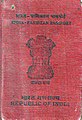 Indian passport, valid only for India-Pakistan travel, issued to migrants to enable them to visit family, friends and ancestral homes located on the other side of the Radcliffe line
 -
 Passport issued by the Dominion of India (1947–1950)
 -
 Cover of a passport (1986)
 -
 Passport Cover (used till March 2021)
 -
 Indian Ordinary Passport (2021)
 -
 Indian Official Passport (2021)
 -
 Indian Diplomatic Passport (2021)


See also[edit]


- Visa requirements for Indian citizens
- Visa policy of India
- Indian nationality law
- Overseas Citizenship of India
- The Passports Act
References[edit]
- ^ a b c d "Fee Structure : Document Advisor – Passport Seva". passportindia.gov.in. Archived from the original on 23 March 2018. Retrieved 26 March 2018.
- ^ "MEA CPV Division". CPV. Archived from the original on 9 April 2008. Retrieved 18 February 2008.
- ^ "Unknown".[permanent dead link]
- ^ "7.2% of Indians own passports, number set to cross 10 crore soon | India News - Times of India". The Times of India. 19 December 2022.
- ^ "Dominions 1931–1947". Historical Atlas of the British Empire. Archived from the original on 22 December 2015. Retrieved 16 December 2015.
- ^ MumbaiSpace Indian Passport History Archived 6 October 2010 at the Wayback Machine
- ^ "Passport (Entry into India) Act, 1920 (No. 34 of 1920)". Archived from the original on 7 October 2012. Retrieved 20 April 2019.
- ^ "History of Passports". Archived from the original on 15 April 2009. Retrieved 20 April 2019.
- ^ Vazira Fazila-Yacoobali Zamindar (2007). The Long Partition and the Making of Modern South Asia. Columbia University Press. p. 162. ISBN 978-0-231-13846-8.
- ^ "When Delhi and London colluded to deny passports to Indians". BBC News. 2 August 2022.
- ^ "Satwant Singh Sawhney vs D. Ramarathnam, Assistant ... on 10 April, 1967". 10 April 1967.
- ^ "41-year-old India-Bangladesh passport regime ends". The Times of India. 2 December 2013. Archived from the original on 6 October 2018. Retrieved 6 October 2018.
- ^ Nurul Islam Hasib (13 November 2013). "Indo-Bangla special passport to go". BdNews24.com. Archived from the original on 14 November 2013.
- ^ Tatkaal passports. "Tatkaal passports". www.passportindia.gov.in. CPV, Government of India. Archived from the original on 22 April 2017. Retrieved 22 April 2017.
- ^ "Passport Seva Miscellaneous Queries". passportindia.gov.in. CPV, Government of India. Archived from the original on 7 May 2017. Retrieved 22 April 2017.
- ^ "Explained: What is an e-passport, how will it work and how to apply for it". 2 February 2022.
- ^ "Passport Seva Programme V2.0".
- ^ "Invalid, but over a lakh Indian handwritten passports still in circulation". 20 November 2017. Archived from the original on 30 December 2018. Retrieved 30 December 2018.
- ^ "| vfsglobal - vfsglobal".
- ^ the Times of India website article accessed 29 January 2016
- ^ Oppili, P. (12 April 2013). "New passports with added security features dispatched". The Hindu. Archived from the original on 5 March 2018. Retrieved 26 March 2018 – via www.thehindu.com.
- ^ "A ghost in your passport to make it tamper-proof". The Times of India. Archived from the original on 30 July 2013. Retrieved 14 April 2013.
- ^ "Indian Passport Fees" (PDF). Government of India. Archived (PDF) from the original on 18 January 2013. Retrieved 19 December 2012.
- ^ "NDTV.com: After US tests, India to get first e-passport". ndtv.com. Archived from the original on 14 February 2009. Retrieved 26 March 2018.
- ^ "India to introduce biometric passports next year". secureidnews.com. 5 July 2012. Archived from the original on 18 September 2012. Retrieved 7 October 2012.
- ^ "India to introduce biometric passports to all of its Citizens". Ministry of External Affairs, Parliament Q&A – 1724. 27 July 2016. Archived from the original on 23 August 2018. Retrieved 7 May 2020.
- ^ "Indian Security Press Global Tender for Supply Electronic contactless inlays" (PDF). Indian Security Press- Nashik, Tender No-54/2016-17. 27 July 2016. Archived (PDF) from the original on 22 October 2016. Retrieved 3 August 2016.
- ^ "India looks to Biometric Passports". Security Documentworld.com. 28 July 2016. Archived from the original on 29 April 2019. Retrieved 3 August 2016.
- ^ "E-Passport coming soon! Indians to get chip-enabled passports with advanced security features; details". The Financial Express. 19 July 2019. Retrieved 23 June 2020.
- ^ Bhattacherjee, Kallol (1 February 2022). "India Union Budget 2022 | e-passports with embedded chip to be rolled out this year". The Hindu. ISSN 0971-751X. Retrieved 2 February 2022.
- ^ Ankita Chakravarti (1 February 2022). "E-Passport for India announced in Budget 2022, here is what it is". India Today. Retrieved 2 February 2022.
- ^ "The Official Passport Index Ranking". Henley & Partners. Retrieved 12 January 2022.
- ^ "Global Passport Power Rank 2022 | Passport Index 2022". Passport Index - Global Mobility Intelligence. Retrieved 11 December 2022.
- ^ Scroll Staff (9 December 2022). "Indian passport ranks 69th among 193 nations on global index, UAE tops the list". Scroll.in. Retrieved 11 December 2022.
- ^ "QUESTION NO.528 INDIA'S RANKING IN TERMS OF STRENGTH OF PASSPORT". mea.gov.in. Retrieved 3 August 2023.
- ^ "Statistical Yearbook – Department of Commerce". Archived from the original on 11 February 2017. Retrieved 9 February 2017.
- ^ "Anuário de Estatística do Turismo". Archived from the original on 13 June 2017. Retrieved 15 October 2017.
- ^ "Tourism Statistics – IAATO". iaato.org. Archived from the original on 14 April 2018. Retrieved 26 March 2018.
- ^ "Tourism Statistics for Antigua and Barbuda". antiguahotels.org. Archived from the original on 29 January 2018. Retrieved 26 March 2018.
- ^ "Tourist visits to Australia" (PDF). Archived (PDF) from the original on 6 March 2018. Retrieved 6 March 2018.
- ^ "Kalenderjahr 2016: Erstmals über 140 Millionen Nächtigungen (Calendar year 2016: Over 140 million overnight stays for the first time)" (PDF) (in German). Archived from the original (PDF) on 14 February 2017. Retrieved 30 May 2017.
- ^ "Number of foreign citizens arrived to Azerbaijan by countries". Archived from the original on 25 June 2019. Retrieved 15 October 2017.
- ^ "Barbados - 2016 Annual Statistics Report" (PDF). Archived (PDF) from the original on 3 February 2018. Retrieved 3 February 2018.
- ^ "Tourisme selon pays de provenance 2016". Archived from the original on 20 August 2017. Retrieved 20 August 2017.
- ^ Namgay, Phunstho. "Annual Reports – Tourism Council of Bhutan". www.tourism.gov.bt. Archived from the original on 12 June 2018. Retrieved 12 June 2018.
- ^ "INE – Instituto Nacional de Estadística – Turismo". Archived from the original on 31 October 2019. Retrieved 15 October 2017.
- ^ "TOURISM STATISTICS Cumulative data, January – December 2017" (PDF). Archived (PDF) from the original on 29 May 2019. Retrieved 20 May 2018.
- ^ "Statistics Botswana". Statistics Botswana. Archived from the original on 21 March 2019. Retrieved 26 March 2018.
- ^ "Ministério do Turismo". Archived from the original on 9 December 2018. Retrieved 20 October 2018.
- ^ "Tourism Statistics Report". www.tourismcambodia.org. Archived from the original on 18 March 2018. Retrieved 26 March 2018.
- ^ "Service bulletin International Travel: Advance Information" (PDF). statcan.gc.ca. Archived (PDF) from the original on 22 February 2017. Retrieved 21 February 2017.
- ^ CIDOT. "Welcome to the Cayman Islands Department of Tourism (CIDOT) Destination Statistics Website". www.caymanislands.ky. Archived from the original on 22 July 2017. Retrieved 26 March 2018.
- ^ Mehta, Shriji (18 October 2018). "Documents Required for Passport in India". Archived from the original on 24 October 2018. Retrieved 24 October 2018.
- ^ "China Inbound Tourism Statistics in 2015". www.travelchinaguide.com. Archived from the original on 29 June 2017. Retrieved 26 March 2018.
- ^ "Tourists in China by country of origin 2016 – Statistic". Statista. Archived from the original on 4 July 2018. Retrieved 18 October 2018.
- ^ The data obtained on request. Ministerio de Comercio, Industria y Turismo de Colombia Archived 6 June 2017 at the Wayback Machine
- ^ "Annuaire Statistique du Tourisme au Congo 2012 (Statistical Yearbook of Tourism in the Congo 2012)" (PDF) (in French). Archived (PDF) from the original on 22 May 2017. Retrieved 6 January 2017.
- ^ "Informes Estadísticos – Instituto Costarricense de Turismo – ICT". www.ict.go.cr. Archived from the original on 24 March 2018. Retrieved 26 March 2018.
- ^ a b "TOURIST ARRIVALS AND NIGHTS IN 2017". Archived from the original on 21 May 2018. Retrieved 20 May 2018.
- ^ "2015 Visitors Statistics Report" (PDF). tourism.gov.dm. Archived (PDF) from the original on 5 October 2018. Retrieved 26 March 2018.
- ^ "BCRD – Estadísticas Económicas". www.bancentral.gov.do. Archived from the original on 3 February 2017. Retrieved 26 March 2018.
- ^ "Swaziland Tourism – Swaziland Safari – Swaziland Attractions – Useful Links – Research". www.thekingdomofswaziland.com. Archived from the original on 8 February 2018. Retrieved 26 March 2018.
- ^ "84,5 millions de touristes étrangers en France en 2015 (84.5 million foreign tourists in France in 2015)" (XLSX) (in French). Archived from the original on 6 January 2017. Retrieved 5 January 2017.
- ^ "Données détaillées". www.ispf.pf. Archived from the original on 14 November 2017. Retrieved 26 March 2018.
- ^ "International arrivals 2017". Archived from the original on 7 January 2018. Retrieved 7 January 2018.
- ^ Tourismus in Zahlen 2016 Archived 4 March 2017 at the Wayback Machine, Statistisches Bundesamt
- ^ "Visitor Arrival Statistics – Research – Research and Reports". www.guamvisitorsbureau.com. Archived from the original on 7 July 2018. Retrieved 26 March 2018.
- ^ "Monthly Report - Visitor Arrival Statistics : Dec 2017" (PDF). Archived from the original (PDF) on 31 January 2018. Retrieved 30 January 2018.
- ^ "TOURISM IN HUNGARY 2016". Archived from the original on 8 October 2017. Retrieved 4 March 2017.
- ^ "Badan Pusat Statistik". Archived from the original on 14 October 2017. Retrieved 14 October 2017.
- ^ TOURIST ARRIVALS TO ISRAEL (EXC. DAY VISITORS & CRUISE PASSENGERS) BY NATIONALITY Archived 22 April 2018 at the Wayback Machine, Ministry of Tourism
- ^ "IAGGIATORI STRANIERI NUMERO DI VIAGGIATORI". Archived from the original on 14 October 2017. Retrieved 13 June 2017.
- ^ "Monthly Statistical Report December 2017 Vol xxvii No 12". Archived from the original on 11 February 2017. Retrieved 9 February 2017.
- ^ "2015 Foreign Visitors & Japanese Departures" (PDF). jnto.go.jp. Japan National Tourism Organization. Archived (PDF) from the original on 19 February 2018. Retrieved 26 March 2018.
- ^ "Tourist Overnight and Same Day Visitors By Nationality during". Archived from the original on 13 April 2018. Retrieved 15 October 2017.
- ^ "Статистические сборники". stat.gov.kz. Archived from the original on 21 December 2016. Retrieved 9 December 2016.
- ^ "Туризм в Кыргызстане – Архив публикаций – Статистика Кыргызстана". www.stat.kg. Archived from the original on 14 October 2018. Retrieved 14 October 2018.
- ^ "Statistical Reports on Tourism in Laos". Archived from the original on 4 December 2018. Retrieved 28 November 2018.
- ^ "TUG02. Visitors staying in hotels and other accommodation establishments by country of residence-PX-Web". csb.gov.lv. Archived from the original on 14 October 2017. Retrieved 26 March 2018.
- ^ "Arrivals according to nationality during year 2016". Archived from the original on 13 November 2018. Retrieved 15 October 2017.
- ^ "DSEC – Statistics Database". www.dsec.gov.mo. Archived from the original on 21 November 2017. Retrieved 26 March 2018.
- ^ "Publications – Statistiques". tourisme.gov.mg. 27 May 2015. Archived from the original on 6 January 2017. Retrieved 26 March 2018.
- ^ "TOURIST ARRIVALS TO MALAYSIA BY COUNTRY OF NATIONALITY DECEMBER 2017" (PDF). tourism.gov.my. Archived from the original (PDF) on 5 March 2018. Retrieved 26 March 2018.
- ^ a b "December 2017 – Ministry of Tourism". www.tourism.gov.mv. Archived from the original on 25 January 2018. Retrieved 26 March 2018.
- ^ "ANNUAIRE 2014". Archived from the original on 7 January 2017. Retrieved 6 January 2017.
- ^ "Visitantes internacionales por vía aérea por principal nacionalidad". sectur.gob.mx. Archived from the original on 4 April 2018. Retrieved 26 March 2018.
- ^ "2017 Оны Жилийн Эцсийн Мэдээг 2016 Онтой Харьцуулсан Мэдээ". Archived from the original on 12 February 2018. Retrieved 11 February 2018.
- ^ "Table 4. Foreign tourist arrivals and overnight stays by countries, 2014" (PDF). monstat.org. Archived (PDF) from the original on 5 March 2016. Retrieved 26 March 2018.
- ^ "Myanmar Tourism Statistics 2015" (PDF). Central Statistical Organization. Ministry of National Planning and Economic Development. Archived from the original (PDF) on 29 December 2016. Retrieved 5 January 2016.
- ^ Tourism Statistics 2015 p.20,31 Archived 31 January 2017 at the Wayback Machine
- ^ "Toerisme in perspectief 2018". Archived from the original on 29 January 2018. Retrieved 28 January 2018.
- ^ "International travel and migration: December 2017". Statistics New Zealand. Archived from the original on 2 February 2018. Retrieved 2 February 2018.
- ^ "Number of Tourists to Oman from 2011-2017". Archived from the original on 20 October 2018. Retrieved 19 October 2018.
- ^ "VARIACIÓN ABSOLUTA Y RELATIVA DEL INGRESO DE VISITANTES POR EL AEROPUERTO 2015 INTERNACIONAL, SEGÚN DOMICILIO PERMANENTE Y MES. AÑOS:2014-2015 (Absolute and relative variation in visitor income by the 2015 International Airport, according to permanent address and month,. Years: 2014-2015)" (PDF) (in Spanish). Archived (PDF) from the original on 27 November 2016. Retrieved 26 November 2016.
- ^ "Visitors Arrival Analysis, Total 2016" (PDF). Archived (PDF) from the original on 4 March 2017. Retrieved 4 March 2017.
- ^ "datosTurismo". datosturismo.mincetur.gob.pe. Archived from the original on 14 October 2018. Retrieved 15 October 2018.
- ^ "VISITOR ARRIVALS TO THE PHILIPPINES BY COUNTRY OF RESIDENCE - JANUARY-DECEMBER 2017" (PDF). Archived from the original (PDF) on 10 February 2018. Retrieved 7 March 2018.
- ^ "2016 Annual Tourism Performance Report" (PDF). visitqatar.qa. Archived (PDF) from the original on 7 November 2017. Retrieved 26 March 2018.
- ^ "The distribution of Romanian tourists' arrivals in the establishments of tourists' reception, by tourist areas, in December 2016 compared to December 2015" (XLS). Archived from the original on 6 March 2017. Retrieved 5 March 2017.
- ^ "Въезд иностранных граждан в РФ". Fedstat.ru. 18 October 2017. Archived from the original on 18 October 2017. Retrieved 18 October 2017.
- ^ "Downloads".
- ^ "Visitor Arrivals". www.stb.gov.sg. Archived from the original on 22 January 2017. Retrieved 26 March 2018.
- ^ "Základné ukazovatele za ubytovacie zariadenia cestovného ruchu SR za rok (Basic indicators for accommodation facilities of the Slovak tourism industry for the year)" (in Slovak). Retrieved 30 December 2023.
- ^ "TOURISM 2015" (PDF). Archived (PDF) from the original on 22 November 2017. Retrieved 22 June 2016.
- ^ "Korea, Monthly Statistics of Tourism – key facts on tourism – Tourism Statistics". kto.visitkorea.or.kr. Archived from the original on 12 October 2015. Retrieved 26 March 2018.
- ^ "Tabla23984". www.ine.es. Archived from the original on 13 February 2017. Retrieved 26 March 2018.
- ^ "TOURIST ARRIVALS BY COUNTRY OF RESIDENCE 2016" (PDF). sltda.gov.lk. Archived from the original (PDF) on 16 December 2017. Retrieved 26 March 2018.
- ^ "Suriname Tourism Statistics" (PDF). www.surinametourism.sr. Archived from the original (PDF) on 12 June 2018. Retrieved 8 June 2018.
- ^ "Visitor Arrivals by Nationality". taiwan.net.tw. Archived from the original on 24 March 2018. Retrieved 26 March 2018.
- ^ "The 2016 International Visitors' Exit Survey Report. International Tourist Arrivals. pp. 73–77" (PDF). nbs.go.tz/. NBS Tanzania. Archived (PDF) from the original on 13 November 2018. Retrieved 18 December 2017.
- ^ "สถิติด้านการท่องเที่ยว ปี 2560 (Tourism Statistics 2017)". Ministry of Tourism & Sports. Archived from the original on 18 August 2017. Retrieved 16 January 2018.
- ^ "2018 Statistics".
- ^ "DILI EM NÚMEROS 2014 - ESTATÍSTICA MUNICIPIO DE DILI (Dili in numbers 2014 - Dili municipal statistics)" (PDF) (in Portuguese). Archived (PDF) from the original on 18 October 2016. Retrieved 16 October 2016.
- ^ "NUMBER OF ARRIVING-DEPARTING VISITORS, FOREIGNERS AND CITIZENS December 2017". Archived from the original on 1 February 2018. Retrieved 31 January 2018.
- ^ "Foreign citizens who visited Ukraine in 2017 year, by countries". Archived from the original on 14 November 2018. Retrieved 10 February 2018.
- ^ Statistics for the Emirate of Dubai
Dubai Statistics, Visitor by Nationality Archived 3 October 2017 at the Wayback Machine - ^ "Annual estimates on visits and spending in the UK by overseas residents, by purpose and region of visit". Office of National Statistics. Archived from the original on 21 July 2018. Retrieved 20 July 2018.
- ^ "Table 28. Nonimmigrant Admissions (I-94 Only) By Selected Category Of Admission And Region And Country Of Citizenship: Fiscal Year 2016". dhs.gov. 16 May 2017. Archived from the original on 7 November 2018. Retrieved 26 March 2018.
- ^ "Распределение въехавших в Республику Узбекистан иностранных граждан по странам в 2015 году". data.gov.uz. Archived from the original on 30 January 2019. Retrieved 12 March 2018.
- ^ "Tourism Statistical Digests". Archived from the original on 1 July 2016. Retrieved 22 June 2016.
- ^ "Tourism Trends and Statistics 2015 Annual Report – Zimbabwe A World Of Wonders". www.zimbabwetourism.net. Archived from the original on 21 December 2016. Retrieved 26 March 2018.
External links[edit]

 Indian travel documents Indian travel documents | |
|---|---|
| Central Government | |
|---|---|
| State Governments | |
| Municipalities | |
| |||||||||||||
| |||||||||||||
| |||||||||||||
| |||||||||||||


