


Indirect utility function
 | This article needs additional citations for verification. (May 2021) |
In economics, a consumer's indirect utility function gives the consumer's maximal attainable utility when faced with a vector of goods prices and an amount of income . It reflects both the consumer's preferences and market conditions.


This function is called indirect because consumers usually think about their preferences in terms of what they consume rather than prices. A consumer's indirect utility can be computed from his or her utility function defined over vectors of quantities of consumable goods, by first computing the most preferred affordable bundle, represented by the vector by solving the utility maximization problem, and second, computing the utility the consumer derives from that bundle. The resulting indirect utility function is



The indirect utility function is:
- Continuous on Rn+ × R+ where n is the number of goods;
- Decreasing in prices;
- Strictly increasing in income;
- Homogenous with degree zero in prices and income; if prices and income are all multiplied by a given constant the same bundle of consumption represents a maximum, so optimal utility does not change;
- quasi-convex in (p,w).
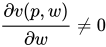
Moreover, Roy's identity states that if v(p,w) is differentiable at and , then


Indirect utility and expenditure[edit]
The indirect utility function is the inverse of the expenditure function when the prices are kept constant. I.e, for every price vector and utility level :[1]: 106


Example[edit]
Let's say the utility function is the Cobb-Douglas function which has the Marshallian demand functions[2]


where is the consumer's income. The indirect utility function is found by replacing the quantities in the utility function with the demand functions thus:


where Note that the utility function shows the utility for whatever quantities its arguments hold, even if they are not optimal for the consumer and do not solve his utility maximization problem. The indirect utility function, in contrast, assumes that the consumer has derived his demand functions optimally for given prices and income.

See also[edit]
References[edit]
- ^ Varian, Hal (1992). Microeconomic Analysis (Third ed.). New York: Norton. ISBN 0-393-95735-7.
- ^ Varian, H. (1992). Microeconomic Analysis (3rd ed.). New York: W. W. Norton., pp. 111, has the general formula.
Further reading[edit]
- Cornes, Richard (1992). "Individual Consumer Behavior: Direct and Indirect Utility Functions". Duality and Modern Economics. New York: Cambridge University Press. pp. 31–62. ISBN 0-521-33601-5.
- Jehle, G. A.; Reny, P. J. (2011). Advanced Microeconomic Theory (Third ed.). Harlow: Prentice Hall. pp. 28–33. ISBN 978-0-273-73191-7.
- Luenberger, David G. (1995). Microeconomic Theory. New York: McGraw-Hill. pp. 103–107. ISBN 0-07-049313-8.
- Mas-Colell, Andreu; Whinston, Michael D.; Green, Jerry R. (1995). Microeconomic Theory. New York: Oxford University Press. pp. 56–57. ISBN 0-19-507340-1.
- Nicholson, Walter (1978). Microeconomic Theory: Basic Principles and Extensions (Second ed.). Hinsdale: Dryden Press. pp. 57–59. ISBN 0-03-020831-9.
