


Lenstra–Lenstra–Lovász lattice basis reduction algorithm
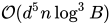
The Lenstra–Lenstra–Lovász (LLL) lattice basis reduction algorithm is a polynomial time lattice reduction algorithm invented by Arjen Lenstra, Hendrik Lenstra and László Lovász in 1982.[1] Given a basis with n-dimensional integer coordinates, for a lattice L (a discrete subgroup of Rn) with , the LLL algorithm calculates an LLL-reduced (short, nearly orthogonal) lattice basis in time





The original applications were to give polynomial-time algorithms for factorizing polynomials with rational coefficients, for finding simultaneous rational approximations to real numbers, and for solving the integer linear programming problem in fixed dimensions.
LLL reduction[edit]
The precise definition of LLL-reduced is as follows: Given a basis


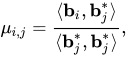

Then the basis is LLL-reduced if there exists a parameter in (0.25, 1] such that the following holds:

- (size-reduced) For . By definition, this property guarantees the length reduction of the ordered basis.
- (Lovász condition) For k = 2,3,..,n .


Here, estimating the value of the parameter, we can conclude how well the basis is reduced. Greater values of lead to stronger reductions of the basis. Initially, A. Lenstra, H. Lenstra and L. Lovász demonstrated the LLL-reduction algorithm for . Note that although LLL-reduction is well-defined for , the polynomial-time complexity is guaranteed only for in .


The LLL algorithm computes LLL-reduced bases. There is no known efficient algorithm to compute a basis in which the basis vectors are as short as possible for lattices of dimensions greater than 4.[4] However, an LLL-reduced basis is nearly as short as possible, in the sense that there are absolute bounds such that the first basis vector is no more than times as long as a shortest vector in the lattice, the second basis vector is likewise within of the second successive minimum, and so on.


Applications[edit]
An early successful application of the LLL algorithm was its use by Andrew Odlyzko and Herman te Riele in disproving Mertens conjecture.[5]
The LLL algorithm has found numerous other applications in MIMO detection algorithms[6] and cryptanalysis of public-key encryption schemes: knapsack cryptosystems, RSA with particular settings, NTRUEncrypt, and so forth. The algorithm can be used to find integer solutions to many problems.[7]
In particular, the LLL algorithm forms a core of one of the integer relation algorithms. For example, if it is believed that r=1.618034 is a (slightly rounded) root to an unknown quadratic equation with integer coefficients, one may apply LLL reduction to the lattice in spanned by and . The first vector in the reduced basis will be an integer linear combination of these three, thus necessarily of the form ; but such a vector is "short" only if a, b, c are small and is even smaller. Thus the first three entries of this short vector are likely to be the coefficients of the integral quadratic polynomial which has r as a root. In this example the LLL algorithm finds the shortest vector to be [1, -1, -1, 0.00025] and indeed has a root equal to the golden ratio, 1.6180339887....

![{\displaystyle [1,0,0,10000r^{2}],[0,1,0,10000r],}](https://wikimedia.org/api/rest_v1/media/math/render/svg/9527e6aabff43bcdec94f0f32fbd0112c0712b7b)
![{\displaystyle [0,0,1,10000]}](https://wikimedia.org/api/rest_v1/media/math/render/svg/a98f39a149ae12b52c5619c0be453ee86c01dacd)
![{\displaystyle [a,b,c,10000(ar^{2}+br+c)]}](https://wikimedia.org/api/rest_v1/media/math/render/svg/83d1ff08d3dfa5db70c4aa303b359f54b8033753)


Properties of LLL-reduced basis[edit]
Let be a -LLL-reduced basis of a lattice . From the definition of LLL-reduced basis, we can derive several other useful properties about .



- The first vector in the basis cannot be much larger than the shortest non-zero vector: . In particular, for , this gives .[8]
- The first vector in the basis is also bounded by the determinant of the lattice: . In particular, for , this gives .
- The product of the norms of the vectors in the basis cannot be much larger than the determinant of the lattice: let , then .






LLL algorithm pseudocode[edit]
The following description is based on (Hoffstein, Pipher & Silverman 2008, Theorem 6.68), with the corrections from the errata.[9]
INPUT
    a lattice basis b1, b2, ..., bn in Zm
    a parameter δ with 1/4 < δ < 1, most commonly δ = 3/4
PROCEDURE
    B* <- GramSchmidt({b1, ..., bn}) = {b1*, ..., bn*};  and do not normalize
    μi,j <- InnerProduct(bi, bj*)/InnerProduct(bj*, bj*);   using the most current values of bi and bj*
    k <- 2;
    while k <= n do
        for j from k−1 to 1 do
            if |μk,j| > 1/2 then
                bk <- bk − ⌊μk,j⌉bj;
               Update B* and the related μi,j's as needed.
               (The naive method is to recompute B* whenever bi changes:
                B* <- GramSchmidt({b1, ..., bn}) = {b1*, ..., bn*})
            end if
        end for
        if InnerProduct(bk*, bk*) > (δ − μ2k,k−1) InnerProduct(bk−1*, bk−1*) then
            k <- k + 1;
        else
            Swap bk and  bk−1;
            Update B* and the related μi,j's as needed.
            k <- max(k−1, 2);
        end if
    end while
    return B the LLL reduced basis of {b1, ..., bn}
OUTPUT
    the reduced basis b1, b2, ..., bn in Zm
Examples[edit]
Example from Z3[edit]
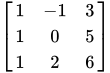
Let a lattice basis , be given by the columns of

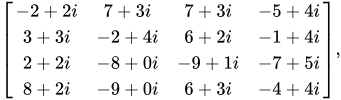
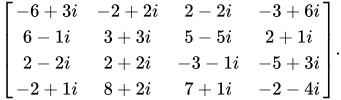
Example from Z[i]4[edit]
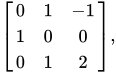
Likewise, for the basis over the complex integers given by the columns of the matrix below,
Implementations[edit]
LLL is implemented in
- Arageli as the function
lll_reduction_int - fpLLL as a stand-alone implementation
- FLINT as the function
fmpz_lll - GAP as the function
LLLReducedBasis - Macaulay2 as the function
LLLin the packageLLLBases - Magma as the functions
LLLandLLLGram(taking a gram matrix) - Maple as the function
IntegerRelations[LLL] - Mathematica as the function
LatticeReduce - Number Theory Library (NTL) as the function
LLL - PARI/GP as the function
qflll - Pymatgen as the function
analysis.get_lll_reduced_lattice - SageMath as the method
LLLdriven by fpLLL and NTL - Isabelle/HOL in the 'archive of formal proofs' entry
LLL_Basis_Reduction. This code exports to efficiently executable Haskell.[11]
See also[edit]
Notes[edit]
- ^ Lenstra, A. K.; Lenstra, H. W. Jr.; Lovász, L. (1982). "Factoring polynomials with rational coefficients". Mathematische Annalen. 261 (4): 515–534. CiteSeerX 10.1.1.310.318. doi:10.1007/BF01457454. hdl:1887/3810. MR 0682664. S2CID 5701340.
- ^ Galbraith, Steven (2012). "chapter 17". Mathematics of Public Key Cryptography.
- ^ Nguyen, Phong Q.; Stehlè, Damien (September 2009). "An LLL Algorithm with Quadratic Complexity". SIAM J. Comput. 39 (3): 874–903. doi:10.1137/070705702. Retrieved 3 June 2019.
- ^ Nguyen, Phong Q.; Stehlé, Damien (1 October 2009). "Low-dimensional lattice basis reduction revisited". ACM Transactions on Algorithms. 5 (4): 1–48. doi:10.1145/1597036.1597050. S2CID 10583820.
- ^ Odlyzko, Andrew; te Reile, Herman J. J. "Disproving Mertens Conjecture" (PDF). Journal für die reine und angewandte Mathematik. 357: 138–160. doi:10.1515/crll.1985.357.138. S2CID 13016831. Retrieved 27 January 2020.
- ^ D. Wübben et al., "Lattice reduction," IEEE Signal Processing Magazine, Vol. 28, No. 3, pp. 70-91, Apr. 2011.
- ^ D. Simon (2007). "Selected applications of LLL in number theory" (PDF). LLL+25 Conference. Caen, France.
- ^ Regev, Oded. "Lattices in Computer Science: LLL Algorithm" (PDF). New York University. Retrieved 1 February 2019.
- ^ Silverman, Joseph. "Introduction to Mathematical Cryptography Errata" (PDF). Brown University Mathematics Dept. Retrieved 5 May 2015.
- ^ Bosma, Wieb. "4. LLL" (PDF). Lecture notes. Retrieved 28 February 2010.
- ^ Divasón, Jose (2018). "A Formalization of the LLL Basis Reduction Algorithm". Conference Paper. Lecture Notes in Computer Science. 10895: 160–177. doi:10.1007/978-3-319-94821-8_10. ISBN 978-3-319-94820-1.
References[edit]
- Napias, Huguette (1996). "A generalization of the LLL algorithm over euclidean rings or orders". Journal de Théorie des Nombres de Bordeaux. 8 (2): 387–396. doi:10.5802/jtnb.176.
- Cohen, Henri (2000). A course in computational algebraic number theory. GTM. Vol. 138. Springer. ISBN 3-540-55640-0.
- Borwein, Peter (2002). Computational Excursions in Analysis and Number Theory. ISBN 0-387-95444-9.
- Luk, Franklin T.; Qiao, Sanzheng (2011). "A pivoted LLL algorithm". Linear Algebra and Its Applications. 434 (11): 2296–2307. doi:10.1016/j.laa.2010.04.003.
- Hoffstein, Jeffrey; Pipher, Jill; Silverman, J.H. (2008). An Introduction to Mathematical Cryptography. Springer. ISBN 978-0-387-77993-5.