


Type 052 destroyer
.jpg) Qingdao at Haifa port, Israel in 2012
| |
| Class overview | |
|---|---|
| Builders | Jiangnan Shipyard |
| Operators |  People's Liberation Army Navy Surface Force People's Liberation Army Navy Surface Force |
| Preceded by | Type 051 |
| Succeeded by | Type 051B |
| Built | 1990 – 1996 |
| In service | 1994 – present |
| Completed | 2 |
| Active | 2 |
| General characteristics | |
| Type | Guided-missile destroyer |
| Displacement | 4,674 tons[1] |
| Length | 144 m (472 ft 5 in)[1] |
| Beam | 16 m (52 ft 6 in)[1] |
| Draught | 5.1 m (16 ft 9 in)[1] |
| Propulsion | |
| Speed | 31 kn (57 km/h; 36 mph)[1] |
| Range | 5,000 nmi (9,300 km; 5,800 mi) at 15 kn[1] |
| Complement | 266[1] |
| Sensors and processing systems | |
| Electronic warfare & decoys | |
| Armament | |
| Aircraft carried | 2 helicopters: Harbin Z-9C[1] |
| Aviation facilities | |
The Type 052 (NATO/OSD Luhu-class destroyer[3] is a class of destroyers developed in the People's Republic of China (PRC) for the People's Liberation Army Navy (PLAN). The Type 052 was an intermediate between the obsolescent Type 051[4] and the modern Type 052B destroyers.[5][6] They were the first PLAN destroyers powered by gas turbines,[6] and the first PLAN ships with modern combat direction systems (CDS).[4] They were also part of the first generation of PLAN warships armed with surface-to-air missiles in the form of the short-range Crotale (called HQ-7 in Chinese service.)[7]
The Type 052 used subsystems imported from the United States and the European Union. The embargo after the 1989 Tiananmen Square protests and massacre ended the supply of and support for those subsystems, limiting production to two ships[4] and likely affecting their operating efficiency due to system integration issues.[4] Afterward, China turned to Russia and Ukraine for technology.[8][5]
Programme
[edit]The Type 052 was the first PLAN warship where the CDS was designed before the ship.[4] The CDS, possible the ZKJ-6 based on the Italian IPN-10 or IPN-20,[9] began development in 1983 and underwent land-based testing in December 1986.[4] Two ships were ordered in 1985, but delayed by export orders to Thailand. The first, Harbin, was laid down in November 1990 and commissioned in July 1994. Qingdao was commissioned in March 1996.[1]
In 2003, Harbin was refitted with a low radar profile 100mm gun turret in 2003; Qingdao followed in 2005.[1]
A major refit began in 2010 for Harbin and Qingdao in 2011 which included changes to sensors and weapons, gas turbine replacement, and some hull work.[1]
Design
[edit]Machinery
[edit]The ships were completed with different gas turbines due to the embargo; Harbin with two General Electric LM2500s from the United States, and Qingdao with two Zorya-Mashproekt DA80s from Ukraine.[2]
Sensors
[edit]The original sensors included the Type 518 air search radar, the Type 362 search radar,[10] and the French[11] DUBV-43 variable depth sonar.[10] These were replaced during the 2010 refit with the Type 517 radar, the Type 362 radar, and a linear towed array sonar respectively.[1]
Weapons
[edit]The ships are armed with an octuple HQ-7/Crotale launcher, and a total of 32 missiles.[1] France agreed to sell the missile systems in 1986, and they were delivered after October 1990.[12]
Four Type 76A twin 37 mm guns were installed at construction. They were removed during 2010 refit, and the aft pair replaced by a pair of Type 730 CIWS.[1]
Other
[edit]The CDS installed on the Type 052 is unclear.[4][13] One ship may have received the Thomson-CSF TAVITAC; the PRC bought two TAVITACs from France in the 1980s.[14] The TAVITAC may be known as, or modified into, the ZKJ-5 CDS in PRC service.[9] The other ship may have received the ZKJ-6.[13][9]
The quarterdecks were built open, and enclosed during the 2010 refit.[1]
The ships may have had severe survivability issues like earlier PLAN warships. Observations by foreign visitors to Harbin in March 1997 suggested limited damage control capability and crew safety features.[4]
Operational history
[edit]Qingdao participated in the PLAN's first cruise to circumnavigate Earth in 2002. German technicians were flown in to repair its diesel engines during the cruise.[11]
Ships of the class
[edit]| Number | Pennant number |
Name | Namesake | Builder | Launched | Commissioned | Fleet | Status |
|---|---|---|---|---|---|---|---|---|
| 1 | 112[1] | 哈尔滨 / Harbin[1] | City of Harbin, provincial capital of Heilongjiang |
Jiangnan Shipyard[1] | October 1991[1] | July 1994[1] | North Sea Fleet[1] | Active[1] |
| 2 | 113[1] | 青岛 / Qingdao | City of Qingdao | Jiangnan Shipyard | October 1993[1] | March 1996[1] | North Sea Fleet[1] | Active[1] |
Gallery
[edit]-
 Harbin at Pearl Harbor, Hawaii, in 1997 with the original main gun turret.
 -
 Harbin at Auckland, New Zealand, in 2007 with the low radar profile turret.
 -
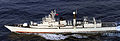 Qingdao in 2013 after the major refit.

.jpg)
.jpg)
See also
[edit]References
[edit]
- ^ a b c d e f g h i j k l m n o p q r s t u v w x y z aa ab ac ad ae af ag ah ai aj ak al am an ao ap aq ar as at au av Saunders, Stephan, ed. (2015). Jane's Fighting Ships 2015-2016. Jane's Information Group. p. 141. ISBN 978-0710631435.
- ^ a b Collins and Grubb (2008): page 36
- ^ "China Equipment" (PDF). United States Navy Office of Naval Intelligence. February 2015. Retrieved 14 March 2022.
- ^ a b c d e f g h Kirchberger (2015): page 186
- ^ a b Kirchberger (2015): page 195
- ^ a b McDevitt (2017): page 57
- ^ Kirchberger (2015): page 231
- ^ Kirchberger (2015): page 143
- ^ a b c Kirchberger (2015): page 188
- ^ a b Saunders, Stephan, ed. (2009). Jane's Fighting Ships 2009-2010. Jane's Information Group. p. 138. ISBN 978-0-7106-2888-6.
- ^ a b Collins and Grubb (2008): page 32
- ^ Gill, Bates; Taeho, Kim (1995). China's Arms Acquisitions from Abroad: A Quest for 'Superb and Secret Weapons'. SIPRI Research Repor. Vol. 11. New York: Oxford University Press. p. 79. ISBN 0-19-829195-7.
- ^ a b Kirchberger (2015): page 187
- ^ Kirchberger (2015): page 185
Bibliography
[edit]- Collins, Gabriel; Grubb, Michael C. (August 2008). A Comprehensive Survey of China's Dynamic Shipbuilding Industry. China Maritime Studies. Vol. 1. United States Naval War College. ISBN 978-1-884733-54-3. Retrieved 18 March 2022.
- Kirchberger, Sarah (2015). Assessing China's Naval Power: Technological Innovation, Economic Constraints, and Strategic Implications. Global Power Shift. Springer. ISBN 978-3-662-47127-2.
- McDevitt, Michael (2017). "The Modern PLA Navy Destroyer Force". CSMI Red Book. 14. United States Naval War College: 55–65. ISBN 978-1-935352-45-7. Retrieved 28 April 2019.
