


Marie-José of Belgium
| Marie-José of Belgium | |||||
|---|---|---|---|---|---|
 Pictured in 1946 | |||||
| Queen consort of Italy | |||||
| Tenure | 9 May 1946 – 12 June 1946 | ||||
| Born | 4 August 1906 Ostend, Belgium | ||||
| Died | 27 January 2001 (aged 94) Thonex, Switzerland | ||||
| Burial | Hautecombe Abbey, France | ||||
| Spouse | |||||
| Issue | |||||
| |||||
| House | Saxe-Coburg and Gotha (until 1920) Belgium (from 1920) | ||||
| Father | Albert I of Belgium | ||||
| Mother | Elisabeth of Bavaria | ||||
Marie-José of Belgium (Marie-José Charlotte Sophie Amélie Henriette Gabrielle; 4 August 1906 – 27 January 2001) was the last Queen of Italy. Her 34-day tenure as queen consort earned her the nickname "the May Queen".
Early life[edit]

Princess Marie-José was born in Ostend, the youngest child of King Albert I of the Belgians and his consort, Duchess Elisabeth in Bavaria. Through her mother she was a grandniece of Empress Elisabeth of Austria and of Maria Sophie of Bavaria, last queen consort of the Kingdom of the Two Sicilies. During the First World War, she was evacuated to England where she was a boarding pupil at the Brentwood Ursuline Convent High School in Brentwood, Essex. She later attended the College of the Santissima Annunziata in Florence, Italy, where she first met her future husband.[1]
In 1924, Marie-José attended her first court ball. For the occasion she was given an antique pearl and diamond tiara that had originally been owned by Stéphanie de Beauharnais.[2]
During the First World War, the Princess resided mainly in Great Britain but was often escorted by the Belgian King's Messenger, Archibald Alexander Gordon to her parents in Belgium. In 1918, the Princess reprimanded Major Gordon when he called her rabbit Marshal Soult by the name Soult. The princess explained that if she called for "Gordon", no one would be able to understand who she meant. Still, if she addressed him as Major Gordon, everyone would understand her because everyone knew who Major Gordon was.[3]
Marriage and children[edit]

On 8 January 1930, she married Crown Prince Umberto of Italy, from the House of Savoy, at the Quirinal Palace in Rome, and so became Princess of Piedmont (Italian: Principessa di Piemonte).
Among the wedding gifts was a turquoise and diamond parure, worn by the bride at her pre-wedding reception,[4] and a diamond bow worn as a sash decoration at state occasions.[5]
The couple had four children:[citation needed]
- Princess Maria Pia of Savoy (24 September 1934), who married Prince Alexander of Yugoslavia on 12 February 1955 and was divorced in 1967. Four children were born during the marriage. She remarried to Prince Michel of Bourbon-Parma in 2003.
- Vittorio Emanuele, Prince of Naples (12 February 1937 — 3 February 2024), who married Marina Ricolfi Doria on 7 October 1971. They have one son.
- Princess Maria Gabriella of Savoy (24 February 1940), who married Robert Zellinger de Balkany on 21 June 1969 and was divorced in November 1990. They have issue.
- Princess Maria Beatrice of Savoy (2 February 1943), who married Luis Reyna-Corvallán y Dillon on 1 April 1970, and has issue.
Princess of Piedmont[edit]
In October 1939, Princess Marie-José was made President of the Red Cross in Italy. The Princess and Duchess of Aosta attended the ceremony where Marie-José was installed as President of the Italian Red Cross.
During the Second World War she was one of the very few diplomatic channels between the German/Italian camp and the other European countries involved in the war, as she was the sister of Leopold III of Belgium (kept hostage by the German forces) and at the same time, as the wife of the heir to the throne, close to some of the ministers of Benito Mussolini's cabinet.[1] A British diplomat in Rome recorded that the Princess of Piedmont was the only member of the Italian Royal Family with good political judgment.
Mussolini's mistress, Claretta Petacci, claimed in her diary that in 1937 the then princess and wife of the heir to the throne tried and failed to seduce the dictator at a beach resort near Rome. However, Mussolini's son, Romano, claims that the princess and dictator entered into a sexual relationship.[6]
In 1943, the Crown Princess involved herself in vain attempts to arrange a separate peace treaty between Italy and the United States; her interlocutor from the Vatican was Monsignor Giovanni Battista Montini, a senior diplomat who later became Pope Paul VI. She also interceded with Adolf Hitler to ask for mercy towards the people of Belgium.[1]
Her attempts were not sponsored by the king and Umberto was not (directly, at least) involved in them. After her failure (she never met the American agents), she was sent with her children to Sarre, in the Aosta Valley, and isolated from the political life of the Royal House.
She sympathised with the partisans, and while she was a refugee in Switzerland, smuggled weapons, money and food for them.[1] She was nominated for appointment as chief of a partisan brigade, but declined.
Queen for a month[edit]
| Styles of Queen Marie-José | |
|---|---|
 | |
| Reference style | Her Majesty |
| Spoken style | Your Majesty |
Following Italy's defection to the Allied side in the war, her discredited father-in-law, King Victor Emmanuel III, withdrew from government. Her husband became regent under the title of Lieutenant General of the Realm. He and Marie-José toured war torn Italy, where they made a positive impression. However, King Victor Emmanuel III refused to abdicate until only weeks before the referendum.
Upon the eventual abdication on 9 May 1946 of her father-in-law, Marie-José became Queen consort of Italy, and remained such until the monarchy was abolished by plebiscite on 2 June 1946, effective 12 June 1946.[1]
Umberto and Marie-José had been widely praised for their performance over the last two years, and it has been argued that had Victor Emmanuel abdicated sooner their relative popularity might have saved the monarchy. Following the monarchy's defeat (54–46%), she and her husband left the country for exile on 13 June 1946.
Exile[edit]
In exile, the family gathered for a brief time on the Portuguese Riviera, but she and Umberto separated. She and their four children soon left for Switzerland, where she lived most of the time for the rest of her life, while Umberto remained in Portugal. However, the couple, both of whom were devout Catholics, never divorced. The republican constitution forbade the restoration of the monarchy and also barred all male members of the House of Savoy, as well as former queens consort, from returning to Italian soil.[1]
Death[edit]
For some time, she lived in Mexico with her daughter, Princess Marie-Beatrice, and her grandchildren.[7]
Queen Marie-José returned to Italy after her husband's death in 1983. She died on 27 January 2001 in a Geneva clinic of lung cancer at the age of 94, surviving her two brothers and some of her nieces and nephews, including King Baudouin of the Belgians.[8]
The funeral was held at Hautecombe Abbey, in Savoy in the south of France, and was attended by 2,000 mourners. Among them were King Albert II of the Belgians, King Juan Carlos I of Spain and Farah Pahlavi, the last Empress of Iran.[citation needed] She was buried in Hautecombe Abbey alongside her husband.
Musical foundation[edit]
Like her mother, Duchess Elisabeth in Bavaria, Marie-José inspired a musical contest. In 1959 she established the Fondation du prix de composition Reine Marie-José. It awarded its biennial prizes for the first time the following year. The first prize at the 1960 Concours was awarded to Giorgio Ferrari for his Quatuor à cordes avec une voix chantée. Subsequent prize winners have included William Albright (1968), Georg Katzer (1978), and Javier Torres Maldonado (2000). The 2017 prize was awarded to Jaehyuck Choi.[9]
Honours[edit]
 |
National dynastic honours[edit]
 House of Savoy: Knight Grand Cordon of the Order of Saints Maurice and Lazarus

Foreign honours[edit]
 Holy See: Knight of the Order of the Golden Spur
 Sovereign Military Order of Malta: Knight Grand Cross of Justice of the Sovereign Military Order of Malta, Special Class
 Austrian Imperial and Royal Family: Dame of the Imperial and Royal Order of the Starry Cross, 1st Class
 Greek Royal Family: Dame Grand Cross of the Royal Order of Saints Olga and Sophia, 1st Class


Arms and monogram[edit]
-
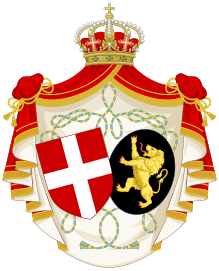 Alliance Coat of Arms of King Umberto II and Queen Maria-José
 -
 Royal Monogram of Queen Maria-José of Italy

Portrayal of Marie in the arts[edit]
Music[edit]
- Dutch singer Petra Berger's song "Terra Promessa", the first song from her album Eternal Woman, is about Marie-José.[10][better source needed]
Ancestry[edit]
| Ancestors of Marie-José of Belgium |
|---|
See also[edit]
References[edit]
- ^ a b c d e f Cope, Rebecca. "The extraordinary life of the beautiful, and radical, last Queen of Italy". Tatler. Retrieved 17 August 2020.
- ^ "An antique and pearl tiara". Christies.com. Retrieved 13 December 2017.
- ^ Gordon, A. A. (1941). Culled from a Diary (1st ed.). Scotland: Oliver&Boyd. p. 155.
- ^ "Fine antique turquoise and diamond parure". Christies.com. Retrieved 13 December 2017.
- ^ "Antique diamond bow". Christies.com. Retrieved 13 December 2017.
- ^ "Mussolini 'had affair with Italy's last queen'". The Guardian. 31 August 2011. Retrieved 4 September 2018.
- ^ "16 Janvier 2018 Archives : la période mexicaine de Marie José d'Italie". Noblesse & Royautés. 16 January 2016.
- ^ "Italy's last queen dies". BBC. 6 June 2018.
- ^ Historique du Prix Archived 11 May 2018 at the Wayback Machine, Fondationreinemariejose.ch. Retrieved 10 May 2017
- ^ Berger, Petra (12 June 2011). "Terra Promessa" (in Italian). Archived from the original on 21 December 2021. Retrieved 4 September 2018 – via YouTube.
Clip from the DVD Live in Concert (2004)
External links[edit]

- "Queen Marie-José international musical composition prize", reinemariejose.ch. Retrieved 5 June 2018.
- short biography in the February 2001 issue of La Rondine. Retrieved 5 June 2018.
| International | |
|---|---|
| National | |
| People | |
| Other | |

- 1906 births
- 2001 deaths
- 20th-century Belgian people
- 21st-century Belgian people
- 20th-century Belgian women
- 21st-century Belgian women
- Belgian princesses
- Deaths from lung cancer in Switzerland
- Princesses of Savoy
- House of Saxe-Coburg and Gotha (Belgium)
- House of Belgium
- Queens consort of Italy
- People from Ostend
- People educated at Brentwood Ursuline Convent High School
- Princesses of Saxe-Coburg and Gotha
- Knights Grand Cross of the Order of Saints Maurice and Lazarus
- Knights of Malta
- Burials at Hautecombe Abbey
- Italian exiles
- Exiled royalty
- Daughters of kings
- Umberto II of Italy