


Plastic moment
 | This article needs additional citations for verification. (December 2009) |
In structural engineering, the plastic moment (Mp) is a property of a structural section. It is defined as the moment at which the entire cross section has reached its yield stress. This is theoretically the maximum bending moment that the section can resist – when this point is reached a plastic hinge is formed and any load beyond this point will result in theoretically infinite plastic deformation.[1] In practice most materials are work-hardened resulting in increased stiffness and moment resistance until the material fails. This is of little significance in structural mechanics as the deflection prior to this occurring is considered to be an earlier failure point in the member.
In general, the method to calculate first requires calculation of the plastic section modulus and then to substitute this into the following formula:


For example, the plastic moment for a rectangular section can be calculated with the following formula:
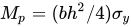
where
- is the width
- is the height
- is the yield stress


The plastic moment for a given section will always be larger than the yield moment (the bending moment at which the first part of the sections reaches the yield stress).
See also[edit]
References[edit]
- ^ MEGSON, T. H. G. (2019). STRUCTURAL AND STRESS ANALYSIS. BUTTERWORTH-HEINEMANN LTD. p. 236. ISBN 978-0081025864. OCLC 1048935955.