


Sumac
| Sumac Temporal range:
| |
|---|---|

| |
| Sumac fruit in the autumn season | |
Scientific classification 
| |
| Kingdom: | Plantae |
| Clade: | Tracheophytes |
| Clade: | Angiosperms |
| Clade: | Eudicots |
| Clade: | Rosids |
| Order: | Sapindales |
| Family: | Anacardiaceae |
| Subfamily: | Anacardioideae |
| Genus: | Rhus L.[1] |
| Type species | |
| Rhus coriaria | |
| Species[2] | |
|
54; see text | |
| Synonyms[2] | |
Sumac or sumach[a] (/ˈsuːmæk, ˈʃuː-/ S(H)OO-mak, UK also /ˈsjuː-/) is any of about 35 species of flowering plants in the genus Rhus and related genera in the cashew family (Anacardiaceae). Sumacs grow in subtropical and temperate regions throughout every continent except Antarctica and South America.[4][5][6] Sumac is used as a spice, as a dye, and in medicine.
Description
[edit]Sumacs are dioecious shrubs and small trees in the family Anacardiaceae that can reach a height of one to ten metres (3–33 ft). The leaves are usually pinnately compound, though some species have trifoliate or simple leaves. The flowers are in dense panicles or spikes 5–30 cm (2–12 in) long, each flower very small, greenish, creamy white or red, with five petals. The fruits are reddish, thin-fleshed drupes covered in varying levels of hairs at maturity and form dense clusters at branch tips, sometimes called sumac bobs.[citation needed]
Sumacs propagate both by seed (spread by birds and other animals through their droppings), and by new shoots from rhizomes, forming large clonal colonies.[citation needed]
Taxonomy
[edit]The taxonomy of Rhus has a long history, with de Candolle proposing a subgeneric classification with 5 sections in 1825. At its largest circumscription, Rhus, with over 250 species, has been the largest genus in the family Anacardiaceae.
Other authors used subgenera and placed some species in separate genera, hence the use of Rhus sensu lato and Rhus sensu stricto (s.s.). One classification uses two subgenera, Rhus (about 10 spp.) and Lobadium (about 25 spp.), while at the same time Cotinus, Duckera, Malosma, Metopium, Searsia and Toxicodendron segregated to create Rhus s.s.. Other genera that have been segregated include Actinocheita and Baronia. As defined, Rhus s.s. appears monophyletic by molecular phylogeny research. However, the subgenera do not appear to be monophyletic. The larger subgenus, Lobadium, has been divided further into sections, Lobadium, Terebinthifolia, and Styphonia (two subsections).[7][8][9]
Accepted species by continent
[edit]As of November 2024, Plants of the World Online accepts 54 species.[2]
Asia, North Africa and southern Europe
- Rhus amherstensis W.W.Sm.
- Rhus chinensis Mill. – Chinese sumac
- Rhus coriaria L. – Sicilian sumac, Tanner's sumac
- Rhus dhuna Buch.-Ham. ex Hook.f.
- Rhus potaninii Maxim. – Potanin's lacquer tree or Chinese varnish tree
- Rhus punjabensis J.L.Stewart ex Brandis
- Rhus taishanensis S.B.Liang
- Rhus teniana Hand.-Mazz.
- Rhus wilsonii Hemsl.
Australia, Pacific
- Rhus caudata Lauterb.
- Rhus lamprocarpa Merr. & L.M.Perry
- Rhus lenticellosa Lauterb.
- Rhus linguata Slis
- Rhus sandwicensis A.Gray – neneleau or Hawaiian sumac (Hawaii)
- Rhus taitensis Guill. (Northeast Australia, Malesia, Micronesia, French Polynesia)
North America
- Rhus allophyloides Standl.
- Rhus andrieuxii Engl.
- Rhus aromatica Aiton – fragrant sumac
- Rhus arsenei F.A.Barkley
- Rhus × ashei (Small) Greene (R. glabra × R. michauxii)
- Rhus bahamensis G.Don
- Rhus barclayi (Hemsl.) Standl.
- Rhus chondroloma Standl.
- Rhus choriophylla Wooton & Standl.
- Rhus ciliolata Turcz.
- Rhus copallinum L. – winged or shining sumac
- Rhus duckerae F.A.Barkley
- Rhus galeottii Standl.
- Rhus glabra L. – smooth sumac
- Rhus integrifolia (Nutt.) Benth. & Hook.f. ex W.H.Brewer & S.Watson – lemonade sumac
- Rhus jaliscana Standl.
- Rhus kearneyi F.A.Barkley – Kearney sumac
- Rhus lanceolata (A.Gray) Britton – prairie sumac
- Rhus lentii Kellogg
- Rhus michauxii Sarg. – Michaux's sumac
- Rhus microphylla Engelm. – desert sumac, littleleaf sumac
- Rhus muelleri Standl. & F.A.Barkley
- Rhus nelsonii F.A.Barkley
- Rhus oaxacana Loes.
- Rhus ovata S.Watson – sugar sumac
- Rhus pachyrrhachis Hemsl.
- Rhus palmeri Rose
- Rhus × pulvinata Greene (R. glabra × R. typhina)
- Rhus rubifolia Turcz.
- Rhus schiedeana Schltdl.
- Rhus schmidelioides Schltdl.
- Rhus standleyi F.A.Barkley
- Rhus tamaulipana B.L.Turner
- Rhus tepetate Standl. & F.A.Barkley
- Rhus terebinthifolia Schltdl. & Cham.
- Rhus trilobata Nutt. – skunkbush sumac
- Rhus typhina L. – staghorn sumac
- Rhus vestita Loes.
- Rhus virens Lindh. ex A.Gray– evergreen sumac
- †Rhus boothillensis Flynn, DeVore, & Pigg-Ypresian, Washington
- †Rhus garwellii Flynn, DeVore, & Pigg-Ypresian, Washington
- †Rhus malloryi Wolfe & Wehr – Ypresian, Washington
- †Rhus republicensis Flynn, DeVore, & Pigg-Ypresian, Washington
- †Rhus rooseae Manchester – Middle Eocene, Oregon
Formerly placed here
[edit]- Searsia mysorensis (G.Don) Moffett (as Rhus mysorensis G.Don) – Mysore sumac
Etymology
[edit]The word sumac traces its etymology from Old French sumac (13th century), from Mediaeval Latin sumach, from Arabic summāq (سماق), from Syriac summāqa (ܣܘܡܩܐ)- meaning "red".[10] The generic name Rhus derives from Ancient Greek ῥοῦς (rhous), meaning "sumac", of unknown etymology; the suggestion that it is connected with the verb ῥέω (rheō), "to flow", is now rejected by scholars.[11][12][13]
-
 Drupes of a staghorn sumac in Coudersport, Pennsylvania
 -
 A young branch of staghorn sumac
 -
 Winged sumac leaves and flowers
 -
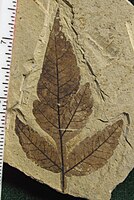 Rhus hybrid fossil – about 49.5 million years old, Early Ypresian, Klondike Mountain Formation, Washington
 -
 Iranian sumac


Cultivation and uses
[edit]
Species including the fragrant sumac (R. aromatica), the littleleaf sumac (R. microphylla), the smooth sumac (R. glabra), and the staghorn sumac (R. typhina) are grown for ornament, either as the wild types or as cultivars.[14][15][16][17]
In food
[edit]The dried fruits of some species are ground to produce a tangy, crimson spice popular in many countries.[18][19] Fruits are also used to make a traditional "pink lemonade" beverage by steeping them in water, straining to remove the hairs that may irritate the mouth or throat, sometimes adding sweeteners such as honey or sugar. Sumac's tart flavor comes from high amounts of malic acid.[20]
The fruits (drupes) of Rhus coriaria are ground into a reddish-purple powder used as a spice in Middle Eastern cuisine to add a tart, lemony taste to salads or meat.[18] In Arab cuisine, it is used as a garnish on meze dishes such as hummus and tashi, it is also commonly added to falafel. Syria uses the spice also, it is one of the main ingredients of Kubah Sumakieh in Aleppo of Syria, it is added to salads in the Levant, as well as being one of the main ingredients in the Palestinian dish musakhan. In Afghan, Armenian, Iraqi, Iranian and Mizrahi cuisines, sumac is added to rice or kebab. In Armenian, Azerbaijani, Central Asian, Syrian, Iraqi, Jordanian, Palestinian, Lebanese, Turkish and Kurdish cuisines, it is added to salads, kebab and lahmajoun. Rhus coriaria is used in the spice mixture za'atar.[21][22]
During medieval times, primarily from the thirteenth to fifteenth centuries, sumac appeared in cookbooks frequently used by the affluent in Western Europe. One dish in particular called sumāqiyya, a stew made from sumac, was frequently rendered as "somacchia" by Europeans.[23]
In North America, the smooth sumac (R. glabra), three-leaf sumac (R. trilobata), and staghorn sumac (R. typhina) are sometimes used to make a beverage termed "sumac-ade", "Indian lemonade", or "rhus juice".[citation needed] This drink is made by soaking the drupes in cool water, rubbing them to extract the essence, straining the liquid through a cotton cloth, and sweetening it. Native Americans also use the leaves and drupes of these sumacs combined with tobacco in traditional smoking mixtures.[24][25][26]
Dye and tanning agent
[edit]The leaves and bark of most sumac species contain high levels of tannins and have been used in the manufacturing of leather by many cultures around the world. The Hebrew name og ha-bursaka'im means "tanner's sumac", as does the Latin name of R. coriaria. The leaves of certain sumacs yield tannin (mostly pyrogallol-type), a substance used in vegetable tanning. Notable sources include the leaves of R. coriaria, Chinese gall on R. chinensis, and wood and roots of R. pentaphylla. Leather tanned with sumac is flexible, light in weight, and light in color. One type of leather made with sumac tannins is morocco leather.[27]
The dyeing property of sumac needed to be considered when it was shipped as a fine floury substance in sacks as a light cargo accompanying heavy cargoes such as marble. Sumac was especially dangerous to marble: "When sumac dust settles on white marble, the result is not immediately apparent, but if it once becomes wet, or even damp, it becomes a powerful purple dye, which penetrates the marble to an extraordinary depth."[28]
Ibn Badis describes a formula for making red ink out of leeched sumac mixed with gum.[29]
Sumac-dye (黄櫨染, kōrozen) was used only for the outerwear of the Emperor of Japan, thus being one of the forbidden сolors.[30][31]
Traditional medicinal use
[edit]Sumac was used as a treatment for several different ailments in medieval medicine, primarily in Middle Eastern and South Asian countries (where sumac was more readily available than in Europe). An 11th-century shipwreck off the coast of Rhodes, excavated by archeologists in the 1970s, contained commercial quantities of sumac drupes. These could have been intended for use as medicine, as a culinary spice, or as a dye.[32] A clinical study showed that dietary sumac decreases the blood pressure in patients with hypertension and can be used as adjunctive treatment.[33]
Other uses
[edit]Some beekeepers use dried sumac bobs as a source of fuel for their smokers.[34]
Sumac stems also have a soft pith in the center that is easily removed to make them useful in traditional Native American pipemaking. They were commonly used as pipe stems in the northern United States.[35]
Dried sumac wood fluoresces under long-wave ultraviolet radiation.[36]
Toxicity and control
[edit]Some species formerly recognized in Rhus, such as poison ivy (Toxicodendron radicans, syn. Rhus toxicodendron), poison oak (Toxicodendron diversilobum, syn. Rhus diversiloba), and poison sumac (Toxicodendron vernix, syn. Rhus vernix), produce the allergen urushiol and can cause severe delayed hypersensitivity reactions. Poison sumac may be identified by its white drupes, which are quite different from the red drupes of true Rhus species.[37]
Mowing of sumac is not a good control measure, since the wood is springy, resulting in jagged, sharp-pointed stumps when mown. The plant will quickly recover with new growth after mowing.[38] Goats have long been considered an efficient and quick removal method, as they eat the bark, which helps prevent new shoots. Sumac propagates by rhizome. Small shoots will be found growing near a more mature sumac tree via a shallow running root quite some distance from the primary tree. Thus, root pruning is a means of control without eliminating the plants altogether.[citation needed]
Explanatory notes
[edit]- ^ Other spellings include sumak, soumak, and sumaq.
References
[edit]- ^ "Rhus L." Germplasm Resources Information Network. United States Department of Agriculture. 2009-11-23. Retrieved 2010-02-09.
- ^ a b c "Rhus L.". Plants of the World Online. Royal Botanic Gardens, Kew. Retrieved 3 November 2024.
- ^ "Rhus L." TROPICOS. Missouri Botanical Garden. Retrieved 2010-02-09.
- ^ "Rhus in Flora of China @ efloras.org". www.efloras.org. Retrieved 2023-02-08.
- ^ "USDA Plants Database". plants.usda.gov. Retrieved 2023-02-08.
- ^ Miller, Allison J.; Young, David A.; Wen, Jun (2001). "Phylogeny and Biogeography of Rhus (Anacardiaceae) Based on ITS Sequence Data". International Journal of Plant Sciences. pp. 1401–1407. doi:10.1086/322948. Retrieved 20 September 2023.
- ^ Miller et al 2001.
- ^ Pell 2004.
- ^ Andrés-Hernández & Terrazas 2009.
- ^ "sumac". www.etymonline.com. Retrieved 26 June 2020.
- ^ "Rhus | Definition of Rhus by Oxford Dictionary on Lexico.com also meaning of Rhus". Lexico Dictionaries | English. Archived from the original on March 19, 2022.
- ^ "ῥοῦς - Ancient Greek (LSJ) 👍". lsj.gr.
- ^ Totelin, Laurence M. V. (October 10, 2009). Hippocratic Recipes: Oral and Written Transmission of Pharmacological Knowledge in Fifth- And Fourth-Century Greece. BRILL. ISBN 978-9004171541 – via Google Books.
- ^ "Plant Database: Rhus typhina". www.wildflower.org. 2015-06-18. Retrieved 2020-09-28.
- ^ "Plant Database: Rhus glabra". www.wildflower.org. 2017-12-12. Retrieved 2020-09-28.
- ^ "Plant Database: Rhus aromatica". www.wildflower.org. 2017-11-03. Retrieved 2020-09-28.
- ^ "Plant database: Rhus microphylla". www.wildflower.org. 2009-02-20. Retrieved 2020-09-28.
- ^ a b One may use sumac as a tisane or tea substitute by boiling the dried leaves.Sumac - Ingredients - Taste.com.au
- ^ "North American Sumacs You Should Know About". The Spruce. Retrieved 2023-02-08.
- ^ "Comparative Study on the Chemical Composition of Syrian Sumac ( Rhus coriaria L.) and Chinese Sumac ( Rhus typhina L.) Fruits".
- ^ Christine Manfield, Charlie Trotter, Ashley Barber -Spice 2008 - Page 28 "Sumac This reddish ground spice is made from the berries of the sumac bush,"
- ^ Aliza Green Field Guide to Herbs & Spices: How to Identify, Select, and Use ... 2006 - Page 257 "In Lebanon, Syria, and Egypt, sumac is cooked with water to a thick sour paste, which is added to meat and vegetable dishes; this method was also common in Roman times. Sumac appears in the middle eastern spice mixture za'atar (page 288) ..."
- ^ Ibn Sayyār al-Warrāq, al-Muẓaffar ibn Naṣr (2010). Annals of the Caliphs' Kitchens: Ibn Sayyār al-Warrāq's Tenth-century Baghdadi Cookbook (Rev. ed.). Leiden, Netherlands: Brill. ISBN 978-90-04-18811-2. OCLC 773412426.
- ^ "BRIT Native American Ethnobotany Database, Rhus glabra".
- ^ "BRIT Native American Ethnobotany Database, Rhus trilobata".
- ^ "BRIT Native American Ethnobotany Database, Rhus typhina".
- ^ Davis, Charles Thomas (1885). The Manufacture of Leather: Being a Description of All of the Processes for the Tanning, Tawing, Currying, Finishing and Dyeing of Every Kind of Leather. Philadelphia, H. C. Baird & co.; etc.
- ^ Lee, Arthur (1888). Marble and marble workers: a handbook for architects, artists, masons and students. London: Crosby Lockwood & Son. p. 19.
- ^ Levey, Martin (1962). "Mediaeval Arabic Bookmaking and Its Relation to Early Chemistry and Pharmacology". Transactions of the American Philosophical Society. 52 (4): 24. doi:10.2307/1005932.
- ^ Shaver, R. (2013). Kabuki Costume. Tuttle Publishing. p. 79. ISBN 9781462903986.
- ^ Nihon Shikisai Gakkai (1985). Shinpen shikisai kagaku handobukku (in Japanese). Tokyo Daigaku Shuppankai. ISBN 4-13-061000-7.
- ^ Bass, George Fletcher; Allan, James W. (2003). Serçe Limanı: An Eleventh-century Shipwreck. Texas A&M University Press. p. 506. ISBN 978-0-89096-947-2.
- ^ Ardalani, Hamidreza; Moghadam, Maryam Hassanpour; Rahimi, Roja; Soltani, Jalal; Mozayanimonfared, Azadeh; Moradi, Mehdi; Azizi, Ali (2016). "Sumac as a novel adjunctive treatment in hypertension: a randomized, double-blind, placebo-controlled clinical trial". RSC Advances. 6 (14): 11507–11512. Bibcode:2016RSCAd...611507A. doi:10.1039/C5RA22840A.
- ^ Avitabile, Alphonse. Sammataro, Diana. The Beekeeper's Handbook. Publisher: Comstock 1998. ISBN 978-0801485039
- ^ Lewis, Thomas H. The Medicine Men: Oglala Sioux Ceremony and Healing. Publisher: University of Nebraska Press. 1992. ISBN 978-0803279391
- ^ Hoadley, R. Bruce (2000). "Chapter 5: Other Properties of Wood". Understanding Wood: a Craftsman's Guide to Wood Technology (2 ed.). Taunton Press. pp. 105–107. ISBN 978-1-56158-358-4.
- ^ "Poison sumac". Encyclopedia Brittanica.
- ^ Ortmann, John; Miles, Katherine L.; Stubbendieck, James H.; Schacht, Walter (1997). "Management of Smooth Sumac on Grasslands". Historical Materials from University of Nebraska-Lincoln Extension. University of Nebraska-Lincoln. Retrieved July 27, 2024.
Further reading
[edit]- Andrés-Hernández, A. R.; Terrazas, Teresa (October 2009). "Leaf architecture of Rhus s.str. (Anacardiaceae)". Feddes Repertorium. 120 (5–6): 293–306. doi:10.1002/fedr.200911109.
- Miller, Allison J.; Young, David A.; Wen, Jun (2001). "Phylogeny and Biogeography of Rhus (Anacardiaceae) Based on ITS Sequence Data". International Journal of Plant Sciences. 162 (6): 1401–1407. doi:10.1086/322948. S2CID 85287571.
- Moffett, RO. "A Revision of Southern African Rhus species". FSA (Flora of South Africa) vol 19 (3) Fascicle 1.
- Pell, Susan Katherine (May 2004). Molecular systematics of the cashew family (Anacardiaceae) (PDF) (PhD). Department of Biological Sciences, Louisiana State University. Archived from the original (PDF) on 14 July 2010.
- Schmidt, Ernst; Lötter, Mervyn; McCleland, Warren (2002). Trees and Shrubs of Mpumalanga and Kruger National Park. Jacana Media. ISBN 978-1-919777-30-6.
External links
[edit] Media related to Rhus at Wikimedia Commons

| Authority control databases: National |
|---|
