


Suzhou
Suzhou
苏州市 Soochow, Sou-tseu | |
|---|---|
 | |
 Location of Suzhou in Jiangsu | |
  Suzhou | |
| Coordinates (Suzhou municipal government): 31°18′00″N 120°37′10″E / 31.30000°N 120.61944°E | |
| Country | People's Republic of China |
| Province | Jiangsu |
| County-level divisions | 11 |
| Established | 514 BC |
| Municipal seat | Gusu District |
| Government | |
| • Type | Prefecture-level city |
| • Party Secretary | Liu Xiaotao |
| • Mayor | Wu Qingwen |
| Area | |
| • Prefecture-level city | 8,488.42 km2 (3,277.40 sq mi) |
| • Land | 5,851 km2 (2,259 sq mi) |
| • Water | 2,394.50 km2 (924.52 sq mi) |
| • Urban | 2,944.4 km2 (1,136.8 sq mi) |
| • Metro | 12,493 km2 (4,824 sq mi) |
| Population (2020 census) | |
| • Prefecture-level city | 12,748,252 |
| • Density | 1,500/km2 (3,900/sq mi) |
| • Urban | 6,715,559 |
| • Urban density | 2,300/km2 (5,900/sq mi) |
| Demonym | Suzhounese |
| GDP[2] | |
| • Prefecture-level city | CN¥ 2.272 trillion US$ 352.2 billion |
| • Per capita | CN¥ 178,207 US$ 27,629 |
| Time zone | UTC+8 (Beijing Time) |
| Postal code | 215000 |
| Area code | 512 |
| ISO 3166 code | CN-JS-05 |
| HDI (2015) | 0.868– very high[3] |
| City flower | Osmanthus |
| City tree | Camphor laurel |
| Regional dialect | Wu: Suzhou dialect |
| License plate prefix | 苏E and 苏U[4] |
| Website | www |


| Suzhou | |||||||||||||||||||||||||||||||
|---|---|---|---|---|---|---|---|---|---|---|---|---|---|---|---|---|---|---|---|---|---|---|---|---|---|---|---|---|---|---|---|
.svg) "Suzhou" in Simplified (top) and Traditional (bottom) Chinese characters | |||||||||||||||||||||||||||||||
| Simplified Chinese | 苏州 | ||||||||||||||||||||||||||||||
| Traditional Chinese | 蘇州 | ||||||||||||||||||||||||||||||
| |||||||||||||||||||||||||||||||
Suzhou (/suːˈdʒoʊ/;[5] Chinese: 苏州; Suzhounese: sou¹ tseu¹ [səu˦ tsøʏ˦], Mandarin: [sú.ʈʂóʊ]), alternately romanized as Soochow, is a major prefecture-level city in southern Jiangsu province, China. As part of the Yangtze Delta megalopolis, it is a major economic center and focal point of trade and commerce.
Founded in 514 BC, Suzhou rapidly grew in size by the Eastern Han dynasty, mostly due to emigration from northern China.[6] From the 10th century onwards, it has been an important economic, cultural, and commercial center,[7] as well as the largest non-capital city in the world, until it was overtaken by Shanghai.[8][9] Since economic reforms began in 1978, Suzhou attained GDP growth rates of about 14% in 35 years.[10][11] In 2023, Suzhou had 5 million registered residents.[12] Suzhou is listed as the 48th cities by scientific output according to the Nature Index 2022.[13] The city is home to universities, including Soochow University, Suzhou University of Science and Technology, Xi'an Jiaotong–Liverpool University, and Changshu Institute of Technology.[14][15]
The city's tourist attractions include canals, stone bridges, pagodas, and gardens. The Classical Gardens of Suzhou were added to the list of the UNESCO World Heritage Sites in 1997 and 2000.[16][17][18]
Names
[edit]During the Zhou dynasty, a settlement known as Gusu after nearby Mount Gusu (Chinese: 姑苏山; pinyin: Gūsūshān) became the capital of the state of Wu. From this role, it also came to be called Wu as well. In 514 BC, King Helü of Wu established a new capital nearby at Helü City and this grew into the modern city. During the Warring States period, Helü City continued to serve as the local seat of government. From the areas it administered, it became known as Wuxian (lit. "Wu County") and Wujun ("Wu Commandery").[19] Under the Qin, it was known as Kuaiji after its greatly enlarged commandery, which was named for the reputed resting place of Yu the Great near modern Shaoxing in Zhejiang.
The name "Suzhou" was first officially used for the city in AD 589 during the Sui dynasty. Su (蘇 or 苏) in its name is a contraction of the old name Gusu. It refers to "Satisfied place" in the Old Yue language. The zhou 州 originally meant something like a province or county (cf. Guizhou), but often came to be used metonymously for the capital of such a region (cf. Guangzhou, Hangzhou, etc.).[20] Suzhou is the Hanyu Pinyin spelling of the Putonghua pronunciation of the name. Prior to the adoption of pinyin, it was variously romanized as Soo-chow, Suchow, or Su-chow.[21][22]
History
[edit]Suzhou, the cradle of Wu culture,[23][24] is one of the oldest towns in the Yangtze Basin. By the Spring and Autumn period of the Zhou, local Baiyue tribes named the Gou Wu are recorded living in the area which would become the modern city of Suzhou. These tribes formed villages on the edges of the hills above the wetlands surrounding Lake Tai.
Sima Qian's Records of the Grand Historian records traditional accounts that the Zhou lord Taibo established the state of Wu at nearby Wuxi during the 11th century BC, civilizing the local people and improving their agriculture and mastery of irrigation. The Wu court later moved to Gusu within the area of modern Suzhou. In 514 BC,[25] King Helü of Wu relocated his court nearby and called the settlement Helü City after himself. His minister Wu Zixu was closely involved with its planning and it was this site that grew into present-day Suzhou. The height of his tower on Gusu Hill (Gusutai) passed into Chinese legend. In 496 BC, King Helü was buried at Tiger Hill. In 473 BC, Wu was defeated and annexed by Yue, a kingdom to its southeast; Yue was annexed in turn by Chu in 306 BC. Remnants of the ancient kingdom include pieces of its 2,500-year-old city wall and the gate through it at Pan Gate.
The city was originally laid out according to a symbolic three-by-three grid of nine squares, with the royal palace occupying the central position.[26]
During the Warring States period, Suzhou was the seat of Wu County (吳縣, Wú xiàn) and Commandery (吳郡, Wú jùn). Following the Qin Empire's conquest of the area in 222 BC, it was made the capital of Kuaiji Commandery, including lands stretching from the south bank of the Yangtze to the unconquered interior of Minyue in southern Zhejiang. Amid the collapse of the Qin, Kuaiji's governor Yin Tong attempted to organize his own rebellion only to be betrayed and executed by Xiang Liang and his nephew Xiang Yu, who launched their own rebellion from the city.

When the Grand Canal was completed, Suzhou found itself strategically located on a major trade route.[21] Suzhou served as the regional metropolis of industry and foreign commerce on the southeastern coast of China. During the Tang dynasty, the great poet Bai Juyi constructed the Shantang Canal (better known as "Shantang Street") to connect the city with Tiger Hill for tourists. In AD 1035, the Suzhou Confucian Temple was founded by famed poet and writer Fan Zhongyan. It became a venue for the imperial civil examinations and then developed into the modern Suzhou High School in the 1910s.

After February 1130, riots and unrest disrupted Suzhou.[27] In 1356, Suzhou became the capital of Zhang Shicheng, King of Wu. In 1367, Zhang's rival Zhu Yuanzhang took the city after a 10-month siege. Zhu – who was soon to proclaim himself the first emperor of the Ming dynasty – demolished the old city walls at the center of Suzhou's walled city and imposed crushing taxes on the city and prefecture's powerful families.[28] Despite the heavy taxation and the forced exile of some prominent citizens' south, Suzhou was soon prosperous again. During the early Ming, Suzhou Prefecture supervised the Yangtze shoals which later became Shanghai's Chongming Island.[29] For centuries the city, with its surroundings as an economic base, represented an extraordinary source of tax revenue.[30]
When the shipwrecked Korean official Choe Bu had a chance to see much of Eastern China from Zhejiang to Liaoning on his way home in 1488, he described Suzhou in his travel report as exceeding every other city.[31] Under the Ming, Suzhou was a prosperous center of the Nanzhili area controlled by the secondary capital at Nanjing; scholar-officials constructed the area's most famous private gardens during this period in a "Jiangnan style" copied at the time by Shanghai's Yu Garden and later by parts of the empress dowager Cixi's Summer Palace.
After the Qing occupied the area in 1644 and 1645, it was reorganized as Jiangnan Province, whose "Right" Governor controlled its eastern prefectures from Suzhou until the division of Jiangnan into the separate provinces of Jiangsu and Anhui at some point during the reign of the Qianlong Emperor. The Taipings captured the city in 1860. Many of its former buildings and gardens were "almost... a heap of ruins"[21] by the time of their recovery by Charles Gordon's Ever-Victorious Army in November 1863.[22] Nonetheless, by 1880, its population was estimated to have recovered to about 500,000,[21] which remained stable for the next few decades.[22] In the late 19th century, the town was particularly known for its wide range of silks and its Chinese-language publishing industry.[21] The town was first opened to direct foreign trades by the Treaty of Shimonoseki ending the First Sino-Japanese War[22] and by the most favored nation clauses of earlier unequal treaties with the Great Powers. The new expatriates opened a European-and-Chinese school in 1900 and the Suzhou railway station, connecting it with Shanghai, opened[22] on 16 July 1906. Just prior to World War I, there were 7000 silk looms in operation, as well as a cotton mill and a large trade in rice.[22]

As late as the early 20th century, much of the city consisted of islands connected by rivers, creeks, and canals to the surrounding countryside.[22] Prior to their demolition, the city walls ran in a circuit of about 10 miles (16 km) with four large suburbs lying outside.[22] The Japanese invaded in 1937, and many gardens were again devastated by the end of the war. In the early 1950s, restoration was done on the Humble Administrator's Garden and the Lingering Garden.
Administrative divisions
[edit]The urban core of Suzhou, Gusu District, is informally called the "Old Town." Suzhou Industrial Park is to the east of the old town, and Suzhou High & New Technology Development Zone is to the west. In 2000, the original Wu County was divided into two districts, Xiangcheng and Wuzhong. They now form the northern and southern parts of the city of Suzhou. In 2012, the original Wujiang City became Wujiang District of Suzhou City.
Suzhou is one of the most prosperous cities in China. Its development has a direct correlation with the growth of its satellite cities, including Kunshan, Taicang, Changshu, and Zhangjiagang, which together with the city of Suzhou form the Suzhou prefecture. The Suzhou prefecture is home to many high-tech enterprises.
| Map | |||||
|---|---|---|---|---|---|
| Subdivision | Simplified Chinese | Hanyu Pinyin | Population (2020)[32] | Area (km2) | Density (/km2) |
| City Proper | |||||
| Gusu District | 姑苏区 | Gūsū Qū | 2,058,010 | 372 | 5,532.28 |
| Suburban | |||||
| Huqiu District | 虎丘区 | Hǔqiū Qū | 832,499 | 258 | 3,226.74 |
| Wuzhong District | 吴中区 | Wúzhōng Qū | 1,388,972 | 672 | 2,066.92 |
| Xiangcheng District | 相城区 | Xiāngchéng Qū | 891,055 | 416 | 2,141.95 |
| Wujiang District | 吴江区 | Wújiāng Qū | 1,545,023 | 1,093 | 1,413.56 |
| Satellite cities (County-level cities) | |||||
| Changshu City | 常熟市 | Chángshú Shì | 1,677,050 | 1,094 | 1,532.95 |
| Taicang City | 太仓市 | Tàicāng Shì | 831,113 | 620 | 1,340.50 |
| Kunshan City | 昆山市 | Kūnshān Shì | 2,092,496 | 865 | 2,419.07 |
| Zhangjiagang City | 张家港市 | Zhāngjiāgǎng Shì | 1,432,044 | 772 | 1,854.97 |
| Total | 12,748,252 | 8,488 | 1,501.84 | ||
| Not formal administrative subdivisions – Suzhou Industrial Park & Suzhou New District Defunct districts – Canglang District, Pingjiang District, & Jinchang District | |||||

Geography
[edit]Suzhou is on the Lake Tai Plain south of the Yangtze River, about 100 km (60 mi) to the west of Shanghai and just over 200 km (120 mi) east of Nanjing.
Climate
[edit]Suzhou has a four-season humid subtropical climate with hot, humid summers and cool, cloudy, damp winters with occasional snowfall (Köppen climate classification Cfa). Northwesterly winds blowing from Siberia during winter can cause temperatures to fall below freezing at night, while southerly or southwesterly winds during the summer can push temperatures above 35 °C (95 °F). The hottest temperature recorded since 1951 was at 41.0 °C (106 °F) on 7 August 2013,[33][34][35] and the lowest at −9.8 °C (14 °F) on 16 January 1958, though an unofficial record low of −12 °C (10 °F) was recorded on 10 January 1933.[36][37]
| Climate data for Suzhou (Wuzhong District) (1991–2020 normals, extremes 1951–present) | |||||||||||||
|---|---|---|---|---|---|---|---|---|---|---|---|---|---|
| Month | Jan | Feb | Mar | Apr | May | Jun | Jul | Aug | Sep | Oct | Nov | Dec | Year |
| Record high °C (°F) | 22.5 (72.5) |
28.0 (82.4) |
31.9 (89.4) |
33.6 (92.5) |
35.8 (96.4) |
37.3 (99.1) |
39.7 (103.5) |
41.0 (105.8) |
37.4 (99.3) |
33.1 (91.6) |
27.2 (81.0) |
24.5 (76.1) |
41.0 (105.8) |
| Mean daily maximum °C (°F) | 8.4 (47.1) |
10.4 (50.7) |
15.2 (59.4) |
21.1 (70.0) |
26.1 (79.0) |
28.7 (83.7) |
33.0 (91.4) |
32.6 (90.7) |
28.4 (83.1) |
23.4 (74.1) |
17.4 (63.3) |
10.8 (51.4) |
21.3 (70.3) |
| Daily mean °C (°F) | 4.9 (40.8) |
6.4 (43.5) |
10.7 (51.3) |
16.3 (61.3) |
21.5 (70.7) |
24.9 (76.8) |
29.1 (84.4) |
28.8 (83.8) |
24.7 (76.5) |
19.5 (67.1) |
13.4 (56.1) |
7.0 (44.6) |
17.3 (63.1) |
| Mean daily minimum °C (°F) | 2.1 (35.8) |
3.4 (38.1) |
7.2 (45.0) |
12.5 (54.5) |
17.9 (64.2) |
22.0 (71.6) |
26.1 (79.0) |
26.0 (78.8) |
21.9 (71.4) |
16.3 (61.3) |
10.2 (50.4) |
4.0 (39.2) |
14.1 (57.4) |
| Record low °C (°F) | −9.8 (14.4) |
−6.6 (20.1) |
−3.7 (25.3) |
−0.5 (31.1) |
7.3 (45.1) |
13.3 (55.9) |
18.4 (65.1) |
18.6 (65.5) |
11.7 (53.1) |
2.8 (37.0) |
−2.2 (28.0) |
−8.5 (16.7) |
−9.8 (14.4) |
| Average precipitation mm (inches) | 98.8 (3.89) |
95.3 (3.75) |
129.3 (5.09) |
119.6 (4.71) |
92.5 (3.64) |
162.1 (6.38) |
92.1 (3.63) |
112.6 (4.43) |
122.3 (4.81) |
123.1 (4.85) |
94.9 (3.74) |
88.6 (3.49) |
1,331.2 (52.41) |
| Average precipitation days (≥ 0.1 mm) | 11.2 | 10.8 | 13.8 | 11.3 | 11.0 | 13.9 | 11.1 | 11.8 | 10.9 | 8.6 | 8.8 | 8.6 | 131.8 |
| Average snowy days | 2.7 | 1.9 | 0.4 | 0 | 0 | 0 | 0 | 0 | 0 | 0 | 0.2 | 0.8 | 6 |
| Average relative humidity (%) | 74 | 74 | 72 | 70 | 69 | 79 | 77 | 77 | 75 | 71 | 73 | 71 | 74 |
| Average dew point °C (°F) | 1.7 (35.1) |
2.7 (36.9) |
6.1 (43.0) |
11.2 (52.2) |
15.6 (60.1) |
21.4 (70.5) |
25.2 (77.4) |
25.0 (77.0) |
20.4 (68.7) |
14.1 (57.4) |
8.7 (47.7) |
2.1 (35.8) |
12.8 (55.2) |
| Mean monthly sunshine hours | 108.8 | 111.5 | 139.0 | 162.0 | 166.1 | 120.5 | 192.4 | 190.4 | 154.5 | 147.3 | 127.7 | 127.2 | 1,747.4 |
| Percent possible sunshine | 34 | 36 | 37 | 42 | 39 | 29 | 45 | 47 | 42 | 42 | 41 | 41 | 40 |
| Source: China Meteorological Administration[38][39] | |||||||||||||
Cityscape and environment
[edit]-

-

-
 Changmen at night
 -

-
-

-
 An entrance to the Youyicun Garden
 -

-


Classical Gardens of Suzhou
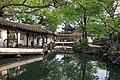
[edit]Suzhou is famous for its over 60 Classical Gardens, collectively a UNESCO World Heritage Site. The city has the most UNESCO-recognized gardens in the world.[40]
The Humble Administrator's Garden and Lingering Garden are among the four most famous classical gardens in China. The Canglang Pavilion, Lion Grove Garden, Humble Administrator's Garden and Lingering Garden, respectively representing the garden styles of traditional architecture are called the four most famous gardens in Suzhou. Other gardens inscribed on the World Heritage List include the Couple's Retreat Garden, the Garden of Cultivation, and the Retreat and Reflection Garden. Five Peaks Garden which dates to the Ming dynasty (1522–1566) is also located in the Suzhou. Ming painter Wen Boren established his home on the site. The original name was Qiayin Shanfang and the garden is located at Changmin West Street.[41]
This UNESCO World Heritage Site is inscribed as a single property, but composed of 9 separate gardens in Suzhou Prefecture | ||
 | ||
Temples
[edit]Canals and Historic Districts
[edit]
The Suzhou section of the Jiangnan Canal, Grand Canal (China), includes ten city gates and over 20 stone bridges of traditional design and historic areas that have been well preserved, as well as temples and pavilions. [42][43] [44] There are a full 24 waterways in Suzhou near the Grand Canal.[45]
In 2015, both 800-year-old Pingjiang Road Historical Block (平江路) and 1,200-year-old Shantang Street Scenic Area (山塘街) were added to the list of China's "National Historic and Cultural Streets".[46][47]
Pingjiang Road runs parallel to the Pingjiang River for 1.5 kilometers and is lined with homes and some teahouses. Shantang Street, over twice as long at 3.8 km, is described by the BBC as retaining "the alluring qualities of an old canal-side street: whitewashed buildings are completed by red-tasseled lanterns that swing softly in the breeze, adding to the charm of the river bank".[45]

Boat tours are offered on the waterways of this city that was dubbed the "Venice of the East" by Marco Polo because of its criss-crossing canals and stone bridges.[48][49] The Grand Canal (from Beijing to Zhejiang province) is a UNESCO World Heritage Site.
Resorts and natural reserves
[edit]Suzhou Taihu National Tourism and Vacation Zone (苏州太湖国家旅游度假区) is in the western part of Suzhou, 15 km (9 mi) from the city center.[50][51]
Skyscrapers
[edit]Gate to the East is a 301.8 meter, 74-story skyscraper in Suzhou's central business district, built in 2015 at a cost of 700 million USD and is currently the tallest building in Suzhou.[52]
Suzhou IFS is a 450 meter tall building home to 95 floors near Gate to the East. You can see the tower from Huqiu which is a special tourist attraction in Suzhou.
Pan Gate
[edit]
Pan Gate is on the southwest corner of the Main Canal or encircling canal of Suzhou. Originally built during the Warring States period in the state of Wu, historians estimate it to be around 2,500 years old. It is now part of the Pan Gate Scenic Area. It is known for the "three landmarks of Pan Gate". They are the Ruiguang Pagoda, the earliest pagoda in Suzhou built in 247 BC, the Wu Gate Bridge, the entrance to the gate at that time over the water passage and the highest bridge in Suzhou at the time, and the Pan Gate. The Ruigang Pagoda is constructed of brick with wooden platforms and has Buddhist carvings at its base.
Baodai Bridge
[edit]Baodai Bridge stretches across the Tantai Lake in the suburbs of Suzhou. To raise money to finance the bridge, the magistrate donated his expensive belt, hence the name. The bridge was first built in 806 A.D. in the Tang dynasty and has 53 arches with a length of 317 meters. It was made out of stone from Jinshan Mountain and is the longest standing bridge of its kind in China. The bridge was included on the list of national monuments (resolution 5–285) in 2001.
Tiger Hill
[edit]Tiger Hill is known for its natural environment and historical sites. The hill is so named because it is said to look like a crouching tiger. Another legend states that a white tiger appeared on the hill to guard it following the burial The hill has been a tourist destination for hundreds, if not thousands, of years, as is evident from the poetry and calligraphy carved into rocks on the hill. The Song dynasty poet, Su Shi said, "It is a lifelong pity if having visited Suzhou you did not visit Tiger Hill."
Pagodas
[edit]Yunyan Pagoda (or Huqiu Tower), built in 961, is a Chinese pagoda built on Tiger Hill in Suzhou. It has several other names, including the "Leaning Tower of China" (as referred to by historian O.G. Ingles)[53] and the Yunyan Temple Tower. The tower rises to a height of 47 m (154 ft). It is a seven-story octagonal building built with blue bricks. In more than a thousand years the tower has gradually slanted due to forces of nature. Now the top and bottom of the tower vary by 2.32 meters. The entire structure weighs some 7,000,000 kilograms (15,000,000 lb), supported by internal brick columns.[54] However, the tower leans roughly 3 degrees due to the cracking of two supporting columns.[54]
Beisi Pagoda or North Temple Pagoda is a Chinese pagoda at Bao'en Temple in Suzhou. It rises nine stories in a height of 76 m (249 ft). It is the tallest Chinese pagoda south of the Yangtze river.
Twin Pagodas (simplified Chinese: 苏州双塔; traditional Chinese: 蘇州雙塔) lie in the Dinghui Temple Lane in the southeastern corner of the city proper of Suzhou. They are artistic and natural as they are close at hand. One of them is called "Clarity-Dispensing Pagoda," and the other, the "Beneficence Pagoda"; they are in the same form of architecture. There are many legends about this one-thousand-year-old pagodas. It is charming that the exquisite and straight Twin Pagoda look like two inserted writing brushes. There was originally a single-story house with three rooms just like a writing brush holder with the shadows of the two pagodas reclining on its roof at sunset. To the east of the pagoda is a square five-story bell building built in the Ming dynasty which appears exactly like a thick ink stick. So there is a saying that "the Twin Pagodas are as writing brushes while the bell building as ink stick".
Museums
[edit]
The city's major museums include the Suzhou Museum (designed by I. M. Pei), Suzhou Silk Museum, and the China Kunqu Museum.
Hospitals
[edit]As a result of its recent rapid population increase, healthcare demand in Suzhou is increasing rapidly. In July 2019, Washington University School of Medicine announced a collaboration with Huici Health Management Co., and the Xiangcheng District, to open the new Huici Medical Center, which will include a 1,000-bed hospital for adult and pediatric patients. Once the hospital is unveiled, Washington University doctors in St. Louis will be able to provide long-distance health-care services to patients in China through a telemedicine program.[55][56]
Demographics
[edit]![[icon]](/wiki/File:Wiki_letter_w_cropped.svg) | This section needs expansion. You can help by adding to it. (August 2015) |
The population of Suzhou is predominantly Han Chinese. The official language of broadcast, instruction, etc. is Mandarin Chinese, although many speak a local dialect known as Suzhounese, a member of the Wu language family. In addition to American and European expatriates, there is a large Korean community in Suzhou. The Industrial Bank of Korea (IBK) estimated that there were 15,000 Koreans in the municipality in 2014. That year 850 Korean companies operated in Suzhou, and the Koreans made up the largest number of students at the Suzhou Singapore International School.[57]
| Region | Total population 总户籍人口 (persons) |
Resident population 常住人口 (10,000 persons) |
|---|---|---|
| Whole municipality | 6 670 124 | 1061.60 |
| Urban area | 3 412 564 | 549.21 |
| Gusu District | 734 362 | 95.20 |
| Wuzhong District | 631 602 | 112.12 |
| Xiangcheng District | 405 400 | 72.87 |
| New & Hi-tech Zone, Huqiu District | 363 713 | 59.08 |
| Industrial Park | 459 535 | 80.26 |
| Wujiang District | 817 952 | 126.68 |
| County-level cities | 3 257 560 | – |
| Changshu | 1 068 211 | 151.01 |
| Zhangjiagang | 922 757 | 125.31 |
| Kunshan | 787 031 | 165.12 |
| Taicang | 479 561 | 70.95 |
Economy
[edit]Suzhou's economy is based primarily on its large manufacturing sector—China's first largest(from 2020)—including iron and steel, IT and electronic equipment, and textile products. The city's service sector is notably well-developed, primarily owing to tourism, which brought in a total of RMB 152 billion of revenue in 2013. Suzhou's overall GDP exceeded RMB 1.3 trillion in 2013 (up 9.6 percent from the year previous).[59]
The city is also one of China's foremost destinations for foreign investment, based on its relative proximity to Shanghai and comparatively low operating costs. The municipal government has enacted various measures to encourage FDI in a number of manufacturing (e.g. pharmaceutical, electronic goods, automobile) and service (e.g. banking, logistics, research services) sectors. Included among these measures is a preferential tax policy for limited partnership venture capital enterprises in the Suzhou Industrial Park.[59]
Suzhou is a highly developed economic region in China and is the economic centre, industrial, commercial and logistical hub city of Jiangsu province, as well as an important financial, cultural, artistic, educational and transportation centre.
Agriculture
In 2013, total grain production reached 1,311,200 tonnes, a decrease of 2.9%. Grain supply was effectively guaranteed through the vigorous construction of commodity grain production bases, wholesale grain markets and reserve systems.[60]
Traditional handicrafts
Suzhou has a long history of reeling silkworms and has always been an important base for silk production in China. Since the Song and Yuan dynasties, Suzhou has been one of the centres of silk weaving and dyeing in the country, and in the Ming dynasty, Suzhou silk was praised as the "clothing of the world".[61]
Development zones
[edit]
Suzhou Industrial Park
[edit]The Suzhou Industrial Park (SIP) is the largest cooperative project between the Chinese and the Singaporean government. It is beside Jinji Lake, which lies to the east of the Suzhou Old City. On 26 February 1994, Vice Premier Li Lanqing and Senior Minister Lee Kuan Yew, representing China and Singapore respectively, signed an agreement to jointly develop Suzhou Industrial Park (originally called the Singapore Industrial Park). The project officially commenced on 12 May in the same year. SIP has a jurisdiction area of 288 km2 (111 sq mi), of which, the China-Singapore cooperation area covers 80 km2 (31 sq mi) with a planned residential population of 1.2 million.[62]
SIP is home to the Suzhou Dushu Lake Science and Education Innovation District, an area of universities and higher education institutions, including Soochow University and Xi'an Jiaotong-Liverpool University. Suzhou Industrial Park is also a popular residential district for many foreigners who work and live in Suzhou, as well as 'new Suzhou' residents who migrate to the area in search of work opportunities.

Suzhou Industrial Park Export Processing Zone
[edit]The Suzhou Industrial Park Export Processing Zone was approved to be established by the government in April 2000, with a planning area of 2.9 km2 (1.1 sq mi). It is in Suzhou Industrial Park set up by China and Singapore. Inside the Export Processing Zone, all the infrastructures are of high standard.[63]
Suzhou New District
[edit]The Suzhou New District was established in 1990. In November 1992, the zone was approved to be the national-level hi-tech industrial zone. By the end of 2007, foreign-invested companies had a registered capital worth of US$13 billion, of which US$6.8 billion was paid in. SND hosts now more than 1,500 foreign companies. Some 40 Fortune 500 companies set up 67 projects in the district.[64]
Sports
[edit]The Suzhou Dongwu currently play in China League One, the second highest level of Chinese professional football competition. The 13,000 seat Suzhou Industrial Park Sports Arena was one of the venues for the 2019 FIBA Basketball World Cup.[65]
Transportation
[edit]
Railway
[edit]Suzhou is on the Shanghai-Nanjing corridor which carries three parallel railways. Suzhou railway station, near the city center, is among the busiest passenger stations in China. It is served by the Beijing–Shanghai railway (mostly "conventional" trains to stations throughout China) and the Shanghai-Nanjing intercity railway (high-speed D- and G-series trains providing frequent service primarily between Shanghai and Nanjing). It takes only 25 minutes to reach Shanghai railway station on the fastest G-series trains and less than 1 hour to Nanjing.
The Suzhou North railway station, a few kilometers to the north, is on the Beijing–Shanghai high-speed railway (opened 2011), served by high-speed trains to Beijing, Qingdao, etc.
Other stations on the Beijing–Shanghai railway and the Shanghai–Nanjing intercity railway serve other points in the same corridor within Suzhou Prefecture-level city, such as Kunshan. In between Suzhou and Kunshan South railway station, Suzhou Industrial Park railway station is also an important station for people visiting and living in the areas.
The northern part of the prefectural area, including Zhangjiagang, Changshu and Taicang, were the last areas to be connected by rail; the Shanghai–Suzhou–Nantong railway reached there in 2020.[66]
Highways
[edit]The Nanjing-Shanghai Expressway connects Suzhou with Shanghai, alternatively, there is the Yangtze Riverine Expressway and the Suzhou-Jiaxing-Hangzhou Expressway. In 2005, the Suzhou Outer Ring was completed, linking the peripheral county-level cities of Taicang, Kunshan, and Changshu. China National Highway 312 also passes through Suzhou.
Water transport
[edit]Port of Suzhou, on the right bank of the Yangtze River, dealt with 428 million tons of cargo and 5.86 million TEU containers in 2012, which made it the busiest inland river port in the world by annual cargo tonnage and container volume.[67][68]
Metro
[edit]The Suzhou Rail Transit currently has six lines in operation and four other lines under construction. The masterplan consists of nine independent lines. Line 1 started operation on 28 April 2012, Line 2 started operation on 28 December 2013,[69] and Line 4 started operation in 2017, Suzhou Railway Line 5 began operation in June 2021. Suzhou railway Line 6 finished construction and opened in June of 2024. Line 7 and Line 8 and Line 11 are under construction, with a target date of completion at Q4 of 2024. The Suzhou rail system is connected with the Shanghai Metro via line 11, where it opened in June 2023.
Tram
[edit]
The Suzhou Tram system has two routes in the Suzhou New District.
Bus
[edit]Suzhou has public bus routes that run into all parts of the city. Fares are flat rated, usually 1 Yuan for a non-air-conditioned bus and 2 Yuan for an air-conditioned one.[citation needed] The Suzhou BRT, a 25-kilometer (16 mi)-long bus rapid transit system opened in 2008, operates 5 lines using elevated busways and bus-only lanes throughout the city.
Culture
[edit]

- Opera: Kunqu originated in the Suzhou region, as does the much later Suzhou Opera. Ballad-singing, or Suzhou pingtan, is a local form of storytelling that mixes singing (accompanied by the pipa and sanxian) with portions in spoken dialect.
- Silk: throughout China's Imperial past, Suzhou silk has been associated with high-quality silk products, supplying silks to ancient royal families. By the 13th century, Suzhou was already the center of the profitable silk trade.
- Song brocade: Suzhou Song-style brocade is one of China's three famous brocades, together with Nanjing Yun brocade and Sichuan Shu brocade.[70] This Song-style brocade, made of silk, has a thin yet strong material with flashy colors, exquisite patterns, and soft texture.[71] Suzhou's brocade production can be traced back to the Five Dynasties. It prospered in the Song dynasty. After the government moved the capital southward, the country's political and cultural center moved to the Yangtze River area.
- Cuisine: Suzhou cuisine (苏帮菜), which is part of Jiangsu cuisine, including Yangcheng Lake large crab, Squirrel fish, etc.[72]
- Handicrafts: Suzhou embroidery, fans, Chinese musical instruments, scroll mounting, lanterns, mahogany furniture, jade carving, silk tapestry, traditional painting pigments of Jiangenxutang Studio, the New Year's wood-block prints of Taohuawu Studio.
- Paintings
- Calligraphic art
- Suzhou Silk Hand Embroidery Art
- Suzhou is the original place of "Jasmine", a song sung by Chinese singers or actresses thousands of times on the occasions of almost every important meetings or celebrations. Jasmine is the symbol of Suzhou as well as Tai Hu Lake.
- Suzhou Gardens: Gardens in Suzhou have an ancient history. The first garden in Suzhou belonged to the emperor of Wu State in Spring and Autumn period (600 BC). More than 200 gardens existed in Suzhou between the 16th and 18th centuries. Gardens in Suzhou were built according to the style of Chinese Paintings. Every view in a garden can be seen as a piece of Chinese Painting and the whole garden is a huge piece of Chinese Paintings. At present, the Humble Administrator's Garden, built in 16th, is the largest private garden in Suzhou. It belonged to by Wang Xianchen, an imperial censor. [citation needed]
- Suzhou embroidery together with embroidery of Hunan, Sichuan and Guangdong are called as the "Four Famous Embroideries". Suzhou tapestry method is done in fine silks and gold thread. Other art forms found in this area are sculpture, Song brocade, jade and rosewood carving. Suzhou embroidery, acknowledged as a cultural heritage, has involved many cultural practitioners in advancing technology and skills with ICH-resources to better engage in economic pursuits.[73]
- The Suzhou Museum has a rich collection of relics from many eras. The collection includes revolutionary records, stele carving, folk customs, drama and verse, Suzhou embroidery, silk cloth, gardens, coins and Buddhist artifacts.[74]
- Wedding gowns[75]
Notable people
[edit]Lu Xun (陆逊) (183–245) military general and politician of the state of Eastern Wu during the Three Kingdoms era, most famous for his defeat of Liu Bei in the Battle of Xiaoting.
Feng Menglong (冯梦龙) (1574–1645) famous vernacular writer and poet of the late Ming dynasty.
Tang Yin (唐寅) (1470–1524) one of the most renowned painter in China history, calligrapher, and poet of the Ming dynasty, better known by his courtesy name Tang Bohu (Chinese: 唐伯虎)[76]
Wen Zhengming (文徵明) (1470–1559) Painter and poet of the Ming dynasty, the founder of Wu School (Chinese: 吴门画派), one of Four Masters of the Ming Dynasty
Weng Tonghe (翁同龢) (1830–1904) Chinese Confucian scholar and imperial tutor of the Tongzhi and Guangxu emperors in the late Qing dynasty, who is one of the most obdurate old guard defending the traditional Confucianism practices while being stubbornly against reform efforts to westernise the country.[77]
I. M. Pei (贝聿铭) (1917–2019) One of the best architects in China history, being recognised as the 'last master of high modernist architecture',[78] famous for his design of Louvre Pyramid, Hong Kong Bank of China tower, Singapore OCBC Centre, East Building of National Gallery of Art in Washington, D.C., Germany Historical Museum, etc.[79]
Cheng Kaijia (程开甲) (1918–2018) A nuclear physicist and engineer. One of the key figure in China's nuclear weapons development and a founding father of the Two Bombs, One Satellite project.
Tsung-Dao Lee (李政道) (1926–2024) Physicist, who won the Nobel Prize in Physics in 1957 at the age of 30, for his work on the violation of the parity law in weak interactions.[80]
Meng Jianzhu (孟建柱) (1947–) Politician, former member of the Politburo and Secretary of the Central Political and Legal Affairs Commission
Education
[edit]Universities and colleges
[edit]

- Changshu Institute of Technology
- Duke Kunshan University
- KEDGE Business School
- Jiangnan Social University
- Jiangsu University Zhangjiagang Campus
- Renmin University of China Suzhou Campus
- Skema Business School – Chinese campus of the French business school
- Soochow University
- Suzhou Polytechnic Institute of Agriculture
- Suzhou University of Science and Technology
- Xi'an Jiaotong-Liverpool University
- Suzhou City University
Under construction
[edit]- Nanjing University Suzhou Campus
- Northwestern Polytechnical University Taicang Campus
High schools
[edit]- Changshu High School
- Dulwich College Suzhou
- Dulwich International High School Suzhou
- Kunshan Senior High School
- SIP Experimental Middle School
- Suzhou Experimental High School
- Suzhou High School
- Suzhou Singapore International School
- Suzhou No.1 High School
- Suzhou No.10 High School
- Suzhou Wuxian High School (苏州吴县中学)
- Taicang Senior High School
- United World College (UWC) Changshu China
- Zhenze Middle School
- Jiangsu Province Mudu senior High School
Postgraduate institutions
[edit]- Southeast University-Monash University Joint Graduate School
- Suzhou Dushu Lake Higher Education Town (National University of Singapore and Fudan Joint Graduate School, Nanjing University Graduate School, etc.)
Others
[edit]- Japanese School of Suzhou
- Overseas Chinese Academy Chiway Suzhou (苏州工业园区海归人才子女学校)[81]
See also
[edit]
Notes
[edit]References
[edit]- ^ "Table showing land area and population". Suzhou People's Government. 2003. Archived from the original on 2 December 2007. Retrieved 7 September 2007.
- ^ "2021年江苏13市Gdp出炉 苏州2.27万亿位居第一". Archived from the original on 26 January 2022. Retrieved 26 January 2022.
- ^
Calculated using data from Suzhou Statistics Bureau. Life Expectancy Index = 0.9672, Education Index = 0.8244, Income Index = 0.868. Refs:
- Suzhou Bureau of Statistics (苏州市统计局). 2016年苏州市情市力 (PDF). Archived (PDF) from the original on 14 March 2017. Retrieved 13 March 2017.
- 新建改扩建410所学校 苏州教育有"国际范". Tencent. Archived from the original on 14 March 2017. Retrieved 13 March 2017.
- 苏州人均期望寿命高于北京上海 癌症仍是"头号杀手". 城市商报. 22 April 2016. Archived from the original on 3 October 2017. Retrieved 5 October 2016.
- ^ 苏U号牌来了!苏州将成江苏首个启用双号牌的城市. 交汇点. 24 October 2018. Archived from the original on 24 October 2018. Retrieved 24 October 2018.
- ^ "Suzhou". Lexico UK English Dictionary. Oxford University Press. Archived from the original on 3 December 2020.
- ^ Tertius Chandler (1987). Four Thousand Years of Urban Growth: An Historical Census. St. David's University Press. ISBN 978-0889462076.
- ^ "The Grand Canal". UNESCO World Heritage Center. Archived from the original on 2 January 2014. Retrieved 1 January 2014.
- ^ Xu (2000), pp. 16, 72–73, 159.
- ^ Marme, Michael (2005). Suzhou: Where the Goods of All the Provinces Converge. Stanford: Stanford University Press. ISBN 9780804731126.
- ^ Suzhou Bureau of Statistics. 2014年苏州市情市力 (PDF). Archived from the original (PDF) on 19 April 2014. Retrieved 19 April 2014.
- ^ 寻梦苏州 探寻一座城市的现代化之路. 人民网. 26 January 2005. Archived from the original on 14 October 2013. Retrieved 27 August 2013.
- ^ "苏州常住人口超500万 跻身特大城市 _大公网". www.takungpao.com. Retrieved 22 March 2024.
- ^ "Nature Index 2020 Science Cities | Supplements | Nature Index". www.natureindex.com. Archived from the original on 28 October 2021. Retrieved 15 October 2020.
- ^ "Nature Index 2018 Science Cities | Nature Index Supplements | Nature Index". www.natureindex.com. Archived from the original on 2 October 2020. Retrieved 15 October 2020.
- ^ "US News Best Global Universities Rankings in Suzhou". U.S. News & World Report. 26 October 2021. Archived from the original on 31 October 2021. Retrieved 26 October 2021.
- ^ Visit some of China's best gardens next week without a passport » Arts/Entertainment » Andover Townsman, Andover, MA. Andovertownsman.com. Retrieved 28 August 2011.
- ^ Thorpe, Annabelle. "Suzhou: Real China outside Shanghai". The Times. London. Archived from the original on 4 June 2011. Retrieved 24 May 2010.
- ^ Fussell, Betty (13 March 1988). "Exploring Twin Cities By Canal Boat". The New York Times. Archived from the original on 1 July 2017. Retrieved 24 May 2010.
- ^ "Supplement to the Local Gazetteer of Wu Prefecture". World Digital Library. 1134. Archived from the original on 12 December 2013. Retrieved 6 September 2013.
- ^ 中国古今地名大词典 [Dictionary of Chinese Place-names Ancient and Modern] (in Chinese (China)). Shanghai: Shanghai Lexicographical Publishing House. 2006. p. 1438.
- ^ a b c d e f EB (1887).
- ^ a b c d e f g h i EB (1911).
- ^ Suzhou Archived 6 October 2014 at the Wayback Machine, China Daily
- ^ "Suzhou, Jiangsu, China". suzhou.jiangsu.net. Archived from the original on 23 April 2013. Retrieved 3 April 2013.
- ^ The old editions of the Britannica give the erroneous date of AD 484.[21][22]
- ^ Xu (2000), pp. 34–36.
- ^ Hargett, James M. (1989). On the Road in Twelfth Century China: The Travel Diaries of Fan Chengda (1126–1193). Stuttgart: Steiner Verlag Wiesbaden. p. 73. ISBN 3-515-05375-1. OCLC 20650465.
- ^ Johnson, Linda C. Cities of Jiangnan in Late Imperial China Archived 8 April 2019 at the Wayback Machine, pp. 26–27. SUNY Press, 1993. ISBN 0-7914-1423-X, 9780791414231.
- ^ "Chongming County" in the Encyclopedia of Shanghai, pp. 50 ff. Archived 10 January 2015 at the Wayback Machine Shanghai Scientific & Technical Publishers (Shanghai), 2010. Hosted by the Municipality of Shanghai.
- ^ Xu (2000), p. 16.
- ^ Brook, Timothy. The Confusions of Pleasure: Commerce and Culture in Ming China. Berkeley: University of California Press, 1988. ISBN 0-520-22154-0. Page 45.
- ^ "苏州市第七次全国人口普查公报(第二号) – 苏州市统计局". tjj.suzhou.gov.cn. Archived from the original on 12 October 2021. Retrieved 21 January 2022.
- ^ 41°C 苏州在最热一天立秋. 中国江苏网. 8 August 2013. Archived from the original on 5 January 2016. Retrieved 5 November 2015.
- ^ 昨最高气温再创历史新高 苏州筹划人工增雨降温. 城市商报 (in Chinese (China)). 1 August 2013. Archived from the original on 4 August 2013. Retrieved 20 January 2014 – via news.2500sz.com [Mingcheng News Online].
- ^ "World Record Temperatures -Highest Lowest Hottest Coldest temperatures-". www.mherrera.org. Retrieved 15 September 2024.
- ^ 苏州历史最高最低气温问题 (in Chinese (China)). Suzhou People's Government. 20 January 2011. Archived from the original on 1 February 2014. Retrieved 20 January 2014.
- ^ "中国各地城市的历史最低气温". weibo.com. Retrieved 15 September 2024.
- ^ 中国气象数据网 – WeatherBk Data (in Simplified Chinese). China Meteorological Administration. Retrieved 22 September 2023.
- ^ 中国气象数据网 (in Simplified Chinese). China Meteorological Administration. Retrieved 22 September 2023.
- ^ "This City in China Has the Most Unesco-Recognized Gardens in the World". Archived from the original on 25 November 2018. Retrieved 24 November 2018.
- ^ "Huiyin Garden and Wufeng garden". Dfzb Suzhou. Suzhou Local Chronicles Office. Archived from the original on 1 March 2010. Retrieved 15 February 2023.
- ^ "The Grand Canal". Visit Our China. Archived from the original on 26 November 2018. Retrieved 26 November 2018.
- ^ "Suzhou Grand Canal – Golden Waterway in China". China Discovery. Archived from the original on 26 November 2018. Retrieved 26 November 2018.
- ^ Gang Xu (11 October 2013). Tourism and Local Development in China: Case Studies of Guilin, Suzhou and Beidaihe. Routledge. p. 47. ISBN 9781136823404. Retrieved 26 November 2018.
- ^ a b "Suzhou: China's Canal Capital". BBC Travel. Archived from the original on 25 November 2018. Retrieved 24 November 2018.
- ^ "Official Travel and Tourism Website for Suzhou". en.visitsz.com. Archived from the original on 26 June 2018. Retrieved 27 December 2018.
- ^ "Historical streets in Jiangsu listed as national heritage". China Daily. Archived from the original on 26 November 2018. Retrieved 26 November 2018.
- ^ "Suzhou --'Venice in the Orient'". China Internet Information Center. Archived from the original on 29 May 2017. Retrieved 24 November 2018.
- ^ "A city called the 'Venice of the East'". Shanghai Daily. 30 June 2015. Archived from the original on 24 November 2018. Retrieved 24 November 2018.
- ^ 苏州太湖旅游度假区顺利晋级5A级景区. Archived from the original on 15 September 2016. Retrieved 30 July 2016.
- ^ 苏州太湖国家旅游度假区中心区控制性详细规划公示. Archived from the original on 12 June 2018. Retrieved 30 July 2016.
- ^ "$700 million skyscraper 'resembles a pair of pants'". Archived from the original on 31 May 2016. Retrieved 30 July 2016.
- ^ Ingles (1982), 144.[citation needed]
- ^ a b Ingles (1982), 145.[citation needed]
- ^ "Washington University to open medical center in China – Xinhua | English.news.cn". Xinhua News Agency. Archived from the original on 2 July 2019. Retrieved 29 February 2020.
- ^ "School of Medicine forms collaboration with medical center in China". Washington University School of Medicine in St. Louis. 1 July 2019. Archived from the original on 29 February 2020. Retrieved 29 February 2020.
- ^ Kim, Hyung Min. "The Role of Foreign Firms in China's Urban Transformation: A Case Study of Suzhou" (Chapter 8). In: Wong, Tai-Chee, Sun Sheng Han, and Hongmei Zhang. Population Mobility, Urban Planning and Management in China. Springer Science+Business Media, 24 March 2015. ISBN 3319152572, 9783319152578. Start: 127 Archived 18 October 2015 at the Wayback Machine. CITED: p. 139 Archived 5 May 2016 at the Wayback Machine
- ^ SuZhou Statistical Yearbook 2016 Archived 8 March 2018 at the Wayback Machine sztjj.gov.cn
- ^ a b "China Regional Focus: Suzhou, Jiangsu Province" Archived 8 May 2014 at the Wayback Machine, China Briefing, Shanghai, 2 May 2014.
- ^ "苏州市率先基本实现农业农村现代化评价考核指标体系3.0版发布". www.moa.gov.cn. Retrieved 3 March 2023.
- ^ zhu, xuanying (2018), Innovative development of traditional handicrafts in Suzhou
- ^ Rightsite.asi |Suzhou Industry Park Archived 25 March 2010 at the Wayback Machine. Rightsite.asia (26 February 1994). Retrieved 2011-08-28.
- ^ Rightsite.asia |Suzhou Industrial Park Export Processing Zone
- ^ Suzhou Hi-Tech Industrial Development Zone Archived 22 April 2010 at the Wayback Machine. Rightsite.asia. Retrieved 28 August 2011.
- ^ The Official website of the 2019 FIBA Basketball World Cup Archived 27 May 2017 at the Wayback Machine, FIBA.com. Retrieved 9 March 2016.
- ^ 沪苏通铁路7月1日开通运营,今起售票 (in Chinese (China)). 30 June 2020. Archived from the original on 15 May 2013. Retrieved 25 December 2012.
- ^ 苏州港外贸吞吐量首破1亿吨. Xinhua Daily. 13 January 2013. Archived from the original on 17 October 2013. Retrieved 15 January 2013.
- ^ 小汤. 苏州港去年货物吞吐量4.28亿吨. Suzhou Post. Archived from the original on 17 October 2013. Retrieved 24 March 2013.
- ^ 苏州地铁规划图 (Suzhou MRT Map) (in Simplified Chinese). 20 April 2009. Archived from the original on 30 April 2012. Retrieved 20 April 2009.
- ^ Chen, Kun; Lu, Dan; Jin, Zimin; Su, Miao; Jin, Jing (2020). "Song Brocade in the Ming and Qing Dynasties". Clothing and Textiles Research Journal. 38 (4): 285–297. doi:10.1177/0887302X20932657. ISSN 0887-302X.
- ^ Lu, Yong Xiang (2015). A history of Chinese science and technology. Heidelberg: Springer. p. 448. ISBN 978-3-662-44163-3.
- ^ "苏州! 这有一篇苏帮菜盘点,看完保证流口水 – 马蜂窝". www.mafengwo.cn. Retrieved 3 March 2023.
- ^ Zhou, Yingqing; Liu, Junmin (17 August 2023). "The Predicament of Suzhou Embroidery: Implications of Intangible Cultural Heritage in China". Textile: 1–18. doi:10.1080/14759756.2023.2228024. ISSN 1475-9756. S2CID 260993902.
- ^ "Suzhou Museum". Archived from the original on 28 April 2009.
- ^ "Coronavirus dampens celebrations in China's wedding gown city". Reuters. 24 August 2020. Archived from the original on 28 August 2020. Retrieved 27 August 2020.
- ^ "The tale of Tang Bohu, the Ming dynasty tiger who was a poet and a painter". South China Morning Post. 10 February 2022. Retrieved 3 March 2023.
- ^ A Mosaic of the Hundred Days: Personalities, Politics and Ideas of 1898 (Harvard University Study Center, 1984), pgs. 51 & 52
- ^ "Architect I.M. Pei Dead At 102". HuffPost. 16 May 2019. Retrieved 3 March 2023.
- ^ Goldberger, Paul (16 May 2019). "I.M. Pei, Master Architect Whose Buildings Dazzled the World, Dies at 102". The New York Times. Retrieved 3 March 2023.
- ^ "The Nobel Prize in Physics 1957". The Nobel Foundation. Retrieved 1 November 2014.
- ^ "Homepage – OCAC Suzhou – 苏州工业园区海归人才子女学校". OCAC Suzhou. Archived from the original on 2 March 2023. Retrieved 16 March 2022.
Works cited
[edit]- Baynes, T. S.; Smith, W. R., eds. (1887), , Encyclopædia Britannica, vol. 22 (9th ed.), New York: Charles Scribner's Sons, p. 617.
- Chisholm, Hugh, ed. (1911), , Encyclopædia Britannica, vol. 26 (11th ed.), Cambridge University Press, p. 7.
- Xu, Yinong (2000). The Chinese City in Space and Time: The Development of Urban Form in Suzhou. Hawaii: University of Hawaii Press. ISBN 9780824820763.
External sources
[edit]

- Official Resource Archived 11 August 2018 at the Wayback Machine for English-speaking travelers
- Official website for Suzhou's municipal government
- Suzhou city guide with open directory (Jiangsu Network)
 Geographic data related to Suzhou at OpenStreetMap

Jiangsu topics | |
|---|---|
| General | |
| Geography | |
| Education | |
| Culture |
|
| Visitor attractions | |


| International | |
|---|---|
| National | |
| Geographic | |
| Other | |


