


Valknut

On the left unicursal trefoil forms; on the right tricursal linked triangle forms.
The valknut is a symbol consisting of three interlocked triangles. It appears on a variety of objects from the archaeological record of the ancient Germanic peoples. The term valknut is a modern development; it is not known what term or terms were used to refer to the symbol historically.
Scholars have proposed a variety of explanations for the symbol, sometimes associating it with the god Odin, and it has been compared to the three-horned symbol found on the 9th-century Snoldelev Stone, to which it may be related.[1]
Archaeological record[edit]
.png)
The valknut appears on a wide variety of objects found in areas inhabited by the Germanic peoples. The symbol is prominently featured on the Nene River Ring, an Anglo-Saxon gold finger ring dated to around the 8th to 9th centuries.[2] A wooden bed in the Viking Age Oseberg Ship buried near Tønsberg, Norway, features a carving of the symbol on an ornately stylized bedpost and the Oseberg tapestry fragments, a partially preserved tapestry found within the ship burial, also features the symbol.[3]
Additionally, the valknut appears prominently on two picture stones from Gotland, Sweden: the Stora Hammars I stone and the Tängelgårda stone.
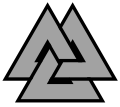
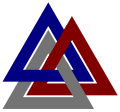
The historically attested instances of the symbol appear in two traditional, topologically distinct forms. The symbol appears in unicursal form, topologically a trefoil knot also seen in the triquetra. This unicursal form is found, for example, on the Tängelgårda stone. The symbol also appears in tricursal form, consisting of three linked triangles, topologically equivalent to the Borromean rings. This tricursal form can be seen on one of the Stora Hammars stones, as well as upon the Nene River Ring, and on the Oseberg ship bed post. Although other forms are topologically possible, these are the only attested forms found so far.
In Norwegian Bokmål, the term valknute is used for a polygon with a loop on each of its corners.[4] In the English language, the looped, four-cornered symbol is called Saint John's Arms.
Theories and interpretations[edit]
Several explanations for the symbol have been proposed:
Hrungnir's heart[edit]
Chapter 17 of the 13th century Prose Edda book Skáldskaparmál contains the following description of the heart of the jötunn Hrungnir: "Hrungnir had a heart that was famous. It was made of hard stone with three sharp-pointed corners just like the carved symbol hrungnishjarta [Hrungnir's heart]."[5] Comparisons have been made between this symbol description and the symbol known as the valknut.[1]
Odin and mental binds[edit]

Hilda Ellis Davidson theorizes a connection between the valknut, the god Odin, and "mental binds":
For instance, beside the figure of Odin on his horse shown on several memorial stones there is a kind of knot depicted, called the valknut, related to the triskele. This is thought to symbolize the power of the god to bind and unbind, mentioned in the poems and elsewhere. Odin had the power to lay bonds upon the mind, so that men became helpless in battle, and he could also loosen the tensions of fear and strain by his gifts of battle-madness, intoxication, and inspiration.[6]
Davidson says that similar symbols are found beside figures of wolves and ravens on "certain cremation urns" from Anglo-Saxon cemeteries in East Anglia.[6]
Other[edit]
Because the symbol appears on picture stones with Odin and on burial gifts in the Oseberg ship burial, Rudolf Simek says that the symbol may have been associated with religious practices surrounding death.[1]
Topology[edit]
The valknut is topologically equivalent to either the Borromean rings, the trefoil knot, or (in modern use only) a closed three-link chain, depending on the particular artistic depiction:
-

-
-
-
 As Borromean rings on the Stora Hammars I stone


Modern popular culture[edit]
The symbol is used for a variety of purposes in modern popular culture. The valknut symbol is used as a religious symbol by adherents of Heathenry, a new religious movement inspired by historic Germanic paganism.[7]
In Europe, the Swedish forest products company Svenska Cellulosa Aktiebolaget uses a triquetra valknut as their logo, which can be commonly seen on many products produced by the company; the DFB has used a logo inspired by the unicursal form of the valknut for the Germany national football team since 1991.[8]
The symbol appears as the fretboard inlay on some of Arch Enemy/Carcass guitarist Michael Amott's signature Dean Guitars "Tyrant" models, and it is also used as a logo by American engineering firm RedViking.[9] In Civilization VI, the valknut is the national symbol of Norway, which in the game is led by Harald Hardrada and mostly representative of Vikings rather than the modern country.
The valknut has seen some use by White supremacists.[10][11] The Anti-Defamation League notes that "nonracist pagans may also use this symbol, so one should carefully examine it in context rather than assume that a particular use of the symbol is racist."[10]
Bogd Bank of Mongolia uses the same symbol as their main corporate logo.[12]
See also[edit]
- Mjölnir, a symbol representing the hammer of the god Thor, particularly popular during the Viking Age
- Looped square, a symbol that produces a square with outward pointing loops at its corners
- Triquetra, a symbol composed of three interlaced arcs
Citations[edit]
- ^ a b c Simek (2007:163).
- ^ The British Museum Online. "finger-ring"
- ^ Davidson (1967:125).
- ^ Municipal arms for Lødingen, blazoned in the Norwegian Royal Decree of 11 May 1984, quoted in Hans Cappelen og Knut Johannessen: Norske kommunevåpen, Oslo 1987, page 197. The term is also used in Anders Bjønnes: Segltegninger fra hyllingene i Norge 1591 og 1610, Oslo 2010, pages 64–65.
- ^ Byock (2001:88).
- ^ a b Davidson (1990:147).
- ^ Harvey 2007: 59.
- ^ "index". DFB - Deutscher Fußball-Bund e.V. 19 March 2014. Retrieved 25 May 2020.
- ^ RedViking home page.
- ^ a b "Hate on Display - Hate Symbols Database: Valknot". Anti-Defamation League.
- ^ "Face of Hate: Chris Allgier Explained". Southern Poverty Law Center. 26 August 2007.
- ^ https://www.bogdbank.com/about-bank
References[edit]
- Byock, Jesse (trans.) (2006). The Prose Edda. Penguin Classics. ISBN 0-14-044755-5
- Davidson, Hilda Roderick Ellis (1967). Pagan Scandinavia. Frederick A. Praeger.
- Davidson, H. R. Ellis (1990). Gods and Myths of Northern Europe. Penguin Books. ISBN 0-14-013627-4
- Harvey, Graham (2007). Listening People, Speaking Earth: Contemporary Paganism (second ed.). London: Hurst & Company. ISBN 978-1-85065-272-4
- Simek, Rudolf (2007), translated by Angela Hall. Dictionary of Northern Mythology. D. S. Brewer. ISBN 0-85991-513-1
External links[edit]
 Media related to Valknut at Wikimedia Commons

| Authority control databases: National |
|---|
