


Yellow-tufted honeyeater
| Yellow-tufted honeyeater | |
|---|---|

| |
Scientific classification 
| |
| Domain: | Eukaryota |
| Kingdom: | Animalia |
| Phylum: | Chordata |
| Class: | Aves |
| Order: | Passeriformes |
| Family: | Meliphagidae |
| Genus: | Lichenostomus |
| Species: | L. melanops
|
| Binomial name | |
| Lichenostomus melanops (Latham, 1801)
| |

The yellow-tufted honeyeater (Lichenostomus melanops) is a passerine bird found in the south-east ranges of Australia. A predominantly black and yellow honeyeater, it is split into four subspecies.
Taxonomy[edit]
The yellow-tufted honeyeater was first described by the English ornithologist John Latham in 1801, and given two different binomial names: Muscicapa auricomis and Turdus melanops.[2][3] The latter name was retained as a nomen protectum, and the former a nomen oblitum, as the epithet melanops has been used consistently for over a century. It belongs to the honeyeater family Meliphagidae. More recently, DNA analysis has shown honeyeaters to be related to the Pardalotidae, and the Petroicidae (Australasian robins) in a large corvid superfamily;[4] some researchers include all these families in a broadly defined Corvidae. The generic name Lichenostomus is derived from the Ancient Greek leikhēn 'lichen, callous' and stoma 'mouth'; the specific epithet melanops derives from Ancient Greek melas 'black' and opsis 'face'.[5]
Subspecies[edit]
Four races are recognised:
- L. m. cassidix, helmeted honeyeater, is restricted to a 5 km length of remnant bushland along two streams in the Yellingbo Nature Conservation Reserve, 50 km east of Melbourne, in Victoria. It is the brightest and largest subspecies, weighing 28–32 g (0.99–1.13 oz). In 2003, there were 103 individuals in the wild with 20 breeding pairs known, as well as a further 34 birds in captivity at the Healesville Sanctuary.[6]
- L. m. gippslandicus, Gippsland yellow-tufted honeyeater
- L. m. melanops, Sydney yellow-tufted honeyeater
- L. m. meltoni, inland yellow-tufted honeyeater, is smaller and duller in plumage with a smaller tuft, which was described by G. M. Mathews in 1912.[7]
Description[edit]
The yellow-tufted honeyeater is 17–23 cm (6.7–9.1 in) long, with females usually smaller.[8] It has a bright yellow forehead, crown and throat, a glossy black mask and bright golden ear-tufts.[9] The back is olive-green to olive-brown on wings and tail, and the underparts are more olive-yellow.[8][9] The bill and gape are black, eyes brown, and legs grey-brown.[10][11]
Distribution and habitat[edit]
The yellow-tufted honeyeater occurs from south-east Queensland through eastern New South Wales and across Victoria. [12][8][13] Its preferred habitats are dry open sclerophyll forests and woodlands dominated by eucalypts with shrubby undergrowth, as well as mallee, brigalow and cypress-pine (Callitris).[11][12]
The helmeted honeyeater subspecies is largely restricted to dense vegetation along riverbanks, dominated by the mountain swamp gum (Eucalyptus camphora) with a dense understorey of woolly tea-tree (Leptospermum lanigerum), scented paperbark (Melaleuca squarrosa), saw-sedge (Gahnia), ferns and tussock grasses.[14][9][11]
Behaviour[edit]
Yellow-tufted honeyeaters are a noisy, active species in colonies from a few up to a hundred.[12] It aggressively defends territories around flowering trees.[12] It has a great variety of calls from a warbled "tui-t-tui-t-tui", a whistled "wheit-wheit", a sharp "querk" to a harsh contact-call "yip" or "chop-chop".[10][9][12]
Diet and Foraging[edit]
The diet of the yellow-tufted honeyeater is primarily arthropods, such as a variety of insects and spiders, and occasionally snails.[11] It also feeds on lerps and honeydew, nectar and sap flows from eucalypts, occasionally fruit and flowers.[12][9][6] It takes insects in flight and by probing the bark of tree-trunks and limbs.[12]
Breeding[edit]
Breeding takes place between July and March (mostly from September to January), with one or two broods each season.[12] The nest is a cup-shaped structure of dried grasses, bits of bark and other plant material, bound with spider webs and lined with fur and feathers, hung by its rim in dense shrubbery or regrowth.[12] Two or three eggs, each measuring 23 mm × 17 mm (0.91 in × 0.67 in), are laid, pinkish in colour, blotched with pale reddish- or buff-brown.[9][15] The eggs are incubated mostly by the female for 14-16 days.[11] The nestlings are brooded by the female and fed by both sexes and any helpers, fledging at 13-15 days post-hatch and usually becoming independent by 6 weeks.[12][11] The nests are parasitized by the fan-tailed cuckoo (Cacomantis flabelliformis), pallid cuckoo (Cacomantis pallidus) and shining bronze-cuckoo (Chrysococcyx lucidus).[11]
Conservation[edit]
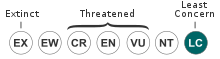
Yellow-tufted honeyeaters, as a species, are not listed as threatened on the Australian Environment Protection and Biodiversity Conservation Act 1999 or on any state-based legislation. However, at the subspecies level, the helmeted honeyeater (L. m. cassidix) is considered to be threatened:
- This subspecies is listed as endangered on the Australian Environment Protection and Biodiversity Conservation Act 1999.
- This subspecies is listed as threatened on the Victorian Flora and Fauna Guarantee Act (1988).[16] Under this Act, an Action Statement for the recovery and future management of this species has been prepared.[17]
- On the 2007 advisory list of threatened vertebrate fauna in Victoria, the helmeted honeyeater is listed as critically endangered.[18]
References[edit]
- ^ BirdLife International (2016). "Lichenostomus melanops". IUCN Red List of Threatened Species. 2016: e.T22704076A93951572. doi:10.2305/IUCN.UK.2016-3.RLTS.T22704076A93951572.en. Retrieved 12 November 2021.
- ^ Latham, John (1801). Supplementum indicis ornithologici sive systematis ornithologiae (in Latin). London: Leigh & Sotheby. pp. xl, xlix.
- ^ Salomonsen, F. (1967). "Family Maliphagidae, Honeyeaters". In Paynter, R.A. Jnr. (ed.). Check-list of Birds of the World (Volume 12). Vol. 12. Cambridge, Mass.: Museum of Comparative Zoology. p. 385.
- ^ Barker, F.K.; Cibois, A.; Schikler, P.; Feinstein, J.; Cracraft, J. (2004). "Phylogeny and diversification of the largest avian radiation". Proc. Natl. Acad. Sci. USA. 101: 11040–11045. doi:10.1073/pnas.0401892101. PMC 503738. PMID 15263073.
- ^ Jobling, James A. (2010). "Helm Dictionary of Scientific Bird-names". Retrieved 2020-04-25.
- ^ a b Menkhorst P, Smales I, Quin B (2003). "Helmeted Honeyeater Recovery Plan 1999-2003". Australian Government, Department of the Environment and Water Resources. Retrieved 2007-06-21.
- ^ Mathews, G.M. (1912). A Reference-List to the Birds of Australia. Novit. Zool. 18: 171-455 [408]
- ^ a b c Simpson, Ken, Day, N. and Trusler, P. (6th edn., 1999). Field Guide to the Birds of Australia. Ringwood, Victoria: Penguin Books Australia ISBN 067087918-5.
- ^ a b c d e f Pizzey, Graham; Doyle, Roy (1980) A Field Guide to the Birds of Australia. Collins Publishers, Sydney. ISBN 073222436-5
- ^ a b Slater, Peter (1974) A Field Guide to Australian Birds: Passerines. Adelaide: Rigby. ISBN 085179813-6
- ^ a b c d e f g Higgins, P., L. Christidis, and H. Ford (2020). "Yellow-tufted Honeyeater (Lichenostomus melanops), version 1.0." In Birds of the World (J. del Hoyo, A. Elliott, J. Sargatal, D. A. Christie, and E. de Juana, Editors). Cornell Lab of Ornithology, Ithaca, NY, USA. https://doi.org/10.2173/bow.yethon3.01
- ^ a b c d e f g h i j Morcombe, Michael (2012) Field Guide to Australian Birds. Pascal Press, Glebe, NSW. Revised edition. ISBN 978174021417-9
- ^ "eBird map: yellow-tufted honeyeater". Retrieved 2020-04-26.
- ^ McMahon, A.R.G. and Franklin, D.C. (1993) "The significance of Mountain Swamp Gum for Helmeted Honeyeater populations in the Yarra Valley." Victorian Naturalist 110: 230-237.
- ^ Beruldsen, G (2003). Australian Birds: Their Nests and Eggs. Kenmore Hills, Qld: self. pp. 308–309. ISBN 0-646-42798-9.
- ^ Department of Sustainability and Environment, Victoria
- ^ Department of Sustainability and Environment, Victoria
- ^ Victorian Department of Sustainability and Environment (2007). Advisory List of Threatened Vertebrate Fauna in Victoria - 2007. East Melbourne, Victoria: Department of Sustainability and Environment. p. 15. ISBN 978-1-74208-039-0.
External links[edit]


- BirdLife Species Factsheet
- Photos, audio and video of yellow-tufted honeyeater from Cornell Lab of Ornithology's Macaulay Library
- Recordings of yellow-tufted honeyeater from Graeme Chapman's sound library