


International Space Station

 Oblique underside view in November 2021 | |
 International Space Station program insignia, with flags of the original signatory states. | |
| Station statistics | |
|---|---|
| COSPAR ID | 1998-067A |
| SATCAT no. | 25544 |
| Call sign | Alpha, Station |
| Crew |
|
| Launch | 20 November 1998 |
| Launch pad |
|
| Mass | 450,000 kg (990,000 lb)[3] |
| Length | 109 m (358 ft) (overall length), 94 m (310 ft) (truss length)[4] |
| Width | 73 m (239 ft) (solar array length)[4] |
| Pressurised volume | 1,005.0 m3 (35,491 cu ft)[4] |
| Atmospheric pressure | 101.3 kPa (14.7 psi; 1.0 atm) 79% nitrogen, 21% oxygen |
| Perigee altitude | 413 km (256.6 mi) AMSL[5] |
| Apogee altitude | 422 km (262.2 mi) AMSL[5] |
| Orbital inclination | 51.64°[5] |
| Orbital speed | 7.66 km/s[5][failed verification] 27,600 km/h; 17,100 mph |
| Orbital period | 92.9 minutes[6] |
| Orbits per day | 15.5[5] |
| Orbit epoch | 16 August 16:19:30[7] |
| Days in orbit | 25 years, 4 months, 29 days (19 April 2024) |
| Days occupied | 23 years, 5 months, 16 days (19 April 2024) |
| No. of orbits | 141,117 as of August 2023[update][7] |
| Orbital decay | 2 km/month |
| Statistics as of 22 December 2022 (unless noted otherwise) References:[4][5][8][9][10] | |
| Configuration | |
 | |
The International Space Station (ISS) is a large space station assembled and maintained in low Earth orbit by a collaboration of five space agencies: NASA (United States), Roscosmos (Russia), JAXA (Japan), ESA (Europe), CSA (Canada), and their contractors. ISS is the largest space station ever built. Its primary purpose is performing microgravity and space environment experiments.
Operationally the station is divided into two sections: the Russian Orbital Segment assembled by Roscosmos and the US Orbital Segment assembled by NASA, JAXA, ESA and CSA. A striking feature of the ISS is the Integrated Truss Structure, which connects the large solar panels and radiators to the pressurized modules. The pressurized modules are specialized for research, habitation, storage, spacecraft control and airlock functions. Visiting spacecraft dock to the station via its eight docking and berthing ports. The ISS maintains an orbit with an average altitude of 400 kilometres (250 mi)[11] and circles the Earth in roughly 93 minutes, completing 15.5 orbits per day.[12]
The ISS programme combines two prior plans to construct crewed Earth-orbiting stations: Space Station Freedom planned by the United States, and the Mir-2 station planned by the Soviet Union. The first ISS module was launched in 1998. Major modules have been launched by Proton and Soyuz rockets and by the Space Shuttle launch system. The first long-term residents, Expedition 1, arrived on 2 November 2000. Since then the station has been continuously occupied for 23 years and 169 days, the longest continuous human presence in space. As of March 2024[update], 279 individuals from 22 countries have visited the space station.[13] The ISS is expected to have additional modules (the Axiom Orbital Segment, for example) before being de-orbited by a dedicated NASA spacecraft in January 2031.
History[edit]
As the space race drew to a close in the early 1970s, the US and USSR began to contemplate a variety of potential collaborations in outer space. This culminated in the 1975 Apollo-Soyuz Test Project, the first docking of spacecraft from two different spacefaring nations. The ASTP was considered a success, and further joint missions were also contemplated.
One such concept was International Skylab, which proposed launching the backup Skylab B space station for a mission that would see multiple visits by both Apollo and Soyuz crew vehicles.[14] More ambitious was the Skylab-Salyut Space Laboratory, which proposed docking the Skylab B to a Soviet Salyut space station. Falling budgets and rising cold war tensions in the late 1970s saw these concepts fall by the wayside, along with another plan to have the Space Shuttle dock with a Salyut space station.[15]
In the early 1980s, NASA planned to launch a modular space station called Freedom as a counterpart to the Salyut and Mir space stations. In 1984 the ESA was invited to participate in Space Station Freedom, and the ESA approved the Columbus laboratory by 1987.[16] The Japanese Experiment Module (JEM), or Kibō, was announced in 1985, as part of the Freedom space station in response to a NASA request in 1982.
In early 1985, science ministers from the European Space Agency (ESA) countries approved the Columbus programme, the most ambitious effort in space undertaken by that organization at the time. The plan spearheaded by Germany and Italy included a module which would be attached to Freedom, and with the capability to evolve into a full-fledged European orbital outpost before the end of the century.[17]
Increasing costs threw these plans into doubt in the early 1990s. Congress was unwilling to provide enough money to build and operate Freedom, and demanded NASA increase international participation to defray the rising costs or they would cancel the entire project outright.[18]
Simultaneously, the USSR was conducting planning for the Mir-2 space station, and had begun constructing modules for the new station by the mid 1980s. However the collapse of the Soviet Union required these plans to be greatly downscaled, and soon Mir-2 was in danger of never being launched at all.[19] With both space station projects in jeopardy, American and Russian officials met and proposed they be combined. [20]
In September 1993, American Vice-President Al Gore and Russian Prime Minister Viktor Chernomyrdin announced plans for a new space station, which eventually became the International Space Station.[21] They also agreed, in preparation for this new project, that the United States would be involved in the Mir programme, including American Shuttles docking, in the Shuttle–Mir programme.[22]
On 12 April 2021, at a meeting with Russian President Vladimir Putin, then-Deputy Prime Minister Yury Borisov announced he had decided that Russia might withdraw from the ISS programme in 2025.[23][24] According to Russian authorities, the timeframe of the station's operations has expired and its condition leaves much to be desired.[23] On 26 July 2022, Borisov, who had become head of Roscosmos, submitted to Putin his plans for withdrawal from the programme after 2024.[25] However, Robyn Gatens, the NASA official in charge of space station operations, responded that NASA had not received any formal notices from Roscosmos concerning withdrawal plans.[26] On 21 September 2022, Borisov stated that Russia was "highly likely" to continue to participate in the ISS programme until 2028.[27]Purpose[edit]
The ISS was originally intended to be a laboratory, observatory, and factory while providing transportation, maintenance, and a low Earth orbit staging base for possible future missions to the Moon, Mars, and asteroids. However, not all of the uses envisioned in the initial memorandum of understanding between NASA and Roscosmos have been realised.[28] In the 2010 United States National Space Policy, the ISS was given additional roles of serving commercial, diplomatic,[29] and educational purposes.[30]
Scientific research[edit]


The ISS provides a platform to conduct scientific research, with power, data, cooling, and crew available to support experiments. Small uncrewed spacecraft can also provide platforms for experiments, especially those involving zero gravity and exposure to space, but space stations offer a long-term environment where studies can be performed potentially for decades, combined with ready access by human researchers.[31][32]
The ISS simplifies individual experiments by allowing groups of experiments to share the same launches and crew time. Research is conducted in a wide variety of fields, including astrobiology, astronomy, physical sciences, materials science, space weather, meteorology, and human research including space medicine and the life sciences.[33][34][35][36] Scientists on Earth have timely access to the data and can suggest experimental modifications to the crew. If follow-on experiments are necessary, the routinely scheduled launches of resupply craft allows new hardware to be launched with relative ease.[32] Crews fly expeditions of several months' duration, providing approximately 160 person-hours per week of labour with a crew of six. However, a considerable amount of crew time is taken up by station maintenance.[37]
Perhaps the most notable ISS experiment is the Alpha Magnetic Spectrometer (AMS), which is intended to detect dark matter and answer other fundamental questions about our universe. According to NASA, the AMS is as important as the Hubble Space Telescope. Currently docked on station, it could not have been easily accommodated on a free flying satellite platform because of its power and bandwidth needs.[38][39] On 3 April 2013, scientists reported that hints of dark matter may have been detected by the AMS.[40][41][42][43][44][45] According to the scientists, "The first results from the space-borne Alpha Magnetic Spectrometer confirm an unexplained excess of high-energy positrons in Earth-bound cosmic rays".
The space environment is hostile to life. Unprotected presence in space is characterised by an intense radiation field (consisting primarily of protons and other subatomic charged particles from the solar wind, in addition to cosmic rays), high vacuum, extreme temperatures, and microgravity.[46] Some simple forms of life called extremophiles,[47] as well as small invertebrates called tardigrades[48] can survive in this environment in an extremely dry state through desiccation.
Medical research improves knowledge about the effects of long-term space exposure on the human body, including muscle atrophy, bone loss, and fluid shift. These data will be used to determine whether high duration human spaceflight and space colonisation are feasible. In 2006, data on bone loss and muscular atrophy suggested that there would be a significant risk of fractures and movement problems if astronauts landed on a planet after a lengthy interplanetary cruise, such as the six-month interval required to travel to Mars.[49][50]
Medical studies are conducted aboard the ISS on behalf of the National Space Biomedical Research Institute (NSBRI). Prominent among these is the Advanced Diagnostic Ultrasound in Microgravity study in which astronauts perform ultrasound scans under the guidance of remote experts. The study considers the diagnosis and treatment of medical conditions in space. Usually, there is no physician on board the ISS and diagnosis of medical conditions is a challenge. It is anticipated that remotely guided ultrasound scans will have application on Earth in emergency and rural care situations where access to a trained physician is difficult.[51][52][53]
In August 2020, scientists reported that bacteria from Earth, particularly Deinococcus radiodurans bacteria, which is highly resistant to environmental hazards, were found to survive for three years in outer space, based on studies conducted on the International Space Station. These findings supported the notion of panspermia, the hypothesis that life exists throughout the Universe, distributed in various ways, including space dust, meteoroids, asteroids, comets, planetoids or contaminated spacecraft.[54][55]
Remote sensing of the Earth, astronomy, and deep space research on the ISS have dramatically increased during the 2010s after the completion of the US Orbital Segment in 2011. Throughout the more than 20 years of the ISS program researchers aboard the ISS and on the ground have examined aerosols, ozone, lightning, and oxides in Earth's atmosphere, as well as the Sun, cosmic rays, cosmic dust, antimatter, and dark matter in the universe. Examples of Earth-viewing remote sensing experiments that have flown on the ISS are the Orbiting Carbon Observatory 3, ISS-RapidScat, ECOSTRESS, the Global Ecosystem Dynamics Investigation, and the Cloud Aerosol Transport System. ISS-based astronomy telescopes and experiments include SOLAR, the Neutron Star Interior Composition Explorer, the Calorimetric Electron Telescope, the Monitor of All-sky X-ray Image (MAXI), and the Alpha Magnetic Spectrometer.[33][56]
Freefall[edit]


Gravity at the altitude of the ISS is approximately 90% as strong as at Earth's surface, but objects in orbit are in a continuous state of freefall, resulting in an apparent state of weightlessness.[57] This perceived weightlessness is disturbed by five effects:[58]
- Drag from the residual atmosphere.
- Vibration from the movements of mechanical systems and the crew.
- Actuation of the on-board attitude control moment gyroscopes.
- Thruster firings for attitude or orbital changes.
- Gravity-gradient effects, also known as tidal effects. Items at different locations within the ISS would, if not attached to the station, follow slightly different orbits. Being mechanically connected, these items experience small forces that keep the station moving as a rigid body.
Researchers are investigating the effect of the station's near-weightless environment on the evolution, development, growth and internal processes of plants and animals. In response to some of the data, NASA wants to investigate microgravity's effects on the growth of three-dimensional, human-like tissues and the unusual protein crystals that can be formed in space.[33]
Investigating the physics of fluids in microgravity will provide better models of the behaviour of fluids. Because fluids can be almost completely combined in microgravity, physicists investigate fluids that do not mix well on Earth. Examining reactions that are slowed by low gravity and low temperatures will improve our understanding of superconductivity.[33]
The study of materials science is an important ISS research activity, with the objective of reaping economic benefits through the improvement of techniques used on the ground.[59] Other areas of interest include the effect of low gravity on combustion, through the study of the efficiency of burning and control of emissions and pollutants. These findings may improve knowledge about energy production and lead to economic and environmental benefits.[33]
Exploration[edit]

The ISS provides a location in the relative safety of low Earth orbit to test spacecraft systems that will be required for long-duration missions to the Moon and Mars. This provides experience in operations, maintenance, and repair and replacement activities on-orbit. This will help develop essential skills in operating spacecraft farther from Earth, reduce mission risks, and advance the capabilities of interplanetary spacecraft.[60] Referring to the MARS-500 experiment, a crew isolation experiment conducted on Earth, ESA states, "Whereas the ISS is essential for answering questions concerning the possible impact of weightlessness, radiation and other space-specific factors, aspects such as the effect of long-term isolation and confinement can be more appropriately addressed via ground-based simulations".[61] Sergey Krasnov, the head of human space flight programmes for Russia's space agency, Roscosmos, in 2011 suggested a "shorter version" of MARS-500 may be carried out on the ISS.[62]
In 2009, noting the value of the partnership framework itself, Sergey Krasnov wrote, "When compared with partners acting separately, partners developing complementary abilities and resources could give us much more assurance of the success and safety of space exploration. The ISS is helping further advance near-Earth space exploration and realisation of prospective programmes of research and exploration of the Solar system, including the Moon and Mars."[63] A crewed mission to Mars may be a multinational effort involving space agencies and countries outside the current ISS partnership. In 2010, ESA Director-General Jean-Jacques Dordain stated his agency was ready to propose to the other four partners that China, India, and South Korea be invited to join the ISS partnership.[64] NASA chief Charles Bolden stated in February 2011, "Any mission to Mars is likely to be a global effort."[65] Currently, US federal legislation prevents NASA co-operation with China on space projects.[66]
Education and cultural outreach[edit]

The ISS crew provides opportunities for students on Earth by running student-developed experiments, making educational demonstrations, allowing for student participation in classroom versions of ISS experiments, and directly engaging students using radio, and email.[67][68] ESA offers a wide range of free teaching materials that can be downloaded for use in classrooms.[69] In one lesson, students can navigate a 3D model of the interior and exterior of the ISS, and face spontaneous challenges to solve in real time.[70]
The Japanese Aerospace Exploration Agency (JAXA) aims to inspire children to "pursue craftsmanship" and to heighten their "awareness of the importance of life and their responsibilities in society".[71] Through a series of education guides, students develop a deeper understanding of the past and near-term future of crewed space flight, as well as that of Earth and life.[72][73] In the JAXA "Seeds in Space" experiments, the mutation effects of spaceflight on plant seeds aboard the ISS are explored by growing sunflower seeds that have flown on the ISS for about nine months. In the first phase of Kibō utilisation from 2008 to mid-2010, researchers from more than a dozen Japanese universities conducted experiments in diverse fields.[74]
Cultural activities are another major objective of the ISS programme. Tetsuo Tanaka, the director of JAXA's Space Environment and Utilization Center, has said: "There is something about space that touches even people who are not interested in science."[75]
Amateur Radio on the ISS (ARISS) is a volunteer programme that encourages students worldwide to pursue careers in science, technology, engineering, and mathematics, through amateur radio communications opportunities with the ISS crew. ARISS is an international working group, consisting of delegations from nine countries including several in Europe, as well as Japan, Russia, Canada, and the United States. In areas where radio equipment cannot be used, speakerphones connect students to ground stations which then connect the calls to the space station.[76]
First Orbit is a 2011 feature-length documentary film about Vostok 1, the first crewed space flight around the Earth. By matching the orbit of the ISS to that of Vostok 1 as closely as possible, in terms of ground path and time of day, documentary filmmaker Christopher Riley and ESA astronaut Paolo Nespoli were able to film the view that Yuri Gagarin saw on his pioneering orbital space flight. This new footage was cut together with the original Vostok 1 mission audio recordings sourced from the Russian State Archive. Nespoli is credited as the director of photography for this documentary film, as he recorded the majority of the footage himself during Expedition 26/27.[77] The film was streamed in a global YouTube premiere in 2011 under a free licence through the website firstorbit.org.[78]
In May 2013, commander Chris Hadfield shot a music video of David Bowie's "Space Oddity" on board the station, which was released on YouTube.[79][80] It was the first music video ever to be filmed in space.[81]
In November 2017, while participating in Expedition 52/53 on the ISS, Paolo Nespoli made two recordings of his spoken voice (one in English and the other in his native Italian), for use on Wikipedia articles. These were the first content made in space specifically for Wikipedia.[82][83]
In November 2021, a virtual reality exhibit called The Infinite featuring life aboard the ISS was announced.[84]
Construction[edit]
Manufacturing[edit]


Since the International Space Station is a multi-national collaborative project, the components for in-orbit assembly were manufactured in various countries around the world. Beginning in the mid-1990s, the U.S. components Destiny, Unity, the Integrated Truss Structure, and the solar arrays were fabricated at the Marshall Space Flight Center and the Michoud Assembly Facility. These modules were delivered to the Operations and Checkout Building and the Space Station Processing Facility (SSPF) for final assembly and processing for launch.[85]
The Russian modules, including Zarya and Zvezda, were manufactured at the Khrunichev State Research and Production Space Center in Moscow. Zvezda was initially manufactured in 1985 as a component for Mir-2, but Mir 2 was never launched and instead became the ISS Service Module.[86]
The European Space Agency (ESA) Columbus module was manufactured at the EADS Astrium Space Transportation facilities in Bremen, Germany, along with many other contractors throughout Europe.[87] The other ESA-built modules – Harmony, Tranquility, the Leonardo MPLM, and the Cupola – were initially manufactured at the Thales Alenia Space factory in Turin, Italy.[88] The structural steel hulls of the modules were transported by aircraft to the Kennedy Space Center SSPF for launch processing.[89]
The Japanese Experiment Module Kibō, was fabricated in various technology manufacturing facilities in Japan, at the NASDA (now JAXA) Tsukuba Space Center, and the Institute of Space and Astronautical Science. The Kibo module was transported by ship and flown by aircraft to the SSPF.[90]
The Mobile Servicing System, consisting of the Canadarm2 and the Dextre grapple fixture, was manufactured at various factories in Canada (such as the David Florida Laboratory) and the United States, under contract by the Canadian Space Agency. The mobile base system, a connecting framework for Canadarm2 mounted on rails, was built by Northrop Grumman.
Assembly[edit]


The assembly of the International Space Station, a major endeavour in space architecture, began in November 1998.[8] Russian modules launched and docked robotically, with the exception of Rassvet. All other modules were delivered by the Space Shuttle, which required installation by ISS and Shuttle crewmembers using the Canadarm2 (SSRMS) and extra-vehicular activities (EVAs); by 5 June 2011, they had added 159 components during more than 1,000 hours of EVA. 127 of these spacewalks originated from the station, and the remaining 32 were launched from the airlocks of docked Space Shuttles.[91] The beta angle of the station had to be considered at all times during construction.[92]
The first module of the ISS, Zarya, was launched on 20 November 1998 on an autonomous Russian Proton rocket. It provided propulsion, attitude control, communications, and electrical power, but lacked long-term life support functions. A passive NASA module, Unity, was launched two weeks later aboard Space Shuttle flight STS-88 and attached to Zarya by astronauts during EVAs. The Unity module has two Pressurized Mating Adapters (PMAs): one connects permanently to Zarya and the other allowed the Space Shuttle to dock to the space station. At that time, the Russian (Soviet) station Mir was still inhabited, and the ISS remained uncrewed for two years. On 12 July 2000, the Zvezda module was launched into orbit. Onboard preprogrammed commands deployed its solar arrays and communications antenna. Zvezda then became the passive target for a rendezvous with Zarya and Unity, maintaining a station-keeping orbit while the Zarya–Unity vehicle performed the rendezvous and docking via ground control and the Russian automated rendezvous and docking system. Zarya's computer transferred control of the station to Zvezda's computer soon after docking. Zvezda added sleeping quarters, a toilet, kitchen, CO2 scrubbers, dehumidifier, oxygen generators, and exercise equipment, plus data, voice and television communications with mission control, enabling permanent habitation of the station.[93][94]
The first resident crew, Expedition 1, arrived in November 2000 on Soyuz TM-31. At the end of the first day on the station, astronaut Bill Shepherd requested the use of the radio call sign "Alpha", which he and cosmonaut Sergei Krikalev preferred to the more cumbersome "International Space Station".[95] The name "Alpha" had previously been used for the station in the early 1990s,[96] and its use was authorised for the whole of Expedition 1.[97] Shepherd had been advocating the use of a new name to project managers for some time. Referencing a naval tradition in a pre-launch news conference he had said: "For thousands of years, humans have been going to sea in ships. People have designed and built these vessels, launched them with a good feeling that a name will bring good fortune to the crew and success to their voyage."[98] Yuriy Semenov, the President of Russian Space Corporation Energia at the time, disapproved of the name "Alpha" as he felt that Mir was the first modular space station, so the names "Beta" or "Mir 2" for the ISS would have been more fitting.[97][99][100]
Expedition 1 arrived midway between the Space Shuttle flights of missions STS-92 and STS-97. These two flights each added segments of the station's Integrated Truss Structure, which provided the station with Ku-band communication for US television, additional attitude support needed for the additional mass of the USOS, and substantial solar arrays to supplement the station's four existing arrays.[101] Over the next two years, the station continued to expand. A Soyuz-U rocket delivered the Pirs docking compartment. The Space Shuttles Discovery, Atlantis, and Endeavour delivered the Destiny laboratory and Quest airlock, in addition to the station's main robot arm, the Canadarm2, and several more segments of the Integrated Truss Structure.
The expansion schedule was interrupted in 2003 by the Space Shuttle Columbia disaster and a resulting hiatus in flights. The Space Shuttle was grounded until 2005 with STS-114 flown by Discovery.[102] Assembly resumed in 2006 with the arrival of STS-115 with Atlantis, which delivered the station's second set of solar arrays. Several more truss segments and a third set of arrays were delivered on STS-116, STS-117, and STS-118. As a result of the major expansion of the station's power-generating capabilities, more pressurised modules could be accommodated, and the Harmony node and Columbus European laboratory were added. These were soon followed by the first two components of Kibō. In March 2009, STS-119 completed the Integrated Truss Structure with the installation of the fourth and final set of solar arrays. The final section of Kibō was delivered in July 2009 on STS-127, followed by the Russian Poisk module. The third node, Tranquility, was delivered in February 2010 during STS-130 by the Space Shuttle Endeavour, alongside the Cupola, followed by the penultimate Russian module, Rassvet, in May 2010. Rassvet was delivered by Space Shuttle Atlantis on STS-132 in exchange for the Russian Proton delivery of the US-funded Zarya module in 1998.[103] The last pressurised module of the USOS, Leonardo, was brought to the station in February 2011 on the final flight of Discovery, STS-133.[104] The Alpha Magnetic Spectrometer was delivered by Endeavour on STS-134 the same year.[105]
By June 2011, the station consisted of 15 pressurised modules and the Integrated Truss Structure. Two power modules called NEM-1 and NEM-2.[106] are still to be launched. Russia's new primary research module Nauka docked in July 2021,[107] along with the European Robotic Arm which will be able to relocate itself to different parts of the Russian modules of the station.[108] Russia's latest addition, the nodal module Prichal, docked in November 2021.[109]
The gross mass of the station changes over time. The total launch mass of the modules on orbit is about 417,289 kg (919,965 lb) (as of 3 September 2011[update]).[91] The mass of experiments, spare parts, personal effects, crew, foodstuff, clothing, propellants, water supplies, gas supplies, docked spacecraft, and other items add to the total mass of the station. Hydrogen gas is constantly vented overboard by the oxygen generators.
Structure[edit]
The ISS functions as a modular space station, enabling the addition or removal of modules from its structure for increased adaptability.
-
 Overview blueprint of components
 -
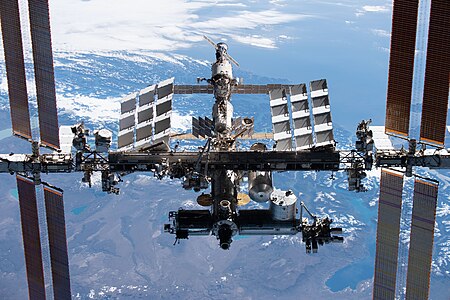 The ISS exterior and steelwork taken on 8 November 2021, from the departing SpaceX Crew-2 capsule
 -
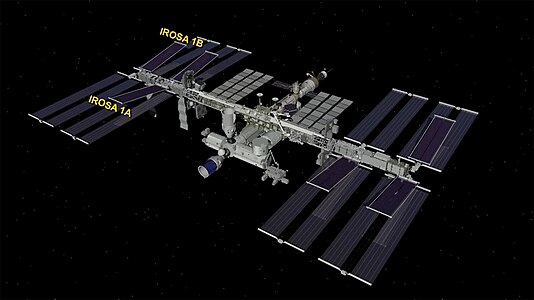 Diagram structure of International Space Station after installation of iROSA solar arrays (as of 2023)
.jpg)

Below is a diagram of major station components. The blue areas are pressurised sections accessible by the crew without using spacesuits. The station's unpressurised superstructure is indicated in red. Planned components are shown in white, non installed, temporarily defunct or non-commissioned components are shown in brown and former ones in gray. Other unpressurised components are yellow. The Unity node joins directly to the Destiny laboratory. For clarity, they are shown apart. Similar cases are also seen in other parts of the structure.
Pressurised modules[edit]
 | This section needs additional citations for verification. (November 2015) |

Zarya[edit]
Zarya (Russian: Заря, lit. 'Dawn'[b]), also known as the Functional Cargo Block or FGB (from the Russian: "Функционально-грузовой блок", lit. 'Funktsionalno-gruzovoy blok' or ФГБ), is the first module of the ISS to have been launched.[110] The FGB provided electrical power, storage, propulsion, and guidance to the ISS during the initial stage of assembly. With the launch and assembly in orbit of other modules with more specialized functionality, Zarya, as of August 2021, is primarily used for storage, both inside the pressurized section and in the externally mounted fuel tanks. The Zarya is a descendant of the TKS spacecraft designed for the Russian Salyut program. The name Zarya ("Dawn") was given to the FGB because it signified the dawn of a new era of international cooperation in space. Although it was built by a Russian company, it is owned by the United States.[111]

Unity[edit]
The Unity connecting module, also known as Node 1, is the first U.S.-built component of the ISS. It connects the Russian and U.S. segments of the station, and is where crew eat meals together.[112][113]
The module is cylindrical in shape, with six berthing locations (forward, aft, port, starboard, zenith, and nadir) facilitating connections to other modules. Unity measures 4.57 metres (15.0 ft) in diameter, is 5.47 metres (17.9 ft) long, made of steel, and was built for NASA by Boeing in a manufacturing facility at the Marshall Space Flight Center in Huntsville, Alabama. Unity is the first of the three connecting modules; the other two are Harmony and Tranquility.[114]

Zvezda[edit]
Zvezda (Russian: Звезда, meaning "star"), Salyut DOS-8, is also known as the Zvezda Service Module. It was the third module launched to the station, and provides all of the station's life support systems, some of which are supplemented in the USOS, as well as living quarters for two crew members. It is the structural and functional center of the Russian Orbital Segment, which is the Russian part of the ISS. Crew assemble here to deal with emergencies on the station.[115][116][117]
The module was manufactured by RKK Energia, with major sub-contracting work by GKNPTs Khrunichev.[118] Zvezda was launched on a Proton rocket on 12 July 2000, and docked with the Zarya module on 26 July 2000.

Destiny[edit]
The Destiny module, also known as the U.S. Lab, is the primary operating facility for U.S. research payloads aboard the ISS.[119][120] It was berthed to the Unity module and activated over a period of five days in February 2001.[121] Destiny is NASA's first permanent operating orbital research station since Skylab was vacated in February 1974. The Boeing Company began construction of the 14.5-tonne (32,000 lb) research laboratory in 1995 at the Michoud Assembly Facility and then the Marshall Space Flight Center in Huntsville, Alabama.[119] Destiny was shipped to the Kennedy Space Center in Florida in 1998, and was turned over to NASA for pre-launch preparations in August 2000. It launched on 7 February 2001, aboard the Space Shuttle Atlantis on STS-98.[121] Astronauts work inside the pressurized facility to conduct research in numerous scientific fields. Scientists throughout the world would use the results to enhance their studies in medicine, engineering, biotechnology, physics, materials science, and Earth science.[120]

Quest[edit]
The Joint Airlock (also known as "Quest") is provided by the U.S. and provides the capability for ISS-based Extravehicular Activity (EVA) using either a U.S. Extravehicular Mobility Unit (EMU) or Russian Orlan EVA suits.[122] Before the launch of this airlock, EVAs were performed from either the U.S. Space Shuttle (while docked) or from the Transfer Chamber on the Service Module. Due to a variety of system and design differences, only U.S. space suits could be used from the Shuttle and only Russian suits could be used from the Service Module. The Joint Airlock alleviates this short-term problem by allowing either (or both) spacesuit systems to be used.[123]
The Joint Airlock was launched on ISS-7A / STS-104 in July 2001 and was attached to the right hand docking port of Node 1.[124] The Joint Airlock is 20 ft. long, 13 ft. in diameter, and weighs 6.5 tons. The Joint Airlock was built by Boeing at Marshall Space Flight Center. The Joint Airlock was launched with the High Pressure Gas Assembly. The High Pressure Gas Assembly was mounted on the external surface of the Joint Airlock and will support EVAs operations with breathing gases and augments the Service Module's gas resupply system. The Joint Airlock has two main components: a crew airlock from which astronauts and cosmonauts exit the ISS and an equipment airlock designed for storing EVA gear and for so-called overnight "campouts" wherein Nitrogen is purged from astronaut's bodies overnight as pressure is dropped in preparation for spacewalks the following day. This alleviates the bends as the astronauts are repressurized after their EVA.[123]
The crew airlock was derived from the Space Shuttle's external airlock. It is equipped with lighting, external handrails, and an Umbilical Interface Assembly (UIA). The UIA is located on one wall of the crew airlock and provides a water supply line, a wastewater return line, and an oxygen supply line. The UIA also provides communication gear and spacesuit power interfaces and can support two spacesuits simultaneously. This can be either two American EMU spacesuits, two Russian ORLAN spacesuits, or one of each design.
Poisk[edit]
Poisk (Russian: По́иск, lit. 'Search') was launched on 10 November 2009[125][126] attached to a modified Progress spacecraft, called Progress M-MIM2, on a Soyuz-U rocket from Launch Pad 1 at the Baikonur Cosmodrome in Kazakhstan. Poisk is used as the Russian airlock module, containing two identical EVA hatches. An outward-opening hatch on the Mir space station failed after it swung open too fast after unlatching, because of a small amount of air pressure remaining in the airlock.[127] All EVA hatches on the ISS open inwards and are pressure-sealing. Poisk is used to store, service, and refurbish Russian Orlan suits and provides contingency entry for crew using the slightly bulkier American suits. The outermost docking port on the module allows docking of Soyuz and Progress spacecraft, and the automatic transfer of propellants to and from storage on the ROS.[128] Since the departure of the identical Pirs module on 26 July 2021, Poisk has served as the only airlock on the ROS.

Harmony[edit]
Harmony, also known as Node 2, is the "utility hub" of the ISS. It connects the laboratory modules of the United States, Europe and Japan, as well as providing electrical power and electronic data. Sleeping cabins for four of the crew are housed here.[129]
Harmony was successfully launched into space aboard Space Shuttle flight STS-120 on 23 October 2007.[130][131] After temporarily being attached to the port side of the Unity node,[132][133] it was moved to its permanent location on the forward end of the Destiny laboratory on 14 November 2007.[134] Harmony added 75.5 m3 (2,666 cu ft) to the station's living volume, an increase of almost 20 per cent, from 424.8 to 500.2 m3 (15,000 to 17,666 cu ft). Its successful installation meant that from NASA's perspective, the station was considered to be "U.S. Core Complete".

Tranquility[edit]
Tranquility, also known as Node 3, is a module of the ISS. It contains environmental control systems, life support systems, a toilet, exercise equipment, and an observation cupola.
The European Space Agency and the Italian Space Agency had Tranquility manufactured by Thales Alenia Space. A ceremony on 20 November 2009 transferred ownership of the module to NASA.[135] On 8 February 2010, NASA launched the module on the Space Shuttle's STS-130 mission.

Columbus[edit]
Columbus is a science laboratory that is part of the ISS and is the largest single contribution to the station made by the European Space Agency.
Like the Harmony and Tranquility modules, the Columbus laboratory was constructed in Turin, Italy by Thales Alenia Space. The functional equipment and software of the lab was designed by EADS in Bremen, Germany. It was also integrated in Bremen before being flown to the Kennedy Space Center in Florida in an Airbus Beluga. It was launched aboard Space Shuttle Atlantis on 7 February 2008, on flight STS-122. It is designed for ten years of operation. The module is controlled by the Columbus Control Centre, located at the German Space Operations Center, part of the German Aerospace Center in Oberpfaffenhofen near Munich, Germany.
The European Space Agency has spent €1.4 billion (about US$2 billion) on building Columbus, including the experiments it carries and the ground control infrastructure necessary to operate them.[136]

Kibō[edit]
The Japanese Experiment Module (JEM), nicknamed Kibō (きぼう, Kibō, Hope), is a Japanese science module for the International Space Station (ISS) developed by JAXA. It is the largest single ISS module, and is attached to the Harmony module. The first two pieces of the module were launched on Space Shuttle missions STS-123 and STS-124. The third and final components were launched on STS-127.[137]

Cupola[edit]
The Cupola is an ESA-built observatory module of the ISS. Its name derives from the Italian word cupola, which means "dome". Its seven windows are used to conduct experiments, dockings and observations of Earth. It was launched aboard Space Shuttle mission STS-130 on 8 February 2010 and attached to the Tranquility (Node 3) module. With the Cupola attached, ISS assembly reached 85 per cent completion. The Cupola's central window has a diameter of 80 cm (31 in).[138]

Rassvet[edit]
Rassvet (Russian: Рассвет; lit. "dawn"), also known as the Mini-Research Module 1 (MRM-1) (Russian: Малый исследовательский модуль, МИМ 1) and formerly known as the Docking Cargo Module (DCM), is a component of the International Space Station (ISS). The module's design is similar to the Mir Docking Module launched on STS-74 in 1995. Rassvet is primarily used for cargo storage and as a docking port for visiting spacecraft. It was flown to the ISS aboard Space Shuttle Atlantis on the STS-132 mission on 14 May 2010,[139] and was connected to the ISS on 18 May 2010.[140] The hatch connecting Rassvet with the ISS was first opened on 20 May 2010.[141] On 28 June 2010, the Soyuz TMA-19 spacecraft performed the first docking with the module.[142]
Science (or Experiment) Airlock[edit]

The airlock, ShK, is designed for a payload with dimensions up to 1,200 mm × 500 mm × 500 mm (47 in × 20 in × 20 in), has a volume of 2.1 m3, weight of 1050 kg and consumes 1.5 kW of power at the peak. Prior to berthing the MLM to the ISS, the airlock is stowed as part of MRM1.[143] On 4 May 2023, 01:00 UTC, the chamber was moved by the ERA manipulator and berthed to the forward active docking port of the pressurized docking hub of the Nauka module during VKD-57 spacewalk. It is intended to be used:
- for extracting payloads and from the MLM docking adapter and placing them on the outer surface of the station;
- enable science investigations to be removed, exposed to the external microgravity environment, then returned inside while being maneuvered with the European robotic arm.
- for receiving payloads from the ERA manipulator and moving them into the internal volume of the airlock and further into the MLM pressurized adapter;
- for conducting scientific experiments in the internal volume of the airlock;
- for conducting scientific experiments outside the airlock chamber on an extended table and in a special organized place.[143][144]
- for launching cubesats into space, with the aid of ERA – very similar to the Japanese airlock and Nanoracks Bishop Airlock on the U.S. segment of the station.[145]

Leonardo[edit]
The Leonardo Permanent Multipurpose Module (PMM) is a module of the International Space Station. It was flown into space aboard the Space Shuttle on STS-133 on 24 February 2011 and installed on 1 March. Leonardo is primarily used for storage of spares, supplies and waste on the ISS, which was until then stored in many different places within the space station. It is also the personal hygiene area for the astronauts who live in the US Orbital Segment. The Leonardo PMM was a Multi-Purpose Logistics Module (MPLM) before 2011, but was modified into its current configuration. It was formerly one of two MPLM used for bringing cargo to and from the ISS with the Space Shuttle. The module was named for Italian polymath Leonardo da Vinci.
Bigelow Expandable Activity Module[edit]

The Bigelow Expandable Activity Module (BEAM) is an experimental expandable space station module developed by Bigelow Aerospace, under contract to NASA, for testing as a temporary module on the International Space Station (ISS) from 2016 to at least 2020. It arrived at the ISS on 10 April 2016,[146] was berthed to the station on 16 April at Tranquility Node 3, and was expanded and pressurized on 28 May 2016. In December 2021, Bigelow Aerospace conveyed ownership of the module to NASA, as a result of Bigelow's cessation of activity.[147]

International Docking Adapters[edit]
The International Docking Adapter (IDA) is a spacecraft docking system adapter developed to convert APAS-95 to the NASA Docking System (NDS). An IDA is placed on each of the ISS's two open Pressurized Mating Adapters (PMAs), both of which are connected to the Harmony module.
Two International Docking Adapters are currently installed aboard the Station. Originally, IDA-1 was planned to be installed on PMA-2, located at Harmony's forward port, and IDA-2 would be installed on PMA-3 at Harmony's zenith. After IDA 1 was destroyed in a launch incident, IDA-2 was installed on PMA-2 on 19 August 2016,[148] while IDA-3 was later installed on PMA-3 on 21 August 2019.[149]

Bishop Airlock Module[edit]
The NanoRacks Bishop Airlock Module is a commercially funded airlock module launched to the ISS on SpaceX CRS-21 on 6 December 2020.[150][151] The module was built by NanoRacks, Thales Alenia Space, and Boeing.[152] It will be used to deploy CubeSats, small satellites, and other external payloads for NASA, CASIS, and other commercial and governmental customers.[153]
Nauka[edit]
Nauka (Russian: Наука, lit. 'Science'), also known as the Multipurpose Laboratory Module-Upgrade (MLM-U), (Russian: Многоцелевой лабораторный модуль, усоверше́нствованный, or МЛМ-У), is a Roscosmos-funded component of the ISS that was launched on 21 July 2021, 14:58 UTC. In the original ISS plans, Nauka was to use the location of the Docking and Stowage Module (DSM), but the DSM was later replaced by the Rassvet module and moved to Zarya's nadir port. Nauka was successfully docked to Zvezda's nadir port on 29 July 2021, 13:29 UTC, replacing the Pirs module.

It had a temporary docking adapter on its nadir port for crewed and uncrewed missions until Prichal arrival, where just before its arrival it was removed by a departing Progress spacecraft.[154]
.jpg)
Prichal[edit]
Prichal, also known as Uzlovoy Module or UM (Russian: Узловой Модуль Причал, lit. 'Nodal Module Berth'),[155] is a 4-tonne (8,800 lb)[156] ball-shaped module that will provide the Russian segment additional docking ports to receive Soyuz MS and Progress MS spacecraft. UM was launched in November 2021.[157] It was integrated with a special version of the Progress cargo spacecraft and launched by a standard Soyuz rocket, docking to the nadir port of the Nauka module. One port is equipped with an active hybrid docking port, which enables docking with the MLM module. The remaining five ports are passive hybrids, enabling docking of Soyuz and Progress vehicles, as well as heavier modules and future spacecraft with modified docking systems. The node module was intended to serve as the only permanent element of the cancelled Orbital Piloted Assembly and Experiment Complex (OPSEK).[157][158][159]
Unpressurised elements[edit]

The ISS has a large number of external components that do not require pressurisation. The largest of these is the Integrated Truss Structure (ITS), to which the station's main solar arrays and thermal radiators are mounted.[160] The ITS consists of ten separate segments forming a structure 108.5 metres (356 ft) long.[8]
The station was intended to have several smaller external components, such as six robotic arms, three External Stowage Platforms (ESPs) and four ExPRESS Logistics Carriers (ELCs).[161][162] While these platforms allow experiments (including MISSE, the STP-H3 and the Robotic Refueling Mission) to be deployed and conducted in the vacuum of space by providing electricity and processing experimental data locally, their primary function is to store spare Orbital Replacement Units (ORUs). ORUs are parts that can be replaced when they fail or pass their design life, including pumps, storage tanks, antennas, and battery units. Such units are replaced either by astronauts during EVA or by robotic arms.[163] Several shuttle missions were dedicated to the delivery of ORUs, including STS-129,[164] STS-133[165] and STS-134.[166] As of January 2011[update], only one other mode of transportation of ORUs had been utilised – the Japanese cargo vessel HTV-2 – which delivered an FHRC and CTC-2 via its Exposed Pallet (EP).[167][needs update]

There are also smaller exposure facilities mounted directly to laboratory modules; the Kibō Exposed Facility serves as an external "porch" for the Kibō complex,[168] and a facility on the European Columbus laboratory provides power and data connections for experiments such as the European Technology Exposure Facility[169][170] and the Atomic Clock Ensemble in Space.[171] A remote sensing instrument, SAGE III-ISS, was delivered to the station in February 2017 aboard CRS-10,[172] and the NICER experiment was delivered aboard CRS-11 in June 2017.[173] The largest scientific payload externally mounted to the ISS is the Alpha Magnetic Spectrometer (AMS), a particle physics experiment launched on STS-134 in May 2011, and mounted externally on the ITS. The AMS measures cosmic rays to look for evidence of dark matter and antimatter.[174][175]
The commercial Bartolomeo External Payload Hosting Platform, manufactured by Airbus, was launched on 6 March 2020 aboard CRS-20 and attached to the European Columbus module. It will provide an additional 12 external payload slots, supplementing the eight on the ExPRESS Logistics Carriers, ten on Kibō, and four on Columbus. The system is designed to be robotically serviced and will require no astronaut intervention. It is named after Christopher Columbus's younger brother.[176][177][178]
MLM outfittings[edit]

.jpg)
In May 2010, equipment for Nauka was launched on STS-132 (as part of an agreement with NASA) and delivered by Space Shuttle Atlantis. Weighing 1.4 metric tons, the equipment was attached to the outside of Rassvet (MRM-1). It included a spare elbow joint for the European Robotic Arm (ERA) (which was launched with Nauka) and an ERA-portable workpost used during EVAs, as well as RTOd add-on heat radiator and internal hardware alongside the pressurized experiment airlock.[145]
The RTOd radiator adds additional cooling capability to Nauka, which enables the module to host more scientific experiments.[145]
The ERA was used to remove the RTOd radiator from Rassvet and transferred over to Nauka during VKD-56 spacewalk. Later it was activated and fully deployed on VKD-58 spacewalk.[179] This process took several months. A portable work platform was also transferred over in August 2023 during VKD-60 spacewalk, which can attach to the end of the ERA to allow cosmonauts to "ride" on the end of the arm during spacewalks.[180][181] However, even after several months of outfitting EVAs and RTOd heat radiator installation, six months later, the RTOd radiator malfunctioned before active use of Nauka (the purpose of RTOd installation is to radiate heat from Nauka experiments). The malfunction, a leak, rendered the RTOd radiator unusable for Nauka. This is the third ISS radiator leak after Soyuz MS-22 and Progress MS-21 radiator leaks. If a spare RTOd is not available, Nauka experiments will have to rely on Nauka's main launch radiator and the module could never be utilized to its full capacity.[182][183]
Another MLM outfitting is a 4 segment external payload interface called means of attachment of large payloads (Sredstva Krepleniya Krupnogabaritnykh Obyektov, SKKO).[184] Delivered in two parts to Nauka by Progress MS-18 (LCCS part) and Progress MS-21 (SCCCS part) as part of the module activation outfitting process.[185][186][187][188] It was taken outside and installed on the ERA aft facing base point on Nauka during the VKD-55 spacewalk.[189][190][191][192]
Robotic arms and cargo cranes[edit]

Strela crane (which is holding photographer Oleg Kononenko)

The Integrated Truss Structure serves as a base for the station's primary remote manipulator system, the Mobile Servicing System (MSS), which is composed of three main components:
- Canadarm2, the largest robotic arm on the ISS, has a mass of 1,800 kilograms (4,000 lb) and is used to: dock and manipulate spacecraft and modules on the USOS; hold crew members and equipment in place during EVAs; and move Dextre around to perform tasks.[193]
- Dextre is a 1,560 kg (3,440 lb) robotic manipulator that has two arms and a rotating torso, with power tools, lights, and video for replacing orbital replacement units (ORUs) and performing other tasks requiring fine control.[194]
- The Mobile Base System (MBS) is a platform that rides on rails along the length of the station's main truss, which serves as a mobile base for Canadarm2 and Dextre, allowing the robotic arms to reach all parts of the USOS.[195]
A grapple fixture was added to Zarya on STS-134 to enable Canadarm2 to inchworm itself onto the Russian Orbital Segment.[166] Also installed during STS-134 was the 15 m (50 ft) Orbiter Boom Sensor System (OBSS), which had been used to inspect heat shield tiles on Space Shuttle missions and which can be used on the station to increase the reach of the MSS.[166] Staff on Earth or the ISS can operate the MSS components using remote control, performing work outside the station without the need for space walks.
Japan's Remote Manipulator System, which services the Kibō Exposed Facility,[196] was launched on STS-124 and is attached to the Kibō Pressurised Module.[197] The arm is similar to the Space Shuttle arm as it is permanently attached at one end and has a latching end effector for standard grapple fixtures at the other.
The European Robotic Arm, which will service the Russian Orbital Segment, was launched alongside the Nauka module.[198] The ROS does not require spacecraft or modules to be manipulated, as all spacecraft and modules dock automatically and may be discarded the same way. Crew use the two Strela (Russian: Стрела́, lit. 'Arrow') cargo cranes during EVAs for moving crew and equipment around the ROS. Each Strela crane has a mass of 45 kg (99 lb).
Former module[edit]
Pirs[edit]
Pirs (Russian: Пирс, lit. 'Pier') was launched on 14 September 2001, as ISS Assembly Mission 4R, on a Russian Soyuz-U rocket, using a modified Progress spacecraft, Progress M-SO1, as an upper stage. Pirs was undocked by Progress MS-16 on 26 July 2021, 10:56 UTC, and deorbited on the same day at 14:51 UTC to make room for Nauka module to be attached to the space station. Prior to its departure, Pirs served as the primary Russian airlock on the station, being used to store and refurbish the Russian Orlan spacesuits.


Planned components[edit]
Axiom segment[edit]
In January 2020, NASA awarded Axiom Space a contract to build a commercial module for the ISS. The contract is under the NextSTEP2 program. NASA negotiated with Axiom on a firm fixed-price contract basis to build and deliver the module, which will attach to the forward port of the space station's Harmony (Node 2) module. Although NASA has only commissioned one module, Axiom plans to build an entire segment consisting of five modules, including a node module, an orbital research and manufacturing facility, a crew habitat, and a "large-windowed Earth observatory". The Axiom segment is expected to greatly increase the capabilities and value of the space station, allowing for larger crews and private spaceflight by other organisations. Axiom plans to convert the segment into a stand-alone space station once the ISS is decommissioned, with the intention that this would act as a successor to the ISS.[199][200][201] Canadarm 2 will also help to berth the Axiom Space Station modules to the ISS and will continue its operations on the Axiom Space Station after the retirement of ISS in late 2020s.[202]
As of December 2023, Axiom Space expects to launch the first module, Hab One, at the end of 2026.[203]
Proposed components[edit]
Independence-1[edit]
Nanoracks, after finalizing its contract with NASA, and after winning NextSTEPs Phase II award, is now developing its concept Independence-1 (previously known as Ixion), which would turn spent rocket tanks into a habitable living area to be tested in space. In Spring 2018, Nanoracks announced that Ixion is now known as the Independence-1, the first 'outpost' in Nanoracks' Space Outpost Program.
Nautilus-X Centrifuge Demonstration[edit]
If produced, this centrifuge will be the first in-space demonstration of sufficient scale centrifuge for artificial partial-g effects. It will be designed to become a sleep module for the ISS crew.
Cancelled components[edit]

Several modules planned for the station were cancelled over the course of the ISS programme. Reasons include budgetary constraints, the modules becoming unnecessary, and station redesigns after the 2003 Columbia disaster. The US Centrifuge Accommodations Module would have hosted science experiments in varying levels of artificial gravity.[204] The US Habitation Module would have served as the station's living quarters. Instead, the living quarters are now spread throughout the station.[205] The US Interim Control Module and ISS Propulsion Module would have replaced the functions of Zvezda in case of a launch failure.[206] Two Russian Research Modules were planned for scientific research.[207] They would have docked to a Russian Universal Docking Module.[208] The Russian Science Power Platform would have supplied power to the Russian Orbital Segment independent of the ITS solar arrays.
Science Power Modules 1 and 2 (Repurposed Components)[edit]
Science Power Module 1 (SPM-1, also known as NEM-1) and Science Power Module 2 (SPM-2, also known as NEM-2) are modules that were originally planned to arrive at the ISS no earlier than 2024, and dock to the Prichal module, which is currently docked to the Nauka module.[159][209] In April 2021, Roscosmos announced that NEM-1 would be repurposed to function as the core module of the proposed Russian Orbital Service Station (ROSS), launching no earlier than 2027[210] and docking to the free-flying Nauka module either before or after the ISS has been deorbited.[211][212] NEM-2 may be converted into another core "base" module, which would be launched in 2028.[213]
Xbase[edit]
Designed by Bigelow Aerospace. In August 2016, Bigelow negotiated an agreement with NASA to develop a full-size ground prototype Deep Space Habitation based on the B330 under the second phase of Next Space Technologies for Exploration Partnerships. The module was called the Expandable Bigelow Advanced Station Enhancement (XBASE), as Bigelow hoped to test the module by attaching it to the International Space Station. However, in March 2020, Bigelow laid off all 88 of its employees, and as of February 2024[update] the company remains dormant and is currently considered defunct,[214][215] making it appear unlikely that the XBASE module will ever be launched.
Onboard systems[edit]
Life support[edit]
The critical systems are the atmosphere control system, the water supply system, the food supply facilities, the sanitation and hygiene equipment, and fire detection and suppression equipment. The Russian Orbital Segment's life support systems are contained in the Zvezda service module. Some of these systems are supplemented by equipment in the USOS. The Nauka laboratory has a complete set of life support systems.
Atmospheric control systems[edit]

The atmosphere on board the ISS is similar to that of Earth.[216] Normal air pressure on the ISS is 101.3 kPa (14.69 psi);[217] the same as at sea level on Earth. An Earth-like atmosphere offers benefits for crew comfort, and is much safer than a pure oxygen atmosphere, because of the increased risk of a fire such as that responsible for the deaths of the Apollo 1 crew.[218][better source needed] Earth-like atmospheric conditions have been maintained on all Russian and Soviet spacecraft.[219]
The Elektron system aboard Zvezda and a similar system in Destiny generate oxygen aboard the station.[220] The crew has a backup option in the form of bottled oxygen and Solid Fuel Oxygen Generation (SFOG) canisters, a chemical oxygen generator system.[221] Carbon dioxide is removed from the air by the Vozdukh system in Zvezda. Other by-products of human metabolism, such as methane from the intestines and ammonia from sweat, are removed by activated charcoal filters.[221]
Part of the ROS atmosphere control system is the oxygen supply. Triple-redundancy is provided by the Elektron unit, solid fuel generators, and stored oxygen. The primary supply of oxygen is the Elektron unit which produces O2 and H2 by electrolysis of water and vents H2 overboard. The 1 kW (1.3 hp) system uses approximately one litre of water per crew member per day. This water is either brought from Earth or recycled from other systems. Mir was the first spacecraft to use recycled water for oxygen production. The secondary oxygen supply is provided by burning oxygen-producing Vika cartridges (see also ISS ECLSS). Each 'candle' takes 5–20 minutes to decompose at 450–500 °C (842–932 °F), producing 600 litres (130 imp gal; 160 US gal) of O2. This unit is manually operated.[222]
The US Orbital Segment has redundant supplies of oxygen, from a pressurised storage tank on the Quest airlock module delivered in 2001, supplemented ten years later by ESA-built Advanced Closed-Loop System (ACLS) in the Tranquility module (Node 3), which produces O2 by electrolysis.[223] Hydrogen produced is combined with carbon dioxide from the cabin atmosphere and converted to water and methane.
Power and thermal control[edit]


Double-sided solar arrays provide electrical power to the ISS. These bifacial cells collect direct sunlight on one side and light reflected off from the Earth on the other, and are more efficient and operate at a lower temperature than single-sided cells commonly used on Earth.[224]
The Russian segment of the station, like most spacecraft, uses 28 V low voltage DC from two rotating solar arrays mounted on Zvezda. The USOS uses 130–180 V DC from the USOS PV array, power is stabilised and distributed at 160 V DC and converted to the user-required 124 V DC. The higher distribution voltage allows smaller, lighter conductors, at the expense of crew safety. The two station segments share power with converters.
The USOS solar arrays are arranged as four wing pairs, for a total production of 75 to 90 kilowatts.[4] These arrays normally track the Sun to maximise power generation. Each array is about 375 m2 (4,036 sq ft) in area and 58 m (190 ft) long. In the complete configuration, the solar arrays track the Sun by rotating the alpha gimbal once per orbit; the beta gimbal follows slower changes in the angle of the Sun to the orbital plane. The Night Glider mode aligns the solar arrays parallel to the ground at night to reduce the significant aerodynamic drag at the station's relatively low orbital altitude.[225]
The station originally used rechargeable nickel–hydrogen batteries (NiH2) for continuous power during the 45 minutes of every 90-minute orbit that it is eclipsed by the Earth. The batteries are recharged on the day side of the orbit. They had a 6.5-year lifetime (over 37,000 charge/discharge cycles) and were regularly replaced over the anticipated 20-year life of the station.[226] Starting in 2016, the nickel–hydrogen batteries were replaced by lithium-ion batteries, which are expected to last until the end of the ISS program.[227]
The station's large solar panels generate a high potential voltage difference between the station and the ionosphere. This could cause arcing through insulating surfaces and sputtering of conductive surfaces as ions are accelerated by the spacecraft plasma sheath. To mitigate this, plasma contactor units create current paths between the station and the ambient space plasma.[228]

The station's systems and experiments consume a large amount of electrical power, almost all of which is converted to heat. To keep the internal temperature within workable limits, a passive thermal control system (PTCS) is made of external surface materials, insulation such as MLI, and heat pipes. If the PTCS cannot keep up with the heat load, an External Active Thermal Control System (EATCS) maintains the temperature. The EATCS consists of an internal, non-toxic, water coolant loop used to cool and dehumidify the atmosphere, which transfers collected heat into an external liquid ammonia loop. From the heat exchangers, ammonia is pumped into external radiators that emit heat as infrared radiation, then back to the station.[229] The EATCS provides cooling for all the US pressurised modules, including Kibō and Columbus, as well as the main power distribution electronics of the S0, S1 and P1 trusses. It can reject up to 70 kW. This is much more than the 14 kW of the Early External Active Thermal Control System (EEATCS) via the Early Ammonia Servicer (EAS), which was launched on STS-105 and installed onto the P6 Truss.[230]
Communications and computers[edit]

* Luch and the Space Shuttle are not in use as of 2020.
Radio communications provide telemetry and scientific data links between the station and mission control centres. Radio links are also used during rendezvous and docking procedures and for audio and video communication between crew members, flight controllers and family members. As a result, the ISS is equipped with internal and external communication systems used for different purposes.[231]
The Russian Orbital Segment communicates directly with the ground via the Lira antenna mounted to Zvezda.[67][232] The Lira antenna also has the capability to use the Luch data relay satellite system.[67] This system fell into disrepair during the 1990s, and so was not used during the early years of the ISS,[67][233][234] although two new Luch satellites – Luch-5A and Luch-5B – were launched in 2011 and 2012 respectively to restore the operational capability of the system.[235] Another Russian communications system is the Voskhod-M, which enables internal telephone communications between Zvezda, Zarya, Pirs, Poisk, and the USOS and provides a VHF radio link to ground control centres via antennas on Zvezda's exterior.[236]
The US Orbital Segment (USOS) makes use of two separate radio links: S band (audio, telemetry, commanding – located on the P1/S1 truss) and Ku band (audio, video and data – located on the Z1 truss) systems. These transmissions are routed via the United States Tracking and Data Relay Satellite System (TDRSS) in geostationary orbit, allowing for almost continuous real-time communications with Christopher C. Kraft Jr. Mission Control Center (MCC-H) in Houston.[67][237][231] Data channels for the Canadarm2, European Columbus laboratory and Japanese Kibō modules were originally also routed via the S band and Ku band systems, with the European Data Relay System and a similar Japanese system intended to eventually complement the TDRSS in this role.[237][238] Communications between modules are carried on an internal wireless network.[239]


UHF radio is used by astronauts and cosmonauts conducting EVAs and other spacecraft that dock to or undock from the station.[67] Automated spacecraft are fitted with their own communications equipment; the ATV used a laser attached to the spacecraft and the Proximity Communications Equipment attached to Zvezda to accurately dock with the station.[240][241]
The ISS is equipped with about 100 IBM/Lenovo ThinkPad and HP ZBook 15 laptop computers. The laptops have run Windows 95, Windows 2000, Windows XP, Windows 7, Windows 10 and Linux operating systems.[242] Each computer is a commercial off-the-shelf purchase which is then modified for safety and operation including updates to connectors, cooling and power to accommodate the station's 28V DC power system and weightless environment. Heat generated by the laptops does not rise but stagnates around the laptop, so additional forced ventilation is required. Portable Computer System (PCS) laptops connect to the Primary Command & Control computer (C&C MDM) as remote terminals via a USB to 1553 adapter.[243] Station Support Computer (SSC) laptops aboard the ISS are connected to the station's wireless LAN via Wi-Fi and ethernet, which connects to the ground via Ku band. While originally this provided speeds of 10 Mbit/s download and 3 Mbit/s upload from the station,[244][245] NASA upgraded the system in late August 2019 and increased the speeds to 600 Mbit/s.[246] Laptop hard drives occasionally fail and must be replaced.[247] Other computer hardware failures include instances in 2001, 2007 and 2017; some of these failures have required EVAs to replace computer modules in externally mounted devices.[248][249][250][251]
The operating system used for key station functions is the Debian Linux distribution.[252] The migration from Microsoft Windows to Linux was made in May 2013 for reasons of reliability, stability and flexibility.[253]
In 2017, an SG100 Cloud Computer was launched to the ISS as part of OA-7 mission.[254] It was manufactured by NCSIST of Taiwan and designed in collaboration with Academia Sinica, and National Central University under contract for NASA.[255]
ISS crew members have access to the Internet, and thus the web.[256][257] This was first enabled in 2010,[256] allowing NASA astronaut T.J. Creamer to make the first tweet from space.[258] Access is achieved via an Internet-enabled computer in Houston, using remote desktop mode, thereby protecting the ISS from virus infection and hacking attempts.[256]
Operations[edit]
Expeditions[edit]


Each permanent crew is given an expedition number. Expeditions run up to six months, from launch until undocking, an 'increment' covers the same time period, but includes cargo spacecraft and all activities. Expeditions 1 to 6 consisted of three-person crews. Expeditions 7 to 12 were reduced to the safe minimum of two following the destruction of the NASA Shuttle Columbia. From Expedition 13 the crew gradually increased to six around 2010.[259][260] With the arrival of crew on US commercial vehicles beginning in 2020,[261] NASA has indicated that expedition size may be increased to seven crew members, the number ISS was originally designed for.[262][263]
Gennady Padalka, member of Expeditions 9, 19/20, 31/32, and 43/44, and Commander of Expedition 11, has spent more time in space than anyone else, a total of 878 days, 11 hours, and 29 minutes.[264] Peggy Whitson has spent the most time in space of any American, totalling 675 days, 3 hours and 48 minutes during her time on Expeditions 5, 16, and 50/51/52 and Axiom Mission 2.[265][266]
Private flights[edit]
Travellers who pay for their own passage into space are termed spaceflight participants by Roscosmos and NASA, and are sometimes referred to as "space tourists", a term they generally dislike.[e] As of June 2023[update], thirteen space tourists have visited the ISS; nine were transported to the ISS on Russian Soyuz spacecraft, and four were transported on American SpaceX Dragon 2 spacecraft. For one-tourist missions, when professional crews change over in numbers not divisible by the three seats in a Soyuz, and a short-stay crewmember is not sent, the spare seat is sold by MirCorp through Space Adventures. Space tourism was halted in 2011 when the Space Shuttle was retired and the station's crew size was reduced to six, as the partners relied on Russian transport seats for access to the station. Soyuz flight schedules increased after 2013, allowing five Soyuz flights (15 seats) with only two expeditions (12 seats) required.[274] The remaining seats were to be sold for around US$40 million to members of the public who could pass a medical exam. ESA and NASA criticised private spaceflight at the beginning of the ISS, and NASA initially resisted training Dennis Tito, the first person to pay for his own passage to the ISS.[f]
Anousheh Ansari became the first self-funded woman to fly to the ISS as well as the first Iranian in space. Officials reported that her education and experience made her much more than a tourist, and her performance in training had been "excellent."[275] She did Russian and European studies involving medicine and microbiology during her 10-day stay. The 2009 documentary Space Tourists follows her journey to the station, where she fulfilled "an age-old dream of man: to leave our planet as a 'normal person' and travel into outer space."[276]
In 2008, spaceflight participant Richard Garriott placed a geocache aboard the ISS during his flight.[277] This is currently the only non-terrestrial geocache in existence.[278] At the same time, the Immortality Drive, an electronic record of eight digitised human DNA sequences, was placed aboard the ISS.[279]
After a 12-year hiatus, the first two wholly space tourism-dedicated private spaceflights to the ISS were undertaken. Soyuz MS-20 launched in December 2021, carrying visiting Roscosmos cosmonaut Alexander Misurkin and two Japanese space tourists under the aegis of the private company Space Adventures;[280][281] in April 2022, the company Axiom Space chartered a SpaceX Dragon 2 spacecraft and sent its own employee astronaut Michael Lopez-Alegria and three space tourists to the ISS for Axiom Mission 1,[282][283][284] followed in May 2023 by one more tourist, John Shoffner, alongside employee astronaut Peggy Whitson and two Saudi astronauts for Axiom Mission 2.[285][286]
Fleet operations[edit]


A wide variety of crewed and uncrewed spacecraft have supported the station's activities. Flights to the ISS include 37 Space Shuttle missions, 83 Progress resupply spacecraft (including the modified M-MIM2, M-SO1 and M-UM module transports), 63 crewed Soyuz spacecraft, 5 European ATVs, 9 Japanese HTVs, 1 Boeing Starliner, 30 SpaceX Dragon (both crewed and uncrewed) and 18 Cygnus missions.[287]
There are currently eleven available docking ports for visiting spacecraft:[288]
- Harmony forward (with IDA 2)
- Harmony zenith (with IDA 3)
- Harmony nadir
- Unity nadir
- Prichal nadir
- Prichal aft
- Prichal forward
- Prichal starboard
- Prichal port
- Poisk zenith
- Rassvet nadir
- Zvezda aft
Crewed[edit]
As of 22 May 2023[ref], 269 people from 21 countries had visited the space station, many of them multiple times. The United States sent 163 people, Russia sent 57, Japan sent 11, Canada sent nine, Italy sent five, France sent four, Germany sent four, the United Arab Emirates , Saudi Arabia and Sweden sent two, and there were one each from Belgium, Brazil, Denmark, the United Kingdom, Kazakhstan, Malaysia, the Netherlands, South Africa, South Korea, Spain, and Israel.[289]
Uncrewed[edit]
Uncrewed spaceflights to the ISS are made primarily to deliver cargo, however several Russian modules have also docked to the outpost following uncrewed launches. Resupply missions typically use the Russian Progress spacecraft, former European ATVs, Japanese Kounotori vehicles, and the American Dragon and Cygnus spacecraft. The primary docking system for Progress spacecraft is the automated Kurs system, with the manual TORU system as a backup. ATVs also used Kurs, however they were not equipped with TORU. Progress and former ATV can remain docked for up to six months.[290][291] The other spacecraft – the Japanese HTV, the SpaceX Dragon (under CRS phase 1), and the Northrop Grumman[292] Cygnus – rendezvous with the station before being grappled using Canadarm2 and berthed at the nadir port of the Harmony or Unity module for one to two months. Under CRS phase 2, Cargo Dragon docks autonomously at IDA-2 or IDA-3. As of December 2020[update], Progress spacecraft have flown most of the uncrewed missions to the ISS.
Soyuz MS-22 was launched in 2022. A micro-meteorite impact in December 2022 caused a coolant leak in its external radiator and it was considered risky for human landing. Thus MS-22 reentered uncrewed on 28 March 2023 and Soyuz MS-23 was launched uncrewed on 24 February 2023, and it returned the MS-22 crew.[293][294][295][1]
Currently docked/berthed[edit]

| Spacecraft | Type | Mission | Location | Arrival (UTC) | Departure (planned) | |
|---|---|---|---|---|---|---|
| Progress MS No. 455 | 
|
Uncrewed | Progress MS-25 | Poisk zenith | 3 December 2023[296][297] | 2024 |
| S.S. Patricia “Patty” Hilliard Robertson | 
|
Uncrewed | NG-20 | Unity nadir | 1 February 2024[296][297] | Q1 2024 |
| Progress MS No. 456 |
|
Uncrewed | Progress MS-26 | Zvezda aft | 17 February 2023[296][297] | 2024 |
| Crew Dragon Endeavour |
|
Crewed | Crew-8 | Harmony forward | 5 March 2024[298] | 2024 |
| Cargo Dragon C209 |
|
Uncrewed | SpX-30 | Harmony zenith | 23 March 2024[296][297] | April 2024 |
| Soyuz MS No. 756 Kazbek |
|
Crewed | Soyuz MS-25 | Prichal nadir | 25 March 2024 | 2024 |
Scheduled missions[edit]
- All dates are UTC. Dates are the earliest possible dates and may change.
- Forward ports are at the front of the station according to its normal direction of travel and orientation (attitude). Aft is at the rear of the station, used by spacecraft boosting the station's orbit. Nadir is closest the Earth, zenith is on top. Port is to the left if pointing one's feet towards the Earth and looking in the direction of travel; starboard to the right.


Docking[edit]


All Russian spacecraft and self-propelled modules are able to rendezvous and dock to the space station without human intervention using the Kurs radar docking system from over 200 kilometres away. The European ATV uses star sensors and GPS to determine its intercept course. When it catches up it uses laser equipment to optically recognise Zvezda, along with the Kurs system for redundancy. Crew supervise these craft, but do not intervene except to send abort commands in emergencies. Progress and ATV supply craft can remain at the ISS for six months,[290][291] allowing great flexibility in crew time for loading and unloading of supplies and trash.
From the initial station programs, the Russians pursued an automated docking methodology that used the crew in override or monitoring roles. Although the initial development costs were high, the system has become very reliable with standardisations that provide significant cost benefits in repetitive operations.[300]
Soyuz spacecraft used for crew rotation also serve as lifeboats for emergency evacuation; they are replaced every six months and were used after the Columbia disaster to return stranded crew from the ISS.[301] The average expedition requires 2,722 kg of supplies, and by 9 March 2011, crews had consumed a total of around 22,000 meals.[91] Soyuz crew rotation flights and Progress resupply flights visit the station on average two and three times respectively each year.[302]
Other vehicles berth instead of docking. The Japanese H-II Transfer Vehicle parked itself in progressively closer orbits to the station, and then awaited 'approach' commands from the crew, until it was close enough for a robotic arm to grapple and berth the vehicle to the USOS. Berthed craft can transfer International Standard Payload Racks. Japanese spacecraft berth for one to two months.[303] The berthing Cygnus and SpaceX Dragon were contracted to fly cargo to the station under phase 1 of the Commercial Resupply Services program.[304][305]
From 26 February 2011 to 7 March 2011 four of the governmental partners (United States, ESA, Japan and Russia) had their spacecraft (NASA Shuttle, ATV, HTV, Progress and Soyuz) docked at the ISS, the only time this has happened to date.[306] On 25 May 2012, SpaceX delivered the first commercial cargo with a Dragon spacecraft.[307]
Launch and docking windows[edit]
Prior to a spacecraft's docking to the ISS, navigation and attitude control (GNC) is handed over to the ground control of the spacecraft's country of origin. GNC is set to allow the station to drift in space, rather than fire its thrusters or turn using gyroscopes. The solar panels of the station are turned edge-on to the incoming spacecraft, so residue from its thrusters does not damage the cells. Before its retirement, Shuttle launches were often given priority over Soyuz, with occasional priority given to Soyuz arrivals carrying crew and time-critical cargoes, such as biological experiment materials.[308]
Repairs[edit]


Orbital Replacement Units (ORUs) are spare parts that can be readily replaced when a unit either passes its design life or fails. Examples of ORUs are pumps, storage tanks, controller boxes, antennas, and battery units. Some units can be replaced using robotic arms. Most are stored outside the station, either on small pallets called ExPRESS Logistics Carriers (ELCs) or share larger platforms called External Stowage Platforms which also hold science experiments. Both kinds of pallets provide electricity for many parts that could be damaged by the cold of space and require heating. The larger logistics carriers also have local area network (LAN) connections for telemetry to connect experiments. A heavy emphasis on stocking the USOS with ORU's occurred around 2011, before the end of the NASA shuttle programme, as its commercial replacements, Cygnus and Dragon, carry one tenth to one quarter the payload.
Unexpected problems and failures have impacted the station's assembly time-line and work schedules leading to periods of reduced capabilities and, in some cases, could have forced abandonment of the station for safety reasons. Serious problems include an air leak from the USOS in 2004,[309] the venting of fumes from an Elektron oxygen generator in 2006,[310] and the failure of the computers in the ROS in 2007 during STS-117 that left the station without thruster, Elektron, Vozdukh and other environmental control system operations. In the latter case, the root cause was found to be condensation inside electrical connectors leading to a short circuit.[311]
During STS-120 in 2007 and following the relocation of the P6 truss and solar arrays, it was noted during unfurling that the solar array had torn and was not deploying properly.[312] An EVA was carried out by Scott Parazynski, assisted by Douglas Wheelock. Extra precautions were taken to reduce the risk of electric shock, as the repairs were carried out with the solar array exposed to sunlight.[313] The issues with the array were followed in the same year by problems with the starboard Solar Alpha Rotary Joint (SARJ), which rotates the arrays on the starboard side of the station. Excessive vibration and high-current spikes in the array drive motor were noted, resulting in a decision to substantially curtail motion of the starboard SARJ until the cause was understood. Inspections during EVAs on STS-120 and STS-123 showed extensive contamination from metallic shavings and debris in the large drive gear and confirmed damage to the large metallic bearing surfaces, so the joint was locked to prevent further damage.[314][315] Repairs to the joints were carried out during STS-126 with lubrication and the replacement of 11 out of 12 trundle bearings on the joint.[316][317]
In September 2008, damage to the S1 radiator was first noticed in Soyuz imagery. The problem was initially not thought to be serious.[318] The imagery showed that the surface of one sub-panel has peeled back from the underlying central structure, possibly because of micro-meteoroid or debris impact. On 15 May 2009 the damaged radiator panel's ammonia tubing was mechanically shut off from the rest of the cooling system by the computer-controlled closure of a valve. The same valve was then used to vent the ammonia from the damaged panel, eliminating the possibility of an ammonia leak.[318] It is also known that a Service Module thruster cover struck the S1 radiator after being jettisoned during an EVA in 2008, but its effect, if any, has not been determined.
In the early hours of 1 August 2010, a failure in cooling Loop A (starboard side), one of two external cooling loops, left the station with only half of its normal cooling capacity and zero redundancy in some systems.[319][320][321] The problem appeared to be in the ammonia pump module that circulates the ammonia cooling fluid. Several subsystems, including two of the four CMGs, were shut down.
Planned operations on the ISS were interrupted through a series of EVAs to address the cooling system issue. A first EVA on 7 August 2010, to replace the failed pump module, was not fully completed because of an ammonia leak in one of four quick-disconnects. A second EVA on 11 August successfully removed the failed pump module.[322][323] A third EVA was required to restore Loop A to normal functionality.[324][325]
The USOS's cooling system is largely built by the US company Boeing,[326] which is also the manufacturer of the failed pump.[319]
The four Main Bus Switching Units (MBSUs, located in the S0 truss), control the routing of power from the four solar array wings to the rest of the ISS. Each MBSU has two power channels that feed 160V DC from the arrays to two DC-to-DC power converters (DDCUs) that supply the 124V power used in the station. In late 2011 MBSU-1 ceased responding to commands or sending data confirming its health. While still routing power correctly, it was scheduled to be swapped out at the next available EVA. A spare MBSU was already on board, but a 30 August 2012 EVA failed to be completed when a bolt being tightened to finish installation of the spare unit jammed before the electrical connection was secured.[327] The loss of MBSU-1 limited the station to 75% of its normal power capacity, requiring minor limitations in normal operations until the problem could be addressed.
On 5 September 2012, in a second six-hour EVA, astronauts Sunita Williams and Akihiko Hoshide successfully replaced MBSU-1 and restored the ISS to 100% power.[328]
On 24 December 2013, astronauts installed a new ammonia pump for the station's cooling system. The faulty cooling system had failed earlier in the month, halting many of the station's science experiments. Astronauts had to brave a "mini blizzard" of ammonia while installing the new pump. It was only the second Christmas Eve spacewalk in NASA history.[329]
Mission control centres[edit]
The components of the ISS are operated and monitored by their respective space agencies at mission control centres across the globe, including RKA Mission Control Center, ATV Control Centre, JEM Control Center and HTV Control Center at Tsukuba Space Center, Christopher C. Kraft Jr. Mission Control Center, Payload Operations and Integration Center, Columbus Control Center and Mobile Servicing System Control.
Life aboard[edit]
Living quarters[edit]
The living and working space on the International Space Station is larger than a six-bedroom house (complete with six sleeping quarters, two bathrooms, a gym, and a 360-degree view bay window).[4]
Crew activities[edit]

A typical day for the crew begins with a wake-up at 06:00, followed by post-sleep activities and a morning inspection of the station. The crew then eats breakfast and takes part in a daily planning conference with Mission Control before starting work at around 08:10. The first scheduled exercise of the day follows, after which the crew continues work until 13:05. Following a one-hour lunch break, the afternoon consists of more exercise and work before the crew carries out its pre-sleep activities beginning at 19:30, including dinner and a crew conference. The scheduled sleep period begins at 21:30. In general, the crew works ten hours per day on a weekday, and five hours on Saturdays, with the rest of the time their own for relaxation or work catch-up.[330]

The time zone used aboard the ISS is Coordinated Universal Time (UTC).[331] The windows are covered during night hours to give the impression of darkness because the station experiences 16 sunrises and sunsets per day. During visiting Space Shuttle missions, the ISS crew mostly followed the shuttle's Mission Elapsed Time (MET), which was a flexible time zone based on the launch time of the Space Shuttle mission.[332][333][334]
The station provides crew quarters for each member of the expedition's crew, with two "sleep stations" in the Zvezda, one in Nauka and four more installed in Harmony.[335][336][337][338] The USOS quarters are private, approximately person-sized soundproof booths. The ROS crew quarters in Zvezda include a small window, but provide less ventilation and sound proofing. A crew member can sleep in a crew quarter in a tethered sleeping bag, listen to music, use a laptop, and store personal items in a large drawer or in nets attached to the module's walls. The module also provides a reading lamp, a shelf and a desktop.[339][340][341] Visiting crews have no allocated sleep module, and attach a sleeping bag to an available space on a wall. It is possible to sleep floating freely through the station, but this is generally avoided because of the possibility of bumping into sensitive equipment.[342] It is important that crew accommodations be well ventilated; otherwise, astronauts can wake up oxygen-deprived and gasping for air, because a bubble of their own exhaled carbon dioxide has formed around their heads.[339] During various station activities and crew rest times, the lights in the ISS can be dimmed, switched off, and colour temperatures adjusted.[343][344]
Food and personal hygiene[edit]


On the USOS, most of the food aboard is vacuum sealed in plastic bags; cans are rare because they are heavy and expensive to transport. Preserved food is not highly regarded by the crew and taste is reduced in microgravity,[339] so efforts are taken to make the food more palatable, including using more spices than in regular cooking. The crew looks forward to the arrival of any spacecraft from Earth as they bring fresh fruit and vegetables. Care is taken that foods do not create crumbs, and liquid condiments are preferred over solid to avoid contaminating station equipment. Each crew member has individual food packages and cooks them using the galley, which has two food warmers, a refrigerator (added in November 2008), and a water dispenser that provides heated and unheated water.[340] Drinks are provided as dehydrated powder that is mixed with water before consumption.[340][341] Drinks and soups are sipped from plastic bags with straws, while solid food is eaten with a knife and fork attached to a tray with magnets to prevent them from floating away. Any food that floats away, including crumbs, must be collected to prevent it from clogging the station's air filters and other equipment.[341]
Showers on space stations were introduced in the early 1970s on Skylab and Salyut 3.[345]: 139 By Salyut 6, in the early 1980s, the crew complained of the complexity of showering in space, which was a monthly activity.[346] The ISS does not feature a shower; instead, crewmembers wash using a water jet and wet wipes, with soap dispensed from a toothpaste tube-like container. Crews are also provided with rinseless shampoo and edible toothpaste to save water.[342][347]
There are two space toilets on the ISS, both of Russian design, located in Zvezda and Tranquility.[340] These Waste and Hygiene Compartments use a fan-driven suction system similar to the Space Shuttle Waste Collection System. Astronauts first fasten themselves to the toilet seat, which is equipped with spring-loaded restraining bars to ensure a good seal.[339] A lever operates a powerful fan and a suction hole slides open: the air stream carries the waste away. Solid waste is collected in individual bags which are stored in an aluminium container. Full containers are transferred to Progress spacecraft for disposal.[340][348] Liquid waste is evacuated by a hose connected to the front of the toilet, with anatomically correct "urine funnel adapters" attached to the tube so that men and women can use the same toilet. The diverted urine is collected and transferred to the Water Recovery System, where it is recycled into drinking water.[341] In 2021, the arrival of the Nauka module also brought a third toilet to the ISS.[349]


Crew health and safety[edit]
Overall[edit]
On 12 April 2019, NASA reported medical results from the Astronaut Twin Study. Astronaut Scott Kelly spent a year in space on the ISS, while his twin spent the year on Earth. Several long-lasting changes were observed, including those related to alterations in DNA and cognition, when one twin was compared with the other.[350][351]
In November 2019, researchers reported that astronauts experienced serious blood flow and clot problems while on board the ISS, based on a six-month study of 11 healthy astronauts. The results may influence long-term spaceflight, including a mission to the planet Mars, according to the researchers.[352][353]
Radiation[edit]
The ISS is partially protected from the space environment by Earth's magnetic field. From an average distance of about 70,000 km (43,000 mi) from the Earth's surface, depending on Solar activity, the magnetosphere begins to deflect solar wind around Earth and the space station. Solar flares are still a hazard to the crew, who may receive only a few minutes warning. In 2005, during the initial "proton storm" of an X-3 class solar flare, the crew of Expedition 10 took shelter in a more heavily shielded part of the ROS designed for this purpose.[354][355]
Subatomic charged particles, primarily protons from cosmic rays and solar wind, are normally absorbed by Earth's atmosphere. When they interact in sufficient quantity, their effect is visible to the naked eye in a phenomenon called an aurora. Outside Earth's atmosphere, ISS crews are exposed to approximately one millisievert each day (about a year's worth of natural exposure on Earth), resulting in a higher risk of cancer. Radiation can penetrate living tissue and damage the DNA and chromosomes of lymphocytes; being central to the immune system, any damage to these cells could contribute to the lower immunity experienced by astronauts. Radiation has also been linked to a higher incidence of cataracts in astronauts. Protective shielding and medications may lower the risks to an acceptable level.[49]
Radiation levels on the ISS are between 12 and 28.8 milli rads per day,[356] about five times greater than those experienced by airline passengers and crew, as Earth's electromagnetic field provides almost the same level of protection against solar and other types of radiation in low Earth orbit as in the stratosphere. For example, on a 12-hour flight, an airline passenger would experience 0.1 millisieverts of radiation, or a rate of 0.2 millisieverts per day; this is only one fifth the rate experienced by an astronaut in LEO. Additionally, airline passengers experience this level of radiation for a few hours of flight, while the ISS crew are exposed for their whole stay on board the station.[357]
Stress[edit]

There is considerable evidence that psychosocial stressors are among the most important impediments to optimal crew morale and performance.[358] Cosmonaut Valery Ryumin wrote in his journal during a particularly difficult period on board the Salyut 6 space station: "All the conditions necessary for murder are met if you shut two men in a cabin measuring 18 feet by 20 [5.5 m × 6 m] and leave them together for two months."
NASA's interest in psychological stress caused by space travel, initially studied when their crewed missions began, was rekindled when astronauts joined cosmonauts on the Russian space station Mir. Common sources of stress in early US missions included maintaining high performance under public scrutiny and isolation from peers and family. The latter is still often a cause of stress on the ISS, such as when the mother of NASA astronaut Daniel Tani died in a car accident, and when Michael Fincke was forced to miss the birth of his second child.
A study of the longest spaceflight concluded that the first three weeks are a critical period where attention is adversely affected because of the demand to adjust to the extreme change of environment.[359] ISS crew flights typically last about five to six months.
The ISS working environment includes further stress caused by living and working in cramped conditions with people from very different cultures who speak a different language. First-generation space stations had crews who spoke a single language; second- and third-generation stations have crew from many cultures who speak many languages. Astronauts must speak English and Russian, and knowing additional languages is even better.[360]
Due to the lack of gravity, confusion often occurs. Even though there is no up and down in space, some crew members feel like they are oriented upside down. They may also have difficulty measuring distances. This can cause problems like getting lost inside the space station, pulling switches in the wrong direction or misjudging the speed of an approaching vehicle during docking.[361]
Medical[edit]

The physiological effects of long-term weightlessness include muscle atrophy, deterioration of the skeleton (osteopenia), fluid redistribution, a slowing of the cardiovascular system, decreased production of red blood cells, balance disorders, and a weakening of the immune system. Lesser symptoms include loss of body mass, and puffiness of the face.[49]
Sleep is regularly disturbed on the ISS because of mission demands, such as incoming or departing spacecraft. Sound levels in the station are unavoidably high. The atmosphere is unable to thermosiphon naturally, so fans are required at all times to process the air which would stagnate in the freefall (zero-G) environment.
To prevent some of the adverse effects on the body, the station is equipped with: two TVIS treadmills (including the COLBERT); the ARED (Advanced Resistive Exercise Device), which enables various weightlifting exercises that add muscle without raising (or compensating for) the astronauts' reduced bone density;[362] and a stationary bicycle. Each astronaut spends at least two hours per day exercising on the equipment.[339][340] Astronauts use bungee cords to strap themselves to the treadmill.[363][364]
Microbiological environmental hazards[edit]
Hazardous molds that can foul air and water filters may develop aboard space stations. They can produce acids that degrade metal, glass, and rubber. They can also be harmful to the crew's health. Microbiological hazards have led to a development of the LOCAD-PTS which identifies common bacteria and molds faster than standard methods of culturing, which may require a sample to be sent back to Earth.[365] Researchers in 2018 reported, after detecting the presence of five Enterobacter bugandensis bacterial strains on the ISS (none of which are pathogenic to humans), that microorganisms on the ISS should be carefully monitored to continue assuring a medically healthy environment for astronauts.[366][367]
Contamination on space stations can be prevented by reduced humidity, and by using paint that contains mold-killing chemicals, as well as the use of antiseptic solutions. All materials used in the ISS are tested for resistance against fungi.[368] Since 2016, a series of ESA-sponsored experiments have been done to test the anti-bacterial properties of various materials, with the goal of developing "smart surfaces" that mitigate bacterial growth in multiple ways, using the best method for a particular circumstance. Dubbed "Microbial Aerosol Tethering on Innovative Surfaces" (MATISS), the programme involves deployment of small plaques containing an array of glass squares covered with different test coatings. They remain on the station for six months before being returned to earth for analysis.[369] The most recent and final experiment of the series was launched on 5 June 2023 aboard the SpaceX CRS-28 cargo mission to ISS, comprising four plaques. Whereas previous experiments in the series were limited to analysis by light microsocopy, the present experiment uses quartz glass made of pure silica, which will allow spectrographic analysis. Two of the plaques will be returned after eight months and the remaining two after 16 months.[370]
In April 2019, NASA reported that a comprehensive study had been conducted into the microorganisms and fungi present on the ISS. The experiment was performed over a period of 14 months on three different flight missions, and involved taking samples from 8 predefined locations inside the station, then returning them to earth for analysis. In prior experiments, analysis was limited to culture-based methods, thus overlooking microbes which cannot be grown in culture. The present study utilized molecular-based methods in addition to culturing, resulting in a more complete catalog. The results may be useful in improving the health and safety conditions for astronauts, as well as better understanding other closed-in environments on earth such as clean rooms used by the pharmaceutical and medical industries.[371][372]
Noise[edit]
Space flight is not inherently quiet, with noise levels exceeding acoustic standards as far back as the Apollo missions.[373][374] For this reason, NASA and the International Space Station international partners have developed noise control and hearing loss prevention goals as part of the health program for crew members. Specifically, these goals have been the primary focus of the ISS Multilateral Medical Operations Panel (MMOP) Acoustics Subgroup since the first days of ISS assembly and operations.[375][376] The effort includes contributions from acoustical engineers, audiologists, industrial hygienists, and physicians who comprise the subgroup's membership from NASA, Roscosmos, the European Space Agency (ESA), the Japanese Aerospace Exploration Agency (JAXA), and the Canadian Space Agency (CSA).
When compared to terrestrial environments, the noise levels incurred by astronauts and cosmonauts on the ISS may seem insignificant and typically occur at levels that would not be of major concern to the Occupational Safety and Health Administration – rarely reaching 85 dBA. But crew members are exposed to these levels 24 hours a day, seven days a week, with current missions averaging six months in duration. These levels of noise also impose risks to crew health and performance in the form of sleep interference and communication, as well as reduced alarm audibility.
Over the 19 plus year history of the ISS, significant efforts have been put forth to limit and reduce noise levels on the ISS. During design and pre-flight activities, members of the Acoustic Subgroup have written acoustic limits and verification requirements, consulted to design and choose quietest available payloads, and then conducted acoustic verification tests prior to launch.[375]: 5.7.3 During spaceflights, the Acoustics Subgroup has assessed each ISS module's in flight sound levels, produced by a large number of vehicle and science experiment noise sources, to assure compliance with strict acoustic standards. The acoustic environment on ISS changed when additional modules were added during its construction, and as additional spacecraft arrive at the ISS. The Acoustics Subgroup has responded to this dynamic operations schedule by successfully designing and employing acoustic covers, absorptive materials, noise barriers, and vibration isolators to reduce noise levels. Moreover, when pumps, fans, and ventilation systems age and show increased noise levels, this Acoustics Subgroup has guided ISS managers to replace the older, noisier instruments with quiet fan and pump technologies, significantly reducing ambient noise levels.
NASA has adopted most-conservative damage risk criteria (based on recommendations from the National Institute for Occupational Safety and Health and the World Health Organization), in order to protect all crew members. The MMOP Acoustics Subgroup has adjusted its approach to managing noise risks in this unique environment by applying, or modifying, terrestrial approaches for hearing loss prevention to set these conservative limits. One innovative approach has been NASA's Noise Exposure Estimation Tool (NEET), in which noise exposures are calculated in a task-based approach to determine the need for hearing protection devices (HPDs). Guidance for use of HPDs, either mandatory use or recommended, is then documented in the Noise Hazard Inventory, and posted for crew reference during their missions. The Acoustics Subgroup also tracks spacecraft noise exceedances, applies engineering controls, and recommends hearing protective devices to reduce crew noise exposures. Finally, hearing thresholds are monitored on-orbit, during missions.
There have been no persistent mission-related hearing threshold shifts among US Orbital Segment crewmembers (JAXA, CSA, ESA, NASA) during what is approaching 20 years of ISS mission operations, or nearly 175,000 work hours. In 2020, the MMOP Acoustics Subgroup received the Safe-In-Sound Award for Innovation for their combined efforts to mitigate any health effects of noise.[377]
Fire and toxic gases[edit]
An onboard fire or a toxic gas leak are other potential hazards. Ammonia is used in the external radiators of the station and could potentially leak into the pressurised modules.[378]
Orbit[edit]
Altitude and orbital inclination[edit]


The ISS is currently maintained in a nearly circular orbit with a minimum mean altitude of 370 km (230 mi) and a maximum of 460 km (290 mi),[379] in the centre of the thermosphere, at an inclination of 51.6 degrees to Earth's equator with an eccentricity of 0.007.[citation needed] This orbit was selected because it is the lowest inclination that can be directly reached by Russian Soyuz and Progress spacecraft launched from Baikonur Cosmodrome at 46° N latitude without overflying China or dropping spent rocket stages in inhabited areas.[380][381] It travels at an average speed of 28,000 kilometres per hour (17,000 mph), and completes 15.5 orbits per day (93 minutes per orbit).[5][382] The station's altitude was allowed to fall around the time of each NASA shuttle flight to permit heavier loads to be transferred to the station. After the retirement of the shuttle, the nominal orbit of the space station was raised in altitude (from about 350 km to about 400 km).[383][384] Other, more frequent supply spacecraft do not require this adjustment as they are substantially higher performance vehicles.[32][385]
Atmospheric drag reduces the altitude by about 2 km a month on average. Orbital boosting can be performed by the station's two main engines on the Zvezda service module, or Russian or European spacecraft docked to Zvezda's aft port. The Automated Transfer Vehicle is constructed with the possibility of adding a second docking port to its aft end, allowing other craft to dock and boost the station. It takes approximately two orbits (three hours) for the boost to a higher altitude to be completed.[385] Maintaining ISS altitude uses about 7.5 tonnes of chemical fuel per annum[386] at an annual cost of about $210 million.[387]

The Russian Orbital Segment contains the Data Management System, which handles Guidance, Navigation and Control (ROS GNC) for the entire station.[388] Initially, Zarya, the first module of the station, controlled the station until a short time after the Russian service module Zvezda docked and was transferred control. Zvezda contains the ESA built DMS-R Data Management System.[389] Using two fault-tolerant computers (FTC), Zvezda computes the station's position and orbital trajectory using redundant Earth horizon sensors, Solar horizon sensors as well as Sun and star trackers. The FTCs each contain three identical processing units working in parallel and provide advanced fault-masking by majority voting.
Orientation[edit]
Zvezda uses gyroscopes (reaction wheels) and thrusters to turn itself around. Gyroscopes do not require propellant; instead they use electricity to 'store' momentum in flywheels by turning in the opposite direction to the station's movement. The USOS has its own computer-controlled gyroscopes to handle its extra mass. When gyroscopes 'saturate', thrusters are used to cancel out the stored momentum. In February 2005, during Expedition 10, an incorrect command was sent to the station's computer, using about 14 kilograms of propellant before the fault was noticed and fixed. When attitude control computers in the ROS and USOS fail to communicate properly, this can result in a rare 'force fight' where the ROS GNC computer must ignore the USOS counterpart, which itself has no thrusters.[390][391][392]
Docked spacecraft can also be used to maintain station attitude, such as for troubleshooting or during the installation of the S3/S4 truss, which provides electrical power and data interfaces for the station's electronics.[393]
Orbital debris threats[edit]
The low altitudes at which the ISS orbits are also home to a variety of space debris,[394] including spent rocket stages, defunct satellites, explosion fragments (including materials from anti-satellite weapon tests), paint flakes, slag from solid rocket motors, and coolant released by US-A nuclear-powered satellites. These objects, in addition to natural micrometeoroids,[395] are a significant threat. Objects large enough to destroy the station can be tracked, and are not as dangerous as smaller debris.[396][397] Objects too small to be detected by optical and radar instruments, from approximately 1 cm down to microscopic size, number in the trillions. Despite their small size, some of these objects are a threat because of their kinetic energy and direction in relation to the station. Spacewalking crew in spacesuits are also at risk of suit damage and consequent exposure to vacuum.[398]
Ballistic panels, also called micrometeorite shielding, are incorporated into the station to protect pressurised sections and critical systems. The type and thickness of these panels depend on their predicted exposure to damage. The station's shields and structure have different designs on the ROS and the USOS. On the USOS, Whipple Shields are used. The US segment modules consist of an inner layer made from 1.5–5.0 cm-thick (0.59–1.97 in) aluminium, a 10 cm-thick (3.9 in) intermediate layers of Kevlar and Nextel (a ceramic fabric),[399] and an outer layer of stainless steel, which causes objects to shatter into a cloud before hitting the hull, thereby spreading the energy of impact. On the ROS, a carbon fibre reinforced polymer honeycomb screen is spaced from the hull, an aluminium honeycomb screen is spaced from that, with a screen-vacuum thermal insulation covering, and glass cloth over the top.[400]
Space debris is tracked remotely from the ground, and the station crew can be notified.[401] If necessary, thrusters on the Russian Orbital Segment can alter the station's orbital altitude, avoiding the debris. These Debris Avoidance Manoeuvres (DAMs) are not uncommon, taking place if computational models show the debris will approach within a certain threat distance. Ten DAMs had been performed by the end of 2009.[402][403][404] Usually, an increase in orbital velocity of the order of 1 m/s is used to raise the orbit by one or two kilometres. If necessary, the altitude can also be lowered, although such a manoeuvre wastes propellant.[403][405] If a threat from orbital debris is identified too late for a DAM to be safely conducted, the station crew close all the hatches aboard the station and retreat into their spacecraft in order to be able to evacuate in the event the station was seriously damaged by the debris. This partial station evacuation has occurred on 13 March 2009, 28 June 2011, 24 March 2012 and 16 June 2015.[406][407]
In November 2021, a debris cloud from the destruction of Kosmos 1408 by an anti-satellite weapons test threatened the ISS, leading to the announcement of a yellow alert, leading to crew sheltering in the crew capsules.[408] A couple of weeks later, it had to perform an unscheduled maneuver to drop the station by 310 meters to avoid a collision with hazardous space debris.[409]
-
 A 7-gram object (shown in centre) shot at 7 km/s (23,000 ft/s), the orbital velocity of the ISS, made this 15 cm (5.9 in) crater in a solid block of aluminium
 -
 Radar-trackable objects, including debris, with distinct ring of geostationary satellites
 -
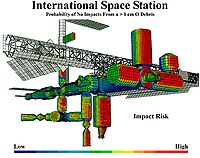 Example of risk management: A NASA model showing areas at high risk from impact for the International Space Station


Sightings from Earth[edit]
The ISS is visible to the naked eye as a slow-moving, bright white dot because of reflected sunlight, and can be seen in the hours after sunset and before sunrise, when the station remains sunlit but the ground and sky are dark.[410] The ISS takes about 10 minutes to pass from one horizon to another, and will only be visible part of that time because of moving into or out of the Earth's shadow. Because of the size of its reflective surface area, the ISS is the brightest artificial object in the sky (excluding other satellite flares), with an approximate maximum magnitude of −4 when in sunlight and overhead (similar to Venus), and a maximum angular size of 63 arcseconds.[411]
Tools are provided by a number of websites such as Heavens-Above (see Live viewing below) as well as smartphone applications that use orbital data and the observer's longitude and latitude to indicate when the ISS will be visible (weather permitting), where the station will appear to rise, the altitude above the horizon it will reach and the duration of the pass before the station disappears either by setting below the horizon or entering into Earth's shadow.[412][413][414][415]
In November 2012 NASA launched its "Spot the Station" service, which sends people text and email alerts when the station is due to fly above their town.[416] The station is visible from 95% of the inhabited land on Earth, but is not visible from extreme northern or southern latitudes.[380]
Under specific conditions, the ISS can be observed at night on five consecutive orbits. Those conditions are 1) a mid-latitude observer location, 2) near the time of the solstice with 3) the ISS passing in the direction of the pole from the observer near midnight local time. The three photos show the first, middle and last of the five passes on 5–6 June 2014.
-
 Skytrack long duration exposure of the ISS
 -
 The ISS on its first pass of the night passing nearly overhead shortly after sunset in June 2014
 -
 The ISS passing north on its third pass of the night near local midnight in June 2014
 -
 The ISS passing west on its fifth pass of the night before sunrise in June 2014


Astrophotography[edit]

Using a telescope-mounted camera to photograph the station is a popular hobby for astronomers,[417] while using a mounted camera to photograph the Earth and stars is a popular hobby for crew.[418] The use of a telescope or binoculars allows viewing of the ISS during daylight hours.[419]

Transits of the ISS in front of the Sun, particularly during an eclipse (and so the Earth, Sun, Moon, and ISS are all positioned approximately in a single line) are of particular interest for amateur astronomers.[420][421]
International co-operation[edit]

Involving five space programs and fifteen countries,[422] the International Space Station is the most politically and legally complex space exploration programme in history.[422] The 1998 Space Station Intergovernmental Agreement sets forth the primary framework for international cooperation among the parties. A series of subsequent agreements govern other aspects of the station, ranging from jurisdictional issues to a code of conduct among visiting astronauts.[423]
Following the 2022 Russian invasion of Ukraine, continued cooperation between Russia and other countries on the International Space Station has been put into question. Roscosmos Director General Dmitry Rogozin insinuated that Russian withdrawal could cause the International Space Station to de-orbit due to lack of reboost capabilities, writing in a series of tweets, "If you block cooperation with us, who will save the ISS from an unguided de-orbit to impact on the territory of the US or Europe? There's also the chance of impact of the 500-ton construction in India or China. Do you want to threaten them with such a prospect? The ISS doesn't fly over Russia, so all the risk is yours. Are you ready for it?"[424] (This latter claim is untrue: the ISS flies over all parts of the Earth between 51.6 degrees latitude north and south, approximately the latitude of Saratov.) Rogozin later tweeted that normal relations between ISS partners could only be restored once sanctions have been lifted, and indicated that Roscosmos would submit proposals to the Russian government on ending cooperation.[425] NASA stated that, if necessary, US corporation Northrop Grumman has offered a reboost capability that would keep the ISS in orbit.[426]
On 26 July 2022, Yury Borisov, Rogozin's successor as head of Roscosmos, submitted to Russian President Putin plans for withdrawal from the programme after 2024.[427] However, Robyn Gatens, the NASA official in charge of the space station, responded that NASA had not received any formal notices from Roscosmos concerning withdrawal plans.[428]
Participating countries[edit]
 Brazil (1997–2007)
 Canada
 European Space Agency
 Japan
Japan Russia
 United States


End of mission[edit]

According to the Outer Space Treaty, the United States and Russia are legally responsible for all modules they have launched.[429] Several possible disposal options were considered: Natural orbital decay with random reentry (as with Skylab), boosting the station to a higher altitude (which would delay reentry), and a controlled targeted de-orbit to a remote ocean area.[430] In late 2010, the preferred plan was to use a slightly modified Progress spacecraft to de-orbit the ISS.[431] This plan was seen as the simplest, cheapest and with the lowest risk to human life.[431]
OPSEK was previously intended to be constructed of modules from the Russian Orbital Segment after the ISS is decommissioned. The modules under consideration for removal from the current ISS included the Multipurpose Laboratory Module (Nauka), launched in July 2021, and the other new Russian modules that are proposed to be attached to Nauka. These newly launched modules would still be well within their useful lives in 2024.[432]
At the end of 2011, the Exploration Gateway Platform concept also proposed using leftover USOS hardware and Zvezda 2 as a refuelling depot and service station located at one of the Earth–Moon Lagrange points. However, the entire USOS was not designed for disassembly and will be discarded.[433]
On 30 September 2015, Boeing's contract with NASA as prime contractor for the ISS was extended to 30 September 2020. Part of Boeing's services under the contract related to extending the station's primary structural hardware past 2020 to the end of 2028.[434]
There have also been suggestions in the commercial space industry that the station could be converted to commercial operations after it is retired by government entities.[435]
In July 2018, the Space Frontier Act of 2018 was intended to extend operations of the ISS to 2030. This bill was unanimously approved in the Senate, but failed to pass in the U.S. House.[436][437] In September 2018, the Leading Human Spaceflight Act was introduced with the intent to extend operations of the ISS to 2030, and was confirmed in December 2018.[438][439][440] Congress later passed similar provisions in its CHIPS and Science Act, signed into law by President Joe Biden on 9 August 2022.[441][442]
In January 2022, NASA announced a planned date of January 2031 to de-orbit the ISS using a deorbit module and direct any remnants into a remote area of the South Pacific Ocean.[443] NASA will launch the deorbiting spacecraft, a year before reentry, docking at the Harmony forward port either through a CBM or to PMA 2/IDA 2 after the removal of Axiom Orbital Segment. The spacecraft would only be functional during the final days of ISS, once the station's orbit has decayed to 220 km (140 mi). The spacecraft would then conduct one or more orientation burns to lower the perigee to 160 km (99 mi), followed by a final deorbiting burn.[444]
Cost[edit]
The ISS has been described as the most expensive single item ever constructed.[445] As of 2010, the total cost was US$150 billion. This includes NASA's budget of $58.7 billion ($89.73 billion in 2021 dollars) for the station from 1985 to 2015, Russia's $12 billion, Europe's $5 billion, Japan's $5 billion, Canada's $2 billion, and the cost of 36 shuttle flights to build the station, estimated at $1.4 billion each, or $50.4 billion in total. Assuming 20,000 person-days of use from 2000 to 2015 by two- to six-person crews, each person-day would cost $7.5 million, less than half the inflation-adjusted $19.6 million ($5.5 million before inflation) per person-day of Skylab.[446]
In film[edit]
Beside numerous documentaries such as the IMAX documentaries Space Station 3D from 2002,[447] or A Beautiful Planet from 2016,[448] and films like Apogee of Fear (2012)[449] and Yolki 5 (2016)[450][451] the ISS is the subject of feature films such as The Day After Tomorrow (2004),[452] Love (2011),[453] together with the Chinese station Tiangong 1 in Gravity (2013),[454] Life (2017),[455] and I.S.S. (2023).[456]
In 2022, the movie The Challenge (Doctor's House Call) was filmed aboard the ISS, and was notable for being the first feature film in which both professional actors and director worked together in space.[457]
See also[edit]
- A Beautiful Planet – 2016 IMAX documentary film showing scenes of Earth, as well as astronaut life aboard the ISS
- Center for the Advancement of Science in Space – operates the US National Laboratory on the ISS
- List of accidents and incidents involving the International Space Station
- List of International Space Station expeditions
- List of International Space Station spacewalks
- List of commanders of the International Space Station
- List of human spaceflights to the International Space Station
- List of space stations
- List of spacecraft deployed from the International Space Station
- Politics of outer space
- Science diplomacy
- Space Station 3D – 2002 Canadian documentary
Notes[edit]
- ^ Temporary docking adapter used until Prichal module arrival
- ^ "Zarya" can have a lot of meanings: "daybreak", "dawn" (in the morning) or "afterglow", "evening glow", "sunset" (in the evening). But usually it means "dawn".
- ^ The temporary docking adapter is the grey ring surrounding the docking probe of Progress MS 17.
- ^ The port had the temporary docking adapter before the SSVP-M or "Hybrid" standard, consisting of the traditional SSVP-G probe‑and‑drogue soft-dock mechanism and an APAS-95 hard-dock collar before Prichal arrival.
- ^ Privately funded travellers who have objected to the term include Dennis Tito, the first such traveller,[267] Mark Shuttleworth, founder of Ubuntu,[268] Gregory Olsen and Richard Garriott.[269][270] Canadian astronaut Bob Thirsk said the term does not seem appropriate, referring to his crewmate, Guy Laliberté, founder of Cirque du Soleil.[271] Anousheh Ansari denied being a tourist[272] and took offence at the term.[273]
- ^ ESA director Jörg Feustel-Büechl said in 2001 that Russia had no right to send 'amateurs' to the ISS. A 'stand-off' occurred at the Johnson Space Center between Commander Talgat Musabayev and NASA manager Robert Cabana who refused to train Dennis Tito, a member of Musabayev's crew along with Yuri Baturin. Musabayev argued that Tito had trained 700 hours in the last year and was as qualified as any NASA astronaut, and refused to allow his crew to be trained on the USOS without Tito. Cabana would not allow training to begin, and the commander returned with his crew to their hotel.
References[edit]
- ^ a b c d e Graf, Abby (27 September 2023). "Crewed Soyuz Spacecraft Undocking Live on NASA TV". NASA Blogs. Archived from the original on 15 October 2023. Retrieved 27 September 2023.
- ^ "Russia's Soyuz MS-24 launches crew for up to yearlong stay on space station". collectSPACE.com. Archived from the original on 6 October 2023. Retrieved 15 September 2023.
- ^ "ISS: International Space Station". Archived from the original on 10 August 2023.
- ^ a b c d e f Garcia, Mark (5 January 2023). "About the Space Station: Facts and Figures". NASA. Archived from the original on 6 February 2023. Retrieved 13 January 2023.
- ^ a b c d e f g Peat, Chris (21 May 2021). "ISS – Orbit". Heavens-Above. Retrieved 21 May 2021.
- ^ Holman, Joseph (12 October 2022). "ISS (ZARYA)". Satellite Tracking. Retrieved 12 October 2022.
- ^ a b "ARISS TLE". ARISS TLE. 16 August 2023. Retrieved 16 August 2023.
- ^ a b c NASA (18 February 2010). "On-Orbit Elements" (PDF). NASA. Archived from the original (PDF) on 29 October 2009. Retrieved 19 June 2010.
- ^ "STS-132 Press Kit" (PDF). NASA. 7 May 2010. Archived (PDF) from the original on 12 October 2023. Retrieved 19 June 2010.
- ^ "STS-133 FD 04 Execute Package" (PDF). NASA. 27 February 2011. Archived from the original (PDF) on 27 November 2020. Retrieved 27 February 2011.
- ^ "NASA – Higher Altitude Improves Station's Fuel Economy". nasa.gov. 14 February 2019. Archived from the original on 25 December 2021. Retrieved 29 May 2019.
- ^ "Current ISS Tracking data". NASA. 15 December 2008. Archived from the original on 25 December 2015. Retrieved 28 January 2009.
 This article incorporates text from this source, which is in the public domain.
- ^ "International Space Station Visitors by Country - NASA". Retrieved 19 March 2023.
- ^ Frieling, Thomas. "Skylab B:Unflown Missions, Lost Opportunities". Quest. 5 (4): 12–21.
- ^ Portree, David S. F. "Skylab-Salyut Space Laboratory (1972)". Wired – via www.wired.com.
- ^ ESA – Columbus
- ^ "International Space Station". Astronautix.com. Archived from the original on 9 April 2002. Retrieved 1 May 2012.
- ^ "fate of space station is in doubt as all options exceed cost goals". The New York Times. 8 June 1993.
- ^ "Mir-2". Astronautix. Archived from the original on 20 August 2016. Retrieved 12 February 2011.
- ^ "U.S. Proposes Space Station Merger with Russia". The Washington Post. 5 November 1993.
- ^ Heivilin, Donna (21 June 1994). "Space Station: Impact of the Expanded Russian Role on Funding and Research" (PDF). Government Accountability Office. Retrieved 3 November 2006.
- ^ Dismukes, Kim (4 April 2004). "Shuttle–Mir History/Background/How "Phase 1" Started". NASA. Archived from the original on 16 November 2001. Retrieved 12 April 2007.
- ^ a b "Russia to decide on pullout from ISS since 2025 after technical inspection". TASS. 18 April 2021. Retrieved 18 April 2021.
- ^ Dobrovidova, Olga (20 April 2021). "Russia mulls withdrawing from the International Space Station after 2024". Science. American Association for the Advancement of Science (AAAS). doi:10.1126/science.abj1005. ISSN 0036-8075. S2CID 235542488.
- ^ Harwood, William (26 July 2022). "Russia says it will withdraw from the International Space Station after 2024". CBS News. ViacomCBS. Retrieved 26 July 2022.
- ^ Roulette, Joey (26 July 2022). "Russia signals space station pullout, but NASA says it's not official yet". Reuters. Retrieved 26 July 2022.
- ^ "Russia is likely to take part in International Space Station until 2028 – RIA". Reuters. 21 September 2022. Retrieved 2 November 2022.
- ^ "Memorandum of Understanding Between the National Aeronautics and Space Administration of the United States of America and the Russian Space Agency Concerning Cooperation on the Civil International Space Station". NASA. Archived from the original on 15 December 2015. Retrieved 19 April 2009. This article incorporates text from this source, which is in the public domain.
- ^ Payette, Julie (10 December 2012). "Research and Diplomacy 350 Kilometers above the Earth: Lessons from the International Space Station". Science & Diplomacy. 1 (4). Archived from the original on 6 March 2013.
- ^ "National Space Policy of the United States of America" (PDF). White House. 28 June 2010. Archived (PDF) from the original on 27 October 2023. Retrieved 20 July 2011. This article incorporates text from this source, which is in the public domain.
- ^ Trinidad, Katherine; Humphries, Kelly (17 November 2008). "Nations Around the World Mark 10th Anniversary of International Space Station" (Press release). NASA. 08-296. Archived from the original on 21 May 2022. Retrieved 6 March 2009. This article incorporates text from this source, which is in the public domain.
- ^ a b c Oberg, James (2005). "International Space Station". World Book Online Reference Center. Retrieved 3 April 2016.[permanent dead link]
- ^ a b c d e "Fields of Research". NASA. 26 June 2007. Archived from the original on 23 January 2008.
- ^ "Getting on Board". NASA. 26 June 2007. Archived from the original on 8 December 2007. This article incorporates text from this source, which is in the public domain.
- ^ "Monitor of All-sky X-ray Image (MAXI)". JAXA. 2008. Archived from the original on 22 July 2011. Retrieved 12 March 2011.
- ^ "SOLAR: three years observing and ready for solar maximum". esa.int. ESA. 11 March 2011. Archived from the original on 10 August 2023. Retrieved 4 June 2023.
- ^ Hartevelt-Velani, Shamim; Walker, Carl; Elmann-Larsen, Benny (23 November 2009). "The International Space Station: life in space". Science in School (10). Archived from the original on 3 February 2023. Retrieved 17 February 2009.
- ^ "AMS to Focus on Invisible Universe". NASA. 18 March 2011. Archived from the original on 5 March 2023. Retrieved 8 October 2011. This article incorporates text from this source, which is in the public domain.
- ^ "In Search of Antimatter Galaxies". NASA. 14 August 2009. Archived from the original on 14 January 2023. Retrieved 8 October 2011. This article incorporates text from this source, which is in the public domain.
- ^ Aguilar, M. et al. (AMS Collaboration) (3 April 2013). "First Result from the Alpha Magnetic Spectrometer on the International Space Station: Precision Measurement of the Positron Fraction in Primary Cosmic Rays of 0.5–350 GeV" (PDF). Physical Review Letters. 110 (14): 141102. Bibcode:2013PhRvL.110n1102A. doi:10.1103/PhysRevLett.110.141102. PMID 25166975. Archived (PDF) from the original on 10 August 2023.
- ^ Staff (3 April 2013). "First Result from the Alpha Magnetic Spectrometer Experiment". AMS Collaboration. Archived from the original on 8 April 2013. Retrieved 3 April 2013.
- ^ Heilprin, John; Borenstein, Seth (3 April 2013). "Scientists find hint of dark matter from cosmos". Associated Press. Archived from the original on 10 May 2013. Retrieved 3 April 2013.
- ^ Amos, Jonathan (3 April 2013). "Alpha Magnetic Spectrometer zeroes in on dark matter". BBC News. Archived from the original on 12 August 2023. Retrieved 3 April 2013.
- ^ Perrotto, Trent J.; Byerly, Josh. "NASA TV Briefing Discusses Alpha Magnetic Spectrometer Results" (Press release). NASA. M13-054. Archived from the original on 9 November 2023. Retrieved 3 April 2013. This article incorporates text from this source, which is in the public domain.
- ^ Overbye, Dennis (3 April 2013). "Tantalizing New Clues Into the Mysteries of Dark Matter". The New York Times. Archived from the original on 20 August 2017. Retrieved 3 April 2013.
- ^ Horneck, Gerda; Klaus, David M.; Mancinelli, Rocco L. (March 2010). "Space Microbiology" (PDF). Microbiology and Molecular Biology Reviews. 74 (1). American Society for Microbiology: 121–156. Bibcode:2010MMBR...74..121H. doi:10.1128/MMBR.00016-09. PMC 2832349. PMID 20197502. Archived from the original (PDF) on 30 August 2011. Retrieved 4 June 2011. (see Space Environment on page 122)
- ^ Amos, Jonathan (23 August 2010). "Beer microbes live 553 days outside ISS". BBC News. Archived from the original on 11 August 2023. Retrieved 4 June 2011.
- ^ Ledford, Heidi (8 September 2008). "Spacesuits optional for 'water bears'". Nature. doi:10.1038/news.2008.1087.
- ^ a b c Buckey, Jay (23 February 2006). Space Physiology. Oxford University Press USA. ISBN 978-0-19-513725-5.
- ^ Grossman, List (22 July 2009). "Ion engine could one day power 39-day trips to Mars". New Scientist. Archived from the original on 15 October 2023. Retrieved 8 January 2010.
- ^ Boen, Brooke (1 May 2009). "Advanced Diagnostic Ultrasound in Microgravity (ADUM)". NASA. Archived from the original on 29 October 2009. Retrieved 1 October 2009. This article incorporates text from this source, which is in the public domain.
- ^ Rao, Sishir; et al. (May 2008). "A Pilot Study of Comprehensive Ultrasound Education at the Wayne State University School of Medicine". Journal of Ultrasound in Medicine. 27 (5): 745–749. doi:10.7863/jum.2008.27.5.745. PMID 18424650. S2CID 30566494.
- ^ Fincke, E. Michael; et al. (February 2005). "Evaluation of Shoulder Integrity in Space: First Report of Musculoskeletal US on the International Space Station". Radiology. 234 (2): 319–322. doi:10.1148/radiol.2342041680. PMID 15533948.
- ^ Strickland, Ashley (26 August 2020). "Bacteria from Earth can survive in space and could endure the trip to Mars, according to new study". CNN News. Archived from the original on 11 August 2023. Retrieved 26 August 2020.
- ^ Kawaguchi, Yuko; et al. (26 August 2020). "DNA Damage and Survival Time Course of Deinococcal Cell Pellets During 3 Years of Exposure to Outer Space". Frontiers in Microbiology. 11: 2050. doi:10.3389/fmicb.2020.02050. PMC 7479814. PMID 32983036. S2CID 221300151.
- ^ "Earth Science & Remote Sensing Missions on ISS". NASA. Archived from the original on 10 August 2023. Retrieved 9 December 2020.
- ^ May, Sandra (15 February 2012). "What Is Microgravity?". NASA Knows! (Grades 5-8). NASA. Archived from the original on 7 November 2023. Retrieved 3 September 2018. This article incorporates text from this source, which is in the public domain.
- ^ "European Users Guide to Low Gravity Platforms". European Space Agency. 6 December 2005. Archived from the original on 2 April 2013. Retrieved 22 March 2013.
- ^ "Materials Science 101". NASA. 15 September 1999. Archived from the original on 14 June 2009. Retrieved 18 June 2009. This article incorporates text from this source, which is in the public domain.
- ^ "ISS Research Program". NASA. Archived from the original on 13 February 2009. Retrieved 27 February 2009.
- ^ "Mars500: study overview". European Space Agency. 4 June 2011. Archived from the original on 19 August 2023.
- ^ "Space station may be site for next mock Mars mission". New Scientist. 4 November 2011. Archived from the original on 11 July 2017. Retrieved 1 September 2017.
- ^ "The Sustainable Utilisation of the ISS Beyond 2015" (PDF). International Astronautical Congress. Archived from the original (PDF) on 26 April 2012. Retrieved 15 December 2011.
- ^ de Selding, Peter B. (3 February 2010). "ESA Chief Lauds Renewed U.S. Commitment to Space Station, Earth Science". Space News.
- ^ Chow, Denise (8 April 2011). "Space Station Crucial for Going to Mars, NASA Chief Says". Space.com. Archived from the original on 11 August 2023.
- ^ Seitz, Virginia A. (19 September 2011). "Memorandum Opinion for the General Counsel, Office of Science and Technology Policy" (PDF). justice.gov. US Justice Department. p. 3. Archived from the original (PDF) on 13 July 2012. Retrieved 23 May 2012.
- ^ a b c d e f Kitmacher, Gary (2006). Reference Guide to the International Space Station. Apogee Books Space Series. Canada: Apogee Books. pp. 71–80. ISBN 978-1-894959-34-6. ISSN 1496-6921.
- ^ Sandal, Gro M.; Manzey, Dietrich (December 2009). "Cross-cultural issues in space operations: A survey study among ground personnel of the European Space Agency". Acta Astronautica. 65 (11–12): 1520–1529. Bibcode:2009AcAau..65.1520S. doi:10.1016/j.actaastro.2009.03.074. ISSN 0094-5765.
- ^ "Online Materials". European Space Agency. Archived from the original on 11 August 2023. Retrieved 3 April 2016.
- ^ "ISS 3-D Teaching Tool: Spaceflight Challenge I". European Space Agency. 24 May 2011. Archived from the original on 11 August 2023. Retrieved 8 October 2011.
- ^ Building Peace in Young Minds through Space Education (PDF). Committee on the Peaceful Uses of Outer Space. Vol. 53. Vienna, Austria: JAXA. June 2010. Archived (PDF) from the original on 11 August 2023.
- ^ "JAXA Spaceflight Seeds Kids I : Spaceflight Sunflower seeds – Let's make them flower! and learn freshly the Earth environment just by contrast with the Space one". JAXA. 2006. Archived from the original on 18 March 2012.
- ^ "JAXA Seeds in Space I : Let's Cultivate Spaceflight Asagao (Japanese morning glory), Miyako-gusa (Japanese bird's foot trefoil) Seeds and Identify the Mutants!". JAXA. 2006. Archived from the original on 18 March 2012.
- ^ Murakami, Keiji (14 October 2009). "JEM Utilization Overview" (PDF). JAXA. Steering Committee for the Decadal Survey on Biological and Physical Sciences in Space. Archived from the original (PDF) on 29 November 2011. Retrieved 27 September 2011.
- ^ Tanaka, Tetsuo. "Kibo: Japan's First Human Space Facility". JAXA. Archived from the original on 29 November 2011. Retrieved 8 October 2011.
- ^ "Amateur Radio on the International Space Station". 6 June 2011. Archived from the original on 27 May 2011. Retrieved 10 June 2011.
- ^ Riley, Christopher (11 April 2011). "What Yuri Gagarin saw: First Orbit film to reveal the view from Vostok 1". The Guardian. Archived from the original on 10 August 2023.
- ^ "Yuri Gagarin's First Orbit – FAQs". firstorbit.org. The Attic Room Ltd. Archived from the original on 10 August 2023. Retrieved 1 May 2012.
- ^ Warr, Philippa (13 May 2013). "Commander Hadfield bids farewell to ISS with Reddit-inspired Bowie cover". wired.co.uk. Archived from the original on 12 October 2013. Retrieved 22 October 2013.
- ^ "Astronaut bids farewell with Bowie cover version (inc. video)". BBC News. 13 May 2013. Archived from the original on 11 August 2023. Retrieved 24 September 2020.
- ^ Davis, Lauren (12 May 2013). "Chris Hadfield sings "Space Oddity" in the first music video in space". Gizmodo. Archived from the original on 11 August 2023.
- ^ Mabbett, Andy (29 November 2017). "Close encounters of the Wikipedia kind: Astronaut is first to specifically contribute to Wikipedia from space". Diff. Wikimedia foundation. Archived from the original on 4 June 2023. Retrieved 4 December 2017.
- ^ Petris, Antonella (1 December 2017). "Primo contributo 'extraterrestre' su Wikipedia: è di Nespoli" [First 'Extraterrestrial' Contribution on Wikipedia: It's by Nespoli.]. Meteo Web (in Italian). Archived from the original on 11 August 2023. Retrieved 4 December 2017.
- ^ Pearlman, Robert Z. (23 November 2021). "'The Infinite' VR space station tour to premiere spacewalk in Houston". Space.com. Archived from the original on 10 August 2023. Retrieved 27 November 2021.
- ^ Harbaugh, Jennifer, ed. (19 February 2016). "Manufacturing Key Parts of the International Space Station: Unity and Destiny". NASA. Archived from the original on 24 November 2023. Retrieved 15 February 2019.
- ^ "ISS Zvezda". Archived from the original on 20 August 2016. Retrieved 5 July 2019.
- ^ "Europe's Airbus-built Columbus orbital outpost: 10 years in space" (Press release). Airbus. 6 February 2018. Archived from the original on 11 August 2022. Retrieved 6 May 2020.
- ^ "Ten years in perfect "Harmony"! – Thales Group" (Press release). Thales Group. 23 October 2017. Archived from the original on 10 August 2023.
- ^ "Building ISS". U.S. National Archives & DVIDS. Retrieved 28 October 2021.
- ^ Shiflett, Kim (22 April 2008). "KSC-08pd0991". NASA Image and Video Library. Cape Canaveral, Fla. Archived from the original on 24 November 2023. Retrieved 5 July 2019.
In the Space Station Processing Facility at NASA's Kennedy Space Center, an overhead crane moves the Kibo Japanese Experiment Module – Pressurized Module toward the payload canister (lower right). The canister will deliver the module, part of the payload for space shuttle Discovery's STS-124 mission, to Launch Pad 39A. On the mission, the STS-124 crew will transport the Kibo module as well as the Japanese Remote Manipulator System to the International Space Station to complete the Kibo laboratory. The launch of Discovery is targeted for May 31.
- ^ a b c "The ISS to Date". NASA. 9 March 2011. Archived from the original on 11 June 2015. Retrieved 21 March 2011.
- ^ Dismukes, Kim (1 December 2002). "Mission Control Answers Your Questions: STS-113 Q17". spaceflight.nasa.gov. NASA. Archived from the original on 24 July 2020. Retrieved 14 June 2009.
- ^ "NASA Facts. The Service Module: A Cornerstone of Russian International Space Station Modules" (PDF). spaceflight.nasa.gov. NASA. January 1999. IS-1999-09-ISS019JSC. Archived from the original (PDF) on 23 August 2020.
- ^ "STS-88". Science.ksc.nasa.gov. Archived from the original on 6 June 2011. Retrieved 19 April 2011.
- ^ Liston, Brad (2 November 2000). "Upward Bound: Tales of Space Station Alpha". Time. Archived from the original on 2 April 2008. Retrieved 5 August 2010.
- ^ "Space Station – Impact on the expanded Russian role of funding and research" (PDF). Government Accountability Office. 21 June 1994. Archived (PDF) from the original on 12 October 2023. Retrieved 9 August 2010.
- ^ a b Ladwig, Alan (3 November 2000). "Call Bill Shepherd the Alpha Male of the International Space Station". Space.com. Archived from the original on 23 May 2009. Retrieved 9 August 2010.
- ^ Halvorson, Todd (2 November 2000). "Expedition One Crew Wins Bid To Name Space Station Alpha". Space.com. Archived from the original on 23 May 2009. Retrieved 9 August 2010.
- ^ "Interview with RSC Energia's Yuri Semenov". Space.com. 3 September 2001. Archived from the original on 5 March 2021. Retrieved 22 August 2010.
- ^ "Interview with Yuri Semenov, general designer of Space Rocket corporation Energy". Voice of Russia. 21 March 2001. Archived from the original on 18 March 2012. Retrieved 5 October 2010.
- ^ "STS-92". Science.ksc.nasa.gov. Archived from the original on 5 March 2011. Retrieved 19 April 2011.
- ^ Bergin, Chris (26 July 2005). "Discovery launches – The Shuttle is back". NASASpaceFlight.com. Archived from the original on 11 August 2023. Retrieved 6 March 2009.
- ^ "Mini-Research Module 1 (MIM1) Rassvet (MRM-1)". RussianSpaceWeb. Archived from the original on 25 August 2011. Retrieved 12 July 2011.
- ^ "STS-133". NASA. Archived from the original on 20 November 2023. Retrieved 1 September 2014.
- ^ "STS-134". NASA. Archived from the original on 20 November 2023. Retrieved 1 September 2014.
- ^ "Russia works on a new-generation space module". RussianSpaceWeb. Archived from the original on 8 April 2016. Retrieved 29 November 2015.
- ^ "Crewed spacecraft docked to ISS's module Nauka first time". TASS. 28 September 2011. Archived from the original on 10 August 2023. Retrieved 11 October 2021.
- ^ "Рогозин подтвердил, что на модуль "Наука" поставят баки от разгонного блока "Фрегат"" [Rogozin confirmed that the module 'Science' placed the tanks from the upper stage 'Frigate'] (in Russian). TASS. 25 March 2019. Archived from the original on 10 August 2023. Retrieved 31 March 2019.
- ^ "Новый модуль вошел в состав российского сегмента МКС" [A new module has entered the composition of the Russian segment of the ISS] (Press release) (in Russian). Roscosmos. 26 November 2021. Archived from the original on 27 November 2021. Retrieved 6 May 2022.
- ^ "Zarya Module". NASA. Archived from the original on 18 November 2023. Retrieved 19 April 2014.
- ^ Zak, Anatoly (15 October 2008). "Russian Segment: Enterprise". RussianSpaceWeb. Archived from the original on 11 August 2023. Retrieved 4 August 2012.
- ^ "NASA - NSSDCA - Spacecraft - Details". nssdc.gsfc.nasa.gov. NASA. 1998-069F. Archived from the original on 23 April 2023. Retrieved 6 May 2022.
- ^ Loff, Sarah (15 November 2018). "Unity". NASA. Archived from the original on 5 June 2022. Retrieved 6 May 2022.
- ^ Roy, Steve (20 October 2009). "ET-134's Mission,STS-130: Launching Tranquility". NASA. Archived from the original on 22 March 2023. Retrieved 23 November 2023.
- ^ Williams, Suni (presenter) (3 July 2015). Departing Space Station Commander Provides Tour of Orbital Laboratory (video). NASA. Event occurs at 17.46-18.26. Retrieved 1 September 2019.
- ^ Roylance, Frank D. (11 November 2000). "Space station astronauts take shelter from solar radiation". The Baltimore Sun. Tribune Publishing. Archived from the original on 1 September 2019. Retrieved 1 September 2019.
- ^ Stofer, Kathryn (29 October 2013). "Tuesday/Wednesday Solar Punch". NASA. Archived from the original on 2 December 2020. Retrieved 1 September 2019.
- ^ "Service Module | RuSpace". suzymchale.com. Archived from the original on 21 September 2020. Retrieved 10 November 2020.
- ^ a b Boeing (2008). "Destiny Laboratory Module". Boeing. Archived from the original on 11 October 2008. Retrieved 7 October 2008.
- ^ a b NASA (2003). "U.S. Destiny Laboratory". NASA. Archived from the original on 9 July 2007. Retrieved 7 October 2008.
- ^ a b NASA (2001). "STS-98". NASA. Archived from the original on 30 August 2013. Retrieved 7 October 2008.
- ^ "Quest Airlock". NASA. Archived from the original on 24 October 2023. Retrieved 24 November 2023.
- ^ a b Stockman, Bill; Boyle, Joe; Bacon, John (2010). International Space Station Systems Engineering Case Study (PDF) (Technical report). United States Air Force. pp. 36–38. Archived (PDF) from the original on 24 November 2023. Retrieved 24 November 2023.
- ^ Uri, John (14 July 2021). "Space Station 20th: STS-104 Brings Quest Joint Airlock to the Space Station". NASA. Archived from the original on 24 November 2023. Retrieved 24 November 2023.
- ^ "August 28, 2009. S.P.Korolev RSC Energia, Korolev, Moscow region". RSC Energia. 28 August 2009. Archived from the original on 21 September 2020. Retrieved 3 September 2009.
- ^ Clark, Stephen (10 November 2009). "Poisk launches to add new room for space station". Spaceflight Now. Archived from the original on 10 August 2023. Retrieved 11 November 2009.
- ^ Zak, Anatoly. "Mir close calls". RussianSpaceWeb. Archived from the original on 11 August 2023. Retrieved 1 May 2012.
- ^ "Pirs Docking Compartment". NASA. 10 May 2006. Archived from the original on 25 October 2005. Retrieved 28 March 2009.
- ^ Williams, Suni (presenter) (19 May 2013). Station Tour: Harmony, Tranquility, Unity (video). NASA. Event occurs at 0.06-0.35. Archived from the original on 11 December 2021. Retrieved 31 August 2019.
So this is Node 2 ... this is where four out of six of us sleep.
- ^ NASA (23 October 2007). "STS-120 MCC Status Report #01". NASA. Archived from the original on 28 October 2007. Retrieved 22 September 2019.
- ^ Johnson, Jr., John (24 October 2007). "Shuttle embarks on busy mission". Los Angeles Times. Archived from the original on 12 August 2023. Retrieved 23 October 2007.
- ^ Harwood, William (26 October 2007). "Harmony module pulled from cargo bay". CBS News. Archived from the original on 17 September 2021. Retrieved 26 October 2007.
- ^ Schwartz, John (26 October 2007). "New Room Added to Space Station". The New York Times. Archived from the original on 11 August 2023. Retrieved 26 October 2007.
- ^ NASA (2007). "PMA-3 Relocation". NASA. Archived from the original on 12 October 2007. Retrieved 28 September 2007.
- ^ "NASA – NASA Receives Tranquility". Nasa.gov. 23 October 2010. Archived from the original on 11 August 2023. Retrieved 12 August 2013.
- ^ Harwood, William (11 February 2008). "Station arm pulls Columbus module from cargo bay". Spaceflight Now. Archived from the original on 7 May 2016. Retrieved 7 August 2009.
- ^ Kamiya, Setsuko (30 June 2009). "Japan a low-key player in space race". Japan Times. p. 3. Archived from the original on 13 August 2013.
- ^ "Thales Alenia Space and ISS modules – Cupola: a window over the Earth". 26 July 2010. Archived from the original on 26 July 2010.
- ^ Gebhardt, Chris (9 April 2009). "STS-132: PRCB baselines Atlantis' mission to deliver Russia's MRM-1". NASASpaceFlight.com. Archived from the original on 12 April 2023. Retrieved 12 November 2009.
- ^ "STS-132 MCC Status Report #09". NASA. 18 May 2010. Archived from the original on 8 April 2013. Retrieved 7 July 2010. This article incorporates text from this source, which is in the public domain.
- ^ "STS-132 MCC Status Report #13". NASA. 20 May 2010. Archived from the original on 7 July 2010. Retrieved 7 July 2010. This article incorporates text from this source, which is in the public domain.
- ^ Ray, Justin (28 June 2010). "Station crew takes Soyuz for 'spin around the block'". Spaceflight Now. Archived from the original on 11 August 2023. Retrieved 7 July 2010.
- ^ a b "Mini-Research Module 1 (MRM1) Rassvet (Dawn)". Reference Guide to the International Space Station (PDF). National Aeronautics and Space Administration. November 2010. p. 62. ISBN 978-0-16-086517-6. LCCN 2010040473. Archived (PDF) from the original on 26 November 2023. Retrieved 18 December 2022.
- ^ "Выход российских космонавтов в открытый космос перенесли на лето" [The spacewalk of Russian cosmonauts has been rescheduled for the summer] (in Russian). RIA Novosti. 17 May 2022. Archived from the original on 10 August 2023. Retrieved 25 November 2022.
- ^ a b c "Многоцелевой лабораторный модуль "Наука"" [Multipurpose Laboratory Module 'Nauka'] (in Russian). Roscosmos. Archived from the original on 14 July 2021. Retrieved 14 July 2021.
- ^ Pearlman, Robert (10 April 2016). "SpaceX Dragon Arrives at Space Station, Delivers Inflatable Room Prototype". Space.com. Archived from the original on 11 June 2023. Retrieved 11 April 2016.
- ^ Foust, Jeff (21 January 2022). "Bigelow Aerospace transfers BEAM space station module to NASA". SpaceNews. Retrieved 13 February 2024.
- ^ Harwood, William (19 August 2016). "Spacewalkers attach docking adapter to space station for commercial vehicles". Spaceflight Now. Archived from the original on 10 August 2023. Retrieved 24 January 2021.
- ^ Garcia, Mark (21 August 2019). "Spacewalkers Complete Installation of Second Commercial Docking Port". NASA Space Station. Archived from the original on 2 June 2020. Retrieved 24 January 2021.
- ^ "Thales Alenia Space reaches key milestone for NanoRacks' airlock module" (Press release). Turin: Thales Alenia Space. 20 March 2019. Archived from the original on 10 August 2023. Retrieved 22 August 2019.
- ^ Clark, Stephen (2 August 2019). "SpaceX to begin flights under new cargo resupply contract next year". Spaceflight Now. Archived from the original on 2 June 2023. Retrieved 22 August 2019.
- ^ "NanoRacks, Boeing to Build First Commercial ISS Airlock Module" (Press release). NanoRacks. 6 February 2017. Archived from the original on 11 August 2023. Retrieved 22 August 2019.
- ^ Garcia, Mark (6 February 2017). "Progress Underway for First Commercial Airlock on Space Station". NASA. Archived from the original on 12 November 2020. Retrieved 22 August 2019.
- ^ Zak, Anatoly (9 February 2021). "Progress MS-17 lifts off to prepare Prichal module arrival". RussianSpaceWeb. Archived from the original on 11 August 2023. Retrieved 21 October 2021.
- ^ "В РКК "Энергия" утвердили эскиз нового узлового модуля МКС". Roskosmos. Archived from the original on 19 June 2013. Retrieved 30 December 2012.
- ^ Clark, Stephen (25 July 2019). "New docking port, spacesuit and supplies en route to space station". Spaceflight Now. Archived from the original on 10 August 2023. Retrieved 17 August 2019.
- ^ a b Zak, Anatoly (22 June 2020). "Prichal Node Module, UM". RussianSpaceWeb. Archived from the original on 20 November 2023. Retrieved 23 June 2020.
- ^ "News January 13, 2011" (Press release). Energia. 13 January 2011. Archived from the original on 2 July 2017. Retrieved 8 October 2011.
- ^ a b Atkinson, Ian (19 August 2020). "Russia's Nauka ISS module arrives at Baikonur for final launch preparations". NASASpaceFlight.com. Archived from the original on 10 August 2023. Retrieved 20 August 2020.
- ^ "Spread Your Wings, It's Time to Fly". NASA. 26 July 2006. Archived from the original on 11 January 2023. Retrieved 21 September 2006. This article incorporates text from this source, which is in the public domain.
- ^ "Consolidated Launch Manifest". NASA. 2008. Archived from the original on 7 March 2009. Retrieved 8 July 2008. This article incorporates text from this source, which is in the public domain.
- ^ "EXPRESS Racks 1 and 2 fact sheet". 1 February 2001. FS-2001-02-34-MSFC. Archived from the original on 29 August 2008. Retrieved 4 October 2009. This article incorporates text from this source, which is in the public domain.
- ^ "Soyuz TMA-03M docks to ISS, returns station to six crewmembers for future ops". NASASpaceFlight.com. 23 December 2011. Archived from the original on 11 August 2023. Retrieved 1 May 2012.
- ^ Welsch, L. D. (30 October 2009). "EVA Checklist: STS-129 Flight Supplement" (PDF). NASA. Archived from the original (PDF) on 29 November 2011. Retrieved 9 July 2011. This article incorporates text from this source, which is in the public domain.
- ^ "Space Shuttle Mission: STS-133 Press Kit" (PDF). NASA. February 2011. Archived (PDF) from the original on 12 October 2023. Retrieved 9 July 2011. This article incorporates text from this source, which is in the public domain.
- ^ a b c "Space Shuttle Mission: STS-134" (PDF). NASA. April 2011. Archived from the original (PDF) on 26 December 2018. Retrieved 9 July 2011. This article incorporates text from this source, which is in the public domain.
- ^ "HTV2: Mission Press Kit" (PDF). Japan Aerospace Exploration Agency. 20 January 2011. Archived (PDF) from the original on 11 August 2023.
- ^ "Exposed Facility:About Kibo". JAXA. 29 August 2008. Archived from the original on 3 August 2009. Retrieved 9 October 2009.
- ^ "NASA–European Technology Exposure Facility (EuTEF)". NASA. 6 October 2008. Archived from the original on 19 October 2008. Retrieved 28 February 2009. This article incorporates text from this source, which is in the public domain.
- ^ "European Technology Exposure Facility (EuTEF)". European Space Agency. 13 January 2009. Archived from the original on 12 August 2023. Retrieved 28 February 2009.
- ^ "Atomic Clock Ensemble in Space (ACES)". ESA. Archived from the original on 9 June 2009. Retrieved 9 October 2009.
- ^ Gebhardt, Chris (10 March 2017). "SpaceX science – Dragon delivers experiments for busy science period". NASASpaceFlight.com. Archived from the original on 10 August 2023. Retrieved 11 January 2019.
- ^ Graham, William (3 June 2017). "Falcon 9 launches with CRS-11 Dragon on 100th 39A launch". NASASpaceFlight.com. Archived from the original on 10 August 2023. Retrieved 11 January 2019.
- ^ "The Alpha Magnetic Spectrometer Experiment". CERN. 21 January 2009. Archived from the original on 11 August 2023. Retrieved 6 March 2009.
- ^ Bergin, Chris (4 April 2013). "Endeavour's ongoing legacy: AMS-02 proving its value". NASASpaceFlight.com. Archived from the original on 10 August 2023. Retrieved 11 January 2019.
- ^ "ESA and Airbus sign partnership agreement for new ISS commercial payload platform Bartolomeo". SpaceDaily. 9 February 2018. Archived from the original on 11 August 2023. Retrieved 10 February 2018.
- ^ "Airbus and ESA to partner on Bartolomeo platform". Aerospace Technology. 8 February 2018. Archived from the original on 10 August 2023. Retrieved 10 February 2018.
- ^ "ISS: Bartolomeo". eoPortal. European Space Agency. 26 October 2016. Archived from the original on 12 August 2023. Retrieved 10 February 2018.
- ^ Garcia, Mark (12 May 2023). "Cosmonauts Deploy Radiator and Complete Spacewalk". NASA Blogs. NASA. Archived from the original on 31 July 2023. Retrieved 12 May 2023.
- ^ "European Robotic Arm Brochure" (PDF). European Space Agency. p. 9. Archived (PDF) from the original on 10 August 2023.
- ^ Harwood, William (9 August 2023). "Russian cosmonauts make spacewalk at International Space Station". Spaceflight Now. Archived from the original on 12 August 2023. Retrieved 10 August 2023.
- ^ "Russian space station laboratory module appears to spring coolant leak – Spaceflight Now". Spaceflight Now. 9 October 2023. Archived from the original on 14 October 2023. Retrieved 10 October 2023.
- ^ "Госкорпорация "Роскосмос"". Telegram. Retrieved 10 October 2023.
- ^ "Sredstva Krepleniya Krupnogabaritnykh Obyektov, SKKO".
- ^ "The Russian Nauka/Multipurpose Laboratory Module (MLM) General Thread". forum.nasaspaceflight.com. Retrieved 15 October 2022.
- ^ "Schedule of ISS flight events (part 2)". forum.nasaspaceflight.com. Retrieved 31 July 2022.
- ^ "The Russian Nauka/Multipurpose Laboratory Module (MLM) General Thread". forum.nasaspaceflight.com. Retrieved 25 March 2022.
- ^ Zak, Anatoly. "Russia to bump its ISS crew back to three". RussianSpaceWeb. Archived from the original on 11 August 2023. Retrieved 25 March 2022.
- ^ Garcia, Mark (16 November 2022). "Cosmonauts Prep for Thursday Spacewalk, Dragon Targets Monday Launch". NASA Blogs. NASA. Archived from the original on 10 August 2023. Retrieved 16 November 2022.
- ^ Lavelle, Heidi (17 November 2022). "Cosmonauts Begin First in a Series of Spacewalks for Station Maintenance". NASA Blogs. NASA. Archived from the original on 10 August 2023. Retrieved 17 November 2022.
- ^ Garcia, Mark (17 November 2022). "Cosmonauts Finish Spacewalk for Work on Science Module". NASA Blogs. NASA. Archived from the original on 29 March 2023. Retrieved 17 November 2022.
- ^ Pearlman, Robert Z. (17 November 2022). "Russian cosmonauts complete station spacewalk to ready radiator for move". Space.com. Archived from the original on 24 November 2023. Retrieved 23 November 2022.
- ^ "Canadarm2 and the Mobile Servicing System". NASA. 8 January 2013. Archived from the original on 23 March 2009. Retrieved 22 June 2015.
- ^ "Dextre, the International Space Station's Robotic Handyman". Canadian Space Agency. 18 April 2011. Archived from the original on 5 April 2023. Retrieved 22 June 2015.
- ^ "Mobile Base System". Canadian Space Agency. Archived from the original on 27 March 2023. Retrieved 22 June 2015.
- ^ "Remote Manipulator System: About Kibo". JAXA. 29 August 2008. Archived from the original on 20 March 2008. Retrieved 4 October 2009.
- ^ "International Space Station Status Report #02-03". NASA. 14 January 2002. Archived from the original on 11 March 2010. Retrieved 4 October 2009.
- ^ "Russia postpones launch of Nauka research module to orbital outpost to 2021". TASS. 2 April 2020. Archived from the original on 10 August 2023. Retrieved 1 March 2021.
- ^ Clark, Stephen (28 January 2020). "Axiom wins NASA approval to attach commercial habitat to space station". Spaceflight Now. Archived from the original on 21 November 2023. Retrieved 29 January 2020.
- ^ Etherington, Darrell (27 January 2020). "NASA taps startup Axiom Space for the first habitable commercial module for the Space Station". TechCrunch. Archived from the original on 28 January 2020. Retrieved 29 January 2020.
- ^ Boyle, Alan (27 January 2020). "NASA clears Axiom Space to put commercial habitat on space station, with Boeing on the team". GeekWire. Archived from the original on 6 April 2023. Retrieved 29 January 2020.
- ^ "Axiom Station Assembly Sequence – Axiom Space Axiom Space". Axiom Space. Archived from the original on 10 August 2023. Retrieved 9 August 2021.
- ^ Foust, Jeff (13 December 2023). "SpaceX yet to select launch pad for next Axiom Space private astronaut mission". SpaceNews. Retrieved 13 December 2023.
Ondler said in the briefing that the first of those modules is now scheduled to launch to the ISS at the end of 2026, about a year later than the company previously announced.
- ^ "CAM – location?". NASA Spaceflight Forums. Retrieved 12 October 2009.
- ^ Malik, Tariq (14 February 2006). "NASA Recycles Former ISS Module for Life Support Research". Space.com. Archived from the original on 12 August 2023. Retrieved 11 March 2009.
- ^ "Russian Research Modules". Boeing. Archived from the original on 8 February 2010. Retrieved 21 June 2009.
- ^ Zak, Anatoly. "Russian segment of the ISS". RussianSpaceWeb. Archived from the original on 6 April 2023. Retrieved 3 October 2009.
- ^ Zak, Anatoly (22 June 2020). "Russian space program in 2024". RussianSpaceWeb. Archived from the original on 2 November 2023. Retrieved 23 June 2020.
- ^ "Russia to set up national orbital outpost in 2027 — Roscosmos". TASS. 24 January 2023. Archived from the original on 9 June 2023. Retrieved 31 January 2023.
- ^ "Роскосмос примет решение о пути развития российской орбитальной станции до конца июля" [Roscosmos to decide development path of Russian orbital station by end of July] (in Russian). TASS. 19 July 2021. Archived from the original on 10 August 2023. Retrieved 20 July 2021.
- ^ Zak, Anatoly (16 April 2021). "Russian Orbital Service Station, ROSS". RussianSpaceWeb. Archived from the original on 14 August 2023. Retrieved 26 April 2021.
- ^ "Научно-энергетический модуль запустят на "Ангаре" с Восточного" [The Science Power Module will be launched on an Angara from Vostochny] (in Russian). Roscosmos. 24 April 2021. Archived from the original on 22 August 2022. Retrieved 26 April 2021.
- ^ Foust, Jeff (23 March 2020). "Bigelow Aerospace lays off entire workforce". SpaceNews. Retrieved 2 December 2023.
- ^ Clark, Stephen (4 August 2023). "Trans-Atlantic joint venture aims to build new "international" space station". Ars Technica. Retrieved 15 February 2024.
- ^ Freudenrich, Craig (20 November 2000). "How Space Stations Work". Howstuffworks. Archived from the original on 12 December 2008. Retrieved 23 November 2008.
- ^ "5–8: The Air Up There". NASAexplores. NASA. Archived from the original on 18 December 2004. Retrieved 31 October 2008.
- ^ Anderson, Clinton P.; et al. (30 January 1968). Apollo 204 Accident: Report of the Committee on Aeronautical and Space Sciences, United States Senate (PDF) (Report). Washington, D.C.: US Government Printing Office. p. 8. Report No. 956. Archived (PDF) from the original on 10 August 2023.
- ^ Davis, Jeffrey R.; Johnson, Robert & Stepanek, Jan (2008). Fundamentals of Aerospace Medicine. Vol. XII. Philadelphia PA, USA: Lippincott Williams & Wilkins. pp. 261–264.
- ^ Malik, Tariq (15 February 2006). "Air Apparent: New Oxygen Systems for the ISS". Space.com. Archived from the original on 14 August 2023. Retrieved 21 November 2008.
- ^ a b Barry, Patrick L. (13 November 2000). "Breathing Easy on the Space Station". NASA. Archived from the original on 21 September 2008. Retrieved 21 November 2008.
- ^ "RuSpace | ISS Russian Segment Life Support System". Suzymchale.com. Archived from the original on 9 August 2011. Retrieved 8 October 2011.
- ^ "Breathing Easy on the Space Station". NASA. 13 November 2000. Archived from the original on 11 March 2019. Retrieved 8 October 2011.
- ^ Cuevas, Andrés (January 2005). The early history of bifacial solar cell. European Photovoltaic Solar Energy Conference. Vol. 20. WIP Renewable Energies. hdl:1885/84487. Archived from the original on 5 April 2023. Retrieved 14 August 2012.
- ^ G. Landis; C-Y. Lu (1991). "Solar Array Orientation Options for a Space Station in Low Earth Orbit". Journal of Propulsion and Power. 7 (1): 123–125. doi:10.2514/3.23302.
- ^ Miller, Thomas B. (24 April 2000). "Nickel-Hydrogen Battery Cell Life Test Program Update for the International Space Station". grc.nasa.gov. Research & Technology. NASA / Glenn Research Center. Archived from the original on 25 August 2009. Retrieved 27 November 2009.
- ^ Clark, Stephen (13 December 2016). "Japanese HTV makes battery delivery to International Space Station". Spaceflight Now. Archived from the original on 10 August 2023. Retrieved 29 January 2017.
- ^ Patterson, Michael J. (18 June 1999). "Cathodes Delivered for Space Station Plasma Contactor System". grc.nasa.gov. Research & Technology. NASA / Lewis Research Center. Archived from the original on 5 July 2011.
- ^ Price, Steve; Phillips, Tony; Knier, Gil (21 March 2001). "Staying Cool on the ISS". NASA. Archived from the original on 3 February 2023. Retrieved 22 July 2016.
- ^ Active Thermal Control System (ATCS) Overview (PDF) (Technical report). Boeing. Archived (PDF) from the original on 16 October 2023. Retrieved 8 October 2011.
- ^ a b "Communications and Tracking". Integrated Defense Systems. Boeing. Archived from the original on 11 June 2008. Retrieved 30 November 2009.
- ^ Mathews, Melissa; James Hartsfield (25 March 2005). "International Space Station Status Report: SS05-015". NASA News. NASA. Archived from the original on 11 January 2012. Retrieved 11 January 2010.
- ^ Harland, David (2004). The Story of Space Station Mir. New York: Springer-Verlag New York Inc. ISBN 978-0-387-23011-5.
- ^ Harvey, Brian (2007). The rebirth of the Russian space program: 50 years after Sputnik, new frontiers. Springer Praxis Books. p. 263. ISBN 978-0-387-71354-0.
- ^ Zak, Anatoly (4 January 2010). "Space exploration in 2011". RussianSpaceWeb. Archived from the original on 26 June 2010. Retrieved 12 January 2010.
- ^ "ISS On-Orbit Status 05/02/10". NASA. 2 May 2010. Archived from the original on 19 January 2012. Retrieved 7 July 2010.
- ^ a b Catchpole, John E. (2008). The International Space Station: Building for the Future. Springer-Praxis. ISBN 978-0-387-78144-0.
- ^ "Memorandum of Understanding Between the National Aeronautics and Space Administration of the United States of America and the Government of Japan Concerning Cooperation on the Civil International Space Station". NASA. 24 February 1998. Archived from the original on 11 January 2012. Retrieved 19 April 2009.
- ^ "Operations Local Area Network (OPS LAN) Interface Control Document" (PDF). NASA. February 2000. Retrieved 30 November 2009.[permanent dead link]
- ^ "ISS/ATV communication system flight on Soyuz". EADS Astrium. 28 February 2005. Retrieved 30 November 2009.
- ^ Bergin, Chris (10 November 2009). "STS-129 ready to support Dragon communication demo with ISS". NASASpaceFlight.com. Archived from the original on 11 August 2023. Retrieved 30 November 2009.
- ^ Heath, Nick (23 May 2016). "From Windows 10, Linux, iPads, iPhones to HoloLens: The tech astronauts use on the ISS". TechRepublic. Archived from the original on 26 May 2016. Retrieved 29 June 2018.
- ^ Keeter, Bill (30 April 2019). "April 2019 – ISS On-Orbit Status Report". blogs.nasa.gov. NASA. Archived from the original on 10 August 2023. Retrieved 5 November 2021.
- ^ Bilton, Nick (22 January 2010). "First Tweet From Space". The New York Times. Archived from the original on 2 November 2010. Retrieved 29 April 2014.
- ^ Smith, Will (19 October 2012). "How Fast is the ISS's Internet? (and Other Space Questions Answered)". Tested.com. Archived from the original on 29 April 2014. Retrieved 29 April 2014.
- ^ Williams, Matt (25 August 2019). "Upgraded ISS Now Has a 600 Megabit per Second Internet Connection". Universe Today. Archived from the original on 6 September 2023. Retrieved 23 June 2020.
- ^ Zell, Martin; Suenson, Rosita (13 August 2013). "ESA ISS Science & System – Operations Status Report #150 Increment 36: 13-26 July 2013". European Space Agency. Archived from the original on 12 August 2023. Retrieved 11 July 2018.
- ^ Burt, Julie (1 June 2001). "Computer problems overcome during STS-100" (PDF). Space Center Roundup. NASA. Archived from the original (PDF) on 23 December 2016. Retrieved 11 July 2018.
- ^ Malik, Tariq (14 June 2007). "NASA: Space Station Computer Crash May Extend Shuttle Mission". Space.com. Archived from the original on 10 August 2023. Retrieved 11 July 2018.
- ^ Klotz, Irene (13 June 2007). "NASA battles failure of space station computer". Reuters. Archived from the original on 10 August 2023. Retrieved 11 July 2018.
- ^ Klotz, Irene (22 May 2017). "NASA Plans Emergency Spacewalk To Replace Key Computer On International Space Station". Huffpost. Reuters. Archived from the original on 11 August 2023. Retrieved 11 July 2018.
- ^ Thomson, Iain (10 May 2013). "Penguins in spa-a-a-ce! ISS dumps Windows for Linux on laptops". The Register. Archived from the original on 11 August 2023. Retrieved 15 May 2013.
- ^ Gunter, Joel (10 May 2013). "International Space Station to boldly go with Linux over Windows". The Daily Telegraph. Archived from the original on 10 January 2022. Retrieved 15 May 2013.
- ^ An, David (5 June 2019). "US-Taiwan Space Cooperation: Formosat, AMS, and the ISS computer". Global Taiwan Brief (11). Global Taiwan Institute. Archived from the original on 30 March 2023. Retrieved 17 June 2019.
- ^ Chin, Jonathan; Tien-pin, Lo (12 June 2017). "Taiwan-designed computer now part of an ISS mission". Taipei Times. Archived from the original on 5 April 2023. Retrieved 17 June 2019.
- ^ a b c Kuksov, Igor (13 September 2019). "Internet in space: Is there Net on Mars?". Kaspersky Daily. Kaspersky Lab. Archived from the original on 31 August 2023. Retrieved 5 December 2022.
- ^ "The ISS Now Has Better Internet Than Most of Us After Its Latest Upgrade". ScienceAlert. 26 August 2019. Archived from the original on 2 November 2023. Retrieved 5 December 2022.
- ^ Creamer, T.J. [@Astro_TJ] (4 November 2010). "Hello Twitterverse! We r now LIVE tweeting from the International Space Station — the 1st live tweet from Space! 🙂 More soon, send your ?s" (Tweet). Earth orbit. Archived from the original on 25 January 2010. Retrieved 5 December 2022 – via Twitter.
- ^ "International Space Station Expeditions". NASA. 10 April 2009. Archived from the original on 14 August 2011. Retrieved 13 April 2009.
- ^ NASA (2008). "International Space Station". NASA. Retrieved 22 October 2008.
- ^ "SpaceX completes emergency crew escape manoeuvre". BBC News. 19 January 2020. Archived from the original on 11 August 2023.
- ^ Morring, Frank (27 July 2012). "ISS Research Hampered By Crew Availability". Aviation Week. Archived from the original on 1 May 2013. Retrieved 30 July 2012.
A commercial capability would allow the station's crew to grow from six to seven by providing a four-seat vehicle for emergency departures in addition to the three-seat Russian Soyuz capsules in use today.
- ^ Hoversten, Paul (April 2011). "Assembly (Nearly) Complete". Air & Space. Smithsonian Institution. Archived from the original on 7 June 2023. Retrieved 8 May 2011.
In fact, we're designed on the U.S. side to take four crew. The ISS design is actually for seven. We operate with six because first, we can get all our work done with six, and second, we don't have a vehicle that allows us to fly a seventh crew member. Our requirement for the new vehicles being designed is for four seats. So I don't expect us to go down in crew size. I would expect us to increase it.
- ^ "Biographies of USSR/Russian Cosmonauts: Padalka". Spacefacts. Archived from the original on 6 September 2017. Retrieved 28 January 2018.
- ^ "Biographies of U.S. Astronauts: Whitson". Spacefacts. Archived from the original on 18 June 2023. Retrieved 18 June 2023.
- ^ "Record-holding astronaut Peggy Whitson and mission pilot John Shoffner to lead Axiom Space's Ax-2 mission to enable new research in space" (Press release). Axiom Space. 25 May 2021. Archived from the original on 11 November 2023.
- ^ Associated Press, 8 May 2001
- ^ Associated Press, The Spokesman Review, 6 January 2002, p. A4
- ^ Schwartz, John (10 October 2008). "Russia Leads Way in Space Tourism With Paid Trips into Orbit". The New York Times. Archived from the original on 22 July 2016.
- ^ Boyle, Alan (13 September 2005). "Space passenger Olsen to pull his own weight". NBC News. Archived from the original on 12 August 2023.
- ^ "Flight to space ignited dreams | St. Catharines Standard". Stcatharinesstandard.ca. Archived from the original on 12 September 2012. Retrieved 1 May 2012.
- ^ ""I am NOT a tourist"". European Space Agency. 16 February 2007. Archived from the original on 26 November 2023. Retrieved 1 May 2012.
- ^ Goudarzi, Sara (15 September 2006). "Interview with Anousheh Ansari, the First Female Space Tourist". Space.com. Archived from the original on 11 August 2023. Retrieved 1 May 2012.
- ^ Harwood, William (12 January 2011). "Resumption of Soyuz tourist flights announced". Spaceflight Now for CBS News. Archived from the original on 10 August 2023. Retrieved 1 May 2012.
- ^ Maher, Heather (15 September 2006). "U.S.: Iranian-American To Be First Female Civilian in Space". Radio Free Europe/Radio Liberty. Archived from the original on 6 September 2023. Retrieved 1 May 2012.
- ^ "Space Tourists - A Film By Christian Frei". Space-tourists-film.com. Archived from the original on 10 August 2023. Retrieved 1 May 2012.
- ^ "Geocaching – The Official Global GPS Cache Hunt Site". www.geocaching.com.
- ^ Cook, John (29 August 2011). "From outer space to the ocean floor, Geocaching.com now boasts more than 1.5 million hidden treasures". Geekwire.com. Archived from the original on 11 August 2023. Retrieved 27 February 2013.
- ^ "American game designer follows father into orbit". ABC News. 12 October 2008. Archived from the original on 10 August 2023. Retrieved 16 May 2016.
- ^ Jefferson, Mark (9 January 2018). "Space Station Experience". Space Adventures. Archived from the original on 25 September 2018.
- ^ "Roscosmos signs new contract on flight of two space tourists to ISS". TASS. 19 February 2019. Archived from the original on 10 August 2023.
- ^ Ralph, Eric (9 March 2020). "SpaceX space tourism ambitions made real with Crew Dragon's first private contract". Teslarati. Archived from the original on 10 August 2023.
- ^ "Axiom Space plans first-ever fully private human spaceflight mission to International Space Station" (Press release). Axiom Space. 5 March 2020. Archived from the original on 12 August 2023.
- ^ "Meet Ax-1, The Beginning of a New Era". Axiom Space. Archived from the original on 24 November 2023. Retrieved 18 June 2023.
- ^ Sheetz, Michael (2 June 2021). "Axiom Space expands SpaceX private crew launch deal, with four total missions to the space station". CNBC. Archived from the original on 29 May 2023. Retrieved 2 August 2022.
- ^ "Ax-2: The second private mission to the International Space Station". Axiom Space. Archived from the original on 24 November 2023. Retrieved 18 June 2023.
- ^ Thompson, Amy (10 August 2021). "Antares rocket launches heaviest Cygnus cargo ship ever to space station for NASA". Space.com. Archived from the original on 5 April 2023. Retrieved 11 August 2021.
- ^ Cook, John; Aksamentov, Valery; Hoffman, Thomas; Bruner, Wes (September 2011). ISS Interface Mechanisms and their Heritage (PDF). AIAA Space. Houston, Texas: Boeing. Archived (PDF) from the original on 10 August 2023. Retrieved 31 March 2015.
Docking is when one incoming spacecraft rendezvous with another spacecraft and flies a controlled collision trajectory in such a manner so as to align and mesh the interface mechanisms. The spacecraft docking mechanisms typically enter what is called soft capture, followed by a load attenuation phase, and then the hard docked position which establishes an air-tight structural connection between spacecraft. Berthing, by contrast, is when an incoming spacecraft is grappled by a robotic arm and its interface mechanism is placed in close proximity of the stationary interface mechanism. Then typically there is a capture process, coarse alignment and fine alignment and then structural attachment.
- ^ Garcia, Mark (22 May 2023). "Visitors to the Station by Country". NASA. Archived from the original on 17 June 2023. Retrieved 18 June 2023.
- ^ a b "Astronaut's role in mission control". European Space Agency. 2 March 2011. Archived from the original on 7 July 2022. Retrieved 23 May 2011.
- ^ a b "Automated Transfer Vehicle". European Space Agency. 16 January 2009. Archived from the original on 17 October 2023. Retrieved 23 May 2011.
- ^ Erwin, Sandra (10 June 2018). "Acquisition of Orbital ATK Approved, Company Renamed Northrop Grumman Innovation Systems". Space.com. Archived from the original on 3 June 2023.
- ^ Garcia, Mark (15 December 2022). "NASA Provides Update on International Space Station Operations". NASA Blogs. NASA. Archived from the original on 7 November 2023. Retrieved 15 December 2022.
- ^ Foust, Jeff (22 December 2022). "Investigation into Soyuz leak continues". Space News. Retrieved 1 January 2023.
- ^ "Russia to launch new capsule to return space station crew". WJXT. Associated Press. 11 January 2023. Archived from the original on 1 April 2023. Retrieved 11 January 2023.
- ^ a b c d e f g h i "Complete ISS flight events". NasaSpaceFlight.com Forum. 15 April 2023. Retrieved 10 November 2020.
- ^ a b c d e f g h "Microgravity Research Flights". Glenn Research Center. NASA. 10 November 2020. Archived from the original on 18 July 2023. Retrieved 10 November 2020.
- ^ "NASA's SpaceX Crew-8 - NASA". Retrieved 13 February 2024.
- ^ Bergin, Chris (14 August 2019). "Cargo Dream Chaser solidifies ULA deal by securing six Vulcan Centaur flights". NASASpaceFlight.com. Archived from the original on 10 August 2023. Retrieved 23 June 2020.
- ^ Woffinden, David C.; Geller, David K. (July 2007). "Navigating the Road to Autonomous Orbital Rendezvous". Journal of Spacecraft and Rockets. 44 (4): 898–909. Bibcode:2007JSpRo..44..898W. doi:10.2514/1.30734.
- ^ "ISS EO-6". Astronautix.com. Archived from the original on 18 June 2012. Retrieved 1 May 2012.
- ^ "Live listing of spacecraft operations". NASA. 1 December 2009. Archived from the original on 3 August 2008. Retrieved 8 December 2009.
- ^ Memi, Ed. "Space Shuttle upgrade lets astronauts at ISS stay in space longer". Boeing. Archived from the original on 2 July 2016. Retrieved 17 September 2011.
- ^ "Human Space Flight Transition Plan" (PDF). NASA.gov. Space Operations Mission Directorate. 30 August 2006. Archived from the original (PDF) on 25 November 2010. Retrieved 20 November 2010.
- ^ "Commercial Orbital Transportation Services Demonstrations" (Press release). NASA. 18 January 2006. COTS-01-05. Archived from the original on 29 September 2006. Retrieved 21 November 2006.
- ^ Harwood, William. "NASA proposes Soyuz photo op; shuttle launch readiness reviewed (UPDATED)". CBS News. Archived from the original on 10 August 2023. Retrieved 11 February 2011.
- ^ Chang, Kenneth (25 May 2012). "First Private Craft Docks With Space Station". The New York Times. Archived from the original on 3 June 2015. Retrieved 25 May 2012.
- ^ Trinidad, Katherine; Thomas, Candrea (22 May 2009). "NASA's Space Shuttle Landing Delayed by Weather". NASA. Archived from the original on 7 March 2016. Retrieved 26 June 2015.
- ^ Oberg, James (6 January 2004). "Crew finds 'culprit' in space station leak". NBC News. Archived from the original on 12 August 2023. Retrieved 22 August 2010.
- ^ Harwood, William (18 September 2006). "Oxygen Generator Problem Triggers Station Alarm". Spaceflight Now for CBS News. Archived from the original on 11 August 2023. Retrieved 24 November 2008.
- ^ Reindl, JC (4 October 2008). "University of Toledo alumnus had role in rescue of space station". Toledo Blade. Archived from the original on 11 August 2023. Retrieved 31 July 2019.
- ^ Savage, Sam (30 October 2007). "Astronauts notice tear in solar panel". redOrbit.com. Associated Press. Archived from the original on 13 August 2023. Retrieved 30 October 2007.
- ^ Stein, Rob (4 November 2007). "Space Station's Damaged Panel Is Fixed". The Washington Post. Archived from the original on 29 June 2011. Retrieved 4 November 2007.
- ^ Harwood, William (25 March 2008). "Station chief gives detailed update on joint problem". Spaceflight Now for CBS News. Archived from the original on 11 August 2023. Retrieved 5 November 2008.
- ^ Harik, Elliot P.; et al. (2010). The International Space Station Solar Alpha Rotary Joint Anomaly Investigation (PDF). 40th Aerospace Mechanisms Symposium. 12–14 May 2010. Cocoa Beach, Florida. JSC-CN-19606. Archived (PDF) from the original on 6 April 2023.
- ^ "Crew Expansion Prep, SARJ Repair Focus of STS-126". NASA. 30 October 2008. Archived from the original on 28 November 2008. Retrieved 5 November 2008.
- ^ Harwood, William (18 November 2008). "Astronauts prepare for first spacewalk of shuttle flight". Spaceflight Now for CBS News. Archived from the original on 10 August 2023. Retrieved 22 November 2008.
- ^ a b Bergin, Chris (1 April 2009). "ISS concern over S1 Radiator – may require replacement via shuttle mission". NASASpaceFlight.com. Archived from the original on 11 August 2023. Retrieved 3 April 2009.
- ^ a b Harwood, William (31 July 2010). "Spacewalks needed to fix station cooling problem". Spaceflight Now for CBS News. Archived from the original on 11 August 2023. Retrieved 16 November 2010.
- ^ "ISS On-Orbit Status 08/01/10" (Press release). NASA. June 2023. Archived from the original on 17 September 2023. Retrieved 16 November 2010.
- ^ "International Space Station Active Thermal Control System". boeing.com. 21 November 2006. Archived from the original on 30 March 2010. Retrieved 16 November 2010.
- ^ Harwood, William (10 August 2010). "Wednesday spacewalk to remove failed coolant pump". Spaceflight Now for CBS News. Archived from the original on 10 August 2023.
- ^ Gebhardt, Chris (11 August 2010). "Large success for second EVA as failed Pump Module is removed". NASASpaceFlight.com. Archived from the original on 10 August 2023.
- ^ Harwood, William (11 August 2010). "Station's bad pump removed; more spacewalking ahead". Spaceflight Now for CBS News. Archived from the original on 10 August 2023.
- ^ Bergin, Chris (18 August 2010). "ISS cooling configuration returning to normal confirming ETCS PM success". NASASpaceFlight.com. Archived from the original on 24 October 2010.
- ^ Chow, Denise (2 August 2010). "Cooling System Malfunction Highlights Space Station's Complexity". Space.com. Archived from the original on 11 August 2023.
- ^ Harding, Pete (30 August 2012). "Astronaut duo complete challenging first post-Shuttle US spacewalk on ISS". NASASpaceFlight.com. Archived from the original on 11 August 2023. Retrieved 22 October 2013.
- ^ Boucher, Marc (5 September 2012). "Critical Space Station Spacewalk a Success". SpaceRef.
- ^ "Astronauts Complete Rare Christmas Eve Spacewalk". Leaker. Associated Press. 24 December 2013. Archived from the original on 26 December 2013. Retrieved 24 December 2013.
- ^ "ISS Crew Timeline" (PDF). NASA. 5 November 2008. Archived from the original (PDF) on 30 July 2016. Retrieved 5 November 2008.
- ^ Mitchell, Gareth. "What time zone do they use on the International Space Station?". BBC Science Focus. Archived from the original on 24 March 2023. Retrieved 26 May 2021.
- ^ "NASA – Time in Space, A Space in Time". nasa.gov. Archived from the original on 20 April 2015. Retrieved 5 May 2015.
- ^ "A Slice of Time Pie". 17 March 2013. Archived from the original on 17 March 2013. Retrieved 5 May 2015.
- ^ "Human Space Flight (HSF) – Crew Answers". spaceflight.nasa.gov. Archived from the original on 21 July 2011. Retrieved 5 May 2015.
- ^ "Новости. Космонавт рассказал, кто может первым заселиться в модуль "Наука" на МКС" [A cosmonaut explained who can be the first to settle in the 'Nauka' module on the ISS] (in Russian). Roscosmos. 11 August 2021. Archived from the original on 22 August 2022. Retrieved 12 August 2021.
- ^ "At Home with Commander Scott Kelly (Video)". International Space Station: NASA. 6 December 2010. Archived from the original on 11 December 2021. Retrieved 8 May 2011.
- ^ "Nauka module prelaunch booklet" (PDF). Roscosmos. Archived from the original (PDF) on 22 August 2022.
- ^ Broyan, James Lee; Borrego, Melissa Ann; Bahr, Juergen F. (2008). International Space Station USOS Crew Quarters Development (PDF). International Conference on Environmental Systems. Vol. 38. San Francisco, CA: SAE International. 08ICES-0222. Archived (PDF) from the original on 18 November 2023. Retrieved 8 May 2011.
- ^ a b c d e "Daily life". European Space Agency. 19 July 2004. Archived from the original on 12 August 2023. Retrieved 28 October 2009.
- ^ a b c d e f Mansfield, Cheryl L. (7 November 2008). "Station Prepares for Expanding Crew". NASA. Archived from the original on 4 December 2008. Retrieved 17 September 2009.
- ^ a b c d "Living and Working on the International Space Station" (PDF). CSA. Archived from the original (PDF) on 19 April 2009. Retrieved 28 October 2009.
- ^ a b Malik, Tariq (27 July 2009). "Sleeping in Space is Easy, But There's No Shower". Space.com. Archived from the original on 12 August 2023. Retrieved 29 October 2009.
- ^ Bedtime in space. YouTube. Event occurs at [time needed]. Archived from the original on 11 December 2021. Retrieved 21 September 2019.
- ^ "STEMonstrations: Sleep Science" (AV media). NASA Image and Video Library. NASA. 13 December 2018. jsc2018m000902-STEMonstrations_Sleep_Science_MP4. Archived from the original on 25 November 2023. Retrieved 13 June 2020.
- ^ Benson, Charles Dunlap; Compton, William David (January 1983). "Living and Working in Space: A History of Skylab". NASA. SP-4208. Archived from the original on 24 November 2023.
- ^ Portree, David S. F. (March 1995). Mir Hardware Heritage (PDF) (Technical report). NASA. p. 86. OCLC 755272548. Reference Publication 1357. Archived (PDF) from the original on 10 August 2023.
- ^ Nyberg, Karen (12 July 2013). Karen Nyberg Shows How You Wash Hair in Space. YouTube. NASA. Archived from the original on 11 December 2021. Retrieved 6 June 2015.
- ^ Lu, Ed (8 September 2003). "Greetings Earthling". NASA. Archived from the original on 1 September 2012. Retrieved 1 November 2009.
- ^ Pesquet, Thomas (18 August 2021). Thomas tours the MLM module (in French with English subtitles available). YouTube. ESA. Archived from the original on 11 December 2021. Retrieved 29 August 2021.
- ^ Zimmer, Carl (11 April 2019). "Scott Kelly Spent a Year in Orbit. His Body Is Not Quite the Same". The New York Times. Archived from the original on 22 May 2020. Retrieved 12 April 2019.
NASA scientists compared the astronaut to his earthbound twin, Mark. The results hint at what humans will have to endure on long journeys through space.
- ^ Garrett-Bakeman, Francine E.; et al. (12 April 2019). "The NASA Twins Study: A multidimensional analysis of a year-long human spaceflight". Science. 364 (6436): eaau8650. Bibcode:2019Sci...364.8650G. doi:10.1126/science.aau8650. PMC 7580864. PMID 30975860.
- ^ Strickland, Ashley (15 November 2019). "Astronauts experienced reverse blood flow and blood clots on the space station, study says". CNN News. Archived from the original on 11 August 2023. Retrieved 16 November 2019.
- ^ Marshall-Goebel, Karina; et al. (13 November 2019). "Assessment of Jugular Venous Blood Flow Stasis and Thrombosis During Spaceflight". JAMA Network Open. 2 (11): e1915011. doi:10.1001/jamanetworkopen.2019.15011. PMC 6902784. PMID 31722025.
- ^ Than, Ker (23 February 2006). "Solar Flare Hits Earth and Mars". Space.com. Archived from the original on 11 August 2023.
- ^ "A new kind of solar storm". NASA. 10 June 2005. Archived from the original on 16 May 2017. Retrieved 12 July 2017.
- ^ Frost, Robert (13 November 2018). "How Much Radiation Are ISS Astronauts Exposed To?". Forbes. Archived from the original on 10 August 2023. Retrieved 4 September 2022.
- ^ "Galactic Radiation Received in Flight". FAA Civil Aeromedical Institute. Archived from the original on 29 March 2010. Retrieved 20 May 2010.
- ^ Suedfeld, Peter; Wilk, Kasia E.; Cassel, Lindi (2011). "Flying with Strangers: Postmission Reflections of Multinational Space Crews". In Vakoch, Douglas A. (ed.). Psychology of Space Exploration, Contemporary Research in Historical Perspective. CreateSpace Independent Publishing Platform. pp. 143–176. ISBN 978-1-46999770-4.
- ^ Manzey, D.; Lorenz, B.; Poljakov, V. (1998). "Mental performance in extreme environments: Results from a performance monitoring study during a 438-day spaceflight". Ergonomics. 41 (4): 537–559. doi:10.1080/001401398186991. PMID 9557591.
- ^ "Behind the Scenes: The Making of an Astronaut". NASA. 23 August 2004. Archived from the original on 19 July 2016. Retrieved 29 June 2018.
- ^ Robson, David (7 October 2014). "Why astronauts get the 'space stupids'". BBC Online. Archived from the original on 11 August 2023.
- ^ Schneider, S. M.; Amonette, W. E.; Blazine, K.; Bentley, J.; c. Lee, S. M.; Loehr, J. A.; Moore, A. D.; Rapley, M.; Mulder, E. R.; Smith, S. M. (2003). "Training with the International Space Station Interim Resistive Exercise Device". Medicine & Science in Sports & Exercise. 35 (11): 1935–1945. doi:10.1249/01.MSS.0000093611.88198.08. PMID 14600562.
- ^ "Bungee Cords Keep Astronauts Grounded While Running". NASA. 16 June 2009. Archived from the original on 15 August 2009. Retrieved 23 August 2009.
- ^ Kauderer, Amiko (19 August 2009). "Do Tread on Me". NASA. Archived from the original on 21 August 2009. Retrieved 23 August 2009.
- ^ Bell, Trudy E. (11 May 2007). "Preventing "Sick" Spaceships". NASA. Archived from the original on 14 May 2017. Retrieved 29 March 2015.
- ^ Korn, Anne (23 November 2018). "ISS microbes should be monitored to avoid threat to astronaut health" (Press release). BioMed Central. Archived from the original on 10 August 2023. Retrieved 11 January 2019.
- ^ Singh, Nitin K.; et al. (23 November 2018). "Multi-drug resistant Enterobacter bugandensis species isolated from the International Space Station and comparative genomic analyses with human pathogenic strains". BMC Microbiology. 18 (1): 175. doi:10.1186/s12866-018-1325-2. PMC 6251167. PMID 30466389.
- ^ Barry, Patrick L. (2000). "Microscopic Stowaways on the ISS". Archived from the original on 2 March 2015. Retrieved 29 March 2015.
- ^ "ISS: MATISS". www.eoportal.org. European Space Agency. 30 June 2023. Archived from the original on 10 August 2023. Retrieved 11 June 2023.
- ^ Khadilkar, Dhananjay (8 June 2023). "Testing antibacterial surfaces on the International Space Station". Ars Technica. Archived from the original on 8 November 2023. Retrieved 11 June 2023.
- ^ Korn, Anne (7 April 2019). "NASA researchers catalogue all microbes and fungi on the International Space Station" (Press release). BioMed Central. Archived from the original on 10 August 2023. Retrieved 30 August 2021.
- ^ Sielaff, Aleksandra Checinska; et al. (8 April 2019). "Characterization of the total and viable bacterial and fungal communities associated with the International Space Station surfaces". Microbiome. 7 (50): 50. doi:10.1186/s40168-019-0666-x. PMC 6452512. PMID 30955503.
- ^ Limardo, José G.; Allen, Christopher S.; Danielson, Richard W. (14 July 2013). "Assessment of Crewmember Noise Exposures on the International Space Station". 43rd International Conference on Environmental Systems. Vail, Colorado: American Institute of Aeronautics and Astronautics. doi:10.2514/6.2013-3516. ISBN 978-1-62410-215-8.
- ^ Nakashima, Ann; Limardo, José; Boone, Andrew; Danielson, Richard W. (31 January 2020). "Influence of impulse noise on noise dosimetry measurements on the International Space Station". International Journal of Audiology. 59 (sup1): S40–S47. doi:10.1080/14992027.2019.1698067. ISSN 1499-2027. PMID 31846378. S2CID 209407363.
- ^ a b "International Space Station Medical Operations Requirements Documents (ISS MORD), SSP 50260 Revision B" (PDF). emits.sso.esa.int. NASA. May 2003. Archived (PDF) from the original on 20 February 2020.
- ^ Allen, Christopher S.; Denham, Samuel A. (17 July 2011). International Space Station Acoustics – A Status Report (PDF). International Conference on Environmental Systems. ntrs.nasa.gov. Portland, OR. hdl:2060/20150010438. JSC-CN-24071 / JSC-CN-22173. Archived (PDF) from the original on 18 November 2023.
- ^ "Safe in Sound Winners". safeinsound.us. 2020. Archived from the original on 25 June 2020.
- ^ Williams, Suni (presenter) (3 July 2015). Departing Space Station Commander Provides Tour of Orbital Laboratory (video). NASA. Event occurs at 18.00-18.17. Retrieved 1 September 2019.
And some of the things we have to worry about in space are fire ... or if we had some type of toxic atmosphere. We use ammonia for our radiators so there is a possibility that ammonia could come into the vehicle.
- ^ Garcia, Mark (28 April 2016). "International Space Station Overview". NASA. Archived from the original on 20 November 2023. Retrieved 28 March 2021.
- ^ a b Cooney, Jim. "Mission Control Answers Your Questions". Houston, TX. Archived from the original on 27 June 2009. Retrieved 12 June 2011.
Jim Cooney ISS Trajectory Operations Officer
- ^ Pelt, Michel van (2009). Into the Solar System on a String : Space Tethers and Space Elevators (1st ed.). New York, NY: Springer New York. p. 133. ISBN 978-0-387-76555-6.
- ^ "Current ISS Tracking data". NASA. 15 December 2008. Archived from the original on 25 December 2015. Retrieved 28 January 2009. This article incorporates text from this source, which is in the public domain.
- ^ "Europe's ATV-2 departs ISS to make way for Russia's Progress M-11M". NASASpaceFlight.com. 20 June 2011. Archived from the original on 11 August 2023. Retrieved 1 May 2012.
- ^ Simberg, Rand (29 July 2008). "The Uncertain Future of the International Space Station: Analysis". Popular Mechanics. Archived from the original on 31 March 2009. Retrieved 6 March 2009.
- ^ a b "ISS Environment". Johnson Space Center. Archived from the original on 13 February 2008. Retrieved 15 October 2007.
- ^ Shiga, David (5 October 2009). "Rocket company tests world's most powerful ion engine". New Scientist. Archived from the original on 10 August 2023. Retrieved 10 August 2017.
- ^ "Executive summary" (PDF). Ad Astra Rocket Company. 24 January 2010. Archived from the original (PDF) on 31 March 2010. Retrieved 27 February 2010.
- ^ Reimers, Claus; Guyomard, Daniel (August 2004). "Exercising Control 49 months of DMS-R Operations" (PDF). on Station. Vol. 17. European Space Agency. Archived (PDF) from the original on 11 August 2023.
- ^ "Russian / US GNC Force Fight" (PDF). pims.grc.nasa.gov. Glenn Research Center. 7 October 2003. Archived from the original (PDF) on 20 July 2012. Retrieved 1 May 2012.
- ^ "International Space Station Status Report #05-7". NASA. 11 February 2005. Archived from the original on 17 March 2005. Retrieved 23 November 2008.
- ^ Roithmayr, Carlos M.; Karlgaard, Christopher D.; Kumar, Renjith R.; Seywald, Hans; Bose, David M. (April 2003). Dynamics and Control of Attitude, Power, and Momentum for a Spacecraft Using Flywheels and Control Moment Gyroscopes (PDF) (Technical report). Hampton, Virginia: NASA. TP-2003-212178. Archived (PDF) from the original on 10 August 2023. Retrieved 12 July 2011.
- ^ Bergin, Chris (14 June 2007). "Atlantis ready to support ISS troubleshooting". NASASpaceFlight.com. Archived from the original on 31 January 2010. Retrieved 6 March 2009.
- ^ Hoffman, Michael (3 April 2009). "National Space Symposium 2009: It's getting crowded up there". Defense News. Retrieved 7 October 2009. [dead link]
- ^ Whipple, F. L. (1949). "The Theory of Micrometeoroids". Popular Astronomy. Vol. 57. p. 517. Bibcode:1949PA.....57..517W.
- ^ Bergin, Chris (28 June 2011). "STS-135: FRR sets 8 July Launch Date for Atlantis – Debris misses ISS". NASASpaceFlight.com. Archived from the original on 11 August 2023. Retrieved 28 June 2011.
- ^ Nahra, Henry (24–29 April 1989). Effect of Micrometeoroid and Space Debris Impacts on the Space Station Freedom Solar Array Surfaces (PDF). Spring Meeting of the Materials Research Society. San Diego, CA: NASA. TM-102287. Archived (PDF) from the original on 25 November 2023. Retrieved 7 October 2009.
- ^ "Space Suit Punctures and Decompression". The Artemis Project. Archived from the original on 15 June 2017. Retrieved 20 July 2011.
- ^ Plain, Charlie (16 July 2004). "Superhero Ceramics!". NASA. Archived from the original on 23 January 2008.
- ^ "International Space Station". Roscosmos. Archived from the original on 27 June 2021. Retrieved 14 May 2020.
- ^ Jorgensen, Kira; Johnson, Nicholas. "Orbital Debris Education Package" (PDF). NASA. Archived from the original (PDF) on 8 April 2008. Retrieved 1 May 2012.
- ^ Courtland, Rachel (16 March 2009). "Space station may move to dodge debris". New Scientist. Archived from the original on 12 August 2023. Retrieved 20 April 2010.
- ^ a b "ISS Maneuvers to Avoid Russian Fragmentation Debris" (PDF). Orbital Debris Quarterly News. 12 (4): 1&2. October 2008. Archived from the original (PDF) on 27 May 2010. Retrieved 20 April 2010.
- ^ "Avoiding satellite collisions in 2009" (PDF). Orbital Debris Quarterly News. 14 (1): 2. January 2010. Archived from the original (PDF) on 27 May 2010. Retrieved 20 April 2010.
- ^ "ATV carries out first debris avoidance manoeuvre for the ISS" (Press release). European Space Agency. 28 August 2008. Archived from the original on 29 September 2022. Retrieved 26 February 2010.
- ^ "ISS crew take to escape capsules in space junk alert". BBC News. 24 March 2012. Archived from the original on 7 November 2023. Retrieved 24 March 2012.
- ^ "Station Crew Takes Precautions for Close Pass of Space Debris". NASA Blogs. NASA. 16 June 2015. Archived from the original on 10 August 2023. Retrieved 16 June 2015.
- ^ Grush, Loren (15 November 2021). "Russia blows up a satellite, creating a dangerous debris cloud in space". The Verge. Archived from the original on 5 October 2023.
- ^ Tétrault-Farber, Gabrielle (3 December 2021). Coghill, Kim; Jones, Gareth (eds.). "International Space Station swerves to dodge space junk". Reuters. Archived from the original on 10 August 2023. Retrieved 3 December 2021.
- ^ Price, Pat (2005). The Backyard Stargazer: An Absolute Beginner's Guide to Skywatching With and Without a Telescope. Gloucester, MA: Quarry Books. p. 140. ISBN 978-1-59253-148-6.
- ^ "Problem 346: The International Space Station and a Sunspot: Exploring angular scales" (PDF). Space Math @ NASA !. 19 August 2018. Archived (PDF) from the original on 10 August 2023. Retrieved 20 May 2022.
- ^ NASA (2 July 2008). "International Space Station Sighting Opportunities". NASA. Archived from the original on 21 December 2015. Retrieved 28 January 2009.
- ^ "ISS – Information". Heavens-Above.com. Retrieved 8 July 2010.
- ^ Weaver, Harold F. (1947). "The Visibility of Stars Without Optical Aid". Publications of the Astronomical Society of the Pacific. 59 (350): 232. Bibcode:1947PASP...59..232W. doi:10.1086/125956. S2CID 51963530.
- ^ "ISS visible during the daytime". Spaceweather.com. 5 June 2009. Archived from the original on 11 August 2023. Retrieved 5 June 2009.
- ^ "Get notified when the International Space Station is in your area". 3 News NZ. 6 November 2012. Archived from the original on 12 October 2013. Retrieved 21 January 2013.
- ^ "Satellite Watching". HobbySpace. Archived from the original on 11 August 2023. Retrieved 1 May 2012.
- ^ "Space StationAstrophotography – NASA Science". NASA. 24 March 2003. Archived from the original on 11 August 2023. Retrieved 1 May 2012.
- ^ "[VIDEO] The ISS and Atlantis shuttle as seen in broad daylight". Zmescience.com. 20 July 2011. Retrieved 1 May 2012.
- ^ "Space Station Transiting 2017 ECLIPSE, My Brain Stopped Working – Smarter Every Day 175". YouTube. 22 August 2017. Archived from the original on 11 December 2021.
- ^ Grossman, Lisa (5 January 2011). "Moon and Space Station Eclipse the Sun". WIRED. Archived from the original on 10 August 2023.
- ^ a b "International Cooperation". NASA. 25 March 2015. Archived from the original on 20 November 2023. Retrieved 12 April 2020.
- ^ Farand, André. "Astronauts' behaviour onboard the International Space Station: regulatory framework" (PDF). UNESCO. Archived from the original (PDF) on 13 September 2006.
- ^ Berger, Eric (25 February 2022). "The Russian invasion of Ukraine will have myriad impacts on spaceflight". Ars Technica. Archived from the original on 5 September 2023. Retrieved 4 March 2022.
- ^ Berger, Eric (2 April 2022). "Russia asked NASA to end sanctions to save the ISS, but the West didn't blink". Ars Technica. Archived from the original on 10 August 2023.
- ^ "Nasa explores how to keep international space station in orbit without Russian help". The Guardian. Agence France-Presse. 1 March 2022. Archived from the original on 5 October 2023. Retrieved 30 April 2022.
- ^ Harwood, William (26 July 2022). "Russia says it will withdraw from the International Space Station after 2024". CBS News. ViacomCBS. Archived from the original on 10 August 2023. Retrieved 26 July 2022.
- ^ Roulette, Joey; Brunnstrom, David; Hunnicutt, Trevor; Gorman, Steve (27 July 2022). Dunham, Will; Porter, Mark; Oatis, Jonathan; Choy, Marguerita (eds.). "Russia signals space station pullout, but NASA says it's not official yet". Reuters. Archived from the original on 10 October 2023. Retrieved 26 July 2022.
- ^ United Nations Treaties and Principles on Outer Space (PDF). New York: United Nations. 2002. ISBN 92-1-100900-6. ST/SPACE/11. Archived (PDF) from the original on 7 November 2023. Retrieved 8 October 2011.
- ^ Final Tier 2 Environmental Impact Statement for International Space Station (PDF) (Technical report). NASA. May 1996. TM-111720. Archived (PDF) from the original on 7 April 2023. Retrieved 12 July 2011. This article incorporates text from this source, which is in the public domain.
- ^ a b Suffredini, Michael (October 2010). ISS End-of-Life Disposal Plan (PDF) (Technical report). NASA. Archived from the original (PDF) on 5 April 2012. Retrieved 7 March 2012. This article incorporates text from this source, which is in the public domain.
- ^ Zak, Anatoly (22 May 2009). "Russia 'to save its ISS modules'". BBC News. Archived from the original on 24 June 2023. Retrieved 23 May 2009.
- ^ "DC-1 and MIM-2". RussianSpaceWeb. Archived from the original on 10 February 2009. Retrieved 12 July 2011.
- ^ Maass, Ryan (30 September 2015). "NASA extends Boeing contract for International Space Station". Space Daily. UPI. Archived from the original on 24 August 2023. Retrieved 2 October 2015.
- ^ Grush, Loren (24 January 2018). "Trump administration wants to end NASA funding for the International Space Station by 2025". The Verge. Archived from the original on 10 August 2023. Retrieved 24 April 2018.
- ^ "Commercial space bill dies in the House". SpaceNews.com. 22 December 2018. Retrieved 18 March 2019.
- ^ Cruz, Ted (21 December 2018). "S.3277 – 115th Congress (2017–2018): Space Frontier Act of 2018". United States Congress. Retrieved 18 March 2019.
- ^ Nelson, Bill [@SenBillNelson] (20 December 2018). "The Senate just passed my bill to help commercial space companies launch more than one rocket a day from Florida! This is an exciting bill that will help create jobs and keep rockets roaring from the Cape. It also extends the International Space Station to 2030!" (Tweet). Archived from the original on 6 June 2020 – via Twitter.
- ^ "House joins Senate in push to extend ISS". SpaceNews. 27 September 2018. Retrieved 9 May 2021.
- ^ Babin, Brian (26 September 2018). "H.R.6910 – 115th Congress (2017-2018): Leading Human Spaceflight Act". United States Congress. Retrieved 18 March 2019.
- ^ Johnson, Lamar (9 August 2022). "Biden ends slog on semiconductor bill with signature". Politico. Archived from the original on 21 June 2023. Retrieved 24 August 2022.
- ^ Errick, Kirsten (4 August 2022). "NASA Authorization Act Aims to Strengthen U.S. Space Exploration". Nextgov.com. Archived from the original on 10 August 2023. Retrieved 24 August 2022.
- ^ "NASA plans to take International Space Station out of orbit in January 2031 by crashing it into 'spacecraft cemetery'". Sky News. 1 February 2022. Archived from the original on 10 October 2023. Retrieved 1 February 2022.
- ^ Foust, Jeff (9 May 2023). "NASA proposes 'hybrid' contract approach for space station deorbit vehicle". SpaceNews. Retrieved 10 May 2023.
- ^ "What Is The Most Expensive Object Ever Built?". Zidbits.com. 6 November 2010. Archived from the original on 5 August 2021. Retrieved 22 October 2013.
- ^ Lafleur, Claude (8 March 2010). "Costs of US piloted programs". The Space Review. Archived from the original on 1 August 2023. Retrieved 18 February 2012. See author correction in comments.
- ^ "Space Station 3D". IMDb. Retrieved 20 March 2022.
- ^ "A Beautiful Planet - Experience Earth Like Never Before". abeautifulplanet.imax.com. Retrieved 20 March 2022.
- ^ Wall, Mike. "Richard Garriott's "Apogee Of Fear," First Sci Fi Movie Ever Shot In Space, Fails To Launch". HuffPost. Archived from the original on 10 April 2023.
- ^ "Бекмамбетов: фильм "Елки-5" могут включить в книгу Гиннесса" [Bekmambetov: the movie 'Yolki-5' might be included in the Guinness Book of Records] (in Russian). RIA Novosti. 12 December 2016. Archived from the original on 27 April 2023.
- ^ Ёлки 5 в 720HD, retrieved 30 October 2023
- ^ Shaw, Debra Benita (2008). Technoculture: The Key Concepts. Bloomsbury Academic. p. 67. ISBN 978-1-84520-298-9.
- ^ "Love". IMDb. Retrieved 20 March 2022.
- ^ "Gravity". IMDb. Retrieved 21 March 2022.
- ^ "Life". Sony Pictures. Sony Pictures. Archived from the original on 10 August 2023. Retrieved 20 March 2022.
- ^ Coggan, Devan (4 December 2023). "Ariana DeBose is an astronaut at war in trailer for space-set thriller I.S.S." Entertainment Weekly. Retrieved 22 January 2024.
- ^ Kramer, Andrew E. (16 September 2021). "Russia to Open New Frontier in Space, Shooting First Full-Length Movie". The New York Times. Archived from the original on 10 August 2023.

Attribution:
- This article incorporates public domain material from websites or documents of the National Aeronautics and Space Administration.
Further reading[edit]
- Reference Guide to the International Space Station (PDF) (Utilization ed.). NASA. September 2015. NP-2015-05-022-JSC.
- Reference Guide to the International Space Station (PDF) (Assembly Complete ed.). NASA. 2010. ISBN 978-0-16-086517-6. NP-2010-09-682-HQ.
- O'Sullivan, John. European Missions to the International Space Station: 2013 to 2019 (Springer Nature, 2020).
- Ruttley, Tara M., Julie A. Robinson, and William H. Gerstenmaier. "The International Space Station: Collaboration, Utilization, and Commercialization." Social Science Quarterly 98.4 (2017): 1160–1174. online
External links[edit]
 Media from Commons
 News from Wikinews
 Quotations from Wikiquote
 Texts from Wikisource
 Textbooks from Wikibooks
 Resources from Wikiversity
 Travel information from Wikivoyage


Agency ISS websites[edit]
- Canadian Space Agency
 European Space Agency
 Centre national d'études spatiales (National Centre for Space Studies)
 German Aerospace Center. Archived 7 November 2020 at the Wayback Machine.
 Italian Space Agency
- Japan Aerospace Exploration Agency
- S.P. Korolev Rocket and Space Corporation Energia. Archived 27 June 2017 at the Wayback Machine.
- Russian Federal Space Agency. Archived 27 June 2021 at the Wayback Machine.
- National Aeronautics and Space Administration

Research[edit]
- NASA: Daily ISS Reports
- NASA: Station Science
- ESA: Columbus
- RSC Energia: Science Research on ISS Russian Segment. Archived 11 January 2018 at the Wayback Machine.
Live viewing[edit]
- Live ISS webcam by NASA at uStream.tv
- Live HD ISS webcams by NASA HDEV at uStream.tv
- Sighting opportunities at NASA.gov
- Complete Orbital Position at KarhuKoti.com
- Real-time position at Heavens-above.com
- Real-time tracking and position at uphere.space
Multimedia[edit]
- Johnson Space Center image gallery at Flickr
- ISS tour with Sunita Williams by NASA (on YouTube)
- Journey to the ISS by ESA (on YouTube)
- The Future of Hope, Kibō module documentary by JAXA (on YouTube)
- Seán Doran's compiled videos of orbital photography from the ISS: Orbit – Remastered, Orbit: Uncut; The Four Seasons, Nocturne – Earth at Night, Earthbound, The Pearl (see Flickr album for more)
- Amateur Radio ISS Contact with Harrogate Ladies College in 2002
| Origins | ||||||||||||||||||||||
|---|---|---|---|---|---|---|---|---|---|---|---|---|---|---|---|---|---|---|---|---|---|---|
| Support vehicles |
| |||||||||||||||||||||
| Mission control | ||||||||||||||||||||||
| Administrative | ||||||||||||||||||||||
| Documentaries |
| |||||||||||||||||||||
| Related |
| |||||||||||||||||||||
| ||||||||||||||||||||||
| ||||||||||||||||||||||
| ||||||||||||||||||||||


People currently in low Earth orbit | |||||||
|---|---|---|---|---|---|---|---|
| International Space Station (Expedition 71) |
| ||||||
| Tiangong space station (Expedition 6) |
| ||||||


| ||
| 2000–2004 |  | |
| 2005–2009 | ||
| 2010–2014 | ||
| 2015–2019 | ||
| 2020–2024 | ||
| Related | ||
Components of the International Space Station | ||||||||
|---|---|---|---|---|---|---|---|---|
| Orbiting |
|  | ||||||
| Former |
| |||||||
| Future |
| |||||||
| Spare hardware |
| |||||||
| Cancelled |
| |||||||
| Related | ||||||||
| ||||||||||||||||||||||||||||||||||||||||||||||||||||||||||||||||||||||||||||||||||||||||||||||||||||||||||||||||||||||||||||||||||||||||||||||||||||||||||||||||


.jpg)
.jpg)


| International | |
|---|---|
| National | |
| Geographic | |
| People | |
- International Space Station
- Satellites in low Earth orbit
- Populated places established in 1998
- Spacecraft launched in 1998
- International science experiments
- Science diplomacy
- Canada–United States relations
- Japan–United States relations
- Russia–United States relations
- Crewed spacecraft
- Space stations
- NASA space stations
- Space program of Russia
- European Space Agency programmes
- Space program of Japan
- Space program of Canada
- Joint ventures