


Abel equation
The Abel equation, named after Niels Henrik Abel, is a type of functional equation of the form

or
- .

The forms are equivalent when α is invertible. h or α control the iteration of f.
Equivalence[edit]
The second equation can be written

Taking x = α−1(y), the equation can be written

For a known function f(x) , a problem is to solve the functional equation for the function α−1 ≡ h, possibly satisfying additional requirements, such as α−1(0) = 1.
The change of variables sα(x) = Ψ(x), for a real parameter s, brings Abel's equation into the celebrated Schröder's equation, Ψ(f(x)) = s Ψ(x) .
The further change F(x) = exp(sα(x)) into Böttcher's equation, F(f(x)) = F(x)s.
The Abel equation is a special case of (and easily generalizes to) the translation equation,[1]

e.g., for ,
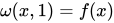
- . (Observe ω(x,0) = x.)

The Abel function α(x) further provides the canonical coordinate for Lie advective flows (one parameter Lie groups).
History[edit]
Initially, the equation in the more general form [2] [3] was reported. Even in the case of a single variable, the equation is non-trivial, and admits special analysis.[4][5][6]
In the case of a linear transfer function, the solution is expressible compactly.[7]
Special cases[edit]
The equation of tetration is a special case of Abel's equation, with f = exp.
In the case of an integer argument, the equation encodes a recurrent procedure, e.g.,

and so on,

Solutions[edit]
The Abel equation has at least one solution on if and only if for all and all , , where , is the function f iterated n times.[8]



Analytic solutions (Fatou coordinates) can be approximated by asymptotic expansion of a function defined by power series in the sectors around a parabolic fixed point.[9] The analytic solution is unique up to a constant.[10]
See also[edit]
- Functional equation
- Infinite compositions of analytic functions
- Iterated function
- Shift operator
- Superfunction
References[edit]
- ^ Aczél, János, (1966): Lectures on Functional Equations and Their Applications, Academic Press, reprinted by Dover Publications, ISBN 0486445232 .
- ^ Abel, N.H. (1826). "Untersuchung der Functionen zweier unabhängig veränderlichen Größen x und y, wie f(x, y), welche die Eigenschaft haben, ..." Journal für die reine und angewandte Mathematik. 1: 11–15.
- ^ A. R. Schweitzer (1912). "Theorems on functional equations". Bull. Amer. Math. Soc. 19 (2): 51–106. doi:10.1090/S0002-9904-1912-02281-4.
- ^ Korkine, A (1882). "Sur un problème d'interpolation", Bull Sci Math & Astron 6(1) 228—242. online
- ^ G. Belitskii; Yu. Lubish (1999). "The real-analytic solutions of the Abel functional equations" (PDF). Studia Mathematica. 134 (2): 135–141.
- ^ Jitka Laitochová (2007). "Group iteration for Abel's functional equation". Nonlinear Analysis: Hybrid Systems. 1 (1): 95–102. doi:10.1016/j.nahs.2006.04.002.
- ^ G. Belitskii; Yu. Lubish (1998). "The Abel equation and total solvability of linear functional equations" (PDF). Studia Mathematica. 127: 81–89.
- ^ R. Tambs Lyche, Sur l'équation fonctionnelle d'Abel, University of Trondlyim, Norvege
- ^ Dudko, Artem (2012). Dynamics of holomorphic maps: Resurgence of Fatou coordinates, and Poly-time computability of Julia sets Ph.D. Thesis
- ^ Classifications of parabolic germs and fractal properties of orbits by Maja Resman, University of Zagreb, Croatia