


Vachellia erioloba
| Vachellia erioloba | |
|---|---|

| |
| Vachellia erioloba camel thorn | |

| |
| Flowers and pods | |
Scientific classification 
| |
| Kingdom: | Plantae |
| Clade: | Tracheophytes |
| Clade: | Angiosperms |
| Clade: | Eudicots |
| Clade: | Rosids |
| Order: | Fabales |
| Family: | Fabaceae |
| Subfamily: | Caesalpinioideae |
| Clade: | Mimosoid clade |
| Genus: | Vachellia |
| Species: | V. erioloba
|
| Binomial name | |
| Vachellia erioloba | |
| Synonyms | |
| |
Vachellia erioloba, the camel thorn, also known as the giraffe thorn, mokala tree, or Kameeldoring in Afrikaans, still more commonly known as Acacia erioloba, is a tree of southern Africa in the family Fabaceae.[3] Its preferred habitat is the deep dry sandy soils in parts of South Africa, Botswana, the western areas of Zimbabwe and Namibia. It is also native to Angola, south-west Mozambique, Zambia and Eswatini.[4] The tree was first described by Ernst Heinrich Friedrich Meyer and Johann Franz Drège in 1836.[4] The camel thorn is a protected tree in South Africa.[5]
The tree can grow up to 20 metres high. It is slow-growing, very hardy to drought and fairly frost-resistant. The light-grey colored thorns reflect sunlight, and the bipinnate leaves close when it is hot.[6] The wood is dark reddish-brown in colour and extremely dense and strong. It is good for fires, which leads to widespread clearing of dead trees and the felling of healthy trees.[citation needed] It produces ear-shaped pods, favoured by many herbivores including cattle. The seeds can be roasted and used as a substitute for coffee beans.[7]
The name 'camel thorn' refers to the fact that giraffe (kameelperd in Afrikaans) commonly feed on the leaves with their specially-adapted tongue and lips that can avoid the thorns. The scientific name 'erioloba' means "wooly lobe", a reference to the ear-shaped pods.[8]
It is commonly associated with the long running PBS wildlife program Nature, as the tree is used in the title sequence and program logo.[9]
Gallery
[edit]-
 Vachellia erioloba hosting a nest of sociable weavers (Philetairus socius).
 -
 Vachellia erioloba seeds, lying upon the ground, scattered among their pods, Sossusvlei, Namib Desert, Namibia
 -
 Bark of a tree near Potgietersrust in Limpopo, South Africa
 -
 The sharp thorns of the Mokala resemble barbed wire (growing near Potgietersrust in Limpopo, South Africa)
 -
 Vachellia erioloba tree in the Namib Desert
 -
 Vachellia erioloba, Kalahari desert
 -
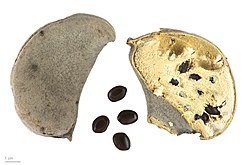 Vachellia erioloba - Museum specimen - MHNT
 -
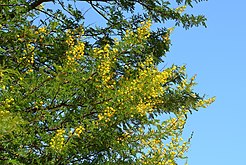 Blossoms of camel thorn tree
 -
 Camel thorn scattered on dunes in the Kalahari Desert in Namibia (2017)
 -
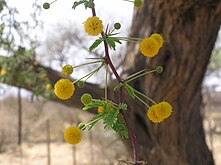 Yellow inflorescences
,_Sossusvlei,_Namibia,_2018-08-06,_DD_169.jpg)


.jpg)

References
[edit]- ^ Timberlake, J.R. (2020). "Vachellia erioloba.". IUCN Red List of Threatened Species. 2020: e.T168997601A169318232. doi:10.2305/IUCN.UK.2020-3.RLTS.T168997601A169318232.en. Retrieved 7 June 2024.
- ^ Kyalangalilwa B, Boatwright JS, Daru BH, Maurin O, van der Bank M (2013). "Phylogenetic position and revised classification of Acacia s.l. (Fabaceae: Mimosoideae) in Africa, including new combinations in Vachellia and Senegalia" (PDF). Bot J Linn Soc. 172 (4): 500–523. doi:10.1111/boj.12047.
- ^ The type specimen of Acacia giraffae, proved on closer examination to be a hybrid of V. haematoxylon and the species which would later become known as V. erioloba. The name V. erioloba was therefore proposed for the vast numbers of camel thorn which are not hybrids.
- ^ a b "Vachellia erioloba". Germplasm Resources Information Network. Agricultural Research Service, United States Department of Agriculture. Retrieved 2015-08-12.
- ^ "Protected Trees" (PDF). Department of Water Affairs and Forestry, Republic of South Africa. 3 May 2013. Archived from the original (PDF) on 5 July 2010. Retrieved 13 June 2013.
- ^ Ehrenbold, Samuel; Keding, Viktoria (2015). It is Time to Identify Selected Plants and Animals of the Namib (2nd ed.). Namib Desert Environment Education Trust (NaDEET). p. 8.
- ^ Mhloniswa Dlamini (2005). "Acacia erioloba". PlantZAfrica.com. South African National Biodiversity Institute. Retrieved 11 November 2014.
- ^ Canada, Tony Hnilica-*AJH* Custom Knives & Services - Lytton, BC. "Hardwood information". ajh-knives.com. Retrieved 2017-08-03.
{{cite web}}: CS1 maint: multiple names: authors list (link) - ^ "Frequently Asked Questions | Nature | PBS". Nature. Retrieved 2019-05-28.
External links
[edit] Media related to Vachellia erioloba at Wikimedia Commons
- Dressler, S.; Schmidt, M. & Zizka, G. (2014). "Acacia erioloba". African plants – a Photo Guide. Frankfurt/Main: Forschungsinstitut Senckenberg.

