


Andrica's conjecture


Andrica's conjecture (named after Romanian mathematician Dorin Andrica) is a conjecture regarding the gaps between prime numbers.[1]
The conjecture states that the inequality

holds for all , where is the nth prime number. If denotes the nth prime gap, then Andrica's conjecture can also be rewritten as




Empirical evidence
[edit]Imran Ghory has used data on the largest prime gaps to confirm the conjecture for up to 1.3002 × 10¹⁶.[2] Using a table of maximal gaps and the above gap inequality, the confirmation value can be extended exhaustively to 4 × 10¹⁸.
The discrete function is plotted in the figures opposite. The high-water marks for occur for n = 1, 2, and 4, with A4 ≈ 0.670873..., with no larger value among the first 105 primes. Since the Andrica function decreases asymptotically as n increases, a prime gap of ever increasing size is needed to make the difference large as n becomes large. It therefore seems highly likely the conjecture is true, although this has not yet been proven.

Generalizations
[edit]
As a generalization of Andrica's conjecture, the following equation has been considered:
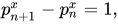
where is the nth prime and x can be any positive number.
The largest possible solution for x is easily seen to occur for n=1, when xmax = 1. The smallest solution for x is conjectured to be xmin ≈ 0.567148... (sequence A038458 in the OEIS) which occurs for n = 30.
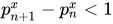
This conjecture has also been stated as an inequality, the generalized Andrica conjecture:
- for

See also
[edit]References and notes
[edit]- ^ Andrica, D. (1986). "Note on a conjecture in prime number theory". Studia Univ. Babes–Bolyai Math. 31 (4): 44–48. ISSN 0252-1938. Zbl 0623.10030.
- ^ Wells, David (May 18, 2005). Prime Numbers: The Most Mysterious Figures in Math. Hoboken (N.J.): Wiley. p. 13. ISBN 978-0-471-46234-7.
- Guy, Richard K. (2004). "Section A8". Unsolved problems in number theory (3rd ed.). Springer-Verlag. ISBN 978-0-387-20860-2. Zbl 1058.11001.