


California tiger salamander
| California tiger salamander | |
|---|---|

| |
Scientific classification 
| |
| Domain: | Eukaryota |
| Kingdom: | Animalia |
| Phylum: | Chordata |
| Class: | Amphibia |
| Order: | Urodela |
| Family: | Ambystomatidae |
| Genus: | Ambystoma |
| Species: | A. californiense
|
| Binomial name | |
| Ambystoma californiense Gray, 1853
| |

| |
| California Tiger Salamander range[2][3] | |
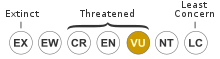
The California tiger salamander (Ambystoma californiense) is a vulnerable amphibian native to California. It is a mole salamander. Previously considered to be a subspecies of the tiger salamander (A. tigrinum), the California tiger salamander was recently designated a separate species again.[4] The California tiger salamander distinct population segment (DPS) in Sonoma County and the Santa Barbara County DPS are listed as federally endangered, while the Central California DPS is listed as federally threatened.[5][6] The Sonoma County, south San Joaquin, and the Santa Barbara County DPS have diverged from the rest of the California tiger salamander populations for over one million years, since the Pleistocene[7] and they may warrant status as separate species.
Description
[edit]The California tiger salamander is a relatively large, secretive amphibian endemic to California. Adults can grow to a total length of about 7–8 inches. It has a stocky body and a broad, rounded snout. Adults are black with yellow or cream spots; larvae are greenish-grey in color. The California tiger salamander has brown protruding eyes with black irises.
Habitat and range
[edit]The California tiger salamander depends on vernal pools and other seasonal ponds and stock ponds for reproduction; its habitat is limited to the vicinity of large, fishless vernal pools or similar water bodies. It occurs at elevations up to 1000 m (3200 ft). Adults migrate at night from upland habitats to aquatic breeding sites beginning with the first major rainfall of fall and winter, and return to upland habitats after breeding.
Historically, the California tiger salamander probably occurred in grassland habitats throughout much of the state.[citation needed] It occurs from Sonoma County, especially in the Laguna de Santa Rosa (outside the floodplain), south to Santa Barbara County, in vernal pool complexes and isolated ponds along the Central Valley from Colusa County to Kern County, and in the coastal range. Both the Santa Barbara and Sonoma populations are listed as endangered since 2000[8][9] and 2003,[10] respectively. On August 4, 2004, the US Fish and Wildlife Service listed the California tiger salamander as threatened within the Central DPS, effective September 3, 2004, reaffirming the prior endangered listings of the other distinct population segments and extending protection to all remaining populations.[11]
The six populations are found in Sonoma County, the Bay Area (Stanislaus County, western Merced County, and most of San Benito County), the Central Valley, the southern San Joaquin Valley, the Central Coast Range, and Santa Barbara County.[7][12][13]
The loss of California tiger salamander populations has been due primarily to human destruction of habitat and predators, such as American bullfrogs and access to breeding habitats.[14][15] There is also a viable hybrid between the California tiger salamander and the introduced barred tiger salamander (Ambystoma tigrinum mavortium), which genetic evidence suggests have been hybridizing for 50–60 years.[16]
Life cycle
[edit]
Adults spend the majority of their lives underground, in burrows created by other animals, such as ground squirrels and gophers;[17][18] these salamanders are poorly equipped for burrowing. Little is known about their underground life. This underground phase has often been referred to as estivation (the summertime equivalent of hibernation), but true estivation has never been observed, and fiber optic cameras in burrows have allowed researchers to witness salamanders actively foraging. Adults are known to eat earthworms,[19] snails, insects, fish, and even small mammals[20][21] but adult California tiger salamanders eat very little.[22]
Reproduction
[edit]_(21065297770).jpg)
Breeding takes place after the first rains in late fall and early winter, when the wet season allows the salamanders to migrate to the nearest pond, a journey that may be as far as a 1.3 miles[23] and take several days. The eggs, which the female lays in small clusters or singly, hatch after 10 to 14 days. The larval period lasts for three to six months. However, California tiger salamander larvae may also "overwinter". Transformation for overwintering larvae may take 13 months or more. Recent discoveries, such as overwintering, have management implications for this threatened species, particularly when aquatic habitats undergo modification. The larvae feed on other small invertebrates, including tadpoles. When their pond dries, they resorb their gills, develop lungs, and then the metamorphs leave the pond in search of a burrow.
"... the average female bred 1.4 times and produced 8.5 young that survived to metamorphosis per reproductive event, resulting in roughly 12 lifetime metamorphic offspring per female."[24]
California tiger salamanders can live up to 15 years.[citation needed]
See also
[edit]- Vernal pools or ponds
References
[edit]- California Natural Diversity Database California Natural Diversity Database
- ^ Geoffrey Hammerson (2004). "Ambystoma californiense". IUCN Red List of Threatened Species. 2004: e.T1098A3234573. doi:10.2305/IUCN.UK.2004.RLTS.T1098A3234573.en. Retrieved 12 November 2021.
- ^ IUCN (International Union for Conservation of Nature), Conservation International & NatureServe (2004). "Ambystoma californiense". IUCN 2014. The IUCN Red List of Threatened Species. Version 2014.3. Archived from the original on 2014-06-27. Retrieved 2015-05-31.
- ^ Hastings, D.; P.K. Dunbar (1999). "Global Land One-kilometer Base Elevation (GLOBE) v.1". National Geophysical Data Center. National Geophysical Data Center, NOAA. doi:10.7289/V52R3PMS. Retrieved 2015-03-16.
- ^ Shaffer, H. B.; S. Stanley (1991). Final report to California Department of Fish and Game. California tiger salamander surveys, 1991 (Report). Rancho Cordova, California: California Department of Fish and Game, Inland Fisheries Division. Contract FG9422.
- ^ "Species Account: California Tiger Salamander" (PDF). U.S. Fish and Wildlife Service. July 29, 2009. Archived from the original (PDF) on April 6, 2010. Retrieved February 17, 2010.
- ^ California Tiger Salamander Endangered Species Facts (PDF) (Report). Environmental Protection Agency. February 2010. Retrieved 2013-03-14.
- ^ a b Shaffer, H. B.; Pauly, G. B.; Oliver, J. C.; Trenham, P. C. (2004). "The molecular phylogenetics of endangerment: cryptic variation and historical phylogeography of the California tiger salamander, Ambystoma californiense". Molecular Ecology. 13 (10): 3033–3049. doi:10.1111/j.1365-294x.2004.02317.x. PMID 15367118. S2CID 912805.
- ^ 65 FR 3096
- ^ 65 FR 57242
- ^ 68 FR 13498
- ^ 69 FR 47212
- ^ "Rules and Regulations" (PDF). Federal Register / Vol. 68, No. 53. 2003-03-19. Retrieved 2009-10-19.[permanent dead link]
- ^ Shaffer, H. B.; P. C. Trenham (2002). Distinct population segments of the California tiger salamander, Ambystoma californiense. Report to the USFWS (Report).
- ^ Fisher, R. N.; H. B. Shaffer (1996). "The decline of amphibians in California's Great Central Valley". Conservation Biology. 10 (5): 1387–1397. doi:10.1046/j.1523-1739.1996.10051387.x.
- ^ Center for Biological Diversity and Citizens for a Sustainable Cotati, petitioners (2001-06-11). "Petition to list the Sonoma County population of the California tiger salmander [sic] as endangered under the Endangered Species Act on an emergency basis" (PDF). Retrieved 2009-10-19.
- ^ Benjamin M. Fitzpatrick and H. Bradley Shaffer (2007-10-02). "Hybrid vigor between native and introduced salamanders raises new challenges for conservation". Proceedings of the National Academy of Sciences of the United States of America. 104 (40): 15793–15798. Bibcode:2007PNAS..10415793F. doi:10.1073/pnas.0704791104. PMC 2000440. PMID 17884982.
- ^ Trenham, Peter C. (2001). "Terrestrial Habitat Use by Adult California Tiger Salamanders". Journal of Herpetology. 35 (2): 343–346. doi:10.2307/1566130. JSTOR 1566130.
- ^ "Ambystoma californiense - California Tiger Salamander". California Herps. Retrieved 2009-10-19.
- ^ "Ambystoma californiense, California tiger salamander". University of Michigan Animal Diversity Web. Retrieved 2009-10-19.
- ^ T. Kucera (1997), California Wildlife Habitat Relationships System, California Department of Fish and Game Updated by: CWHR Program Staff, August 2005.
- ^ Stebbins, R.C. (1972). California amphibians and reptiles. Berkeley: University of California Press. 152 pp.
- ^ Shaffer, H. B.; R. N. Fisher & S. E. Stanley (1993). Status report: the California tiger salamander (Ambystoma californiense). Final report to the California Department of Fish and Game, Inland Fisheries Division, Rancho Cordova California, under Contracts FG9422 and 1383 (Report).
- ^ Sweet, Sam (1998). "Vineyard Development Posing an Imminent Threat to Ambystoma californiense in Santa Barbara County, California". Letter to the USFWS.
- ^ Trenham, Peter C.; Shaffer, H. Bradley; Koenig, Walter D; Stromberg, Mark R (2000). "Life History and Demographic Variation in the California Tiger Salamander (Ambystoma californiense)". Copeia. 2000 (2): 365–377. doi:10.1643/0045-8511(2000)000[0365:LHADVI]2.0.CO;2.
External links
[edit]
- Santa Rosa Plain Conservation Strategy Santa Rosa Plain Conservation Strategy
- Description from the California Department of Fish and Game.
- USGS Field Guide
- IUCN Red List vulnerable species
- Mole salamanders
- Endemic fauna of California
- ESA threatened species
- Endemic amphibians of the United States
- Fauna of the California chaparral and woodlands
- Natural history of the California Coast Ranges
- Natural history of the Central Valley (California)
- Taxa named by John Edward Gray
- Endangered fauna of California
- Amphibians described in 1853