


Chirality (physics)
A chiral phenomenon is one that is not identical to its mirror image (see the article on mathematical chirality). The spin of a particle may be used to define a handedness, or helicity, for that particle, which, in the case of a massless particle, is the same as chirality. A symmetry transformation between the two is called parity transformation. Invariance under parity transformation by a Dirac fermion is called chiral symmetry.
Chirality and helicity[edit]
The helicity of a particle is positive ("right-handed") if the direction of its spin is the same as the direction of its motion. It is negative ("left-handed") if the directions of spin and motion are opposite. So a standard clock, with its spin vector defined by the rotation of its hands, has left-handed helicity if tossed with its face directed forwards.
Mathematically, helicity is the sign of the projection of the spin vector onto the momentum vector: "left" is negative, "right" is positive.

The chirality of a particle is more abstract: It is determined by whether the particle transforms in a right- or left-handed representation of the Poincaré group.[a]
For massless particles – photons, gluons, and (hypothetical) gravitons – chirality is the same as helicity; a given massless particle appears to spin in the same direction along its axis of motion regardless of point of view of the observer.
For massive particles – such as electrons, quarks, and neutrinos – chirality and helicity must be distinguished: In the case of these particles, it is possible for an observer to change to a reference frame moving faster than the spinning particle, in which case the particle will then appear to move backwards, and its helicity (which may be thought of as "apparent chirality") will be reversed. That is, helicity is a constant of motion, but it is not Lorentz invariant. Chirality is Lorentz invariant, but is not a constant of motion: a massive left-handed spinor, when propagating, will evolve into a right handed spinor over time, and vice versa.
A massless particle moves with the speed of light, so no real observer (who must always travel at less than the speed of light) can be in any reference frame where the particle appears to reverse its relative direction of spin, meaning that all real observers see the same helicity. Because of this, the direction of spin of massless particles is not affected by a change of inertial reference frame (a Lorentz boost) in the direction of motion of the particle, and the sign of the projection (helicity) is fixed for all reference frames: The helicity of massless particles is a relativistic invariant (a quantity whose value is the same in all inertial reference frames) which always matches the massless particle's chirality.
The discovery of neutrino oscillation implies that neutrinos have mass, so the photon is the only confirmed massless particle; gluons are expected to also be massless, although this has not been conclusively tested.[b] Hence, these are the only two particles now known for which helicity could be identical to chirality, and only the photon has been confirmed by measurement. All other observed particles have mass and thus may have different helicities in different reference frames.[c]
Chiral theories[edit]
Particle physicists have only observed or inferred left-chiral fermions and right-chiral antifermions engaging in the charged weak interaction.[1] In the case of the weak interaction, which can in principle engage with both left- and right-chiral fermions, only two left-handed fermions interact. Interactions involving right-handed or opposite-handed fermions have not been shown to occur, implying that the universe has a preference for left-handed chirality. This preferential treatment of one chiral realization over another violates parity, as first noted by Chien Shiung Wu in her famous experiment known as the Wu experiment. This is a striking observation, since parity is a symmetry that holds for all other fundamental interactions.
Chirality for a Dirac fermion ψ is defined through the operator γ5, which has eigenvalues ±1; the eigenvalue's sign is equal to the particle's chirality: +1 for right-handed, −1 for left-handed. Any Dirac field can thus be projected into its left- or right-handed component by acting with the projection operators 1/2(1 − γ5) or 1/2(1 + γ5) on ψ.
The coupling of the charged weak interaction to fermions is proportional to the first projection operator, which is responsible for this interaction's parity symmetry violation.
A common source of confusion is due to conflating the γ5, chirality operator with the helicity operator. Since the helicity of massive particles is frame-dependent, it might seem that the same particle would interact with the weak force according to one frame of reference, but not another. The resolution to this paradox is that the chirality operator is equivalent to helicity for massless fields only, for which helicity is not frame-dependent. By contrast, for massive particles, chirality is not the same as helicity, or, alternatively, helicity is not Lorentz invariant, so there is no frame dependence of the weak interaction: a particle that couples to the weak force in one frame does so in every frame.
A theory that is asymmetric with respect to chiralities is called a chiral theory, while a non-chiral (i.e., parity-symmetric) theory is sometimes called a vector theory. Many pieces of the Standard Model of physics are non-chiral, which is traceable to anomaly cancellation in chiral theories. Quantum chromodynamics is an example of a vector theory, since both chiralities of all quarks appear in the theory, and couple to gluons in the same way.
The electroweak theory, developed in the mid 20th century, is an example of a chiral theory. Originally, it assumed that neutrinos were massless, and assumed the existence of only left-handed neutrinos and right-handed antineutrinos. After the observation of neutrino oscillations, which imply that neutrinos are massive (like all other fermions) the revised theories of the electroweak interaction now include both right- and left-handed neutrinos. However, it is still a chiral theory, as it does not respect parity symmetry.
The exact nature of the neutrino is still unsettled and so the electroweak theories that have been proposed are somewhat different, but most accommodate the chirality of neutrinos in the same way as was already done for all other fermions.
Chiral symmetry[edit]
Vector gauge theories with massless Dirac fermion fields ψ exhibit chiral symmetry, i.e., rotating the left-handed and the right-handed components independently makes no difference to the theory. We can write this as the action of rotation on the fields:
- and
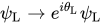

or
- and

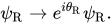
With N flavors, we have unitary rotations instead: U(N)L × U(N)R.
More generally, we write the right-handed and left-handed states as a projection operator acting on a spinor. The right-handed and left-handed projection operators are
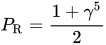
and
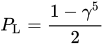
Massive fermions do not exhibit chiral symmetry, as the mass term in the Lagrangian, mψψ, breaks chiral symmetry explicitly.
Spontaneous chiral symmetry breaking may also occur in some theories, as it most notably does in quantum chromodynamics.
The chiral symmetry transformation can be divided into a component that treats the left-handed and the right-handed parts equally, known as vector symmetry, and a component that actually treats them differently, known as axial symmetry.[2] (cf. Current algebra.) A scalar field model encoding chiral symmetry and its breaking is the chiral model.
The most common application is expressed as equal treatment of clockwise and counter-clockwise rotations from a fixed frame of reference.
The general principle is often referred to by the name chiral symmetry. The rule is absolutely valid in the classical mechanics of Newton and Einstein, but results from quantum mechanical experiments show a difference in the behavior of left-chiral versus right-chiral subatomic particles.
Example: u and d quarks in QCD[edit]
Consider quantum chromodynamics (QCD) with two massless quarks u and d (massive fermions do not exhibit chiral symmetry). The Lagrangian reads

In terms of left-handed and right-handed spinors, it reads

(Here, i is the imaginary unit and the Dirac operator.)

Defining

it can be written as

The Lagrangian is unchanged under a rotation of qL by any 2×2 unitary matrix L, and qR by any 2×2 unitary matrix R.
This symmetry of the Lagrangian is called flavor chiral symmetry, and denoted as U(2)L × U(2)R. It decomposes into

The singlet vector symmetry, U(1)V, acts as

and thus invariant under U(1) gauge symmetry. This corresponds to baryon number conservation.
The singlet axial group U(1)A transforms as the following global transformation

However, it does not correspond to a conserved quantity, because the associated axial current is not conserved. It is explicitly violated by a quantum anomaly.
The remaining chiral symmetry SU(2)L × SU(2)R turns out to be spontaneously broken by a quark condensate formed through nonperturbative action of QCD gluons, into the diagonal vector subgroup SU(2)V known as isospin. The Goldstone bosons corresponding to the three broken generators are the three pions. As a consequence, the effective theory of QCD bound states like the baryons, must now include mass terms for them, ostensibly disallowed by unbroken chiral symmetry. Thus, this chiral symmetry breaking induces the bulk of hadron masses, such as those for the nucleons — in effect, the bulk of the mass of all visible matter.
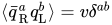
In the real world, because of the nonvanishing and differing masses of the quarks, SU(2)L × SU(2)R is only an approximate symmetry[3] to begin with, and therefore the pions are not massless, but have small masses: they are pseudo-Goldstone bosons.[4]
More flavors[edit]
For more "light" quark species, N flavors in general, the corresponding chiral symmetries are U(N)L × U(N)R′, decomposing into

and exhibiting a very analogous chiral symmetry breaking pattern.
Most usually, N = 3 is taken, the u, d, and s quarks taken to be light (the eightfold way), so then approximately massless for the symmetry to be meaningful to a lowest order, while the other three quarks are sufficiently heavy to barely have a residual chiral symmetry be visible for practical purposes.
An application in particle physics[edit]
In theoretical physics, the electroweak model breaks parity maximally. All its fermions are chiral Weyl fermions, which means that the charged weak gauge bosons W+ and W− only couple to left-handed quarks and leptons.[d]
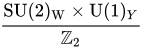
Some theorists found this objectionable, and so conjectured a GUT extension of the weak force which has new, high energy W′ and Z′ bosons, which do couple with right handed quarks and leptons:
to

Here, SU(2)L (pronounced "SU(2) left") is SU(2)W from above, while B−L is the baryon number minus the lepton number. The electric charge formula in this model is given by

where and are the left and right weak isospin values of the fields in the theory.


There is also the chromodynamic SU(3)C. The idea was to restore parity by introducing a left-right symmetry. This is a group extension of (the left-right symmetry) by


to the semidirect product

This has two connected components where acts as an automorphism, which is the composition of an involutive outer automorphism of SU(3)C with the interchange of the left and right copies of SU(2) with the reversal of U(1)B−L. It was shown by Mohapatra & Senjanovic (1975)[5] that left-right symmetry can be spontaneously broken to give a chiral low energy theory, which is the Standard Model of Glashow, Weinberg, and Salam, and also connects the small observed neutrino masses to the breaking of left-right symmetry via the seesaw mechanism.
In this setting, the chiral quarks

and

are unified into an irreducible representation ("irrep")

The leptons are also unified into an irreducible representation

The Higgs bosons needed to implement the breaking of left-right symmetry down to the Standard Model are

This then provides three sterile neutrinos which are perfectly consistent with current[update] neutrino oscillation data. Within the seesaw mechanism, the sterile neutrinos become superheavy without affecting physics at low energies.
Because the left–right symmetry is spontaneously broken, left–right models predict domain walls. This left-right symmetry idea first appeared in the Pati–Salam model (1974)[6] and Mohapatra–Pati models (1975).[7]
See also[edit]
Notes[edit]
- ^ Note, however, that representations such as Dirac spinors and others, necessarily have both right- and left-handed components. In such cases, we can define projection operators that remove (set to zero) either the right- or left-hand components, and discuss the left- or right-handed portions of the representation that remain.
- ^ Gravitons are also assumed the be massless, but so far are merely hypothetical.
- ^ It is still possible that as-yet unobserved particles, like the graviton, might be massless, and like the photon, have invariant helicity that matches their chirality.
- ^ Unlike the W+ and W− bosons, the neutral electroweak Z0 boson couples to both left and right-handed fermions, although not equally.
References[edit]
- ^ Povh, Bogdan; Rith, Klaus; Scholz, Christoph; Zetsche, Frank (2006). Particles and Nuclei: An introduction to the physical concepts. Springer. p. 145. ISBN 978-3-540-36683-6.
- ^ Ta-Pei Cheng and Ling-Fong Li, Gauge Theory of Elementary Particle Physics, (Oxford 1984) ISBN 978-0198519614
- ^ Gell-Mann, M.; Renner, B. (1968). "Behavior of Current Divergences under SU3×SU3" (PDF). Physical Review. 175 (5): 2195. Bibcode:1968PhRv..175.2195G. doi:10.1103/PhysRev.175.2195.
- ^ Peskin, Michael; Schroeder, Daniel (1995). An Introduction to Quantum Field Theory. Westview Press. p. 670. ISBN 0-201-50397-2.
- ^ Senjanovic, Goran; Mohapatra, Rabindra N. (1975). "Exact left-right symmetry and spontaneous violation of parity". Physical Review D. 12 (5): 1502. Bibcode:1975PhRvD..12.1502S. doi:10.1103/PhysRevD.12.1502.
- ^ Pati, Jogesh C.; Salam, Abdus (1 June 1974). "Lepton number as the fourth "color"". Physical Review D. 10 (1): 275–289. Bibcode:1974PhRvD..10..275P. doi:10.1103/physrevd.10.275.
- ^ Mohapatra, R.N.; Pati, J.C. (1975). "'Natural' left-right symmetry". Physical Review D. 11 (9): 2558–2561. Bibcode:1975PhRvD..11.2558M. doi:10.1103/PhysRevD.11.2558.
- Walter Greiner; Berndt Müller (2000). Gauge Theory of Weak Interactions. Springer. ISBN 3-540-67672-4.
- Gordon L. Kane (1987). Modern Elementary Particle Physics. Perseus Books. ISBN 0-201-11749-5.
- Kondepudi, Dilip K.; Hegstrom, Roger A. (January 1990). "The Handedness of the Universe". Scientific American. 262 (1): 108–115. Bibcode:1990SciAm.262a.108H. doi:10.1038/scientificamerican0190-108.
- Winters, Jeffrey (November 1995). "Looking for the Right Hand". Discover. Retrieved 12 September 2015.
External links[edit]
- To see a summary of the differences and similarities between chirality and helicity (those covered here and more) in chart form, one may go to Pedagogic Aids to Quantum Field Theory and click on the link near the bottom of the page entitled "Chirality and Helicity Summary". To see an in depth discussion of the two with examples, which also shows how chirality and helicity approach the same thing as speed approaches that of light, click the link entitled "Chirality and Helicity in Depth" on the same page.
- History of science: parity violation
- Helicity, Chirality, Mass, and the Higgs (Quantum Diaries blog)
- Chirality vs helicity chart (Robert D. Klauber)
| Authority control databases: National |
|---|
