


Conversion of units
Conversion of units is the conversion of the unit of measurement in which a quantity is expressed, typically through a multiplicative conversion factor that changes the unit without changing the quantity. This is also often loosely taken to include replacement of a quantity with a corresponding quantity that describes the same physical property.
Unit conversion is often easier within a metric system such as the SI than in others, due to the system's coherence and its metric prefixes that act as power-of-10 multipliers.
Overview[edit]
The definition and choice of units in which to express a quantity may depend on the specific situation and the intended purpose. This may be governed by regulation, contract, technical specifications or other published standards. Engineering judgment may include such factors as:
- the precision and accuracy of measurement and the associated uncertainty of measurement
- the statistical confidence interval or tolerance interval of the initial measurement
- the number of significant figures of the measurement
- the intended use of the measurement, including the engineering tolerances
- historical definitions of the units and their derivatives used in old measurements; e.g., international foot vs. US survey foot.
For some purposes, conversions from one system of units to another are needed to be exact, without increasing or decreasing the precision of the expressed quantity. An adaptive conversion may not produce an exactly equivalent expression. Nominal values are sometimes allowed and used.
Factor–label method[edit]
The factor–label method, also known as the unit–factor method or the unity bracket method,[1] is a widely used technique for unit conversions that uses the rules of algebra.[2][3][4]
The factor–label method is the sequential application of conversion factors expressed as fractions and arranged so that any dimensional unit appearing in both the numerator and denominator of any of the fractions can be cancelled out until only the desired set of dimensional units is obtained. For example, 10 miles per hour can be converted to metres per second by using a sequence of conversion factors as shown below:

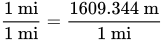
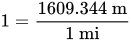
Each conversion factor is chosen based on the relationship between one of the original units and one of the desired units (or some intermediary unit), before being rearranged to create a factor that cancels out the original unit. For example, as "mile" is the numerator in the original fraction and , "mile" will need to be the denominator in the conversion factor. Dividing both sides of the equation by 1 mile yields , which when simplified results in the dimensionless . Because of the identity property of multiplication, multiplying any quantity (physical or not) by the dimensionless 1 does not change that quantity.[5] Once this and the conversion factor for seconds per hour have been multiplied by the original fraction to cancel out the units mile and hour, 10 miles per hour converts to 4.4704 metres per second.

As a more complex example, the concentration of nitrogen oxides (NOx) in the flue gas from an industrial furnace can be converted to a mass flow rate expressed in grams per hour (g/h) of NOx by using the following information as shown below:
- NOx concentration
- = 10 parts per million by volume = 10 ppmv = 10 volumes/106 volumes
- NOx molar mass
- = 46 kg/kmol = 46 g/mol
- Flow rate of flue gas
- = 20 cubic metres per minute = 20 m3/min
- The flue gas exits the furnace at 0 °C temperature and 101.325 kPa absolute pressure.
- The molar volume of a gas at 0 °C temperature and 101.325 kPa is 22.414 m3/kmol.

After cancelling any dimensional units that appear both in the numerators and the denominators of the fractions in the above equation, the NOx concentration of 10 ppmv converts to mass flow rate of 24.63 grams per hour.
Checking equations that involve dimensions[edit]
The factor–label method can also be used on any mathematical equation to check whether or not the dimensional units on the left hand side of the equation are the same as the dimensional units on the right hand side of the equation. Having the same units on both sides of an equation does not ensure that the equation is correct, but having different units on the two sides (when expressed in terms of base units) of an equation implies that the equation is wrong.
For example, check the universal gas law equation of PV = nRT, when:
- the pressure P is in pascals (Pa)
- the volume V is in cubic metres (m3)
- the amount of substance n is in moles (mol)
- the universal gas constant R is 8.3145 Pa⋅m3/(mol⋅K)
- the temperature T is in kelvins (K)
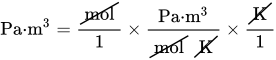
As can be seen, when the dimensional units appearing in the numerator and denominator of the equation's right hand side are cancelled out, both sides of the equation have the same dimensional units. Dimensional analysis can be used as a tool to construct equations that relate non-associated physico-chemical properties. The equations may reveal undiscovered or overlooked properties of matter, in the form of left-over dimensions – dimensional adjusters – that can then be assigned physical significance. It is important to point out that such 'mathematical manipulation' is neither without prior precedent, nor without considerable scientific significance. Indeed, the Planck constant, a fundamental physical constant, was 'discovered' as a purely mathematical abstraction or representation that built on the Rayleigh–Jeans law for preventing the ultraviolet catastrophe. It was assigned and ascended to its quantum physical significance either in tandem or post mathematical dimensional adjustment – not earlier.
Limitations[edit]
The factor–label method can convert only unit quantities for which the units are in a linear relationship intersecting at 0 (ratio scale in Stevens's typology). Most conversions fit this paradigm. An example for which it cannot be used is the conversion between the Celsius scale and the Kelvin scale (or the Fahrenheit scale). Between degrees Celsius and kelvins, there is a constant difference rather than a constant ratio, while between degrees Celsius and degrees Fahrenheit there is neither a constant difference nor a constant ratio. There is, however, an affine transform (, rather than a linear transform ) between them.


For example, the freezing point of water is 0 °C and 32 °F, and a 5 °C change is the same as a 9 °F change. Thus, to convert from units of Fahrenheit to units of Celsius, one subtracts 32 °F (the offset from the point of reference), divides by 9 °F and multiplies by 5 °C (scales by the ratio of units), and adds 0 °C (the offset from the point of reference). Reversing this yields the formula for obtaining a quantity in units of Celsius from units of Fahrenheit; one could have started with the equivalence between 100 °C and 212 °F, which yields the same formula.
Hence, to convert the numerical quantity value of a temperature T[F] in degrees Fahrenheit to a numerical quantity value T[C] in degrees Celsius, this formula may be used:
- T[C] = (T[F] − 32) × 5/9.
To convert T[C] in degrees Celsius to T[F] in degrees Fahrenheit, this formula may be used:
- T[F] = (T[C] × 9/5) + 32.
Example[edit]
Starting with:
![{\displaystyle Z=n_{i}\times [Z]_{i}}](https://wikimedia.org/api/rest_v1/media/math/render/svg/9382a912ccadecfbe407dd9d2feec9b83febe4c0)
replace the original unit with its meaning in terms of the desired unit , e.g. if , then:
![{\displaystyle [Z]_{i}}](https://wikimedia.org/api/rest_v1/media/math/render/svg/4c2e8f9c6283ef4fd7440576f12b3a002e33cc77)
![{\displaystyle [Z]_{j}}](https://wikimedia.org/api/rest_v1/media/math/render/svg/847ac5e13a07a2784aec0cd0f809a2853097580a)
![{\displaystyle [Z]_{i}=c_{ij}\times [Z]_{j}}](https://wikimedia.org/api/rest_v1/media/math/render/svg/d39d68c50a6f4eda1abeacd4a2a60c4f001cd19c)
![{\displaystyle Z=n_{i}\times (c_{ij}\times [Z]_{j})=(n_{i}\times c_{ij})\times [Z]_{j}}](https://wikimedia.org/api/rest_v1/media/math/render/svg/dd906cc1b06feb5974f2df92ddbad412489f41ae)
Now and are both numerical values, so just calculate their product.


Or, which is just mathematically the same thing, multiply Z by unity, the product is still Z:
![{\displaystyle Z=n_{i}\times [Z]_{i}\times (c_{ij}\times [Z]_{j}/[Z]_{i})}](https://wikimedia.org/api/rest_v1/media/math/render/svg/8f15189d031793d2d77b3a9337e805c69f3ca8f8)
For example, you have an expression for a physical value Z involving the unit feet per second () and you want it in terms of the unit miles per hour ():
- Find facts relating the original unit to the desired unit:
- 1 mile = 5280 feet and 1 hour = 3600 seconds
- Next use the above equations to construct a fraction that has a value of unity and that contains units such that, when it is multiplied with the original physical value, will cancel the original units:
- Last, multiply the original expression of the physical value by the fraction, called a conversion factor, to obtain the same physical value expressed in terms of a different unit. Note: since valid conversion factors are dimensionless and have a numerical value of one, multiplying any physical quantity by such a conversion factor (which is 1) does not change that physical quantity.


Or as an example using the metric system, you have a value of fuel economy in the unit litres per 100 kilometres and you want it in terms of the unit microlitres per metre:

Calculation involving non-SI Units[edit]
In the cases where non-SI units are used, the numerical calculation of a formula can be done by first working out the factor, and then plug in the numerical values of the given/known quantities.
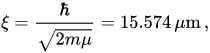
For example, in the study of Bose–Einstein condensate,[6] atomic mass m is usually given in daltons, instead of kilograms, and chemical potential μ is often given in the Boltzmann constant times nanokelvin. The condensate's healing length is given by:
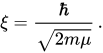
For a 23Na condensate with chemical potential of (the Boltzmann constant times) 128 nK, the calculation of healing length (in micrometres) can be done in two steps:
Calculate the factor[edit]
Assume that , this gives

Calculate the numbers[edit]
Now, make use of the fact that . With , .


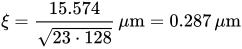
This method is especially useful for programming and/or making a worksheet, where input quantities are taking multiple different values; For example, with the factor calculated above, it is very easy to see that the healing length of 174Yb with chemical potential 20.3 nK is .

Software tools[edit]
There are many conversion tools. They are found in the function libraries of applications such as spreadsheets databases, in calculators, and in macro packages and plugins for many other applications such as the mathematical, scientific and technical applications.
There are many standalone applications that offer the thousands of the various units with conversions. For example, the free software movement offers a command line utility GNU units for Linux and Windows. The Unified Code for Units of Measure is also a popular option.
See also[edit]
Notes and references[edit]
- ^ Béla Bodó; Colin Jones (26 June 2013). Introduction to Soil Mechanics. John Wiley & Sons. pp. 9–. ISBN 978-1-118-55388-6.
- ^ Goldberg, David (2006). Fundamentals of Chemistry (5th ed.). McGraw-Hill. ISBN 978-0-07-322104-5.
- ^ Ogden, James (1999). The Handbook of Chemical Engineering. Research & Education Association. ISBN 978-0-87891-982-6.
- ^ "Dimensional Analysis or the Factor Label Method". Mr Kent's Chemistry Page.
- ^ "Identity property of multiplication". Retrieved 2015-09-09.
- ^ Foot, C. J. (2005). Atomic physics. Oxford University Press. ISBN 978-0-19-850695-9.
- Notes
External links[edit]
 | This article's use of external links may not follow Wikipedia's policies or guidelines. (July 2023) |


- Statutory Instrument 1995 No. 1804 Units of measurement regulations 1995 From legislation.gov.uk
- "NIST: Fundamental physical constants – Non-SI units" (PDF). Archived from the original (PDF) on 2016-12-27. Retrieved 2004-03-15.
- NIST Guide to SI Units Many conversion factors listed.
- The Unified Code for Units of Measure
- Units, Symbols, and Conversions XML Dictionary Archived 2023-05-02 at the Wayback Machine
- Units of Measurement Software at Curlie
- Units of Measurement Online Conversion at Curlie
- "Instruction sur les poids et mesures républicaines – déduites de la grandeur de la terre, uniformes pour toute la République, et sur les calculs relatifs à leur division décimale" (in French)
- Unicalc Live web calculator doing units conversion by dimensional analysis
- Math Skills Review
- A Discussion of Units
- Short Guide to Unit Conversions
- Canceling Units Lesson
- Chapter 11: Behavior of Gases Chemistry: Concepts and Applications, Denton independent school District
- Air Dispersion Modeling Conversions and Formulas
- www.gnu.org/software/units free program, very practical

