


Emperor tamarin
| Emperor tamarin Temporal range: Pleistocene - recent[1]
| |
|---|---|

| |
| S. i. subgrisescens | |
.jpg)
| |
| S. i. imperator | |
Scientific classification 
| |
| Domain: | Eukaryota |
| Kingdom: | Animalia |
| Phylum: | Chordata |
| Class: | Mammalia |
| Order: | Primates |
| Suborder: | Haplorhini |
| Infraorder: | Simiiformes |
| Family: | Callitrichidae |
| Genus: | Saguinus |
| Species: | S. imperator
|
| Binomial name | |
| Saguinus imperator (Goeldi, 1907)
| |
| Subspecies | |

| |
| Range of the emperor tamarin | |
The emperor tamarin (Saguinus imperator) is a species of tamarin monkey allegedly named for its resemblance to the German emperor Wilhelm II.[3] It lives in the north Brazilian states of Acre and Amazonas[2] and the southwest Amazon Basin, in east Peru, north Bolivia.
The fur of the emperor tamarin is predominantly grey colored, with yellowish speckles on its chest. The hands and feet are black and the tail is brown. Outstanding is its long, white beard, which extends to both sides beyond the shoulders. The animal reaches a length of 23–26 centimetres (9–10 in), plus a 35–41.5 cm (13.8–16.3 in) long tail.[3] It weighs approximately 500 grams (18 oz).[2]
Physical description
[edit](Saguinus imperator imperator) Black-chinned emperor tamarin
There are claws on each of the animal's toes and fingers, aside from its big toe, which has a nail. While it has a definitive long mustache, it also has almost inconspicuous white hairs on its chin. Visually, however, the saguinus imperator has a black chin. The hair on its chest and belly are a mixture of red, orange, and white hairs. On its back, the fur is dark brown. The inner side of its arms and legs are an orange-like color.
(Saguinus imperator subgrisecens) Bearded emperor tamarin
Saguinus imperator subgrisecens, unlike S. imperator imperator, has a variation in color on its chest, belly, and arms. Also, in addition to its long white mustache, this subspecies has a large white-haired beard, unlike S. imperator imperator, which merely has faint black whiskers upon its chin.
Aside from the color changes and visually striking beard, the two tamarins essentially have the same body structure. They are very small, compared to most other primates. Using their claws, they cling to tree branches, maintaining a consistent verticality in the jungle environment. To navigate their lush environment, which typically is in rainforests, they leap and move quickly through trees, rarely touching the forest floor.[4]
Habitat
[edit]Emperor tamarins occur mostly in Amazonian lowland and lower mountain rain forests, as well as remnant, primary, and secondary forests.[2][5] Amazonian lowland holds an abundance of water during high sea level due to the flooding by nearby water sources. This contributes to a very humid, tropical climate to occur year-round.[6] The lower montane forests Emperor tamarins are primarily found in are considered tropical and moist with an abundance of vegetation. During the dry season, flowering peaks and in the wet season, flowering decreases, affecting the diets of the Emperor tamarins.[7] Many Emperor tamarins are found in Amazonian secondary forests, which account for 40% of the forest area. Secondary forests appear to accumulate woody plant species at a relatively rapid rate but the mechanisms involved are complex and no clear pattern emerged. This process helped grow the trees in which Emperor tamarins primarily reside in when found in secondary forests.[8] The average size of the group tamarins live in is two to eight individuals, but it can range from four to eighteen. They reside in the form of an extended family group, usually with only one breeding female. The groups they live in usually only consist of Emperor tamarins, but occasionally can also include Saddle-back tamarins considering their food scavenging groups often join together. This is due to the fact Emperor tamarins tend to stay higher in the canopy than 10 meters, and Saddle-back tamarins usually stay below 10 meters.
Emperor tamarins consume a wide range of specimens in their daily dietary routine. They eat fruits and flowers, many of which are readily available due to their flourishing vegetational habitats.[7] They also eat the exudes of plants such as gums and saps, easily gouged from the trees they are living in. Many also choose to consume animal prey, such as insects and frogs, depending upon what type of forest they are located in. Emperor tamarins have been reported to engage in mixed species associations with Weddell's saddle-back tamarins (S. fuscicollis weddelli), spending up to 20% of their day foraging in these mixed species troops. Emperor tamarin society is based on a dominance hierarchy led by a dominant female and her mate. It is the dominant emperor tamarins who form these foraging troops, forming these mixed species groups is beneficial to the emperor tamarins and their ability to find quality food resources. Some speculated at one point that females of the species were the primary scavengers of food, specifically fruit and flowers, because of their enhanced abilities over the males in the form of stronger visual cues. Upon research, it was found that males and females possess the same abilities to locate food patches. Though it does not discriminate between the two species, females do tend to be the more dominant hunters, which led to the speculation.[9] Weddell's saddle-back tamarins are better and faster at locating food resources. S.fuscicollis are a smaller bodied species of tamarins and are able to move fast through the canopy, saddle-back tamarins often arrive to the food resources before the emperor tamarins. The emperor tamarins follow the saddle-back tamarins to food patches using their larger size to intimidate the feeding Weddell's saddle-back tamarins into leaving the feeding tree. This foraging strategy is beneficial to both species, the mixed species troops provide more vigilance for predator protection. Observations of tamarins foraging in mixed species troops using feeding platforms and monitoring fruiting trees show that these troops spend less time foraging in smaller patches of fruiting trees with limited amounts of fruiting resources.[10]
Reproduction and infant care
[edit]The age of first reproduction in emperor tamarins is around 16–20 months old, with a gestation period of up to 6 months.[11] Tamarins are seasonal breeders. Breeding is based around food availability. Most births occur during the wet season when food resources are in abundance.
Tamarin species were once thought to be a monogamous species, but observations of emperor tamarins in the wild show that they have a polyandrous mating system, with one dominant female mating with multiple males. This mating system works to ensure paternal investment in offspring. If a female mates with multiple males and give birth to a litter, males are more likely to invest because of the possibility that one of the infants will carry their genes onto the next generation. Due to high rates of twinning or multiple births in Emperor tamarins, parental care and paternal investment is important to infant survival. Previously the only knowledge of tamarin infant care came from captive studies on Cotton-top tamarins (S. oedipus), which demonstrated that infant survival is dependent on helpers. Helpers are either older female offspring of the dominant female that have remained in their natal group or the males that most frequently interact with the dominant female. Infant carrying has a high energetic cost due to the relatively large fetal weight of infants to the weight of adults. Helpers provide the extra support to remove some of the cost of caring for multiple infants. Male emperor tamarins have been observed to spend the most time with infants, often carrying both infants while the dominant female forages. Male emperor tamarins are reported to be more observant of the infants and more protective. For example, they are known to react faster to infant distress calls than females.
Infant mortality in the wild is at its highest during weeks 5–15 of their lives, when they begin to move around and explore on their own, this is because one of the greatest threats to infant survival is falling from the canopy.[12]
Distribution
[edit]The emperor tamarin can be found in Brazil; places in Peru and Bolivia that are parts of the southwest Amazon Basin; east of the upper Purus river; between the Purus river and Rio Acre; east of the upper Juruá river to the Tarauacá river and Juruparí river; west to the Urubamba river and Inuya river; and south of Tahuamanú river.[13]
According to Buchanan's research, the subspecies of S. imperator, S. i. imperator, are rarely found in Los Campos and Buena Vista, which are located near the left bank of the Rio Acre; and in the banks of the Purus River and Eiru River.[14][5]
Lastly, according to Buchanan and Bairrao, the subspecies, S. i. subgrisescens, can be found on the upper banks of the Juruá River; south of the Tahuamanú river and along the banks of the Muyumanu river.[5][13]
Behavior
[edit]Emperor tamarins behave actively, rapidly, gracefully, gregariously, and playfully in the wild. In captivity the tamarins are very social and interactive with humans. A study by Knox, Kerry L. and Donald Stone Sade of the social behavior of emperor tamarins in captivity found that tamarin colonies behave agonistically according to seniority. There is an agonistic network where each component along a continuum from strongly dominant individuals interaction with strongly subordinate individuals. In the interactions the tamarins usually communicate threat and submission. The aggression is more frequently among individuals of the same sex, most frequently between juvenile males and juvenile males, between juvenile females and juvenile females and also between sexed twins. There are matrices of within family groups of emperor tamarins where a large proportion of the total number of agonistic interaction within a group occurs between pairs of siblings from different litters. The dynamics of agonistic relations within a group is not just only for the status of the breeding pair but may also influence the allocation of reproductive effort. Family members other than the breeding female may suppress reproduction in adult daughters too. There are certain behaviors that were identified as dominant and some responses as subordinate. The dominant most frequent behaviors happened when the tamarin's mouth is completely opened and show the teeth, when they mount another tamarin or when a tamarin approaches from the rear and encircles another tamarin's waist with both arms. A dominant tamarin will usually display many components at the same time. The Subordinate most frequent behaviors are always responses to dominant components and they happened when the subordinate tamarin brings his or her anogenital region into the view of the other tamarin as usually part of a sequence of their body being displayed, when they made a wide-mouth grimace or after they have been mounted they look backward at the dominant tamarin but does not make eye contact. There is always a dominant component toward another tamarin, which immediately responds, with a subordinate component. Long calls and tongue flicking was sometimes part of the agonistic behavior repertoire.[excessive detail?]
Communication is a key behavior, a facilitation of cohesion and coordination among group-living tamarins. There was also an agonistic interaction with saddle back tamarins and emperors, where the emperor tamarins were the dominant species. The long call is the most likely call in the tamarin vocal repertoire to serve as a coordinating signal. Long call vocalization has been hypothesized to serve as communicative signals both within and between Tamarin species. Long calls are usually quite loud and can be hear by humans over 150 m away. Emperor tamarins often produce long call upon leaving their sleeping sites at the morning and then periodically throughout the day, especially when travelling or participating in territorial encounters with neighbor tamarin groups. Long calls promote contact between neighbor tamarin groups. Long calls also function as interspecific signals consisting of counter-calling between heterospecific groups that travel together or approach another after period separations throughout the day. Emperor tamarin long calls generally cover a broader frequency range and the notes are shorter and repeated more quickly than those produced by saddle back tamarins. The acoustical differences between saddle back and emperor tamarin calls allow humans to differentiate between them easily. Tamarins are able to identify the sex of unfamiliar callers too. Emperor tamarins respond in high rates of to the calls from conspecific and heterospecific species calls but not that much to polyspecific species calls. Emperor tamarins displayed higher frequencies of approach towards the speaking following playback of tamarin long calls. Communication between tamarin species via long calls included high vocalization rates before reinitiating contact in the morning and during travel when two groups may become separated. Individuals also call at high rates in the morning and during travel when they are with another tamarin and when they are alone. They call the groups simultaneously. The calls are an exchange has the potential to act as a proximate mechanism facilitating coordination, both within conspecific tamarin and heterospecific tamarin. Sometimes tamarins consider the broadcast of calls as a challenge to their territory against intruders. Counter-calling between species represents interspecific communication in polyspecific tamarin associations. Emperor tamarins distinguish between calls on the basis of social relationships.[15][16][17][18]
The emperor tamarin forms mixed-species troops with Weddell's saddle-back tamarin and also associates with Goeldi's marmoset.[19]
Conservation
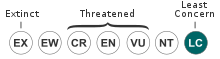
[edit]Emperor tamarins are listed by the International Union for Conservation of Nature (IUCN) as a species of Least Concern, and there are no conservation efforts aimed directly towards this species of primates. Emperor tamarins populations have been in decline due to threats of deforestation and human encroachment. Forest fragmentation has become a huge problem for arboreal primate species in the neotropics: fragmentation causes the tamarins range to be restricted, causing populations to be isolated. Emperor tamarins are located in protected areas in Peru at Manú National Park and Bolivia at Manuripi-Heath Amazonian Wildlife National Reserve. There are no protected areas that overlap with the Brazilian populations of emperor tamarins.
Manú National Park in Peru provides protection of the natural habitat of the emperor tamarins. This national park is considered to be one of the world's most important protected areas because of it being located within one of the largest biodiversity hotspots and its high species richness. The National Park is home to small populations of indigenous people, these indigenous people are permitted to hunt in the park. Research shows that indigenous subsistence hunting has effects on the larger bodied primates in the park but shows minimal effects on the emperor tamarin population size. There is evidence that hunting has extended the range of emperor tamarins which originally were restricted to the north bank of the Manú River are also now found on the south bank.[20] Manú National Park had a successful community based ecotourism industry, and in recent years ecotourism has increased as Park administration and NGOs have taken interest in improving the livelihoods of the indigenous populations. Though there is cause for concern that improving the livelihoods and infrastructure of the national park may lead to negative effects on the wildlife populations including the emperor tamarins.[21]
Human interactions
[edit]Many zoos observe interesting behaviors of Emperor tamarins held in captivity. According to staff at the Jackson Zoo in Jackson, Mississippi, their Emperor tamarins display a need for tenderness. They love to be stroked by human hands and lie on their backs in order to indicate to their caretakers they are requesting more special attention.[22] Staff at San Francisco Zoo have reported that the species takes part in mutual grooming.[23]
References
[edit]- ^ [1]
- ^ a b c d Ravetta, A.L.; Calouro, A.M.; Wallace, R.B.; Mollinedo, J.M.; Röhe, F.; Bicca-Marques, J.C.; Heymann, E.W.; Mittermeier, R.A. (2021). "Saguinus imperator". IUCN Red List of Threatened Species. 2021: e.T39948A192551472. doi:10.2305/IUCN.UK.2021-1.RLTS.T39948A192551472.en. Retrieved 12 November 2021.
- ^ a b "Wildfacts - Emperor tamarin". BBC. April 2012.
- ^ Hershkovitz Philip. 1979. "Races of the emperor tamarin, Saguinus imperator Goeldi (Callitrichidae, Primates)"
- ^ a b c Buchanan-Smith H.M, Hardie SM, Caceres C, Prescott M.J 2000. Distribution and Forest Utilization of Saguinus and Other Primates of the Pando Department, Northern Bolivia. Journal of Primatology 21:353-379
- ^ Irion G., Muller J., Nunes de Mello J., Junk W.J. 1995. Quaternary geoglogy of Amazonian lowland. Geo-Marine Letters 15:172-178
- ^ a b Jackson J.F. 1978. Seasonality of Flowering and Leaf-Fall in a Brazilian Subtropical Lower Montane Moist Forest. Biotropica 10:38-42
- ^ Brown S. and Lugo A. 1990. Tropical Secondary Forests. Journal of Tropical Ecology 6:1-32
- ^ Dominy N.J., Garber P.A., Bicca-Marques J.C., de Azevedo-Lopes, M.A. 2003. Do female tamarins use visual cues to detect fruit rewards more successfully than do males? Animal Behaviour 66:829-837
- ^ Bicca-Marques J.C and Garber P.A. 2003. Experimental field study of relative costs and benefits to wild tamarins (Saguinus imperator and S. fuscicollis) of exploiting contestable food patches as sing- and mixed- species troops. American Journal of Primatology 60:139-153
- ^ Jones, K.E., Bielby, J., Cardillo, M., Fritz, S.A., O’Dell, J., Orme, C.D.L., Safi, K., Sechrest, W., Boakes, E.H., Carbone, C., Connolly, C., Cutts, M.J., Foster, J.K., Grenyer, R., Habib, M.Plaster, C.A., Price, S.A., Rigby, E.A., Rist, J., Teacher, A., BinindaEmonds, O.R.P., Gittleman, J.L., Mace, G.M., Purvis, A., Michener, W.K., 2009.PanTHERIA: a species-level database of life history, ecology, and geography of extant and recently extinct mammals. Ecology 90, 2648
- ^ Windfelder T.L. 2000. Observations on the birth and subsequent care of offspring by a lone pair of wild emperor tamarins (Saguinus imperator). American Journal of Primatology. 52:107-113
- ^ a b Bairrao Ruvio E. 2010. Husbandry Guidelines for Callitrichidae. EAZA. 2nd Edition. 1-218.
- ^ TAXONOMY OF TAMARINS (CALLITRICHIDAE) (PDF). The Linnean Society of London,Zoological Journal of the Linnean Society, 2016. Archived from the original (PDF) on 2017-01-28. Retrieved 2019-06-01.
- ^ Buchanam-Smith, Hannah M. "Tamarin Polyspecific Associations: Forest Utilization and Stability of Mixed-species Groups". Research. University of Stirling. Stirling: Primates Socioecology, 1999.
- ^ Knox, Kerry L. and Donald Stone Sade. "Social Behavior of the Emperor Tamarin in Captivity: Components of Agonistic Display and the Agonistic Network". Research. Evaston: International Journal of Primatology, 1991.
- ^ Windfelder, Tammy L. "Interspecific Communication in mixed-species groups of tamarins: evidence from playback experiments". Research. Duke University. Ann Arbor: Animal Behavior, 2001.
- ^ "Saguinus imperator". Animal Diversity Web. University of Michigan Museum of Zoology. Retrieved June 22, 2016.
- ^ Porter, Leila M.; Dacier, Anand (2016). Rowe, Noel; Myers, Marc (eds.). All the World's Primates. Pogonias Press. pp. 345–346. ISBN 9781940496061.
- ^ Endo E., Peres C.A., Salas E., Morl S., Sanchez-Vega J., Shepard G., Pacheco V., Yu D.W. 2009. Game vertebrate densities in hunted and nonhunted forest sites in Manú National Park. Biotropica. 42(2):251-261
- ^ Shepard G.H, Rummenhoeller K., Ohl-Schacherer J., Yu D.W. 2010. Trouble in paradise: indigenous populations, anthropological poliies, and biodiversity conservation in Manu National Park, Peru. Journal of Sustainable forestry. 29(2-4):252-301
- ^ "Emperor Tamarin (Saguinus imperator)" (PDF). Jackson Zoo. Archived from the original (PDF) on 2012-05-22. Retrieved 2013-10-25.
- ^ "Emperor Tamarin". San Francisco Zoo. Archived from the original on 2013-10-29. Retrieved 2013-10-25.
External links
[edit] Data related to Saguinus imperator at Wikispecies
 Media related to Saguinus imperator at Wikimedia Commons

