


Flores, Buenos Aires
 | This article needs additional citations for verification. (February 2012) |
Flores | |
|---|---|
 The Basilica of San José de Flores | |
 Emblem[1] | |
 Location of Flores within Buenos Aires | |
| Country | Argentina |
| Autonomous City | Buenos Aires |
| Comuna | C7 |
| Important sites | |
| Area | |
| • Total | 8.1 km2 (3.1 sq mi) |
| Population (2001) | |
| • Total | 150,484 |
| • Density | 19,000/km2 (48,000/sq mi) |
| Time zone | UTC-3 (ART) |
Flores (Spanish for “Flowers”) is a middle-class barrio or district in the center part of Buenos Aires city, Argentina. Flores was considered a rural area of the Province of Buenos Aires until 1888 when it was integrated into the city. Flores is the birthplace of Pope Francis.
Limits
[edit]The limits of the neighborhood are marked by several streets and avenues: Portela, Cuenca, Av. Gaona, Av. Donato Álvarez, Curapaligüe, Av. Directorio, Av. Carabobo, Av. Castañares, Torres y Tenorio, Av. Riestra, Av. Perito Moreno, Av. Castañares, Lacarra, and Av. Luis J. Dellepiane.
History
[edit]Flores was mainly composed of country houses from the wealthy people of the City of Buenos Aires. Today, remains of those houses can still be found, including the house owned by Juan Manuel de Rosas, the Governor of the Province around the 19th century.
One of the most prominent of these early homeowners in Flores was the Marcó del Pont family, descendants of a former Spanish governor of Chile. Purchasing property facing the new railway station (one of Argentina's first), they had a comfortable yet understated italianate property built in 1860. Relocating in 1929, the family sold the property and the estate fell into disrepair. Slated at one time for demolition, it eventually caught the attention of the San José de Flores Historical Society, who prevailed on the city to declare it a National Historic Monument, in 1976. Its fate is now secure, as the home became the Marcó del Pont Cultural Center.
The neighbourhood's commercial areas are centered on the train station, Rivadavia Avenue, and the nearby parish church, Basílica de San José de Flores, dating from 1831 which has a romanticist architectural style.
A fictitious mythology of the neighborhood was created by author Alejandro Dolina, centered on the grey angel of Flores. A famous tango song, San José de Flores, centers on the sorrow of a man returning to the barrio after a long and tumultuous absence.
The Pueyrredón theatre was a famous ballroom, where tango vocalist Edmundo Rivero gained fame in the 1930s and was also an oft-used venue by early Argentine rock bands such as Almendra.
On 13 September 2011, a bus on a level crossing at Flores rail station was hit by a train traveling on the Sarmiento Line, operated by Trenes de Buenos Aires, heading for Moreno. The train derailed and crashed into a second train, standing at the station, bound for Once. The accident, which occurred during the morning rush hour, resulted in 11 deaths and 228 injuries. The bus, operated by Empresa de Transportes Microómnibus Sáenz Peña, was working a scheduled service on route 92, heading for Retiro. Video evidence revealed that the bus driver, who was killed in the accident, ignored warning lights and a partly lowered barrier at the crossing.[2][3]
Notable locals
[edit]Jorge Mario Bergoglio, later known as Pope Francis, was born and grew up in Flores,[4] as did Roberto Arlt.[5][6] Author Cesar Aira resides in Flores.[7]
Images
[edit]-
 Bidegain Stadium, home of the San Lorenzo de Almagro football team
 -
 Flores Railway Station, scene of the 2011 Flores rail crash
 -
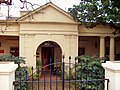 Marcó del Pont Cultural Center
 -
 Plaza Pueyrredón


References
[edit]- ^ "The emblems of the 48 barrios of Buenos Aires were presented" Archived 2016-03-13 at the Wayback Machine (Spanish) by ámbito.com August 29, 2011
- ^ "Al Menos Once Muertos y 228 Heridos en la Mayor Tragedia con Trenes en la Ciudad en Casi 50 Años". Clarín (in Spanish). Buenos Aires. 13 September 2011. Retrieved 23 February 2012.
- ^ "Argentina Bus and Trains Crash Killing at Least 11". British Broadcasting Corporation. 14 September 2011. Retrieved 24 February 2012.
- ^ Claudio Iván Remeseira: Pope Francis: A humble and outspoken man, and technically also Italian Archived 2014-10-27 at the Wayback Machine NBCLatino, 14 March 2013
- ^ Jason Wilson, Buenos Aires: A Cultural and Literary Companion (Interlink Books, 2000; ISBN 156656347X), p. 233: "Roberto Arlt (1900-1942) was born in Flores of a German father and an Italian mother and later lived there in 1926 on calle Yerbal 2000."
- ^ Michele McKay Aynesworth, introduction to Roberto Arlt, Mad Toy (Duke University Press, 2002; ISBN 0822383330), p. 4: "He grew up in a neighborhood called Flores in the city of Buenos Aires."
- ^ Chacoff, Alejandro (7 May 2024). "César Aira's unreal magic: how the eccentric author took over Latin American literature". The Guardian. Retrieved 9 May 2024.
External links
[edit]
- Flores Portal (in Spanish)
- Information from the city's legislative files (in Spanish)
- Flores at City's Government (in Spanish)
- Map
- Marcó del Pont Cultural Center (in Spanish)
