


Golomb–Dickman constant
In mathematics, the Golomb–Dickman constant arises in the theory of random permutations and in number theory. Its value is

It is not known whether this constant is rational or irrational.[1]
Definitions[edit]
Let an be the average — taken over all permutations of a set of size n — of the length of the longest cycle in each permutation. Then the Golomb–Dickman constant is
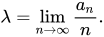
In the language of probability theory, is asymptotically the expected length of the longest cycle in a uniformly distributed random permutation of a set of size n.

In number theory, the Golomb–Dickman constant appears in connection with the average size of the largest prime factor of an integer. More precisely,
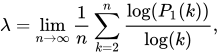
where is the largest prime factor of k (sequence A006530 in the OEIS) . So if k is a d digit integer, then is the asymptotic average number of digits of the largest prime factor of k.


The Golomb–Dickman constant appears in number theory in a different way. What is the probability that second largest prime factor of n is smaller than the square root of the largest prime factor of n? Asymptotically, this probability is . More precisely,


where is the second largest prime factor n.

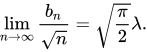
The Golomb-Dickman constant also arises when we consider the average length of the largest cycle of any function from a finite set to itself. If X is a finite set, if we repeatedly apply a function f: X → X to any element x of this set, it eventually enters a cycle, meaning that for some k we have for sufficiently large n; the smallest k with this property is the length of the cycle. Let bn be the average, taken over all functions from a set of size n to itself, of the length of the largest cycle. Then Purdom and Williams[2] proved that

Formulae[edit]
There are several expressions for . These include:
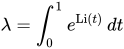
where is the logarithmic integral,

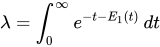
where is the exponential integral, and

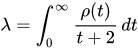
and
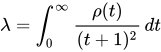
where is the Dickman function.

See also[edit]
External links[edit]
- Weisstein, Eric W. "Golomb-Dickman Constant". MathWorld.
- OEIS sequence A084945 (Decimal expansion of Golomb-Dickman constant)
- Finch, Steven R. (2003). Mathematical Constants. Cambridge University Press. pp. 284–286. ISBN 0-521-81805-2.
References[edit]
- ^ Lagarias, Jeffrey (2013). "Euler's constant: Euler's work and modern developments". Bull. Amer. Math. Soc. 50 (4): 527–628. arXiv:1303.1856. Bibcode:2013arXiv1303.1856L. doi:10.1090/S0273-0979-2013-01423-X. S2CID 119612431.
- ^ Purdon, P.; Williams, J.H (1968). "Cycle length in a random function". Trans. Amer. Math. Soc. 133 (2): 547–551. doi:10.1090/S0002-9947-1968-0228032-3.