


Parrotfish
| Parrotfish | |
|---|---|

| |
| Scarus frenatus | |
Scientific classification 
| |
| Domain: | Eukaryota |
| Kingdom: | Animalia |
| Phylum: | Chordata |
| Class: | Actinopterygii |
| Order: | Labriformes |
| Family: | Scaridae Rafinesque, 1810 |
| Genera | |
|
Bolbometopon | |
Parrotfish are a group of fish species traditionally regarded as a family (Scaridae), but now often treated as a subfamily (Scarinae) or tribe (Scarini) of the wrasses (Labridae).[1] With roughly 95 species, this group's largest species richness is in the Indo-Pacific. They are found in coral reefs, rocky coasts, and seagrass beds, and can play a significant role in bioerosion.[2][3][4]
Description
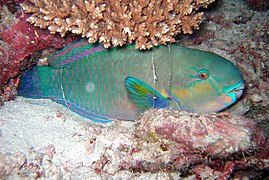
[edit]Parrotfish are named for their dentition,[5] which is distinct from other fish, including other labrids. Their numerous teeth are arranged in a tightly packed mosaic on the external surface of their jaw bones, forming a parrot-like beak with which they rasp algae from coral and other rocky substrates[6] (which contributes to the process of bioerosion).
Maximum sizes vary within the group, with the majority of species reaching 30–50 cm (12–20 in) in length. However, a few species reach lengths in excess of 1 m (3 ft 3 in), and the green humphead parrotfish can reach up to 1.3 m (4 ft 3 in).[7] The smallest species is the bluelip parrotfish (Cryptotomus roseus), which has a maximum size of 13 cm (5.1 in).[8][9][10]
Mucus
[edit]
Some parrotfish species, including the queen parrotfish (Scarus vetula), secrete a mucus cocoon, particularly at night.[11] Prior to going to sleep, some species extrude mucus from their mouths, forming a protective cocoon that envelops the fish, presumably hiding its scent from potential predators.[12][13] This mucus envelope may also act as an early warning system, allowing the parrotfish to flee when it detects predators such as moray eels disturbing the membrane.[13] The skin itself is covered in another mucous substance which may have antioxidant properties helpful in repairing bodily damage,[11][13] or repelling parasites, in addition to providing protection from UV light.[11]
Feeding
[edit]
Most parrotfish species are herbivores, feeding mainly on epilithic algae.[14][15][16] A wide range of other small organisms are sometimes eaten, including invertebrates (sessile and benthic species, as well as zooplankton), bacteria and detritus.[17] A few mostly larger species such as the green humphead parrotfish (Bolbometopon muricatum) feed extensively on living coral (polyps).[6][15][16] None of these are exclusive corallivores, but polyps can make up as much as half their diet[16] or even more in the green humphead parrotfish.[14] Overall it has been estimated that fewer than one percent of parrotfish bites involve live corals and all except the green humphead parrotfish prefer algae-covered surfaces over live corals.[16] Nevertheless, when they do eat coral polyps, localized coral death can occur.[16] Their feeding activity is important for the production and distribution of coral sands in the reef biome, and can prevent algal overgrowth of the reef structure. The teeth grow continuously, replacing material worn away by feeding.[9] Whether they feed on coral, rock or seagrasses, the substrate is ground up between the pharyngeal teeth.[16][18] After they digest the edible portions from the rock, they excrete it as sand, helping create small islands and the sandy beaches. The humphead parrotfish can produce 90 kg (200 lb) of sand each year.[19] Or, on average (as there are so many variables i.e. size/species/location/depth etc.), almost 250 g (9 oz) per parrotfish per day. While feeding, parrotfish must be cognizant of predation by one of their main predators, the lemon shark.[20] On Caribbean coral reefs, parrotfish are important consumers of sponges.[21] An indirect effect of parrotfish grazing on sponges is the protection of reef-building corals that would otherwise be overgrown by fast-growing sponge species.[22][23]
Analysis of parrotfish feeding biology describes three functional groups: excavators, scrapers and browsers.[14] Excavators have larger, stronger jaws that can gouge the substrate,[24] leaving visible scars on the surface.[14] Scrapers have less powerful jaws that can but infrequently do leave visible scraping scars on the substrate.[14][24] Some of these may also feed on sand instead of hard surfaces.[14] Browsers mainly feed on seagrasses and their epiphytes.[14] Mature excavating species include Bolbometopon muricatum, Cetoscarus, Chlorurus and Sparisoma viride.[14] These excavating species all feed as scrapers in early juvenile stages, but Hipposcarus and Scarus, which also feed as scrapers in early juvenile stages, retain the scraping feeding mode as adults.[14][24] Browsing species are found in the genera Calotomus, Cryptotomus, Leptoscarus, Nicholsina and Sparisoma.[14] Feeding modes reflect habitat preferences, with browsers chiefly living in the grassy seabed, and excavators and scrapers on coral reefs.[25][14]
Recently, the microphage feeding hypothesis challenged the prevailing paradigm of parrotfish as algal consumers by proposing that:
Most parrotfishes are microphages that target cyanobacteria and other protein-rich autotrophic microorganisms that live on (epilithic) or within (endolithic) calcareous substrata, are epiphytic on algae or seagrasses, or endosymbiotic within sessile invertebrates.[26]
Microscopy and molecular barcoding of coral reef substrate bitten by scraping and excavating parrotfish suggest that coral reef cyanobacteria from the order Nostocales are important in the feeding of these parrotfish.[27] Additional microscopy and molecular barcoding research indicates that some parrotfish may ingest microscopic biota associated with endolithic sponges.[28]
Life cycle
[edit]
The development of parrotfishes is complex and accompanied by a series of changes in sex and colour (polychromatism). Most species are sequential hermaphrodites, starting as females (known as the initial phase) and then changing to males (the terminal phase). In many species, for example the stoplight parrotfish (Sparisoma viride), a number of individuals develop directly to males (i.e., they do not start as females). These directly developing males usually most resemble the initial phase, and often display a different mating strategy than the terminal phase males of the same species.[29] A few species such as the Mediterranean parrotfish (S. cretense) are secondary gonochorists. This means that some females do not change sex (they remain females throughout their lives), the ones that do change from female to male do it while still immature (reproductively functioning females do not change to males) and there are no males with female-like colors (the initial phase males in other parrotfish).[30][31][32] The marbled parrotfish (Leptoscarus vaigiensis) is the only species of parrotfish known not to change sex.[9] In most species, the initial phase is dull red, brown, or grey, while the terminal phase is vividly green or blue with bright pink, orange or yellow patches.[9][33] In a smaller number of species the phases are similar,[9][33] and in the Mediterranean parrotfish the adult female is brightly colored, while the adult male is gray.[34] In most species, juveniles have a different color pattern from adults. Juveniles of some tropical species can alter their color temporarily to mimic other species.[35] Where the sexes and ages differ, the remarkably different phases often were first described as separate species.[33] As a consequence early scientists recognized more than 350 parrotfish species, which is almost four times the actual number.[29]
Most tropical species form large schools when feeding and these are often grouped by size. Harems of several females presided over by a single male are normal in most species, with the males vigorously defending their position from any challenge.
As pelagic spawners, parrotfish release many tiny, buoyant eggs into the water, which become part of the plankton. The eggs float freely, settling into the coral until hatching.


The sex change in parrotfishes is accompanied by changes in circulating steroids. Females have high levels of estradiol, moderate levels of T and undetectable levels of the major fish androgen 11-ketotestosterone. During the transition from initial to terminal coloration phases, concentrations of 11-ketotestosterone rise dramatically and estrogen levels decline. If a female is injected with 11-ketotestosterone, it will cause a precocious change in gonadal, gametic and behavioural sex.[citation needed]
Economic importance
[edit]A commercial fishery exists for some of the larger species, particularly in the Indo-Pacific,[9] but also for a few others like the Mediterranean parrotfish.[36] Protecting parrotfishes is proposed as a way of saving Caribbean coral reefs from being overgrown with seaweed[37] and sponges.[22][23] Despite their striking colors, their feeding behavior renders them highly unsuitable for most marine aquaria.[9]
A new study has discovered that the parrotfish is extremely important for the health of the Great Barrier Reef; it is the only one of thousands of reef fish species that regularly performs the task of scraping and cleaning inshore coral reefs.[38]
Taxonomy
[edit]Traditionally, the parrotfishes have been considered to be a family level taxon, Scaridae. Although phylogenetic and evolutionary analyses of parrotfishes are ongoing, they are now accepted to be a clade in the tribe Cheilini, and are now commonly referred to as scarine labrids (subfamily Scarinae, family Labridae).[1] Some authorities have preferred to maintain the parrotfishes as a family-level taxon,[33] resulting in Labridae not being monophyletic (unless split into several families).
The World Register of Marine Species divides the group into two subfamilies as follows:
- subfamily Scarinae
- genus Bolbometopon Smith, 1956 (1 species)
- genus Cetoscarus Smith, 1956 (2 species)
- genus Chlorurus Swainson, 1839 (18 species)
- genus Hipposcarus Smith, 1956 (2 species)
- genus Scarus Forsskål, 1775 (53 species)
- subfamily Sparisomatinae
- genus Calotomus Gilbert, 1890 (5 species)
- genus Cryptotomus Cope, 1870 (1 species)
- genus Leptoscarus Swainson, 1839 (1 species)
- genus Nicholsina Fowler, 1915 (3 species)
- genus Sparisoma Swainson, 1839 (15 species)
Some sources retain the Scaridae as a family, placing it alongside the wrasses of the family Labridae and the weed whitings Odacidae in the order Labriformes, part of the Percomorpha. They also do not support the division of the Scaridae into two subfamilies.[39]
Gallery
[edit]-
 Scarus globiceps (male)
 -

-

-

-

-
-

-

-


.jpg)

Timeline of genera
[edit]
References
[edit]- ^ a b Westneat, MW; Alfaro, ME (2005). "Phylogenetic relationships and evolutionary history of the reef fish family Labridae". Molecular Phylogenetics & Evolution. 36 (2): 370–90. doi:10.1016/j.ympev.2005.02.001. PMID 15955516.
- ^ Streelman, J. T., Alfaro, M. E.; et al. (2002). "Evolutionary History of The Parrotfishes: Biogeography, Ecomorphology, and Comparative Diversity". Evolution. 56 (5): 961–971. doi:10.1111/j.0014-3820.2002.tb01408.x. PMID 12093031. S2CID 41840374.
{{cite journal}}: CS1 maint: multiple names: authors list (link) - ^ Bellwood, D. R., Hoey, A. S., Choat, J. H. (2003). "Limited functional redundancy in high diversity systems: resilience and ecosystem function on coral reefs". Ecology Letters. 6 (4): 281–285. doi:10.1046/j.1461-0248.2003.00432.x.
{{cite journal}}: CS1 maint: multiple names: authors list (link) - ^ Lokrantz, J., Nyström, Thyresson, M., M., C. Johansson (2008). "The non-linear relationship between body size and function in parrotfishes". Coral Reefs. 27 (4): 967–974. Bibcode:2008CorRe..27..967L. doi:10.1007/s00338-008-0394-3. S2CID 37926874.
{{cite journal}}: CS1 maint: multiple names: authors list (link) - ^ Ostéologie céphalique de deux poissons perroquets (Scaridae: Teleostei) TH Monod, JC Hureau, AE Bullock - Cybium, 1994 - Société française d'ichtyologie
- ^ a b Choat, J.H. & Bellwood, D.R. (1998). Paxton, J.R. & Eschmeyer, W.N. (eds.). Encyclopedia of Fishes. San Diego: Academic Press. pp. 209–211. ISBN 978-0-12-547665-2.
- ^ Froese, Rainer; Pauly, Daniel (eds.). "Bolbometopon muricatum". FishBase. December 2009 version.
- ^ Froese, Rainer; Pauly, Daniel (eds.). "Cryptotomus roseus". FishBase. September 2015 version.
- ^ a b c d e f g Lieske, E., and Myers, R. (1999). Coral Reef Fishes. 2nd edition. Princeton University Press. ISBN 0-691-00481-1
- ^ Shah, A.K. (2016). Cryptotomus roseus (Slender Parrotfish). The Online Guide to the Animals of Trinidad and Tobago. The University of the West Indies. Accessed 11 March 2018.
- ^ a b c Cerny-Chipman, E. "Distribution of Ultraviolet-Absorbing Sunscreen Compounds Across the Body Surface of Two Species of Scaridae." DigitalCollections@SIT 2007. Accessed 2009-06-21.
- ^ Langerhans, R.B. "Evolutionary consequences of predation: avoidance, escape, reproduction, and diversification. Archived 14 June 2011 at the Wayback Machine" pp. 177–220 in Elewa, A.M.T. ed. Predation in organisms: a distinct phenomenon. Heidelberg, Germany, Springer-Verlag. 2007. Accessed 2009-06-21.
- ^ a b c Videlier, H.; Geertjes, G.J.; Videlier, J.J. (1999). "Biochemical characteristics and antibiotic properties of the mucous envelope of the queen parrotfish". Journal of Fish Biology. 54 (5): 1124–1127. doi:10.1111/j.1095-8649.1999.tb00864.x.
- ^ a b c d e f g h i j k Bellwood, David R. (14 July 1994). "A phylogenetic study of the parrotfish family Scaridae (Pisces: Labroidea), with a revision of genera". Records of the Australian Museum, Supplement. 20: 1–86. doi:10.3853/j.0812-7387.20.1994.51. ISSN 0812-7387.
- ^ a b Bellwood, D.R.; Choat, J.H. (1990). "A functional analysis of grazing in parrotfishes (family Scaridae): the ecological implications". Environ Biol Fish. 28 (1–4): 189–214. doi:10.1007/BF00751035. S2CID 11262999.
- ^ a b c d e f Bonaldo, R.M. & R.D. Rotjan (2018). The Good, the Bad, and the Ugly: Parrotfishes as Coral Predators. in Hoey, A.S. & R.M. Bonaldo, eds. Biology of Parrotfishes. CRC Press. ISBN 978-1482224016
- ^ Comeros-Raynal, Choat; Polidoro, Clements; Abesamis, Craig; Lazuardi, McIlwain; Muljadi, Myers; Nañola Jr, Pardede; Rocha, Russell; Sanciangco, Stockwell; Harwell; Carpenter (2012). "The Likelihood of Extinction of Iconic and Dominant Herbivores and Detritivores of Coral Reefs: The Parrotfishes and Surgeonfishes". PLOS ONE. 7 (7): e39825. Bibcode:2012PLoSO...739825C. doi:10.1371/journal.pone.0039825. PMC 3394754. PMID 22808066.
- ^ Murphy, Richard C. (2002). Coral Reefs: Cities Under The Seas. The Darwin Press, Inc. ISBN 978-0-87850-138-0.
- ^ Thurman, H.V; Webber, H.H. (1984). "Chapter 12, Benthos on the Continental Shelf". Marine Biology. Charles E. Merrill Publishing. pp. 303–313. Accessed 2009-06-14.
- ^ Bright, Michael (2000). The private life of sharks : the truth behind the myth. Mechanicsburg, PA: Stackpole Books. ISBN 978-0-8117-2875-1.
- ^ Dunlap, M; Pawlik, JR (1996). "Video-monitored predation by Caribbean reef fishes on an array of mangrove and reef sponges". Marine Biology. 126: 117–123. doi:10.1007/BF00571383. S2CID 84799900.
- ^ a b Loh, T-L; Pawlik, JR (2014). "Chemical defenses and resource trade-offs structure sponge communities on Caribbean coral reefs". Proceedings of the National Academy of Sciences. 111 (11): 4151–4156. Bibcode:2014PNAS..111.4151L. doi:10.1073/pnas.1321626111. PMC 3964098. PMID 24567392.
- ^ a b Loh, TL; et al. (2015). "Indirect effects of overfishing on Caribbean reefs: sponges overgrow reef-building corals". PeerJ. 3: e901. doi:10.7717/peerj.901. PMC 4419544. PMID 25945305.
- ^ a b c Price, Samantha A.; Wainwright, Peter C.; Bellwood, David R.; Kazancioglu, Erem; Collar, David C.; Near, Thomas J. (1 October 2010). "Functional Innovations and Morphological Diversification in Parrotfish". Evolution. 64 (10): 3057–3068. doi:10.1111/j.1558-5646.2010.01036.x. ISSN 1558-5646. PMID 20497217. S2CID 19070148.
- ^ Environmental Biology of Fishes 28: 189-214, 1990
- ^ Clements, Kendall D.; German, Donovan P.; Piché, Jacinthe; Tribollet, Aline; Choat, John Howard (November 2016). "Integrating ecological roles and trophic diversification on coral reefs: multiple lines of evidence identify parrotfishes as microphages". Biological Journal of the Linnean Society. doi:10.1111/bij.12914.
- ^ Georgina M Nicholson, Kendall D Clements, Micro-photoautotroph predation as a driver for trophic niche specialization in 12 syntopic Indo-Pacific parrotfish species, Biological Journal of the Linnean Society, Volume 139, Issue 2, June 2023, Pages 91–114, https://doi.org/10.1093/biolinnean/blad005
- ^ Nicholson, G.M., Clements, K.D. A role for encrusting, endolithic sponges in the feeding of the parrotfish Scarus rubroviolaceus? Evidence of further trophic diversification in Indo-Pacific Scarini. Coral Reefs (2024). https://doi.org/10.1007/s00338-024-02482-z
- ^ a b Bester, C. Stoplight parrotfish. Archived 20 January 2016 at the Wayback Machine Florida Museum of Natural History, Ichthyology Department. Accessed 15-12-2009
- ^ Afonso, Pedro; Morato, Telmo; Santos, Ricardo Serrão (2008). "Spatial patterns in reproductive traits of the temperate parrotfish Sparisoma cretense" (PDF). Fisheries Research. 90 (1–3): 92–99. doi:10.1016/j.fishres.2007.09.029.
- ^ de Girolamo, Scaggiante; Rasotto (1999). "Social organization and sexual pattern in the Mediterranean parrotfish Sparisoma cretense (Teleostei: Scaridae)". Marine Biology. 135 (2): 353–360. doi:10.1007/s002270050634. S2CID 85428235.
- ^ Sadovy; Shapiro (1987). "Criteria for the diagnosis of hermaphroditism in fishes". Copeia. 1987 (1): 136–156. doi:10.2307/1446046. JSTOR 1446046.
- ^ a b c d Randall, J. E. (2007). Reef and Shore Fishes of the Hawaiian Islands. ISBN 978-1-929054-03-9
- ^ Debelius, H. (1997). Mediterranean and Atlantic Fish Guide: From Spain to Turkey - From Norway to South Africa. ConchBooks. p. 221. ISBN 978-3925919541.
- ^ Cardwell JR1, Liley NR.Gen Comp Endocrinol. 1991 Jan;81(1):7-20
- ^ Cardigos, F. (2001). "Vejas" (PDF). Revista Mundo Submerso. 58 (V): 48–51. Archived from the original (PDF) on 8 July 2018.
- ^ Morelle, Rebecca (1 November 2007) Parrotfish to aid reef repair. BBC
- ^ Australian Geographic (September 2014). "Single species may be key to reef health".
{{cite journal}}: Cite journal requires|journal=(help) - ^ J. S. Nelson; T. C. Grande; M. V. H. Wilson (2016). Fishes of the World (5th ed.). Wiley. pp. 429–430. ISBN 978-1-118-34233-6.
Further reading
[edit]- Hoey and Bonaldo. The Biology of Parrotfishes
- Monod, Th., 1979. "Scaridae". pp. 444–445. In J.C. Hureau and Th. Monod (eds.) Check-list of the fishes of the north-eastern Atlantic and of the Mediterranean (CLOFNAM). UNESCO, Paris. Vol. 1.
- Sepkoski, Jack (2002). "A compendium of fossil marine animal genera". Bulletins of American Paleontology. 363: 560. Retrieved 3 May 2014.
- Smith, J.L.B. (1956). "The parrotfishes of the family Callyodontidae of the Western Indian Ocean". Ichthyological Bulletin, Department of Ichthyology, Rhodes University. 1. hdl:10962/d1018535.
- Smith, J.L.B. (1959). "The identity of Scarus gibbus Ruppell, 1828 and of other parrotfishes of the family Callyodontidae from the Red Sea and the Western Indian Ocean". Ichthyological Bulletin, Department of Ichthyology, Rhodes University. 16. hdl:10962/d1018777.
- Bullock, A.E. and T. Monod, 1997. "Myologie céphalique de deux poissons perroquets (Teleostei: Scaridae)". Cybium 21(2):173–199.
- Randall, John E.; Bruce, Robin W. (1983). "The parrotfishes of the subfamily Scarinae of the Western Indian Ocean with descriptions of three new species". Ichthyological Bulletin. 47. J.L.B. Smith Institute of Ichthyology, Rhodes University. hdl:10962/d1019747.
External links
[edit]
- "parrotfish factsheet". Waitt Institute. Retrieved 8 June 2015.
- Parrot Fish Profile from National Geographic
- Parrot Fish Care
- Parrotfish info on Fishbase
