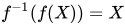
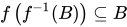
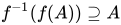
For the function that maps a Person to their Favorite Food, the image of Gabriela is Apple. The preimage of Apple is the set {Gabriela, Maryam}. The preimage of Fish is the empty set. The image of the subset {Richard, Maryam} is {Rice, Apple}. The preimage of {Rice, Apple} is {Gabriela, Richard, Maryam}.
In mathematics, for a function , the image of an input value is the single output value produced by when passed . The preimage of an output value is the set of input values that produce .
More generally, evaluating at each element of a given subset of its domain produces a set, called the "image of under (or through) ". Similarly, the inverse image (or preimage) of a given subset of the codomain is the set of all elements of that map to a member of
The image of the function is the set of all output values it may produce, that is, the image of . The preimage of , that is, the preimage of under , always equals (the domain of ); therefore, the former notion is rarely used.
Image and inverse image may also be defined for general binary relations, not just functions.
is a function from domain to codomain . The image of element is element . The preimage of element is the set {}. The preimage of element is . is a function from domain to codomain . The image of all elements in subset is subset . The preimage of is subset is a function from domain to codomain The yellow oval inside is the image of . The preimage of is the entire domain
The word "image" is used in three related ways. In these definitions, is a function from the set to the set
If is a member of then the image of under denoted is the value of when applied to is alternatively known as the output of for argument
Given the function is said to take the value or take as a value if there exists some in the function's domain such that
Similarly, given a set is said to take a value in if there exists some in the function's domain such that
However, takes [all] values in and is valued in means that for every point in the domain of .
Throughout, let be a function.
The image under of a subset of is the set of all for It is denoted by or by when there is no risk of confusion. Using set-builder notation, this definition can be written as[1][2]
This induces a function where denotes the power set of a set that is the set of all subsets of See § Notation below for more.
The image of a function is the image of its entire domain, also known as the range of the function.[3] This last usage should be avoided because the word "range" is also commonly used to mean the codomain of
"Preimage" redirects here. For the cryptographic attack on hash functions, see preimage attack.
Let be a function from to The preimage or inverse image of a set under denoted by is the subset of defined by
Other notations include and [4]
The inverse image of a singleton set, denoted by or by is also called the fiber or fiber over or the level set of The set of all the fibers over the elements of is a family of sets indexed by
For example, for the function the inverse image of would be Again, if there is no risk of confusion, can be denoted by and can also be thought of as a function from the power set of to the power set of The notation should not be confused with that for inverse function, although it coincides with the usual one for bijections in that the inverse image of under is the image of under
The traditional notations used in the previous section do not distinguish the original function from the image-of-sets function ; likewise they do not distinguish the inverse function (assuming one exists) from the inverse image function (which again relates the powersets). Given the right context, this keeps the notation light and usually does not cause confusion. But if needed, an alternative[5] is to give explicit names for the image and preimage as functions between power sets:
Some texts refer to the image of as the range of [8] but this usage should be avoided because the word "range" is also commonly used to mean the codomain of
defined by The image of the set under is The image of the function is The preimage of is The preimage of is also The preimage of under is the empty set
defined by The image of under is and the image of is (the set of all positive real numbers and zero). The preimage of under is The preimage of set under is the empty set, because the negative numbers do not have square roots in the set of reals.
defined by The fibers are concentric circles about the origin, the origin itself, and the empty set (respectively), depending on whether (respectively). (If then the fiber is the set of all satisfying the equation that is, the origin-centered circle with radius )
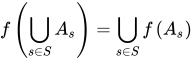
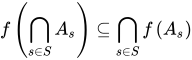
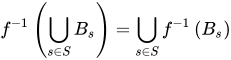
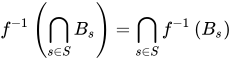
The results relating images and preimages to the (Boolean) algebra of intersection and union work for any collection of subsets, not just for pairs of subsets:
With respect to the algebra of subsets described above, the inverse image function is a lattice homomorphism, while the image function is only a semilattice homomorphism (that is, it does not always preserve intersections).
Fiber (mathematics) – Set of all points in a function's domain that all map to some single given point
Image (category theory) – term in category theoryPages displaying wikidata descriptions as a fallback
Kernel of a function – Equivalence relation expressing that two elements have the same image under a functionPages displaying short descriptions of redirect targets
Set inversion – Mathematical problem of finding the set mapped by a specified function to a certain range





![{\displaystyle f[A],}](https://wikimedia.org/api/rest_v1/media/math/render/svg/40c7a5932d5a29a5b20593c82ad6f21c2216d138)

![{\displaystyle f[A]=\{f(a):a\in A\}.}](https://wikimedia.org/api/rest_v1/media/math/render/svg/bc01f7f90bd43f9de004147ea4064a23a484e7bf)
![{\displaystyle f[\,\cdot \,]:{\mathcal {P}}(X)\to {\mathcal {P}}(Y),}](https://wikimedia.org/api/rest_v1/media/math/render/svg/abffc1c466ae46c2a94661dbcc88cf2e5b93d01b)






![{\displaystyle f^{-1}[B],}](https://wikimedia.org/api/rest_v1/media/math/render/svg/f6dbf84017bfac544e2b90326d745c352343f1a1)
![{\displaystyle f^{-1}[B]=\{x\in X\,:\,f(x)\in B\}.}](https://wikimedia.org/api/rest_v1/media/math/render/svg/e050cb119eb86cfaeefe36aad4c569dc8bb9ccbf)


![{\displaystyle f^{-1}[\{y\}]}](https://wikimedia.org/api/rest_v1/media/math/render/svg/08e16042ec23362592815cff817c8b2760d62671)
![{\displaystyle f^{-1}[y],}](https://wikimedia.org/api/rest_v1/media/math/render/svg/0cc714ff09a271d825aa652c1991d34833140d64)


![{\displaystyle f^{-1}[B]}](https://wikimedia.org/api/rest_v1/media/math/render/svg/6089e39c5def7b9907ba317bbb0593f74e5550aa)










![{\displaystyle f[A]}](https://wikimedia.org/api/rest_v1/media/math/render/svg/35ed71bdb47bfe4c79812b2740415da6f8914c21)






























![{\displaystyle A=[-4,2]}](https://wikimedia.org/api/rest_v1/media/math/render/svg/43003748ab0ca4b4a821c4b5accad858d6155679)
![{\displaystyle B=[-2,4]}](https://wikimedia.org/api/rest_v1/media/math/render/svg/64442023d6e9792651d8b4088dbddffce2f96a23)
![{\displaystyle A_{3}=[-2,2]}](https://wikimedia.org/api/rest_v1/media/math/render/svg/e9d73ae1daa856a3eb86573c3510c9fcdd8f23fb)