


Clifford module
In mathematics, a Clifford module is a representation of a Clifford algebra. In general a Clifford algebra C is a central simple algebra over some field extension L of the field K over which the quadratic form Q defining C is defined.
The abstract theory of Clifford modules was founded by a paper of M. F. Atiyah, R. Bott and Arnold S. Shapiro. A fundamental result on Clifford modules is that the Morita equivalence class of a Clifford algebra (the equivalence class of the category of Clifford modules over it) depends only on the signature p − q (mod 8). This is an algebraic form of Bott periodicity.
Matrix representations of real Clifford algebras[edit]
We will need to study anticommuting matrices (AB = −BA) because in Clifford algebras orthogonal vectors anticommute

For the real Clifford algebra , we need p + q mutually anticommuting matrices, of which p have +1 as square and q have −1 as square.

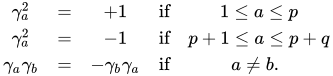
Such a basis of gamma matrices is not unique. One can always obtain another set of gamma matrices satisfying the same Clifford algebra by means of a similarity transformation.
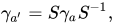
where S is a non-singular matrix. The sets γa′ and γa belong to the same equivalence class.
Real Clifford algebra R3,1[edit]
Developed by Ettore Majorana, this Clifford module enables the construction of a Dirac-like equation without complex numbers, and its elements are called Majorana spinors.
The four basis vectors are the three Pauli matrices and a fourth antihermitian matrix. The signature is (+++−). For the signatures (+−−−) and (−−−+) often used in physics, 4×4 complex matrices or 8×8 real matrices are needed.
See also[edit]
References[edit]
- Atiyah, Michael; Bott, Raoul; Shapiro, Arnold (1964), "Clifford Modules" (PDF), Topology, 3 (Suppl. 1): 3–38, doi:10.1016/0040-9383(64)90003-5, archived from the original (PDF) on 2011-07-17, retrieved 2011-07-28
- Deligne, Pierre (1999), "Notes on spinors", in Deligne, P.; Etingof, P.; Freed, D.S.; Jeffrey, L.C.; Kazhdan, D.; Morgan, J.W.; Morrison, D.R.; Witten, E. (eds.), Quantum Fields and Strings: A Course for Mathematicians, Providence: American Mathematical Society, pp. 99–135, ISBN 978-0-8218-2012-4. See also the programme website for a preliminary version.
- Harvey, F. Reese (1990), Spinors and Calibrations, Academic Press, ISBN 978-0-12-329650-4.
- Lawson, H. Blaine; Michelsohn, Marie-Louise (1989), Spin Geometry, Princeton University Press, ISBN 0-691-08542-0.