


Strangler fig

Strangler fig is the common name for a number of tropical and subtropical plant species in the genus Ficus, including those that are commonly known as banyans.
Species[edit]
Some of the more well-known species are:
- Ficus altissima
- Ficus aurea, also known as the Florida strangler fig
- Ficus benghalensis
- Ficus benjamina
- Ficus burtt-davyi
- Ficus citrifolia
- Ficus craterostoma
- Ficus tinctoria
- Ficus macrophylla
- Ficus obliqua
- Ficus virens
- Ficus watkinsiana
- Ficus henneana
These all share a common "strangling" growth habit that is found in many tropical forest species, particularly of the genus Ficus.[1] This growth habit is an adaptation for growing in dark forests where the competition for light is intense. These plants are hemiepiphytes, spending the first part of their life without rooting into the ground. Their seeds, often bird-dispersed, germinate in crevices atop other trees. These seedlings grow their roots downward and envelop the host tree while also growing upward to reach into the sunlight zone above the canopy.[2][3]
An original support tree can sometimes die, so that the strangler fig becomes a "columnar tree" with a hollow central core.[4] However, it is also believed that the strangler fig can help its support tree survive storms.[5]
Strangler trees are able to colonize the challenging habitat found on the sides of buildings in urban areas. Strangler figs in the tropics are pre-adapted to adopt an aerophytic as well as "acrobatic" urban life by clinging on to building envelopes.[6]
Gallery[edit]
-
 A strangler fig sapling starts to grow on a tree. Roots can be seen
 -
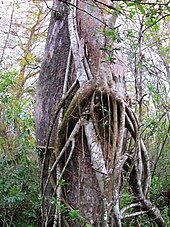 The trunk of a bald cypress, surrounded by the roots of a strangler fig
 -
 A strangler fig. The supporting tree, now dead, can also be seen. Photo from Kannavam forest


-
 Old strangler fig in the final stage, Costa-Rica, Pacific
 -
 A cross section of a bald cypress at the Corkscrew Swamp Sanctuary, showing the roots of a strangler fig inside of it
 -
 A columnar tree formed by a strangler fig after the central tree has died. The tree is hollow as seen in this photograph from below.


See also[edit]
- Ficus benjamina – weeping fig, benjamin fig or ficus tree
References[edit]
- ^ Zhekun, Zhou & Michael G. Gilbert (2003) "Flora of China" (Moraceae) 5: 21–73. hua.huh.harvard.edu Archived 2006-09-01 at the Wayback Machine
- ^ Serventy, V. (1984). Australian Native Plants. Victoria: Reed Books.
- ^ "Light in the rainforest" 1992 Tropical topics. Vol 1 No. 5, epa.qld.gov.au Archived 2007-07-01 at the Wayback Machine
- ^ Margaret Lowman; H. Bruce Rinker (2004). Forest Canopies. Academic Press. pp. 180–. ISBN 978-0-12-457553-0.
- ^ Richard, Leora.; Halkin, Sylvia (June 2017). "Strangler figs may support their host trees during severe storms". Symbiosis. 72 (2): 153–157. doi:10.1007/s13199-017-0484-5. S2CID 29202538.
- ^ Jim, C.Y. (2018). "Epiphytic strangler trees colonizing extreme habitats of building envelopes in Hong Kong". Landscape and Urban Planning. 178: 281–291. doi:10.1016/j.landurbplan.2018.07.003. S2CID 92651962.
External links[edit]

- The Tropical Rain Forest, including photos of strangler figs
- The Queen of Trees: Fig Trees – From the Sacred to the Strangler
- Being strangled may save this tree’s life

If an internal link led you here, you may wish to edit the linking article so that it links directly to the intended article.