Acer pensylvanicum
| Acer pensylvanicum | |
|---|---|

| |
| Striped maple leaves, Cranberry Wilderness, West Virginia | |
Scientific classification 
| |
| Kingdom: | Plantae |
| Clade: | Tracheophytes |
| Clade: | Angiosperms |
| Clade: | Eudicots |
| Clade: | Rosids |
| Order: | Sapindales |
| Family: | Sapindaceae |
| Genus: | Acer |
| Section: | Acer sect. Macrantha |
| Species: | A. pensylvanicum
|
| Binomial name | |
| Acer pensylvanicum | |

| |
| Natural range | |
| Synonyms[2] | |
| |
Acer pensylvanicum, known as the striped maple, moosewood, moose maple or goosefoot maple, is a small North American species of maple. The striped maple is a sequential hermaphrodite, meaning that it can change its sex throughout its lifetime.
Description
[edit]The striped maple is a small deciduous tree growing to 5–10 meters (16–33 ft) tall, with a trunk up to 20 cm (8 in) in diameter.[3] The shape of the tree is broadly columnar, with a short, forked trunk that divides into arching branches which create an uneven, flat-topped crown.[citation needed]
The young bark is striped with green and white, and when a little older, brown.[3]
The leaves are broad and soft, 8–15 cm (3–6 in) long and 6–12 cm (2.5–4.5 in) broad, with three shallow forward-pointing lobes.[3]
The fruit is a samara; the seeds are about 27 mm (1.1 in) long and 11 mm (0.43 in) broad, with a wing angle of 145° and a conspicuously veined pedicel.[3][4][5]
The bloom period for Acer pensylvanicum is around late spring.[6]
The spelling pensylvanicum is the one originally used by Carl Linnaeus.[citation needed]
Small, finger-diameter sections of branches can be used to make whistles due to the ability to lightly bruise the bark, slip it off the wood, carve the whistle hollow and airflow channel into the wood, and slip the tube of bark back on.[citation needed]
Distribution
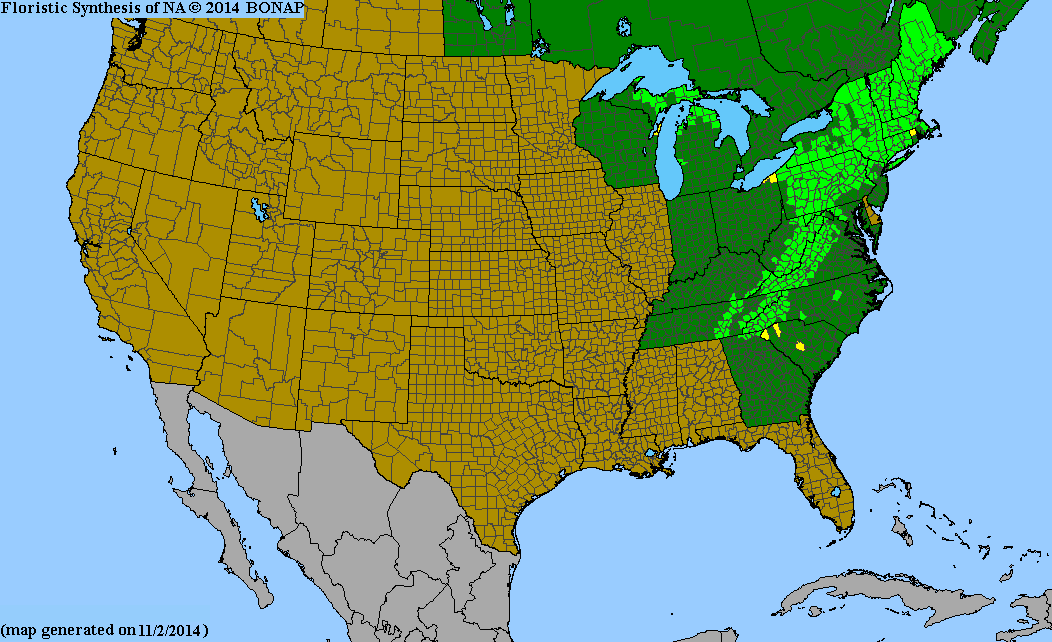
[edit]The natural range of the striped maple extends from Nova Scotia and the Gaspé Peninsula of Quebec, west to southern Ontario, Michigan, and Saskatchewan; south to northeastern Ohio, Pennsylvania, and New Jersey, and along the Appalachian Mountains as far south as northern Georgia.[7][8]
Ecology
[edit],_Ashford,_CT_(32047733011).jpg)
Moosewood is an understory tree of cool, moist forests, often preferring slopes. It is among the most shade-tolerant of deciduous trees, capable of germinating and persisting for years as a small understory shrub, then growing rapidly to its full height when a gap opens up. However, it does not grow high enough to become a canopy tree, and once the gap above it closes through succession, it responds by flowering and fruiting profusely, and to some degree spreading by vegetative reproduction.[9][10]
Mammals such as moose, deer, beavers, and rabbits eat the bark, particularly during the winter.[11]
References
[edit]- ^ Barstow, M.; Crowley, D. (2017). "Acer pensylvanicum". IUCN Red List of Threatened Species. 2017: e.T193849A2285894. doi:10.2305/IUCN.UK.2017-3.RLTS.T193849A2285894.en. Retrieved 12 November 2021.
- ^ "Acer pensylvanicum L. — The Plant List". www.theplantlist.org.
- ^ a b c d "Virginia Tech Dendrology Fact Sheet". dendro.cnre.vt.edu. Retrieved 2024-12-08.
- ^ "Striped Maple (Acer pensylvanicum)". www.carolinanature.com. Retrieved 2024-12-08.
- ^ "Lady Bird Johnson Wildflower Center - The University of Texas at Austin". www.wildflower.org. Retrieved 2024-12-08.
- ^ NRCS. "Acer pensylvanicum". PLANTS Database. United States Department of Agriculture (USDA). Retrieved 2019-02-18.
- ^ "Striped Maple". Archived from the original on 24 August 2014. Retrieved 8 September 2014.
- ^ "Biota of North America Program 2014 county distribution map". bonap.net.
- ^ Hibbs, D. E; B. C. Fischer (1979). "Sexual and Vegetative Reproduction of Striped Maple (Acer pensylvanicum L.)". Bull. Torrey Bot. Club. 106 (3): 222–227. doi:10.2307/2484558. JSTOR 2484558.
- ^ Hibbs, D. E.; Wilson, B. F.; Fischer, B. C. (1980). "Habitat Requirements and Growth of Striped Maple (Acer pensylvanicum L.)". Ecology. 61 (3): 490–496. Bibcode:1980Ecol...61..490H. doi:10.2307/1937413. JSTOR 1937413.
- ^ Little, Elbert L. (1980). The Audubon Society Field Guide to North American Trees: Eastern Region. New York: Knopf. p. 575. ISBN 0-394-50760-6.
External links
[edit] Media related to Acer pensylvanicum at Wikimedia Commons
- "Acer pensylvanicum". Plants for a Future.
- Interactive Distribution Map of Acer pensylvanicum