


Tellima
| Tellima | |
|---|---|

| |
Scientific classification 
| |
| Kingdom: | Plantae |
| Clade: | Tracheophytes |
| Clade: | Angiosperms |
| Clade: | Eudicots |
| Order: | Saxifragales |
| Family: | Saxifragaceae |
| Genus: | Tellima R.Br. (1823) |
| Species: | T. grandiflora
|
| Binomial name | |
| Tellima grandiflora | |
| Synonyms[2] | |
| |
Tellima grandiflora, the bigflower tellima[3] or fringecups, is a herbaceous perennial flowering plant in the family Saxifragaceae. It is the only species in the genus Tellima.[4][5]
Description[edit]
It has rounded stalked leaves mostly growing from the base emerging from a rootstock and bluntly toothed reaching heights of 30 cm.[6] It is evergreen in mild winters. Flowers are borne in spring and early summer, on spikes, terminal racemes, up to 60 cm high. The green calyx is 6–8 mm long; the five flower petals are greenish-white to purple, pinnately divided and spreading. The petals are deeply fringed. It has 10 stamens and 2 styles.[6]
Distribution[edit]
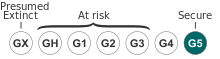
The plant is a native of moist forests in western North America, from Alaska and British Columbia to northern California.[7] It can be a garden escape and become naturalised in some other areas, e.g. Ireland and Great Britain. Although it is secure in the western portions of its range, Tellima grandiflora is listed as vulnerable in Idaho and Montana, and as critically imperiled in Alberta.[8]

Uses[edit]
It is widely grown in gardens. Different strains have been developed. It seeds itself freely in suitable climates.
This plant, crushed and made into an infusion, was used by the Skagit to aid people in sicknesses such as loss of appetite.[9] Ellagitannins are chemical compounds that have potential antiviral activity.[10] Tellimagrandin II, the first of the ellagitannins, formed from pentagalloyl glucose, is laccase-catalyzed dimerised to cornusiin E in T. grandiflora.[11]
References[edit]
- ^ "tellima grandiflora". NatureServe Explorer. NatureServe. Retrieved 2018-04-13.
- ^ Tellima grandiflora (Pursh) Douglas ex Lindl. Plants of the World Online. Retrieved 14 April 2024.
- ^ USDA, NRCS (n.d.). "Tellima grandiflora". The PLANTS Database (plants.usda.gov). Greensboro, North Carolina: National Plant Data Team. Retrieved 8 December 2015.
- ^ Charles Leo Hitchcock & Arthur Cronquist (1973). Flora of the Pacific Northwest: an Illustrated Manual. Seattle: University of Washington Press. ISBN 978-0-295-95273-4.
- ^ Mark Turner & Phyllis Gustafson (2006). Wildflowers of the Pacific Northwest. Portland, OR: Timber Press. ISBN 978-0-88192-745-0.
- ^ a b Parnell, J. and Curtis, T. 2012. Webb's An Irish Flora. Cork University Press.ISBN 978-185918-4783
- ^ "Tellima grandiflora". WTU Herbarium Image Collection. Burke Museum of Natural History and Culture. Retrieved April 26, 2011.
- ^ "Comprehensive Report Species -". explorer.natureserve.org. Retrieved 2018-04-14.
- ^ Jim Pojar & Andy MacKinnon (2004). Plants of the Pacific Northwest Coast. Edmonton: Lone Pine Publishing. ISBN 978-1-55105-530-5.
- ^ Stéphane Quideau; Tatiana Varadinova; Diana Karagiozova; Michael Jourdes; Patrick Pardon; Christian Baudry; Petia Genova; Theodore Diakov & Rozalina Petrova (February 2004). "Main structural and stereochemical aspects of the antiherpetic activity of nonahydroxyterphenoyl-containing C-glycosidic ellagitannins". Chemistry & Biodiversity. 1 (2): 247–258. doi:10.1002/cbdv.200490021. PMID 17191843. S2CID 21637300.
- ^ Ruth Niemetz & Georg G. Gross (2003). "Ellagitannin biosynthesis: laccase-catalyzed dimerization of tellimagrandin II to cornusiin E in Tellima grandiflora". Phytochemistry. 64 (7): 1197–1201. doi:10.1016/j.phytochem.2003.08.013. PMID 14599517.
External links[edit]
 Media related to Tellima grandiflora at Wikimedia Commons
 Data related to Tellima grandiflora at Wikispecies

