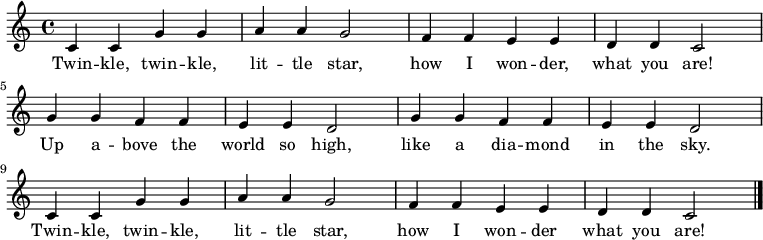
Twinkle Twinkle Little Star
From Wikipedia, the free encyclopedia
| "Twinkle, Twinkle, Little Star" Roud #7666 |
|
| Music by | Traditional |
|---|---|
| Lyrics by | Jane Taylor |
| Published | 1806 |
| Written | England |
| Language | English |
| Form | Nursery Rhyme |
"Twinkle, Twinkle, Little Star" is one of the most popular English nursery rhymes. The lyrics are from an early nineteenth-century English poem, "The Star" by Jane Taylor. The poem, which is in couplet form, was first published in 1806 in Rhymes for the Nursery, a collection of poems by Taylor and her sister Ann. It is often sung to the tune of the French melody "Ah! vous dirai-je, Maman" (oldest known publication 1761).[1] The English lyrics have five stanzas, although only the first is widely known. Mozart wrote twelve variations on ‘Ah! Vous dirai-je, Maman’. It has a Roud Folk Song Index number of 7666.
Contents |
[edit] Lyrics
The English lyrics were first published as a poem with the title "The Star" by sisters Ann and Jane Taylor (1793-1824) in Rhymes for the Nursery in London in 1806.[2] The poem was probably written by Jane.[3] There are five verses. The repetition of the first two lines at the end of each verse is not in the original, but is needed to fit the usual melody. Below is the whole text without the repetition of the first two lines added:
|
|
|
||||
| Problems listening to this file? See media help. | |||||
Twinkle, twinkle, little star,
How I wonder what you are!
Up above the world so high,
Like a diamond in the sky!
When the blazing sun is gone,
When the nothing shines upon,
Then you show your little light,
Twinkle, twinkle, all the night.
Then the traveller in the dark,
Thanks you for your tiny spark,
He could not see which way to go,
If you did not twinkle so.
In the dark blue sky you keep,
And often through my curtains peep,
For you never shut your eye,
Till the sun is in the sky.
As your bright and tiny spark,
Lights the traveller in the dark,—
Though I know not what you are,
Twinkle, twinkle, little star.[2][3][4]
[edit] Melody
| This section may require copy-editing. |
|
|
The introduction to this article provides insufficient context for those unfamiliar with the subject. Please help improve the article with a good introductory style. (July 2009) |
|
|
|
||||
| Problems listening to this file? See media help. | |||||
Popular belief holds that Wolfgang Amadeus Mozart was the original composer of this melody, a misconception[5] reinforced by its appearance as a "correct answer" in the original edition of Trivial Pursuit. However, Mozart wrote twelve variations for piano on the melody (Variations on "Ah vous dirai-je, Maman"), now catalogued as K. 265/300e in the Köchel-Verzeichnis.
[edit] Appearances of the melody
Many songs in various languages have been based on the "Ah! vous dirai-je, Maman" melody. In English, "Twinkle Twinkle Little Star" shares its melody with the "Alphabet Song" from 1834, and "Baa, Baa, Black Sheep".
The German Christmas carol "Morgen kommt der Weihnachtsmann", with words by Hoffmann von Fallersleben, also uses the melody, as does the Hungarian Christmas carol "Hull a pelyhes fehér hó", and the Dutch "Altijd is Kortjakje ziek".
Several classical compositions have been inspired by the tune:
- Wolfgang Amadeus Mozart, Variations on "Ah vous dirai-je, Maman" (K. 265 / K. 300e)
- Camille Saint-Saëns, Carnival of the Animals, 12th movement (Fossiles) quotes the tune
- Ernő Dohnányi, Variations on a Nursery Tune
- Erwin Schulhoff, Ten Variations on 'Ah! vous dirai-je, Maman' and Fugue
- John Corigliano, The Mannheim Rocket
- Franz Liszt, Album Leaf: "Ah! vous dirai-je, Maman" (S.163b)
- Theodor von Schacht, 3rd movement (Allegretto con variazioni) of his clarinet concerto in B flat major
[edit] First appearances of the melody and the original French text version
The original French rhyme Ah! vous dirai-je, Maman, was far from a children's rhyme. Apparently it originated in the first half of the 18th century. As there was no published version of the text before 1774, several slightly differing versions of what could have been the "original" version exist:
- "La confidence" (anonymous)
- Ah! vous dirai-je Maman?, as published in the early 20th century in a collection of French songs by Jean Gilleguin.
- Comparing two versions of "La Confidence" with the nursery rhyme version
In these versions a girl confides a secret to her mother: that she has been seduced by "Silvandre". Only in one version cited above did the girl apparently make a narrow escape ("Je m'échappai par bonheur"[6]), in the other versions the girl appears to have been "beaten" by L'Amour ("Love").
As for the history of the melody and the non-nursery rhyme version(s) of the French text:[7][8]
- 1761: first publication of the music (without lyrics) of Ah! vous dirai-je, Maman in "Les Amusements d'une Heure et Demy" by Mr. Bouin (Paris), p. 1.
- Around 1765, the words and music appear in a manuscript entitled "Recueil de Chansons" under the title "Le Faux Pas", p. 43.
- 1774: earliest known printed publication of the lyrics together with the music in volume two of "Recueil de Romances" by M.D.L. (De Lusse) published in Brussels, under the title "La Confidence – Naive" (p. 75).
- Around 1780 (Paris): the words and music appear in sheet music under the title "Les Amours de Silvandre".
- 1785: First publication of Mozart's Ah! vous dirai-je, Maman variations.
As for the composition date of Mozart's Variations, for a time the variations were thought to have been composed in 1778, while Mozart stayed in Paris from April to September in that year, the assumption being that the melody of a French song could only have been picked up by Mozart while residing in France. For this presumed composition date, in the chronological catalogue of Mozart's compositions the composition was renumbered from K. 265 to K. 300e.[8] Later analysis of Mozart's manuscript of the composition by Wolfgang Plath rather indicated 1781-1782 as the probable composition date.[9]
[edit] French "nursery rhyme" version
Origin unknown.
| French lyrics | English translation |
|---|---|
|
Ah! vous dirai-je, Maman, |
Ah! I shall tell you, mum, |
The French "nursery rhyme" version also appears with slight variations:
| French lyrics | English translation |
|---|---|
| A variation | |
|
Ah! vous dirai-je, Maman, |
Ah! I would tell you, Mother, |
| Another variation | |
|
Ah! vous dirai-je, Maman, |
Ah! I shall tell you, Mother, |
The lyrics from "The Star" were first published with the tune in The Singing Master: First Class Tune Book in 1838.[3]
[edit] Other text versions
The song is a popular target for parodies. "Twinkle, Twinkle, Little Bat," is a parody of "Twinkle Twinkle Little Star" recited by the Mad Hatter during the mad tea-party, in Lewis Carroll's Alice's Adventures in Wonderland. It reads:
- Twinkle, twinkle, little bat!
- How I wonder what you're at!
- Up above the world you fly,
- Like a tea tray in the sky.
- Twinkle, twinkle—[3]
The Mad Hatter is interrupted in his recitation. "The Bat" was the nickname of Professor Bartholomew Price, one of the Dons at Oxford, a former teacher of Carroll's and well known to the Liddell family. It is one of the few parodies in the Alice books of which the original is still widely known.
A Latin translation appeared in Mary Mapes Dodge's When life is young (1894):
- Mica, mica, parva stella,
- Miror quaenam sis tam bella.
- Super terra in caelo,
- Alba gemma splendido.
- Mica, mica, parva stella,
- Miror quaenam sis tam bella.
The Elegants released a single adapted from this song called Little Star, which made #1 on the Billboard Hot 100 in 1958.
A version using synonyms from Roget's Thesaurus exists.[12] An anonymous astronomy parody, quoted in Violent Universe by Nigel Calder (BBC, 1969), refers to pulsars and quasars. A different version of this parody attributed to George Gamow and Nigel Calder was published in Galaxies in the Universe: An Introduction by Linda Sparke and John Gallagher (Cambridge University Press, 2000 - ISBN 0-521-59740-4).
The Girl Scouts of the USA placed a full page ad in the March 19th 2006 New York Times containing a version of the rhyme that was "resung by science" as part of their "Girls Go Tech" campaign.
Vashti Bunyan, an English singer-songwriter, composed "Lily Pond" based on this tune. It can be found on her 1970 album Just Another Diamond Day. American singer Elizabeth Mitchell covers the song on her 2006 album You Are My Little Bird.
[edit] Notable covers, remixes, samples and uses
- A version of the song appears in a scene from the 1950 Clark Gable movie Key to the City.
- American recording artist Jewel did a cover of Twinkle Twinkle Little Star in her 2009 release Lullaby.
[edit] Notes
- ^ "The melody was first known as 'Ah! vous dirai-je, Maman,' the music of which appeared (without words) in 1761 in 'Les Amusements d'une Heure et Demy' by Mr. Bouin (Paris), p. 1." [1]
- ^ a b I. Opie and P. Opie, The Oxford Dictionary of Nursery Rhymes (Oxford University Press, 1951, 2nd edn., 1997), pp. 397-8.
- ^ a b c d M. Cryer, Love Me Tender: The Stories Behind the World's Best-loved Songs (Frances Lincoln, 2009), pp. 83-5.
- ^ The Star, Representative Poetry Online (RPO), University of Toronto, 2005
- ^ http://bdb.co.za/shackle/articles/twinkle.htm
- ^ See http://ourworld.compuserve.com/homepages/Thierry_klein/ahvousdi.htm
- ^ The chronology is based on an account by Bob Kosovsky, librarian at the Music Division of The New York Public Library for the Performing Arts, 2001
- ^ a b (in German:) Neue Mozart-Ausgabe, IX/26: Variationen für Klavier, Kritischer Bericht (Fischer, 1962), p. 58-59
- ^ Based on booklet notes by Robin Golding, 1991 for Daniel Barenboims Mozart: The Complete Piano Sonatas and Variations, EMI Classics 8 CD box No. 5 73915 2
- ^ a b literally, mignons = "darlings;" objects of affection
- ^ a b An antienne is literally an antiphon, a short liturgical text chanted or sung alternately by two choirs preceding or following a psalm or canticle.
- ^ G. Hughes, A history of English words (Wiley-Blackwell, 2000), p. 40.
[edit] External links
- Sheet music on Wikifonia
- Lullabies of Europe/Languages from the Cradle A European Union, government funded, education project to collect lullabies (in their native language) from across Europe - includes samples in 7 languages.
- The original melody
- BBC Radio 4 Woman's Hour article (with audio): http://www.bbc.co.uk/radio4/womanshour/04/2006_35_wed.shtml
- The lyrics, the tune and an mp3 recording of Twinkle, Twinkle, Little Star, also a score and a French Translation
- A new upbeat version to celebrate the International Year of Astronomy
- Twinkle Twinkle Little Star Song in Indian Desi Style