


Old states of Germany

| History of Germany |
|---|
 |


The old states of Germany (German: die alten Länder) is a jargon referring to the ten of the sixteen states of the Federal Republic of Germany (FRG) that were part of West Germany and that unified with the eastern German Democratic Republic's 5 states, which are given the contrasting term new states of Germany. Usage of this terminology usually excludes one other state, Berlin, conterminous with the capital city of the reunified nation which used to be divided, with its western part linked with West Germany.
The old states are Baden-Württemberg, Bavaria, Bremen, Hamburg, Hesse, Lower Saxony, North Rhine-Westphalia, Rhineland-Palatinate, Saarland, and Schleswig-Holstein. The state of Berlin, the result of a merger between East and West Berlin, is usually not considered one of the old states although West Berlin was associated with the Federal Republic of Germany, but its status was disputed because of the Four Power Agreement on Berlin.
Demographics[edit]

In the old states, the populations also developed differently. In Baden-Württemberg, Bavaria, Hamburg, Hesse and Schleswig-Holstein, the population increased steadily. In Saarland, on the other hand, the population dropped steadily. The population of North Rhine-Westphalia (until 2004), Lower Saxony and Rhineland-Palatinate (both until 2003) initially increased and then fell off again. The population of Bremen dropped until the year 2001, then rose to the year 2007 and began to fall again in 2008.
Since 1980, birth rates have been relatively constant.[1]
Migration[edit]
There are more migrants in former West Germany than in former East Germany.[2][3][4]
Religion[edit]
Eurostat's Eurobarometer survey in 2015, found that Christians comprised 81.4% of the total population; by denomination, Catholics were 37.1%, members of the Protestant Churches were 36.5%, members of other Christian denominations were 7.2%, the Christian Orthodox were 0.6%. Around 6.7% of the adult population themselves as agnostics or non believer, while 7.4% declared themselves as atheists. Muslims comprised 2.8% of the total population.[5]
Economy[edit]
.jpeg)
The standard of living and annual income remains significantly higher in the old states.[6] In former West Germany, there is more income than in the East.[1]
In former West Germany, there were smaller farms than in the east.[1]
In the old states there are fewer unemployed than in the new states.[7][8]
Politics[edit]
In the West and West Berlin[9] the Union, SPD, FDP and Greens are stronger, but right-wing populist parties and The Left are weaker than in the east.[10][11]
Unlike in the East, there are not 3 or 4 (since 2016) equally-strong parties but a "two-party dominance" of the SPD and CDU.[12]
A study of the University of Berlin from 1998–1999 comes to 13% for the whole of Germany, and 12% for the West and 17% for the East for right-wing extremist recruitment potential.[13] In the 2017 Federal Election, AfD reached ~ 22%[14] in the East and ~ 11%[15] in the West.[16]
There is also a higher voter turnout in the West.[12]
-
 Social Democrats (SPD)
 -
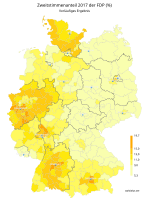 Free Democrats (FDP)
 -
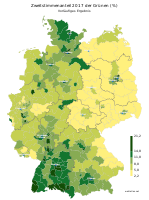 Alliance 90/The Greens (B90/Grünen)
 -
 Christian Democrats (CDU & CSU)


See also[edit]
References[edit]
- ^ a b c "ZEIT ONLINE | Lesen Sie zeit.de mit Werbung oder im PUR-Abo. Sie haben die Wahl". www.zeit.de. Archived from the original on 2019-11-10. Retrieved 2021-02-26.
- ^ "Die Rechten ziehen in den Osten, Ausländer in den Westen". katapult-magazin.de. Archived from the original on 2018-07-12. Retrieved 2021-02-26.
- ^ Bildung, Bundeszentrale für politische. "Ausländische Bevölkerung nach Bundesländern | bpb". bpb.de. Archived from the original on 2019-05-07. Retrieved 2021-02-26.
- ^ "Ausländische Bewohner in den deutschen Bundesländern". www.laenderdaten.de. Archived from the original on 2018-07-12. Retrieved 2021-02-26.
- ^ "Discrimination in the EU in 2015", Special Eurobarometer, 437, European Union: European Commission, 2015, archived from the original on 7 October 2019, retrieved 2 March 2019 – via GESIS
- ^ "The Price of a Failed Reunification". Spiegel International. 2005-09-05. Archived from the original on 2007-11-20. Retrieved 2006-11-28.
- ^ "ZEIT ONLINE | Lesen Sie zeit.de mit Werbung oder im PUR-Abo. Sie haben die Wahl". www.zeit.de. Archived from the original on 2018-04-13. Retrieved 2021-02-26.
- ^ "Statistiken nach Regionen - Statistik der Bundesagentur für Arbeit". statistik.arbeitsagentur.de. Archived from the original on 2021-02-26. Retrieved 2021-02-26.
- ^ "Ergebnisse in Ost und West: Berlin bleibt bei der Wahl gespalten | RBB|24". Archived from the original on 2018-08-24. Retrieved 2017-11-12.
- ^ "Bundestagswahl: Osten wählt immer noch anders als der Westen". www.wiwo.de. Archived from the original on 2015-08-19. Retrieved 2017-11-12.
- ^ "Zahlen & Fakten - Ost und West wählen noch immer unterschiedlich - Statistisches Bundesamt (Destatis)". Archived from the original on 2017-11-13. Retrieved 2017-11-12.
- ^ a b Holtkamp, Lars; Bathge, Thomas. "Parteien und Parteienwettbewerb in West- und Ostdeutschland | bpb". bpb.de. Archived from the original on 2019-05-22. Retrieved 2017-11-11.
- ^ Nach Iris Huth: Politische Verdrossenheit, Band 3, 2004, S. 226.
- ^ "Bundestagswahlen - Neue Bundesländer und Berlin-Ost". www.wahlen-in-deutschland.de. Archived from the original on 2017-10-23. Retrieved 2017-11-12.
- ^ "Bundestagswahlen - Alte Bundesländer und Berlin-West". www.wahlen-in-deutschland.de. Archived from the original on 2017-10-24. Retrieved 2017-11-12.
- ^ "Bundestagswahl 2017". Archived from the original on 2017-10-23. Retrieved 2017-11-12.
| Authority control databases: National |
|---|
