


White-lipped tree frog
| White-lipped tree frog | |
|---|---|

| |
Scientific classification 
| |
| Domain: | Eukaryota |
| Kingdom: | Animalia |
| Phylum: | Chordata |
| Class: | Amphibia |
| Order: | Anura |
| Family: | Hylidae |
| Genus: | Nyctimystes |
| Species: | N. infrafrenatus
|
| Binomial name | |
| Nyctimystes infrafrenatus | |
| Synonyms | |
|
List
| |
The white-lipped tree frog (Nyctimystes infrafrenatus) is a species of frog in the subfamily Pelodryadinae. It is the world's largest tree frog (the Cuban tree frog reaches a similar maximum size) and is found in Australia. Other common names include the New Guinea treefrog, giant tree frog, and Australian giant treefrog.[4]
Description[edit]
The white-lipped tree frog reaches 11–14 cm (4.3–5.5 in) in length.[5] Females are larger than males, and have thicker skin in correlation with the difference in body size.[6] Its dorsal surface is usually bright green, although the colour changes depending on the temperature and background, and can be brown. The ventral surface is off-white. The lower lip has a distinctive white stripe (giving this species its name), which continues to the shoulder. The white stripes on the trailing edges of the lower leg may turn pink in the breeding male. The white-lipped tree frog has large toe pads, which aid it to climb. The toes are completely webbed, and the hands are partially webbed.
-
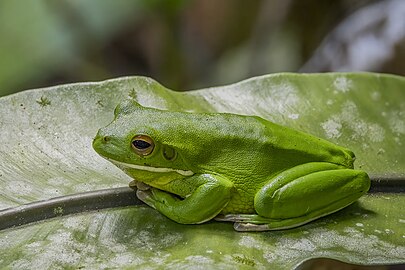 In Daintree rainforest, Queensland
 -
 A brown example
 -
 Being eaten by a green tree snake - Dendrelaphis punctulatus near Cooktown, Queensland
_Daintree.jpg)


Ecology and behaviour[edit]
The white-lipped tree frog is found along the coastal areas of Cape York Peninsula and the wet tropics of north-eastern Queensland, Australia. It is the most widely distributed tree frog in the New Guinea region, spanning from eastern Indonesia, through the New Guinea mainland, to the Bismarck and the Admiralty Islands in the north. It lives in rainforests, cultivated areas, and around houses in coastal areas, and is restricted to areas below 1200 m in altitude.
It has a loud, barking call, but when distressed, it makes a cat-like "mew" sound or may discharge urine. Males call during spring and summer after rain from vegetation around the breeding site, normally a still body of water.
Its diet is mainly insects and other arthropods. It can live to over 10 years in the wild.
This species of frog is known for being moved around in fruit produce from northern Australia and ending up becoming a lost frog in southern areas.
As a pet[edit]
It is kept as a pet; but in Australia, it may be kept in captivity only with an appropriate permit.
References[edit]
- ^ Iskandar, D.; Mumpuni; Hero, J.; Retallick, R.; Richards, S. (2017). "Nyctimystes infrafrenatus". IUCN Red List of Threatened Species. 2017: e.T41095A114114070. doi:10.2305/IUCN.UK.2017-1.RLTS.T41095A114114070.en. Retrieved 19 November 2021.
- ^ EOL.org
- ^ Barker, J., Grigg, G. C., and Tyler, M. J. (1995). A Field Guide to Australian Frogs. Surrey Beatty and Sons, New South Wales.
- ^ "Nyctimystes infrafrenatus (Günther, 1867) | Amphibian Species of the World". research.amnh.org. Retrieved 2019-10-02.
- ^ "Litoria infrafrenata (White-lipped Tree Frog)". Australia: James Cook University. Retrieved 27 April 2024.
- ^ Vanburen, Collin S.; Norman, David B.; Fröbisch, Nadia B. (2019). "Examining the relationship between sexual dimorphism in skin anatomy and body size in the white-lipped treefrog, Litoria infrafrenata (Anura: Hylidae)". Zoological Journal of the Linnean Society. 186 (2): 491–500. doi:10.1093/zoolinnean/zly070. PMC 7797633. PMID 33551467.
- Menzies, J.I. (1976). Handbook of Common New Guinea Frogs. Wau Ecology Institute.
- Cronin, L., (2001). Australian Reptiles and Amphibians, Envirobook, ISBN 0-85881-186-3
- Cogger, H.G. (2000). Reptiles and amphibians of Australia. Reed Books: Sydney.
External links[edit]

- Queensland Department of Environment and Science: White-lipped tree frog—Conservation status and audio of frog call
- Frog Australia Network—frog call available here.
- Article Road: List of All Frog Breeds: Things You Can Do to Ensure Your Frog Has a Long, Happy and Healthy Life: White Lipped Tree Frog
- Department of Environment, Climate Change and Water, New South Wales: Amphibian Keeper's Licence: Species Lists
| Authority control databases: National |
|---|
