


Senegalia berlandieri
| Senegalia berlandieri | |
|---|---|

| |
Scientific classification 
| |
| Kingdom: | Plantae |
| Clade: | Tracheophytes |
| Clade: | Angiosperms |
| Clade: | Eudicots |
| Clade: | Rosids |
| Order: | Fabales |
| Family: | Fabaceae |
| Subfamily: | Caesalpinioideae |
| Clade: | Mimosoid clade |
| Genus: | Senegalia |
| Species: | S. berlandieri
|
| Binomial name | |
| Senegalia berlandieri (Benth.) Britton & Rose
| |

| |
| Range of Senegalia berlandieri | |
| Synonyms | |
|
Acacia berlandieri Benth. | |

Senegalia berlandieri (Berlandier acacia, guajillo acacia, guajillo, huajillo, huajilla) is a shrub native to the Southwestern United States and northeast Mexico that belongs to the Mimosoid clade of Fabaceae. It grows 1 to 5 metres (3.3 to 16.4 ft) tall, with blossoms that are spherical and white, occurring from February through April.[1] The berlandieri epithet comes from the name of Jean-Louis Berlandier,[2] a French naturalist who studied wildlife native to Texas and Mexico. S. berlandieri contains a wide variety of alkaloids and has been known to cause toxic reactions in domestic animals such as goats.[3][4]
Uses[edit]
Senegalia berlandieri is toxic to livestock and thus should not be used as forage or fodder.[5]
Alkaloids[edit]
Senegalia berlandieri contains a diverse range of alkaloids, the most plentiful of which are N-methylphenethylamine, tyramine, and phenethylamine.[3] The total alkaloid content in dried leaves has been reported to be in the range 0.28-0.66%.[6]
Four phenolic amines (N-methyl-β-phenethylamine, tyramine, N-methyltyramine, and hordenine) have been detected.[7]
Other trace alkaloids include nicotine and mescaline (the latter of which is found in many cacti but infrequently in other plants).[3] The same group of researchers later reported finding most of the same alkaloids in Acacia rigidula, a related species also native to the Southwestern U.S.[8] However, their findings have not been corroborated by other research, leading to the suggestion that they may have resulted from cross-contamination or simply been artifacts of the researchers' analytical technique.[9]
Illicit use in supplements[edit]
After the FDA declared that the use of Acacia rigdula was unlawful in supplements (because of frequent adulteration with synthetic drugs), many supplement sellers began replacing previously reported 'rigdula' containing supplements with 'Acacia berlandieri'.[citation needed] Some of these products declare their Acacia extracts as containing Methylsynephrine, an entirely synthetic drug that has never been found in nature.[citation needed]
Gallery[edit]
-
 Senegalia berlandieri foliage and flowers
 -
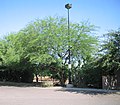 Senegalia berlandieri tree
 -
 Senegalia berlandieri bark
 -
 Senegalia berlandieri flowers and seed pods
 -
 Senegalia berlandieri seeds


References[edit]
- ^ University of Texas Native Plant Information Network
- ^ Holloway, Joel Ellis (2005). A Dictionary of Common Wildflowers of Texas & the Southern Great Plains. Texas Christian University Press. ISBN 978-3-540-63293-1.
- ^ a b c B.A. Clement, C. M. Goff and T. D. A. Forbes (1997). "Toxic amines and alkaloids from Acacia berlandieri." Phytochemistry 46 249-254.
- ^ I. J. Pemberton, G. R. Smith, T. D. Forbes, and C. M. Hensarling (1993). "Technical note: an improved method for extraction and quantification of toxic phenethylamines from Acacia berlandieri." J. Anim. Sci. 71 467-70. http://www.journalofanimalscience.org/content/71/2/467.full.pdf
- ^ "Guajillo". Texas Toxic Plant Database. Texas A&M University.
- ^ Hegnauer, Robert mass (1994). Chemotaxonomie der Pflanzen. Springer Science+Business Media. p. 500. ISBN 978-3-7643-2979-2.
- ^ Clement, Beverly A.; Goff, Christina M.; Forbes, T. David A. (1 September 1997). "Toxic amines and alkaloids from Acacia berlandieri". Phytochemistry. 46 (2): 249–254. Bibcode:1997PChem..46..249C. doi:10.1016/S0031-9422(97)00240-9. ISSN 0031-9422.
- ^ B. A. Clement, C. M. Goff, and T.D. A. Forbes (1998). "Toxic amines and alkaloids from Acacia rigidula." Phytochemistry 49 1377-1380.
- ^ "Acacias and Natural Amphetamine". Ask Dr. Shulgin Online. Center for Cognitive Liberty & Ethics. 2001-09-26. Archived from the original on 2002-12-27.
External links[edit]
 Media related to Senegalia berlandieri at Wikimedia Commons
 Data related to Acacia berlandieri at Wikispecies

