


Adolph de Meyer
Adolph de Meyer | |
|---|---|
 | |
| Born | 1 September 1868 Paris, France |
| Died | 6 January 1946 (aged 77) Los Angeles, California, U.S. |
| Resting place | Forest Lawn Memorial Park |
| Occupation | Photographer |
| Known for | Celebrity portrait photographs |
| Spouse | |
Baron Adolph de Meyer (1 September 1868[1] – 6 January 1946) was a photographer famed for his photographic portraits in the early 20th century, many of which depicted celebrities such as Mary Pickford, Rita Lydig, Luisa Casati, Billie Burke, Irene Castle, John Barrymore, Lillian Gish, Ruth St. Denis, King George V, and Queen Mary. He was also the first official fashion photographer for the American magazine Vogue, appointed to that position in 1913.
Background[edit]

Reportedly born in Paris and educated in Dresden, Germany, Adolphus Meyer was the son of a German Jewish father and Scottish mother—Adolphus Louis Meyer and his wife, the former Adele Watson.[2][3] In 1893, he joined the Royal Photographic Society and moved to London in 1895.
He used the surnames Meyer, von Meyer, de Meyer, de Meyer-Watson, and Meyer-Watson at various times in his life.[4] From 1897, he was known as Baron Adolph Edward Sigismond de Meyer, though some contemporary sources list him as Baron Adolph von Meyer and Baron Adolph de Meyer-Watson.[5][6]
In editions dating from 1898 until 1913, Whitaker's Peerage stated that de Meyer's title had been granted in 1897 by Frederick Augustus III of Saxony, and another source states "the photographer inherited it from his grandfather in the 1890s".[7] Some sources state that no evidence of this nobiliary creation, however, has been found.[8]
Marriage[edit]
.jpg)
On 25 July 1899, at Holy Trinity Church, Sloane Street, Cadogan Square in London, England, de Meyer married Donna Olga Caracciolo, an Italian noblewoman who had been divorced earlier that year from Marino Brancaccio; some said she was a goddaughter of Edward VII.[9][10] The couple reportedly met in 1897, at the home of a member of the Sassoon banking family, and Olga would be the subject of many of her husband's photographs.
The de Meyers' marriage was one of convenience rather than romantic love because the groom was homosexual and the bride was bisexual or lesbian.[11][12] As Baron de Meyer wrote in an unpublished autobiographical novel, before they wed, he explained to Olga "the real meaning of love shorn of any kind of sensuality". He continued by observing, "Marriage based too much on love and unrestrained passion has rarely a chance to be lasting, whilst perfect understanding and companionship, on the contrary, generally make the most durable union".[13]
After the death of his wife in 1931, Baron de Meyer became romantically involved with a young German, Ernest Frohlich (born circa 1914), whom he hired as his chauffeur and later adopted as his son. The latter went by the name Baron Ernest Frohlich de Meyer.[14][15][16]
Career[edit]
From 1898 to 1913, de Meyer lived in fashionable Cadogan Gardens, London. And from 1903 to 1907, his work was published in Alfred Stieglitz's quarterly Camera Work. Cecil Beaton dubbed him "the Debussy of photography". In 1912, he photographed Nijinsky in Paris.
On the outbreak of World War I, the de Meyers, who in 1916 took the new names of Mahrah and Gayne, on the advice of an astrologer, moved to New York City, where he became a photographer for Vogue from 1913 to 1921, and for Vanity Fair. In 1922, de Meyer accepted an offer to become the chief photographer and Parisian fashion correspondent for Harper's Bazaar in Paris, spending the next 12 years there.[17]
During the World War I years, de Meyer brought to Vogue an Edwardian style featuring a rebellion against the rationality of the second industrial revolution and a fashion movement that was characterized as a queer counterculture.[18]
On the eve of World War II in 1938, de Meyer returned to the United States.[19] Today, few of his prints survive, most having been destroyed during World War II but some 52 photographs of Olga, packed by his adopted son Ernest, came to light in 1988 and were published in 1992.[20]
He died in Los Angeles on the anniversary of his wife's death, 6 January 1946, he being registered as 'Gayne Adolphus Demeyer, writer (retired),[21] and was buried at Forest Lawn Memorial Park (Glendale), Glendale, Los Angeles County, California.
Gallery[edit]
-
 Gertrude Käsebier, c. 1900
 -
 Vaslav Nijinsky, 1912
 -
 Luisa Casati, 1912
 -
 Jeanne Eagels wearing a cape over a dress in tulle with an ostrich ruff by Madeleine Chéruit, Paris fashion designer, 1921
 -
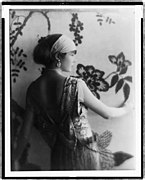 Portrait of a woman, 1920-1930
 -
 Woman in black in Mosque Archway, 1900s
 -
 A street in China, Camera Work, 1912
 -
 The Shadows on the Wall (Chrysanthemums), c.1906
 -
 Hydrangea, 1907
 -
 Glass and Shadows,1912
 -
 John Barrymore, 1920


_MET_DP258345.jpg)


Sources[edit]
- Royal Mistresses and Bastards (2007) page 358 re Blanche, Duchess of Carraciolo and Olga de Meyer.
- Baron Adolf de Meyer
- Adolf de Meyer
References[edit]
- ^ "View on the online birth certificate, number 729: Declaration of birth was made on the 3 September, but the parents declared the child was born on 1 September at 10:00 AM". Archived from the original on 3 March 2016. Retrieved 29 March 2012.
- ^ Adolphus Louis Meyer is given as the name of Baron de Meyer's father on his 1899 marriage license, found through ancestry.com.
- ^ Of Passions and Tenderness: Portraits of Olga by Baron de Meyer, Graystone Press, 1992, page 7.
- ^ A circa-1900 photograph of his wife Olga bears the signature Adolph Meyer, a signature he frequently used before adopting De Meyer. See Of Passions and Tenderness: Portraits of Olga by Baron de Meyer, Graystone Press, 1992, page 111.
- ^ The name "Baron A. de Meyer-Watson" is cited in Photograms of the Year: The Annual Review of the World's Pictorial Photographic Work, 1899, page 188
- ^ Who's Who in England, 1905
- ^ Of Passions and Tenderness: Portraits of Olga by Baron de Meyer (Greystone Books, 1992), page 6
- ^ Anthony Camp, Royal Mistresses and Bastards: fact and fiction 1714-1936 (London, 2007) 357-8.
- ^ British marriage records available through Freebmd.rootsweb.com state the bride and groom as Maria Beatrice Olga Brancaccio, Princess de Moavero, and Baron Adolphus Edward Sigismund von Meyer.
- ^ Of Passions and Tenderness: Portraits of Olga by Baron de Meyer, Graystone Books, 1992
- ^ American Book Collector, Volume 2, 1981, page 15
- ^ History of Art: Adolf de Meyer
- ^ Of Passions and Tenderness: Portraits of Olga by Baron de Meyer (Graystone Books, 1992), pages 17 and 105.
- ^ John Hannavy, Encyclopaedia of Nineteenth-Century Photography, Volume 1, page 396
- ^ A Singular Elegance: The Photographs of Baron Adolph de Meyer, International Center for Photography, 1994
- ^ "Hold Alien in Officer Garb", The New York Times, 16 December 1941
- ^ Rowland, Penelope (2005). A Dash of Daring: Carmel Snow and her Life in Fashion, Art, and Letters. New York: Atria Books. p. 173. ISBN 978-0-7434-8045-1.
- ^ Brown, Elspeth H. (2009). "De Meyer at Vogue: Commercializing Queer Affect in First World War-era Fashion Photography". Photography and Culture. 2 (3): 253–273. doi:10.2752/175145109X12532077132275. ISSN 1751-4517. S2CID 191612759.
- ^ elisa_rolle (1 September 2015). "Baron Adolph de Meyer, Olga de Meyer & Ernest Frohlich". Elisa - My reviews and Ramblings. Retrieved 14 February 2022.
- ^ G. Ray Hawkins and Alexandra Anderson-Spivy, Of passions and tenderness: portraits of Olga by Baron de Meyer (Graystone Books, Marina Del Rey, 1992).
- ^ Authorities cited in Anthony Camp, op.cit., 358.
External links[edit]
 Media related to Adolf de Meyer at Wikimedia Commons
| International | |
|---|---|
| National | |
| Artists | |
| People | |
| Other | |

- American people of Scottish descent
- 1868 births
- 1946 deaths
- Fashion photographers
- American portrait photographers
- Ballet photographers
- Gay photographers
- German LGBT photographers
- American LGBT photographers
- German gay artists
- American gay artists
- LGBT people from California
- LGBT people from New York (state)
- Photographers from Paris
- Vanity Fair (magazine) people
- Vogue (magazine) people
- Photographers from Saxony
- 20th-century American photographers
- French emigrants to the United States