


Australian wood duck
| Australian wood duck | |
|---|---|

| |
| Adult female | |

| |
| Adult male | |
Scientific classification 
| |
| Domain: | Eukaryota |
| Kingdom: | Animalia |
| Phylum: | Chordata |
| Class: | Aves |
| Order: | Anseriformes |
| Family: | Anatidae |
| Genus: | Chenonetta |
| Species: | C. jubata
|
| Binomial name | |
| Chenonetta jubata (Latham, 1801)
| |

| |
| Range in red | |
The Australian wood duck, maned duck or maned goose (Chenonetta jubata) is a dabbling duck found throughout much of Australia. It is the only living species in the genus Chenonetta. Traditionally placed in the subfamily Anatinae (dabbling ducks), it might belong to the subfamily Tadorninae (shelducks);[2] the ringed teal may be its closest living relative.[3]
Taxonomy[edit]
The Australian wood duck was first described by the English ornithologist John Latham in 1801 under the binomial name Anas jubata.[4]
The flightless New Zealand species Chenonetta finschi (Finsch's duck) which was formerly believed to constitute a monotypic genus (Euryanas) has been determined to belong to Chenonetta.[5] It became extinct before scientists could properly survey the New Zealand avifauna, but possibly as late as 1870 (based on a report of a flightless goose caught in Ōpōtiki.[6])
Etymology[edit]
Chenonetta: Greek: χην khēn, χηνος khēnos "goose"; νηττα nētta "duck".[7]
jubata: Latin: iubatus "maned, crested", from iuba "mane, crest"[8]
Description[edit]
This 45–51 cm duck looks like a small goose, and mostly feeds by grazing in flocks.
The male is grey with a dark brown head and mottled breast. The female has white stripes above and below the eye and mottled underparts. Both sexes have grey wings with black primaries and a white speculum. Juveniles are similar to adult females, but lighter and with a more streaky breast.
Distribution and habitat[edit]
The Australian wood duck is widespread in Australia, including Tasmania. The Australian wood duck is found in grasslands, open woodlands, wetlands, flooded pastures and along the coast in inlets and bays. It is also common on farmland with dams, as well as around rice fields, sewage ponds and in urban parks. It will often be found around deeper lakes that may be unsuitable for other waterbirds' foraging, as it prefers to forage on land. It has been recorded as a vagrant in New Zealand, although in 2015 and 2016 a pair successfully bred there.[9]
Behaviour[edit]
Call[edit]
The most common call is a loud, rising croaky gnow sound by the females,[10] and the male call is the same except smoother, shorter and higher than the females. Staccato chattering is also present in flocks.[10]
Protection[edit]
Australian wood duck is widespread in its geographic range and can be observed in a range of environments. This species has benefited from agriculture and urban developments due to the abundance of fresh water sources. In comparison to other species of Australian ducks, the Australian Wood Duck is very common in urban areas, especially near permanent water sources such as dams, ponds, pools and irrigated grass areas such as sporting facilities, urban parks and residential nature strips.
The Australian Wood Duck is classified as a game bird in states and territories where recreational hunting is permitted and with the exception of the Australian Capital Territory, Australian Wood Duck can be harvested throughout its geographic range by licensed hunters in all states and territories either as a pest animal or during declared recreational hunting seasons.
In Western Australia the Australian Wood Duck is a declared pest of agriculture in the South West Land Division of WA under the provisions of Section 35 the Agriculture and Related Resources Protection Act 1976 and can be legally harvested on private land between the 1st January and the 30th June, in accordance with a restricted open season notice, without the need to obtain a damage licence from the Western Australian Department of Environment and Conservation.[11][12][13]
In New South Wales the Australian Wood Duck along with 9 other species of Australian duck can be harvested under the NSW Native Game Bird Management Program on private property by land owners and recreational hunters who have passed the nationally recognised 'Waterfowl Identification Test' (WIT)[14][15] and hold the appropriate New South Wales Game license.[16]
In Queensland Australian Wood Ducks along with other species of waterfowl can be harvested by under the appropriate Damage Mitigation Permit (DMP) for culling and dispersal of wildlife identified as posing a risk of damage to property or agricultural production.[17]
In addition to recreational and mitigation harvesting, Australian Wood Duck ('Ngawurk' in the Dja Dja Wurrung language [18] ) and other species of waterfowl can be harvested by traditional owners using traditional and modern methods in all states and territories.[19][20][21][22][23]
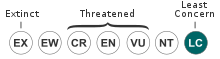
This species is not threatened and due to its environmental adaptability, its numbers are considered to be ascending.
Reproduction[edit]

Australian wood duck nests in cavities in trees or in nest-boxes above or near water. Nests are made with a pile of down.
Breeding[edit]
This duck nests in a tree cavity laying 9–11 cream-white eggs, similar to the Mandarin ducks.[10] The female incubates them while the male stands guard. Once the ducklings are ready to leave the nest, the female flies to the ground and the duckling will leap to the ground and follow their parents. The males also secure their ducklings closely along with the females.
Feeding[edit]
The Australian wood duck eats grasses, grains, clover and other herbs, and occasionally, insects. It is rarely seen on open water, preferring to forage by dabbling in shallow water, or in grasslands and crops.
Similar species[edit]
The Australian wood duck can be distinguished from pygmy geese, Nettapus spp., which are smaller, have bold white face markings and are usually seen on water. Whistling ducks, Dendrocygna spp., have longer legs and necks, larger, more duck-like bills and tend to walk more upright. When flying, the Australian wood duck is the only duck with white secondary feathers and dark wingtips.
Gallery[edit]
-
 Family in Australia
 -
 Profile view of female
 -
 Female swimming
 -
 Profile view of male
 -
 Ducklings in Kings Park, Western Australia
 -
 Family in Queensland
 -
 Duckling
 -
Males grazing at Belair National Park, South Australia


References[edit]
- ^ BirdLife International (2016). "Chenonetta jubata". IUCN Red List of Threatened Species. 2016: e.T22680111A92844188. doi:10.2305/IUCN.UK.2016-3.RLTS.T22680111A92844188.en. Retrieved 12 November 2021.
- ^ Sraml, M.; Christidis, L.; Easteal, S.; Horn, P.; Collet, C. (1996). "Molecular Relationships Within Australasian Waterfowl (Anseriformes)". Australian Journal of Zoology. 44 (1): 47–58. doi:10.1071/ZO9960047.
- ^ Johnson, Kevin P; Sorenson, Michael D (July 1999). "Phylogeny and Biogeography of Dabbling Ducks (Genus: Anas): A Comparison of Molecular and Morphological Evidence" (PDF). The Auk. 116 (3). University of California Press on behalf of the American Ornithologists' Union: 792–805. doi:10.2307/4089339. JSTOR 4089339.
- ^ Latham, John (1801). Supplementum indicis ornithologici sive systematis ornithologiae (in Latin). London: Leigh & Sotheby. p. lxix.
- ^ Worthy, Trevor H.; Olson, Storrs L. (2002). "Relationships, adaptations, and habits of the extinct duck 'Euryanas' finschi" (PDF). Notornis. 49 (1). Ornithological Society of New Zealand: 1–17. Archived from the original (PDF) on 2013-02-16. Retrieved 2017-07-19.
- ^ Tennyson, A; Martinson, P. (2006). Extinct Birds of New Zealand. Wellington: Te Papa Press. ISBN 978-0-909010-21-8.
- ^ Jobling, J.A. (2017). "Key to Scientific Names in Ornithology". In del Hoyo, J.; Elliott, A.; Sargatal, J.; Christie, D.A.; de Juana, E. (eds.). Handbook of the Birds of the World Alive. Barcelona: Lynx Edicions.
- ^ Jobling, J.A. (2017). "Key to Scientific Names in Ornithology". In del Hoyo, J.; Elliott, A.; Sargatal, J.; Christie, D.A.; de Juana, E. (eds.). Handbook of the Birds of the World Alive. Barcelona: Lynx Edicions.
- ^ "Australian Wood Ducks breed in Mapua, Tasman". Stuff.co.nz. 2 May 2016. Retrieved 14 January 2019.
- ^ a b c Pizzey, G. and Knight, F. (1997). Field Guide to the Birds of Australia. Angus and Robertson, Sydney.
- ^ "Agriculture and Related Resources Protection Act 1976" (PDF).
- ^ Western Australia Department of Environment and Conservation. "Guidance note on the status of Wood Duck's in WA" (PDF).
- ^ SSAA Western Australia. "What can you int in WA".
- ^ Game Management Authority (9 December 2019). "Waterfowl Identification Test".
- ^ NSW Department of Primary Industries (2017). "Waterfowl Identification Test (WIT)".
- ^ NWS Department of Primary Industry. "Don't Wing It" (PDF).
- ^ Queensland Department of Environment and Science (9 April 2003). "Licences and Permits: Plants and Animals".
- ^ Matthews, R.H (1904). "The Native Tribes of Victoria: Their languages and Customs". Proceedings of the American Philosophical Society. 43 (175): 54–70. JSTOR 983416.
- ^ Game Management Authority (6 May 2021). "Game Licence exemptions for Traditional Owners".
- ^ Cultural Survival Quarterly Magazine (19 March 2010). "Traditional Aboriginal Hunting in Australia: A cultural heritage issue".
- ^ NSW Aboriginal Land Council (17 December 2019). "Accessing Country".
- ^ Australian Government, Australian Law Reform Commission. "Traditional Hunting, Fishing and Gathering in Australia".
- ^ Berry, Marion. "Indigenous Hunting and Fishing in Queensland: A legislative overview" (PDF).
- Madge, Steve & Burn, Hilary (1987): Wildfowl : an identification guide to the ducks, geese and swans of the world. Christopher Helm, London. ISBN 0-7470-2201-1
Marchant, S. and Higgins, P.J. (eds). 1993. Handbook of Australian, New Zealand and Antarctic Birds. Vol 1B (Ratites to Ducks), Oxford University Press, Sydney.
Simpson, K and Day, N. (1999). Field guide to the birds of Australia, 6th Edition. Penguin Books, Australia.
Handbook of the Birds of the World vol 1 by Josep del Hoyo-Andrew Elliot-Jordi Sargatal - Lynx Edicions - ISBN 84-87334-10-5
Guide De Canards, des oies et des cygnes – de Steve Madge - Delachaux et Niestlé - ISBN 2-603-01376-9
External links[edit]

 Media related to Chenonetta jubata at Wikimedia Commons
- Australian Museum data sheet
- BirdLife Species Factsheet
