


BK-tree
 | This article may be too technical for most readers to understand. (March 2019) |
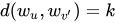
A BK-tree is a metric tree suggested by Walter Austin Burkhard and Robert M. Keller[1] specifically adapted to discrete metric spaces. For simplicity, consider integer discrete metric . Then, BK-tree is defined in the following way. An arbitrary element a is selected as root node. The root node may have zero or more subtrees. The k-th subtree is recursively built of all elements b such that . BK-trees can be used for approximate string matching in a dictionary.[2][example needed]


Example
[edit]
This picture depicts the BK-tree for the set of words {"book", "books", "cake", "boo", "boon", "cook", "cake", "cape", "cart"} obtained by using the Levenshtein distance

- each node is labeled by a string of ;
- each arc is labeled by where denotes the word assigned to .


The BK-tree is built so that:
- for all node of the BK-tree, the weight assigned to its egress arcs are distinct;
- for all arc labeled by , each descendant of satisfies the following equation: :
- Example 1: Consider the arc from "book" to "books". The distance between "book" and any word in {"books", "boo", "boon", "cook"} is equal to 1;
- Example 2: Consider the arc from "books" to "boo". The distance between "books" and any word in {"boo", "boon", "cook"} is equal to 2.


Insertion
[edit]The insertion primitive is used to populate a BK-tree according to a discrete metric .


Input:
- : the BK-tree;
- denotes the weight assigned to an arc ;
- denotes word assigned to a node ;
- : the discrete metric used by (e.g. the Levenshtein distance);
- : the element to be inserted into ;


Output:
- The node of corresponding to
Algorithm:
- If the is empty:
- Create a root node in
- Return
- Set to the root of
- While exists:
- If :
- Return
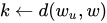
- Find the child of such that
- If is not found:
- Create the node
- Create the arc
- Return




Lookup
[edit]Given a searched element , the lookup primitive traverses the BK-tree to find the closest element of . The key idea is to restrict the exploration of to nodes that can only improve the best candidate found so far by taking advantage of the BK-tree organization and of the triangle inequality (cut-off criterion).
Input:
- : the BK-tree;
- : the corresponding discrete metric (e.g. the Levenshtein distance);
- : the searched element;
- : the maximum distance allowed between the best match and , defaults to ;


Output:
- : the closest element to stored in and according to or if not found;


Algorithm:
- If is empty:
- Return
- Create a set of nodes to process, and insert the root of into .
- While :
- Pop an arbitrary node from
- If :
- For each egress-arc :
- If : (cut-off criterion)
- Insert into .
- If : (cut-off criterion)
- Return







Example of the lookup algorithm
[edit]Consider the example 8-node B-K Tree shown above and set "cool". is initialized to contain the root of the tree, which is subsequently popped as the first value of with ="book". Further since the distance from "book" to "cool" is 2, and as this is the best (i.e. smallest) distance found thus far. Next each outgoing arc from the root is considered in turn: the arc from "book" to "books" has weight 1, and since is less than , the node containing "books" is inserted into for further processing. The next arc, from "book" to "cake," has weight 4, and since is not less than , the node containing "cake" is not inserted into . Therefore, the subtree rooted at "cake" will be pruned from the search, as the word closest to "cool" cannot appear in that subtree. To see why this pruning is correct, notice that a candidate word appearing in "cake"s subtree having distance less than 2 to "cool" would violate the triangle inequality: the triangle inequality requires that for this set of three numbers (as sides of a triangle), no two can sum to less than the third, but here the distance from "cool" to "book" (which is 2) plus the distance from "cool" to (which is less than 2) cannot reach or exceed the distance from "book" to "cake" (which is 4). Therefore, it is safe to disregard the entire subtree rooted at "cake".


Next the node containing "books" is popped from and now , the distance from "cool" to "books." As , remains set at 2 and the single outgoing arc from the node containing "books" is considered. Next, the node containing "boo" is popped from and , the distance from "cool" to "boo." This again does not improve upon . Each outgoing arc from "boo" is now considered; the arc from "boo" to "boon" has weight 1, and since , "boon" is added to . Similarly, since , "cook" is also added to .




Finally each of the two last elements in are considered in arbitrary order: suppose the node containing "cook" is popped first, improving to distance 1, then the node containing "boon" is popped last, which has distance 2 from "cool" and therefore does not improve the best result. Finally, "cook" is returned as the answer with .

See also
[edit]- Levenshtein distance – the distance metric commonly used when building a BK-tree
- Damerau–Levenshtein distance – a modified form of Levenshtein distance that allows transpositions
References
[edit]- ^ W. Burkhard and R. Keller. Some approaches to best-match file searching, CACM, 1973
- ^ R. Baeza-Yates, W. Cunto, U. Manber, and S. Wu. Proximity matching using fixed queries trees. In M. Crochemore and D. Gusfield, editors, 5th Combinatorial Pattern Matching, LNCS 807, pages 198–212, Asilomar, CA, June 1994.
- ^ Ricardo Baeza-Yates and Gonzalo Navarro. Fast Approximate String Matching in a Dictionary. Proc. SPIRE'98