


Cevian
In geometry, a cevian is a line segment which joins a vertex of a triangle to a point on the opposite side of the triangle.[1][2] Medians and angle bisectors are special cases of cevians. The name "cevian" comes from the Italian mathematician Giovanni Ceva, who proved a well-known theorem about cevians which also bears his name.[3]
Length[edit]

Stewart's theorem[edit]
The length of a cevian can be determined by Stewart's theorem: in the diagram, the cevian length d is given by the formula

Less commonly, this is also represented (with some rearrangement) by the following mnemonic:

Median[edit]
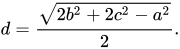
If the cevian happens to be a median (thus bisecting a side), its length can be determined from the formula

or

since

Hence in this case
Angle bisector[edit]
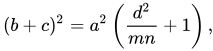
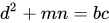
If the cevian happens to be an angle bisector, its length obeys the formulas
and[5]
and
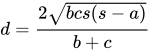
where the semiperimeter

The side of length a is divided in the proportion b : c.
Altitude[edit]
If the cevian happens to be an altitude and thus perpendicular to a side, its length obeys the formulas

and

where the semiperimeter
Ratio properties[edit]

There are various properties of the ratios of lengths formed by three cevians all passing through the same arbitrary interior point:[6]: 177–188 Referring to the diagram at right,
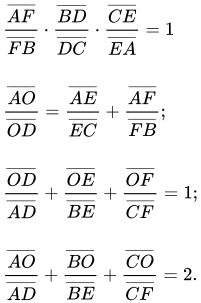
The first property is known as Ceva's theorem. The last two properties are equivalent because summing the two equations gives the identity 1 + 1 + 1 = 3.
Splitter[edit]
A splitter of a triangle is a cevian that bisects the perimeter. The three splitters concur at the Nagel point of the triangle.
Area bisectors[edit]
Three of the area bisectors of a triangle are its medians, which connect the vertices to the opposite side midpoints. Thus a uniform-density triangle would in principle balance on a razor supporting any of the medians.
Angle trisectors[edit]
If from each vertex of a triangle two cevians are drawn so as to trisect the angle (divide it into three equal angles), then the six cevians intersect in pairs to form an equilateral triangle, called the Morley triangle.
Area of inner triangle formed by cevians[edit]
Routh's theorem determines the ratio of the area of a given triangle to that of a triangle formed by the pairwise intersections of three cevians, one from each vertex.
See also[edit]
Notes[edit]
- ^ Coxeter, H. S. M.; Greitzer, S. L. (1967). Geometry Revisited. Washington, DC: Mathematical Association of America. p. 4. ISBN 0-883-85619-0.
- ^ Some authors exclude the other two sides of the triangle, see Eves (1963, p.77)
- ^ Lightner, James E. (1975). "A new look at the 'centers' of a triangle". The Mathematics Teacher. 68 (7): 612–615. JSTOR 27960289.
- ^ "Art of Problem Solving". artofproblemsolving.com. Retrieved 2018-10-22.
- ^ Johnson, Roger A., Advanced Euclidean Geometry, Dover Publ., 2007 (orig. 1929), p. 70.
- ^ Alfred S. Posamentier and Charles T. Salkind, Challenging Problems in Geometry, Dover Publishing Co., second revised edition, 1996.
References[edit]
- Eves, Howard (1963), A Survey of Geometry (Vol. One), Allyn and Bacon
- Ross Honsberger (1995). Episodes in Nineteenth and Twentieth Century Euclidean Geometry, pages 13 and 137. Mathematical Association of America.
- Vladimir Karapetoff (1929). "Some properties of correlative vertex lines in a plane triangle." American Mathematical Monthly 36: 476–479.
- Indika Shameera Amarasinghe (2011). “A New Theorem on any Right-angled Cevian Triangle.” Journal of the World Federation of National Mathematics Competitions, Vol 24 (02), pp. 29–37.