


Chuck-will's-widow
| Chuck-will's-widow | |
|---|---|

| |
| Female | |
| Song | |
Scientific classification 
| |
| Domain: | Eukaryota |
| Kingdom: | Animalia |
| Phylum: | Chordata |
| Class: | Aves |
| Clade: | Strisores |
| Order: | Caprimulgiformes |
| Family: | Caprimulgidae |
| Genus: | Antrostomus |
| Species: | A. carolinensis
|
| Binomial name | |
| Antrostomus carolinensis (Gmelin, JF, 1789)
| |

| |
Breeding Resident Nonbreeding
| |
| Synonyms | |
|
Caprimulgus carolinensis | |
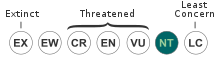
The chuck-will's-widow (Antrostomus carolinensis) is a nocturnal bird of the nightjar family Caprimulgidae. It is mostly found in the southeastern United States (with disjunct populations in Long Island, New York, Ontario, Canada and Cape Cod, Massachusetts) near swamps, rocky uplands, and pine woods. It migrates to the West Indies, Central America, and northwestern South America.
Taxonomy[edit]
The chuck-will's-widow was formally described in 1789 by the German naturalist Johann Friedrich Gmelin in his revised and expanded edition of Carl Linnaeus's Systema Naturae. He placed it with all the other nightjars in the genus Caprimulgus and coined the binomial name Caprimulgus carolinensis.[3] Gmelin based his description on those of earlier authors including the "Goat-sucker of Carolina" that had been described and illustrated by the English naturalist Mark Catesby in his The Natural History of Carolina, Florida and the Bahama Islands that was published between 1729 and 1732.[4] Chuck-will's-widow is now placed with 11 other species in the genus Antrostomus that was erected by the French naturalist Charles Bonaparte in 1838.[5][6] The generic name combines the Ancient Greek antron meaning "cavern" and stoma meaning "mouth". The specific epithet carolinensis is from the toponym Carolina.[7] The type locality is South Carolina.[8] The species is monotypic: no subspecies are recognised.[6]
The common English name "chuck-will's-widow " is an onomatopoeia from the bird's song.[9] Alternative names include "chuckwuts-widow" and "chip-fell-out-of-a-oak".[10]
This bird is sometimes confused with the better-known whippoorwill (Antrostomus vociferus),[11] because of their similar calls and unusual names. Though rather closely related, they are two distinct species.
Description[edit]
The chuck-will's-widow has a short bill and a long tail typical of the nightjars. It has mottled brownish underparts, a buff throat, reddish-brown feathers lined with black, and brown and white patterning on head and chest. Males have patches of white on their outer tail feathers. It is the largest nightjar in North America. In length, it ranges from 28 to 33 cm (11 to 13 in). The wingspan can range from 58 to 66 cm (23 to 26 in). The body mass of the species is from 66 to 188 g (2.3 to 6.6 oz).[12] Among standard measurements, the wing chord is 20.1 to 22.5 cm (7.9 to 8.9 in), the tail is 13 to 15.1 cm (5.1 to 5.9 in), the bill is 1.1 to 1.4 cm (0.43 to 0.55 in) and the tarsus is 1.5 to 1.9 cm (0.59 to 0.75 in).[13]
The repetitive song is often heard at night. It consists of a series of calls with a vibrating middle note between two shorter notes, not much shifting in pitch.[14] It is slower, lower-pitched and less piercing than the song of the whip-poor-will.
Behavior and ecology[edit]
Diet[edit]
It eats primarily insects, particularly those active at night such as moths, beetles, and winged ants. It will also eat small birds and bats, swallowing them whole.[15][16]
Breeding[edit]
The eggs are laid on patches of dead leaves on the ground. They are pink with spots of brown and lavender and are incubated by the female.
Gallery[edit]
-
 Eggs on leaves
 -
 Camouflaged female on nest
 -
 Mimicking a Cottonmouth snake
 -
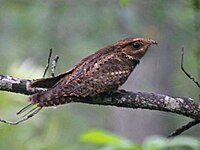 Perched on a branch
 -
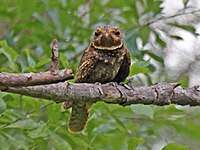 Perched on a branch
 -
 Adult male (upper right) and female (lower left)
 -
 South Padre Island - Texas


References[edit]
- ^ BirdLife International (2020). "Antrostomus carolinensis". IUCN Red List of Threatened Species. 2020: e.T22689778A154067182. doi:10.2305/IUCN.UK.2020-3.RLTS.T22689778A154067182.en. Retrieved 13 November 2021.
- ^ "NatureServe Explorer 2.0". explorer.natureserve.org. Retrieved 5 November 2022.
- ^ Gmelin, Johann Friedrich (1789). Systema naturae per regna tria naturae : secundum classes, ordines, genera, species, cum characteribus, differentiis, synonymis, locis (in Latin). Vol. 1, Part 1 (13th ed.). Lipsiae [Leipzig]: Georg. Emanuel. Beer. p. 1028.
- ^ Catesby, Mark (1729–1732). The Natural History of Carolina, Florida and the Bahama Islands (in English and French). Vol. 1. London: W. Innys and R. Manby. p. 8, Plate 8.
- ^ Bonaparte, Charles Lucien (1838). A Geographical and Comparative List of the Birds of Europe and North America. London: John Van Voorst. p. 8.
- ^ a b Gill, Frank; Donsker, David; Rasmussen, Pamela, eds. (January 2022). "Frogmouths, Oilbird, potoos, nightjars". IOC World Bird List Version 12.1. International Ornithologists' Union. Retrieved 8 July 2022.
- ^ Jobling, James A. (2010). The Helm Dictionary of Scientific Bird Names. London: Christopher Helm. pp. 50, 92. ISBN 978-1-4081-2501-4.
- ^ Peters, James Lee, ed. (1940). Check-List of Birds of the World. Vol. 4. Cambridge, Massachusetts: Harvard University Press. p. 197.
- ^ Straight, C.A.; Cooper, R.J. (2020). Poole, A.F. (ed.). "Chuck-will's-widow (Antrostomus carolinensis), version 1.0". Birds of the World. Ithaca, NY, USA: Cornell Lab of Ornithology. doi:10.2173/bow.chwwid.01. Retrieved 8 July 2022.
- ^ Cleere, Nigel (2010). "Appendix 2 – Alternative English Names". Nightjars, Potoos, Frogmouths, Oilbird and Owlet-nightjars of the World. Old Basing: WILDGuides. pp. 443–447. ISBN 978-1-903657-07-2.
- ^ For example, Henninger (1906) combines the old scientific name of C. carolinensis with the common name "Whip-poor-will". As C. carolinensis does not occur in the area discussed, he obviously refers to C. vociferus. In other cases, the specific identity of birds may not be determinable.
- ^ Chuck Wills Widow. All About Birds. The Cornell Lab of Ornithology.
- ^ Holyoak, D.T. (2001): Nightjars and their Allies: the Caprimulgiformes. Oxford University Press, Oxford, New York. ISBN 0-19-854987-3.
- ^ "Call recording". www.floridamuseum.ufl.edu. Retrieved Dec 21, 2022.
- ^ Owre, Oscar (September 1967). "Predation by the Chuck-will's-widow upon migrating warblers" (PDF). Wilson Bulletin. 79 (3): 342.
- ^ Thayer, Gerald H (1899). "The Chuck-will's-widow on shipboard" (PDF). The Auk. 16 (3): 273–276. doi:10.2307/4069463. JSTOR 4069463.
Sources[edit]
- Henninger, W.F. (1906). "A preliminary list of the birds of Seneca County, Ohio" (PDF). Wilson Bulletin. 18 (2): 47–60.
External links[edit]

 Media related to Antrostomus carolinensis at Wikimedia Commons
- audubon.org
- Chuck-will's-widow – USGS Patuxent Bird Identification InfoCenter
- Chuck-will's-widow Species Account – Cornell Lab of Ornithology
- Chuck-will's-widow Bird Sound