Measure of the influence of a data point in regression analysis
In statistics, Cook's distance or Cook's D is a commonly used estimate of the influence of a data point when performing a least-squares regression analysis.[1] In a practical ordinary least squares analysis, Cook's distance can be used in several ways: to indicate influential data points that are particularly worth checking for validity; or to indicate regions of the design space where it would be good to be able to obtain more data points. It is named after the American statistician R. Dennis Cook, who introduced the concept in 1977.[2][3]
Data points with large residuals (outliers) and/or high leverage may distort the outcome and accuracy of a regression. Cook's distance measures the effect of deleting a given observation. Points with a large Cook's distance are considered to merit closer examination in the analysis.
For the algebraic expression, first define
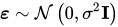
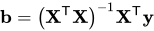
where is the error term, is the coefficient matrix, is the number of covariates or predictors for each observation, and is the design matrix including a constant. The least squares estimator then is , and consequently the fitted (predicted) values for the mean of are
where is the projection matrix (or hat matrix). The -th diagonal element of , given by ,[4] is known as the leverage of the -th observation. Similarly, the -th element of the residual vector is denoted by .
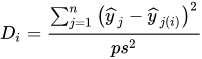
Cook's distance of observation is defined as the sum of all the changes in the regression model when observation is removed from it[5]
where p is the rank of the model (i.e., number of independent variables in the design matrix) and is the fitted response value obtained when excluding , and is the mean squared error of the regression model.[6]
Equivalently, it can be expressed using the leverage[5] ():
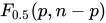
There are different opinions regarding what cut-off values to use for spotting highly influential points. Since Cook's distance is in the metric of an F distribution with and (as defined for the design matrix above) degrees of freedom, the median point (i.e., ) can be used as a cut-off.[7] Since this value is close to 1 for large , a simple operational guideline of has been suggested.[8]
The -dimensional random vector , which is the change of due to a deletion of the -th case, has a covariance matrix of rank one and therefore it is distributed entirely over one dimensional subspace (a line) of the -dimensional space.
However, in the introduction of Cook’s distance, a scaling matrix of full rank is chosen and as a result is treated as if it is a random vector distributed over the whole space of dimensions.
Hence the Cook's distance measure is likely to distort the real influence of observations,
misleading the right identification of influential observations.[9][10]
Relationship to other influence measures (and interpretation)[edit]
can be expressed using the leverage[5] () and the square of the internallyStudentized residual (), as follows:
The benefit in the last formulation is that it clearly shows the relationship between and to (while p and n are the same for all observations). If is large then it (for non-extreme values of ) will increase . If is close to 0 then will be small, while if is close to 1 then will become very large (as long as , i.e.: that the observation is not exactly on the regression line that was fitted without observation ).
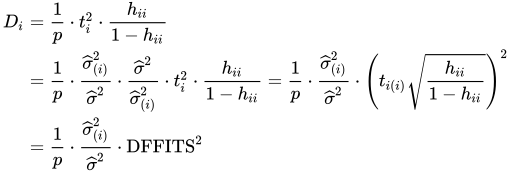
is related to DFFITS through the following relationship (note that is the externally studentized residual, and are defined here):
can be interpreted as the distance one's estimates move within the confidence ellipsoid that represents a region of plausible values for the parameters.[clarification needed] This is shown by an alternative but equivalent representation of Cook's distance in terms of changes to the estimates of the regression parameters between the cases, where the particular observation is either included or excluded from the regression analysis.
An alternative to has been proposed. Instead of considering the influence a single observation has on the overall model, the statistics serves as a measure of how sensitive the prediction of the -th observation is to the deletion of each observation in the original data set. It can be formulated as a weighted linear combination of the 's of all data points. Again, the projection matrix is involved in the calculation to obtain the required weights:
In this context, () resembles the correlation between the predictions and [a].
In contrast to , the distribution of is asymptotically normal for large sample sizes and models with many predictors. In absence of outliers the expected value of is approximately . An influential observation can be identified if
with as the median and as the median absolute deviation of all -values within the original data set, i.e., a robust measure of location and a robust measure of scale for the distribution of . The factor 4.5 covers approx. 3 standard deviations of around its centre.
When compared to Cook's distance, was found to perform well for high- and intermediate-leverage outliers, even in presence of masking effects for which failed.[12]
Interestingly, and are closely related because they can both be expressed in terms of the matrix which holds the effects of the deletion of the -th data point on the -th prediction:
where extracts the main diagonal of a square matrix . In this context, is referred to as the influence matrix whereas resembles the so-called sensitivity matrix. An eigenvector analysis of and - which both share the same eigenvalues – serves as a tool in outlier detection, although the eigenvectors of the sensitivity matrix are more powerful. [13]
High-dimensional Influence Measure (HIM) is an alternative to Cook's distance for when (i.e., when there are more predictors than observations).[14] While the Cook's distance quantifies the individual observation's influence on the least squares regression coefficient estimate, the HIM measures the influence of an observation on the marginal correlations.
^The indices and are often interchanged in the original publication as the projection matrix is symmetric in ordinary linear regression, i.e., . Since this is not always the case, e.g., in weighted linear regression, the indices have been written consistently here to account for potential asymmetry and thus allow for direct usage.[11]
^Mendenhall, William; Sincich, Terry (1996). A Second Course in Statistics: Regression Analysis (5th ed.). Upper Saddle River, NJ: Prentice-Hall. p. 422. ISBN0-13-396821-9. A measure of overall influence an outlying observation has on the estimated coefficients was proposed by R. D. Cook (1979). Cook's distance, Di, is calculated...
Atkinson, Anthony; Riani, Marco (2000). "Deletion Diagnostics". Robust Diagnostics and Regression Analysis. New York: Springer. pp. 22–25. ISBN0-387-95017-6.
Heiberger, Richard M.; Holland, Burt (2013). "Case Statistics". Statistical Analysis and Data Display. Springer Science & Business Media. pp. 312–27. ISBN9781475742848.




![{\displaystyle {\boldsymbol {\beta }}=\left[\beta _{0}\,\beta _{1}\dots \beta _{p-1}\right]^{\mathsf {T}}}](https://wikimedia.org/api/rest_v1/media/math/render/svg/e3c608dda415070ee23c44697525c81a7a434912)














![{\displaystyle D_{i}={\frac {e_{i}^{2}}{ps^{2}}}\left[{\frac {h_{ii}}{(1-h_{ii})^{2}}}\right].}](https://wikimedia.org/api/rest_v1/media/math/render/svg/0e1940d0d869a2ec32a4628045c36feca472dbe6)



![{\displaystyle {\begin{aligned}D_{i}&={\frac {e_{i}^{2}}{ps^{2}}}\cdot {\frac {h_{ii}}{(1-h_{ii})^{2}}}={\frac {1}{p}}\cdot {\frac {e_{i}^{2}}{{1 \over n-p}\sum _{j=1}^{n}{\widehat {\varepsilon \,}}_{j}^{\,2}(1-h_{ii})}}\cdot {\frac {h_{ii}}{1-h_{ii}}}\\[5pt]&={\frac {1}{p}}\cdot t_{i}^{2}\cdot {\frac {h_{ii}}{1-h_{ii}}}.\end{aligned}}}](https://wikimedia.org/api/rest_v1/media/math/render/svg/d3cd49482b87a4c146dc0cf6031d6fad8faf6b1c)










![{\displaystyle {\begin{aligned}&\mathbf {T} =\left[{\begin{matrix}{\widehat {y}}_{1}-{{\widehat {y}}_{1}}_{\left(1\right)}&{\widehat {y}}_{1}-{{\widehat {y}}_{1}}_{\left(2\right)}&{\widehat {y}}_{1}-{{\widehat {y}}_{1}}_{\left(3\right)}&\cdots &{\widehat {y}}_{1}-{{\widehat {y}}_{1}}_{\left(n-1\right)}&{\widehat {y}}_{1}-{{\widehat {y}}_{1}}_{\left(n\right)}\\{\widehat {y}}_{2}-{{\widehat {y}}_{2}}_{\left(1\right)}&{\widehat {y}}_{2}-{{\widehat {y}}_{2}}_{\left(2\right)}&{\widehat {y}}_{2}-{{\widehat {y}}_{2}}_{\left(3\right)}&\cdots &{\widehat {y}}_{2}-{{\widehat {y}}_{2}}_{\left(n-1\right)}&{\widehat {y}}_{2}-{{\widehat {y}}_{2}}_{\left(n\right)}\\\vdots &\vdots &\vdots &\ddots &\vdots &\vdots \\{\widehat {y}}_{n-1}-{{\widehat {y}}_{n-1}}_{\left(1\right)}&{\widehat {y}}_{n-1}-{{\widehat {y}}_{n-1}}_{\left(2\right)}&{\widehat {y}}_{n-1}-{{\widehat {y}}_{n-1}}_{\left(3\right)}&\cdots &{\widehat {y}}_{n-1}-{{\widehat {y}}_{n-1}}_{\left(n-1\right)}&{\widehat {y}}_{n-1}-{{\widehat {y}}_{n-1}}_{\left(n\right)}\\{\widehat {y}}_{n}-{{\widehat {y}}_{n}}_{\left(1\right)}&{\widehat {y}}_{n}-{{\widehat {y}}_{n}}_{\left(2\right)}&{\widehat {y}}_{n}-{{\widehat {y}}_{n}}_{\left(3\right)}&\cdots &{\widehat {y}}_{n}-{{\widehat {y}}_{n}}_{\left(n-1\right)}&{\widehat {y}}_{n}-{{\widehat {y}}_{n}}_{\left(n\right)}\end{matrix}}\right]\\\\&\ \ =\mathbf {H} \mathbf {E} \mathbf {G} =\mathbf {H} \left[{\begin{matrix}e_{1}&0&0&\cdots &0&0\\0&e_{2}&0&\cdots &0&0\\\vdots &\vdots &\vdots &\ddots &\vdots &\vdots \\0&0&0&\cdots &e_{n-1}&0\\0&0&0&\cdots &0&e_{n}\end{matrix}}\right]\left[{\begin{matrix}{\frac {1}{1-h_{11}}}&0&0&\cdots &0&0\\0&{\frac {1}{1-h_{22}}}&0&\cdots &0&0\\\vdots &\vdots &\vdots &\ddots &\vdots &\vdots \\0&0&0&\cdots &{\frac {1}{1-h_{n-1,n-1}}}&0\\0&0&0&\cdots &0&{\frac {1}{1-h_{nn}}}\end{matrix}}\right]\end{aligned}}}](https://wikimedia.org/api/rest_v1/media/math/render/svg/b37a8d61763a401e6a219554356b2559268215a2)

![{\displaystyle \mathbf {D} =\left[{\begin{matrix}D_{1}\\D_{2}\\\vdots \\D_{n-1}\\D_{n}\end{matrix}}\right]={\frac {1}{ps^{2}}}\operatorname {diag} \left(\mathbf {T} ^{\mathsf {T}}\mathbf {T} \right)={\frac {1}{ps^{2}}}\operatorname {diag} \left(\mathbf {G} \mathbf {E} \mathbf {H} ^{\mathsf {T}}\mathbf {H} \mathbf {E} \mathbf {G} \right)=\operatorname {diag} (\mathbf {M} )}](https://wikimedia.org/api/rest_v1/media/math/render/svg/ff183354e5e3b140be61cb57a5ee0dd0cd91007b)


![{\displaystyle {\begin{aligned}&\mathbf {S} =\left[{\begin{matrix}S_{1}\\S_{2}\\\vdots \\S_{n-1}\\S_{n}\end{matrix}}\right]={\frac {1}{ps^{2}}}\mathbf {F} \operatorname {diag} \left(\mathbf {T} \mathbf {T} ^{\mathsf {T}}\right)={\frac {1}{ps^{2}}}\left[{\begin{matrix}{\frac {1}{h_{11}}}&0&0&\cdots &0&0\\0&{\frac {1}{h_{22}}}&0&\cdots &0&0\\\vdots &\vdots &\vdots &\ddots &\vdots &\vdots \\0&0&0&\cdots &{\frac {1}{h_{n-1n-1}}}&0\\0&0&0&\cdots &0&{\frac {1}{h_{nn}}}\end{matrix}}\right]\operatorname {diag} \left(\mathbf {T} \mathbf {T} ^{\mathsf {T}}\right)\\\\&\ \ ={\frac {1}{ps^{2}}}\mathbf {F} \operatorname {diag} \left(\mathbf {H} \mathbf {E} \mathbf {G} \mathbf {G} \mathbf {E} \mathbf {H} ^{\mathsf {T}}\right)=\mathbf {F} \operatorname {diag} (\mathbf {P} )\end{aligned}}}](https://wikimedia.org/api/rest_v1/media/math/render/svg/db58307889e9df073493850073316089e68196d4)






