


Double negation
| Type | Theorem |
|---|---|
| Field | |
| Statement | If a statement is true, then it is not the case that the statement is not true." |
| Symbolic statement |
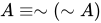
In propositional logic, double negation is the theorem that states that "If a statement is true, then it is not the case that the statement is not true." [citation needed] This is expressed by saying that a proposition A is logically equivalent to not (not-A), or by the formula A ≡ ~(~A) where the sign ≡ expresses logical equivalence and the sign ~ expresses negation.[1]
Like the law of the excluded middle, this principle is considered to be a law of thought in classical logic,[2] but it is disallowed by intuitionistic logic.[3] The principle was stated as a theorem of propositional logic by Russell and Whitehead in Principia Mathematica as:
- [4]
- "This is the principle of double negation, i.e. a proposition is equivalent of the falsehood of its negation."

Elimination and introduction[edit]
Double negation elimination and double negation introduction are two valid rules of replacement. They are the inferences that, if not not-A is true, then A is true, and its converse, that, if A is true, then not not-A is true, respectively. The rule allows one to introduce or eliminate a negation from a formal proof. The rule is based on the equivalence of, for example, It is false that it is not raining. and It is raining.
The double negation introduction rule is:
- P P


and the double negation elimination rule is:
- P P
Where "" is a metalogical symbol representing "can be replaced in a proof with."
In logics that have both rules, negation is an involution.
Formal notation[edit]
The double negation introduction rule may be written in sequent notation:

The double negation elimination rule may be written as:

In rule form:

and

or as a tautology (plain propositional calculus sentence):

and

These can be combined into a single biconditional formula:
- .

Since biconditionality is an equivalence relation, any instance of ¬¬A in a well-formed formula can be replaced by A, leaving unchanged the truth-value of the well-formed formula.
Double negative elimination is a theorem of classical logic, but not of weaker logics such as intuitionistic logic and minimal logic. Double negation introduction is a theorem of both intuitionistic logic and minimal logic, as is .

Because of their constructive character, a statement such as It's not the case that it's not raining is weaker than It's raining. The latter requires a proof of rain, whereas the former merely requires a proof that rain would not be contradictory. This distinction also arises in natural language in the form of litotes.
Proofs[edit]
In classical propositional calculus system[edit]
In Hilbert-style deductive systems for propositional logic, double negation is not always taken as an axiom (see list of Hilbert systems), and is rather a theorem. We describe a proof of this theorem in the system of three axioms proposed by Jan Łukasiewicz:
- A1.
- A2.
- A3.
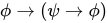


We use the lemma proved here, which we refer to as (L1), and use the following additional lemma, proved here:

- (L2)

We first prove . For shortness, we denote by φ0. We also use repeatedly the method of the hypothetical syllogism metatheorem as a shorthand for several proof steps.


- (1) (instance of (A1))
- (2) (instance of (A3))
- (3) (instance of (A3))
- (4) (from (2) and (3) by the hypothetical syllogism metatheorem)
- (5) (instance of (A1))
- (6) (from (4) and (5) by the hypothetical syllogism metatheorem)
- (7) (instance of (L2))
- (8) (from (1) and (7) by modus ponens)
- (9) (from (6) and (8) by the hypothetical syllogism metatheorem)







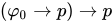
We now prove .

- (1) (instance of the first part of the theorem we have just proven)
- (2) (instance of (A3))
- (3) (from (1) and (2) by modus ponens)


And the proof is complete.
See also[edit]
References[edit]
- ^ Or alternate symbolism such as A ↔ ¬(¬A) or Kleene's *49o: A ∾ ¬¬A (Kleene 1952:119; in the original Kleene uses an elongated tilde ∾ for logical equivalence, approximated here with a "lazy S".)
- ^ Hamilton is discussing Hegel in the following: "In the more recent systems of philosophy, the universality and necessity of the axiom of Reason has, with other logical laws, been controverted and rejected by speculators on the absolute.[On principle of Double Negation as another law of Thought, see Fries, Logik, §41, p. 190; Calker, Denkiehre odor Logic und Dialecktik, §165, p. 453; Beneke, Lehrbuch der Logic, §64, p. 41.]" (Hamilton 1860:68)
- ^ The o of Kleene's formula *49o indicates "the demonstration is not valid for both systems [classical system and intuitionistic system]", Kleene 1952:101.
- ^ PM 1952 reprint of 2nd edition 1927 pp. 101–02, 117.
Bibliography[edit]
- William Hamilton, 1860, Lectures on Metaphysics and Logic, Vol. II. Logic; Edited by Henry Mansel and John Veitch, Boston, Gould and Lincoln.
- Christoph Sigwart, 1895, Logic: The Judgment, Concept, and Inference; Second Edition, Translated by Helen Dendy, Macmillan & Co. New York.
- Stephen C. Kleene, 1952, Introduction to Metamathematics, 6th reprinting with corrections 1971, North-Holland Publishing Company, Amsterdam NY, ISBN 0-7204-2103-9.
- Stephen C. Kleene, 1967, Mathematical Logic, Dover edition 2002, Dover Publications, Inc, Mineola N.Y. ISBN 0-486-42533-9
- Alfred North Whitehead and Bertrand Russell, Principia Mathematica to *56, 2nd edition 1927, reprint 1962, Cambridge at the University Press.