


Dual cone and polar cone


Dual cone and polar cone are closely related concepts in convex analysis, a branch of mathematics.
Dual cone[edit]
In a vector space[edit]
The dual cone C* of a subset C in a linear space X over the reals, e.g. Euclidean space Rn, with dual space X* is the set

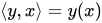
where is the duality pairing between X and X*, i.e. .

C* is always a convex cone, even if C is neither convex nor a cone.
In a topological vector space[edit]
If X is a topological vector space over the real or complex numbers, then the dual cone of a subset C ⊆ X is the following set of continuous linear functionals on X:
- ,[1]

which is the polar of the set -C.[1] No matter what C is, will be a convex cone. If C ⊆ {0} then .


In a Hilbert space (internal dual cone)[edit]
Alternatively, many authors define the dual cone in the context of a real Hilbert space (such as Rn equipped with the Euclidean inner product) to be what is sometimes called the internal dual cone.

Properties[edit]
Using this latter definition for C*, we have that when C is a cone, the following properties hold:[2]
- A non-zero vector y is in C* if and only if both of the following conditions hold:
- y is a normal at the origin of a hyperplane that supports C.
- y and C lie on the same side of that supporting hyperplane.
- C* is closed and convex.
- implies .
- If C has nonempty interior, then C* is pointed, i.e. C* contains no line in its entirety.
- If C is a cone and the closure of C is pointed, then C* has nonempty interior.
- C** is the closure of the smallest convex cone containing C (a consequence of the hyperplane separation theorem)


Self-dual cones[edit]
A cone C in a vector space X is said to be self-dual if X can be equipped with an inner product ⟨⋅,⋅⟩ such that the internal dual cone relative to this inner product is equal to C.[3] Those authors who define the dual cone as the internal dual cone in a real Hilbert space usually say that a cone is self-dual if it is equal to its internal dual. This is slightly different from the above definition, which permits a change of inner product. For instance, the above definition makes a cone in Rn with ellipsoidal base self-dual, because the inner product can be changed to make the base spherical, and a cone with spherical base in Rn is equal to its internal dual.
The nonnegative orthant of Rn and the space of all positive semidefinite matrices are self-dual, as are the cones with ellipsoidal base (often called "spherical cones", "Lorentz cones", or sometimes "ice-cream cones"). So are all cones in R3 whose base is the convex hull of a regular polygon with an odd number of vertices. A less regular example is the cone in R3 whose base is the "house": the convex hull of a square and a point outside the square forming an equilateral triangle (of the appropriate height) with one of the sides of the square.
Polar cone[edit]

For a set C in X, the polar cone of C is the set[4]

It can be seen that the polar cone is equal to the negative of the dual cone, i.e. Co = −C*.
For a closed convex cone C in X, the polar cone is equivalent to the polar set for C.[5]
See also[edit]
References[edit]
- ^ a b Schaefer & Wolff 1999, pp. 215–222.
- ^ Boyd, Stephen P.; Vandenberghe, Lieven (2004). Convex Optimization (pdf). Cambridge University Press. pp. 51–53. ISBN 978-0-521-83378-3. Retrieved October 15, 2011.
- ^ Iochum, Bruno, "Cônes autopolaires et algèbres de Jordan", Springer, 1984.
- ^ Rockafellar, R. Tyrrell (1997) [1970]. Convex Analysis. Princeton, NJ: Princeton University Press. pp. 121–122. ISBN 978-0-691-01586-6.
- ^ Aliprantis, C.D.; Border, K.C. (2007). Infinite Dimensional Analysis: A Hitchhiker's Guide (3 ed.). Springer. p. 215. doi:10.1007/3-540-29587-9. ISBN 978-3-540-32696-0.
Bibliography[edit]
- Boltyanski, V. G.; Martini, H.; Soltan, P. (1997). Excursions into combinatorial geometry. New York: Springer. ISBN 3-540-61341-2.
- Goh, C. J.; Yang, X.Q. (2002). Duality in optimization and variational inequalities. London; New York: Taylor & Francis. ISBN 0-415-27479-6.
- Narici, Lawrence; Beckenstein, Edward (2011). Topological Vector Spaces. Pure and applied mathematics (Second ed.). Boca Raton, FL: CRC Press. ISBN 978-1584888666. OCLC 144216834.
- Ramm, A.G. (2000). Shivakumar, P.N.; Strauss, A.V. (eds.). Operator theory and its applications. Providence, R.I.: American Mathematical Society. ISBN 0-8218-1990-9.
- Schaefer, Helmut H.; Wolff, Manfred P. (1999). Topological Vector Spaces. GTM. Vol. 8 (Second ed.). New York, NY: Springer New York Imprint Springer. ISBN 978-1-4612-7155-0. OCLC 840278135.