


Finite Fourier transform
In mathematics the finite Fourier transform may refer to either
- another name for discrete-time Fourier transform (DTFT) of a finite-length series. E.g., F.J.Harris (pp. 52–53) describes the finite Fourier transform as a "continuous periodic function" and the discrete Fourier transform (DFT) as "a set of samples of the finite Fourier transform". In actual implementation, that is not two separate steps; the DFT replaces the DTFT.[A] So J.Cooley (pp. 77–78) describes the implementation as discrete finite Fourier transform.
or
- another name for the Fourier series coefficients.[1]
or
- another name for one snapshot of a short-time Fourier transform.[2]
See also[edit]
Notes[edit]
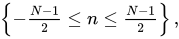
- ^ Harris' motivation for the distinction is to distinguish between an odd-length data sequence with the indices which he calls the finite Fourier transform data window, and a sequence on which is the DFT data window.

References[edit]
- ^ George Bachman, Lawrence Narici, and Edward Beckenstein, Fourier and Wavelet Analysis (Springer, 2004), p. 264
- ^ Morelli, E., "High accuracy evaluation of the finite Fourier transform using sampled data," NASA technical report TME110340 (1997).
- Harris, Fredric J. (Jan 1978). "On the use of Windows for Harmonic Analysis with the Discrete Fourier Transform" (PDF). Proceedings of the IEEE. 66 (1): 51–83. CiteSeerX 10.1.1.649.9880. doi:10.1109/PROC.1978.10837. S2CID 426548.
- Cooley, J.; Lewis, P.; Welch, P. (1969). "The finite Fourier transform". IEEE Trans. Audio Electroacoustics. 17 (2): 77–85. doi:10.1109/TAU.1969.1162036.
Further reading[edit]
- Rabiner, Lawrence R.; Gold, Bernard (1975). Theory and application of digital signal processing. Englewood Cliffs, N.J.: Prentice-Hall. pp 65–67. ISBN 0139141014.